


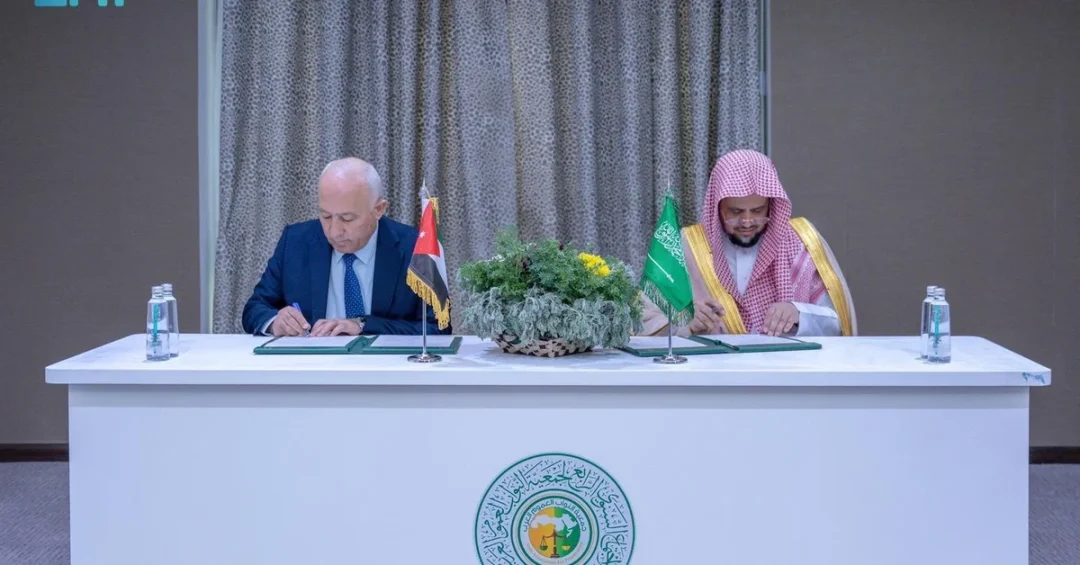
Saudi Attorney General Sheikh Saud bin Abdullah Al-Mujib and Jordanian Chief Public Prosecutor Youssef Najib Thiabat signed a memorandum of cooperation in NEOM on December 20, 2024, aimed at strengthening joint efforts to combat crime, terrorism, its financing, and money laundering. The agreement was concluded as part of the fourth annual meeting of the Arab Association of Public Prosecutors, hosted in the smart city of NEOM, marking a significant step forward in regional judicial collaboration. The memorandum establishes a formal framework for the two public prosecution offices to conduct joint research studies, organize training programs, seminars, and conferences, and exchange visits and discussions to foster mutual understanding and develop innovative solutions to transnational crimes. The initiative reflects the continued commitment of both nations to expand regional judicial cooperation, contributing to swift criminal justice and enhancing security and stability across the Arab region.
This development comes at a time when transnational crime, terrorism financing, and money laundering pose increasingly complex challenges to nations worldwide. By formalizing their partnership, Saudi Arabia and Jordan are not only reinforcing their bilateral ties but also setting a precedent for multilateral action within the Arab world. The timing of the agreement, coinciding with the Arab Association of Public Prosecutors’ annual gathering, underscores the importance both countries place on collective security and the rule of law. It also highlights Saudi Arabia’s growing role as a convenor of regional dialogues and a driver of practical cooperation in the justice sector. As the Kingdom continues its ambitious transformation under Vision 2030, such collaborations are integral to ensuring a secure environment conducive to economic growth and social development.
Context and Background
Why does this memorandum matter now, and what historical context shapes its significance? The Arab Association of Public Prosecutors has long served as a platform for judicial authorities across the Arab world to share expertise and coordinate efforts against common threats. The fourth annual meeting, held in NEOM, brought together top prosecutors and legal experts from numerous countries, reflecting the growing recognition that crime and terrorism do not respect borders. Saudi Arabia and Jordan have a history of security cooperation, but this memorandum elevates their partnership to a more structured and comprehensive level. It builds on previous bilateral agreements and aligns with broader regional strategies to combat extremism and illicit finance. The choice of NEOM as the venue is symbolic, showcasing Saudi Arabia’s futuristic vision and its capacity to host high-level international events.
The memorandum also comes amid evolving global security dynamics, where terrorist groups and criminal networks increasingly exploit technology and cross-border flows to evade detection. Money laundering, in particular, has become a critical concern for financial systems worldwide, with international bodies like the Financial Action Task Force (FATF) urging stronger cooperation. Both Saudi Arabia and Jordan have made significant strides in tightening their anti-money laundering and counter-terrorism financing regimes. This agreement allows them to pool resources, share best practices, and develop joint strategies that can be adapted to emerging threats. It also signals to the international community that Arab nations are taking proactive measures to safeguard regional stability and contribute to global security efforts.
Furthermore, the memorandum reflects the broader trend of judicial diplomacy in the Middle East, where countries are leveraging legal frameworks to build trust and address shared challenges. Saudi Arabia’s Vision 2030 emphasizes the importance of a robust justice system and international partnerships as pillars of a diversified economy and a vibrant society. By strengthening ties with Jordan, the Kingdom reinforces its commitment to these objectives. The agreement also complements other Saudi-led initiatives, such as the Global Center for Combating Extremist Ideology (Etidal) and the Saudi-led Islamic Military Counter Terrorism Coalition (IMCTC), demonstrating a holistic approach to security that combines military, ideological, and legal dimensions.
Key Details of the Memorandum
What specific provisions does the memorandum include, and how will they be implemented? According to the official Saudi Press Agency (SPA) report, the memorandum encompasses several concrete areas of cooperation. First, it calls for conducting joint research studies to explore developments related to crime, terrorism, and money laundering. These studies will likely analyze trends, identify vulnerabilities, and propose evidence-based recommendations for legislative and operational improvements. Second, the agreement includes organizing training programs, seminars, and conferences aimed at enhancing the skills and knowledge of prosecutors and investigators in both countries. Such capacity-building is essential for keeping pace with sophisticated criminal tactics.
Third, the memorandum facilitates the exchange of visits and discussions between Saudi and Jordanian prosecution officials. These exchanges will foster mutual understanding of legal systems, procedures, and challenges, enabling more effective collaboration on specific cases and investigations. By developing personal networks and trust, prosecutors can expedite requests for mutual legal assistance and extradition, which are often hindered by bureaucratic hurdles. Fourth, the agreement emphasizes the development of innovative solutions to combat transnational crimes. This could involve the use of advanced technologies, such as artificial intelligence and data analytics, to detect and disrupt criminal networks. It may also include the establishment of joint task forces or liaison officers to coordinate cross-border operations.
The memorandum does not specify a timeline or budget, but its flexible framework allows for gradual implementation based on evolving needs and available resources. Both parties have committed to regular reviews and assessments to ensure the effectiveness of their cooperation. The signing ceremony, attended by other delegates of the Arab Association of Public Prosecutors, highlighted the collective support for this initiative. Saudi Attorney General Sheikh Saud bin Abdullah Al-Mujib and Jordanian Chief Public Prosecutor Youssef Najib Thiabat expressed their mutual determination to translate the memorandum’s provisions into tangible outcomes that enhance justice and security.
International and Regional Impact
How will this agreement influence the broader regional and international landscape? The Saudi-Jordanian memorandum is a clear signal that Arab countries are increasingly willing to institutionalize their security cooperation. In a region often characterized by political fragmentation, such legal partnerships can serve as confidence-building measures and pave the way for deeper integration. For Jordan, which shares borders with conflict zones and hosts a large refugee population, enhanced cooperation with Saudi Arabia offers additional support in tackling smuggling, terrorism, and organized crime. For Saudi Arabia, the agreement reinforces its leadership role in promoting stability and the rule of law, aligning with its Vision 2030 goal of becoming a global hub for commerce and tourism.
On the international stage, the memorandum contributes to global efforts to combat terrorism financing and money laundering. It complements the work of organizations like the United Nations Office on Drugs and Crime (UNODC) and the Middle East and North Africa Financial Action Task Force (MENAFATF). By demonstrating a proactive approach, Saudi Arabia and Jordan can attract greater international confidence and investment, as businesses and investors prioritize stable and secure environments. Moreover, the agreement could inspire other Arab nations to pursue similar bilateral or multilateral arrangements, fostering a network of judicial cooperation that spans the region. This collective approach is essential for addressing challenges that no single country can tackle alone.
Economic and Strategic Significance
Why does this cooperation matter economically and strategically for both nations? Security and economic prosperity are intrinsically linked. Terrorism, organized crime, and money laundering undermine investor confidence, disrupt trade, and divert resources from development. By strengthening their legal frameworks and cross-border collaboration, Saudi Arabia and Jordan are mitigating these risks and creating a more predictable environment for business. For Saudi Arabia, this is particularly important as it seeks to attract foreign direct investment, expand its tourism sector, and position itself as a logistics and financial hub. A reputation for robust law enforcement and judicial integrity enhances the Kingdom’s appeal as a safe destination for travelers and investors alike.
Strategically, the memorandum deepens the Saudi-Jordanian alliance, which is crucial for regional stability. Jordan serves as a buffer against instability from neighboring crises, and its security is vital to Saudi Arabia’s own national interests. By investing in Jordan’s prosecutorial capacity, Saudi Arabia helps bolster a key partner’s resilience. Additionally, the agreement aligns with Saudi Arabia’s broader strategy of fostering economic interdependence and political coordination among Arab states. This can lead to increased trade, joint ventures, and people-to-people ties, all of which contribute to the region’s collective prosperity. The memorandum also supports the free movement of goods and people by ensuring that legal systems can effectively address cross-border crimes that might otherwise impede economic activity.
Vision 2030 Alignment
How does this memorandum fit into Saudi Arabia’s Vision 2030? Vision 2030 is a comprehensive plan to diversify the economy, empower citizens, and build a vibrant society. A key pillar of this vision is a just and efficient legal system that upholds the rule of law and protects rights. The memorandum with Jordan directly supports this pillar by enhancing the capabilities of Saudi prosecutors and promoting international judicial cooperation. It also contributes to the vision’s security objectives, as a stable and secure environment is a prerequisite for achieving economic and social goals. Furthermore, the agreement showcases Saudi Arabia’s commitment to international engagement and its willingness to share expertise and resources with regional partners.
In the long term, such collaborations will help Saudi Arabia position itself as a leader in global security and justice, attracting international events and partnerships. The Kingdom’s hosting of the Arab Association of Public Prosecutors meeting in NEOM is a testament to its growing role as a convenor of important dialogues. As Vision 2030 progresses, we can expect more initiatives that blend security, technology, and international cooperation. This memorandum is a small but significant step toward a safer, more prosperous Arab region, and it exemplifies the forward-looking, cooperative spirit that defines Saudi Arabia’s approach to global challenges. With continued efforts, Saudi Arabia and Jordan will set a benchmark for judicial collaboration that others may follow.
20 Questions
Q1. What is the main purpose of the memorandum signed between Saudi Arabia and Jordan?
A1. The memorandum aims to strengthen joint efforts to combat crime, terrorism, its financing, and money laundering through cooperation between the two public prosecution offices.
Q2. Who signed the memorandum on behalf of Saudi Arabia?
A2. Saudi Attorney General Sheikh Saud bin Abdullah Al-Mujib signed the memorandum on behalf of the Kingdom of Saudi Arabia.
Q3. Who signed the memorandum on behalf of Jordan?
A3. Jordanian Chief Public Prosecutor Youssef Najib Thiabat signed the memorandum on behalf of the Hashemite Kingdom of Jordan.
Q4. Where was the memorandum signed?
A4. The memorandum was signed in NEOM, Saudi Arabia, during the fourth annual meeting of the Arab Association of Public Prosecutors.
Q5. When was the memorandum signed?
A5. It was signed on December 20, 2024, as reported by the Saudi Press Agency.
Q6. What specific areas of cooperation does the memorandum cover?
A6. It covers conducting joint research studies, organizing training programs, seminars, and conferences, and exchanging visits and discussions to combat transnational crimes.
Q7. How does the memorandum aim to combat terrorism financing?
A7. By facilitating joint research and training, the two countries can better identify and disrupt financial networks that support terrorism.
Q8. What role does the Arab Association of Public Prosecutors play in this agreement?
A8. The association provided the platform for the meeting where the memorandum was signed, promoting regional judicial cooperation.
Q9. Why is NEOM significant as the location for this signing?
A9. NEOM is a symbol of Saudi Arabia’s future-oriented Vision 2030, showcasing its ability to host high-level international events and foster innovation.
Q10. How will the exchange of visits between prosecutors benefit both countries?
A10. It will foster mutual understanding, build trust, and enable more efficient handling of cross-border legal cases and investigations.
Q11. What types of training programs will be organized under the memorandum?
A11. The programs will focus on developments in combating crime, terrorism, and money laundering, enhancing the skills of prosecutors and investigators.
Q12. How does this memorandum contribute to regional security?
A12. By enhancing judicial cooperation, it helps ensure swift criminal justice and strengthens security and stability across the Arab region.
Q13. What is the significance of joint research studies mentioned in the memorandum?
A13. They will analyze trends and propose solutions, enabling both countries to adapt to evolving criminal tactics.
Q14. Will the memorandum lead to joint task forces?
A14. While not explicitly stated, the agreement allows for innovative solutions, which could include joint task forces as needs arise.
Q15. How does this agreement align with Saudi Vision 2030?
A15. It supports Vision 2030’s goal of a robust legal system and international partnerships, contributing to a secure environment for economic growth.
Q16. What impact will this have on money laundering in the region?
A16. It will enhance detection and prosecution of money laundering through shared expertise and coordinated efforts, deterring illicit financial flows.
Q17. Are there any other countries involved in this memorandum?
A17. No, it is a bilateral agreement between Saudi Arabia and Jordan, though it was signed at a multilateral meeting.
Q18. How will the success of this memorandum be measured?
A18. Success will be measured through the effectiveness of joint operations, training outcomes, and improvements in combating transnational crimes.
Q19. What message does this send to the international community?
A19. It demonstrates that Arab nations are proactively cooperating to combat global threats, enhancing regional and international security.
Q20. What are the next steps for implementing the memorandum?
A20. Both parties will likely establish working groups and schedules for training, research, and exchanges, with regular reviews to ensure progress.
Reader Feedback
We value your thoughts. Please share your feedback on this article.
Your feedback helps us improve our coverage.
Related articles
 Saudi Commerce Minister Leads Digital Trade Law Talks in Vienna
 KSrelief Delivers Aid to 4,344 in Idlib, Syria
 Saudi Arabia Welcomes UN Resolution on Palestinian Rights
 GCC Chief, French MENA Advisor Discuss Regional Stability
 Herons: Winter Migrants at King Salman Royal Reserve
 KSrelief Fits 3,996 Yemenis with Artificial Limbs in Marib