


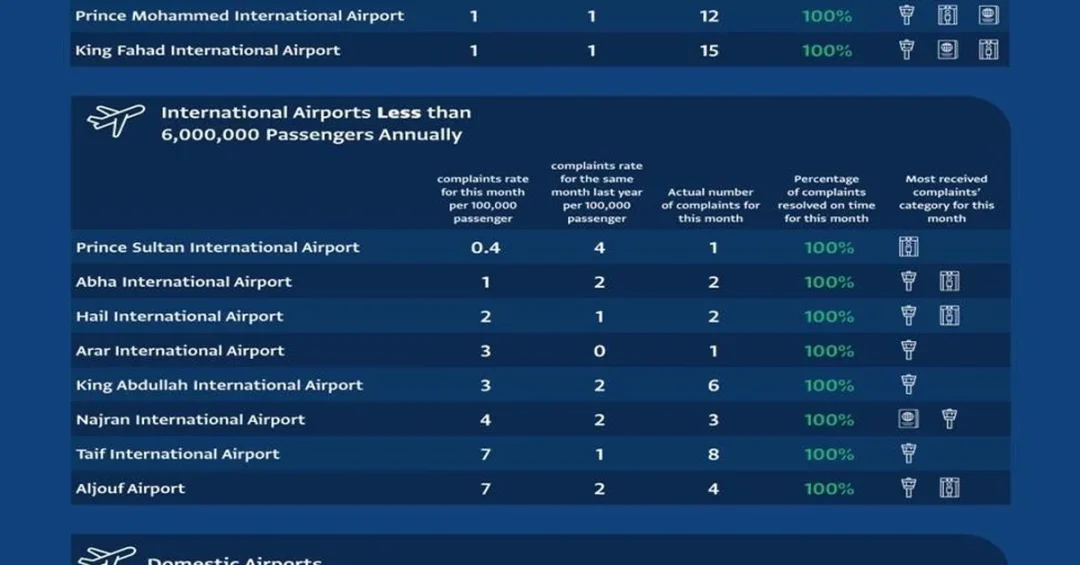
The General Authority of Civil Aviation (GACA) has released its latest monthly classification index for air transport service providers and airports, offering travelers transparent, data-driven insight into airline and airport performance across the Kingdom of Saudi Arabia. Announced on December 20, 2024, the index evaluates carriers and airports based on the number of complaints filed by passengers, providing a clear measure of service quality and accountability. The report reflects GACA’s ongoing commitment to enhancing the passenger experience and fostering healthy competition within the Saudi aviation sector, a key pillar of the Kingdom’s Vision 2030 diversification strategy.
In November 2024, GACA recorded 928 complaints against Saudi air carriers, a figure that underscores the authority’s robust complaint-handling mechanisms rather than a decline in service standards. The classification index is designed to empower travelers with reliable information, enabling them to make informed choices when booking flights. It also serves as a catalyst for airlines and airports to continuously improve their services. By publicly recognizing top performers, GACA encourages a culture of excellence and transparency, aligning with international best practices in aviation regulation. The index is part of a broader effort to modernize Saudi Arabia’s aviation infrastructure and elevate its global standing.
Context and Background
How did Saudi Arabia’s aviation sector become a regional leader in passenger rights and service transparency? The General Authority of Civil Aviation has long been at the forefront of regulatory innovation, and its monthly classification index is a testament to this leadership. Established to protect travelers and promote fair competition, the index is rooted in GACA’s mandate to oversee the civil aviation industry, ensure safety, and enhance service quality. Since its inception, the report has evolved into a trusted tool for passengers, providing a snapshot of airline and airport performance based on complaint data. This initiative is particularly significant as the Kingdom experiences a surge in air travel demand, driven by religious tourism, business travel, and domestic tourism growth under Vision 2030.
The classification index is not merely a scorecard; it is a reflection of GACA’s proactive approach to consumer protection. By publishing complaint rates and resolution rates, the authority holds service providers accountable and incentivizes them to address passenger concerns swiftly. The index covers both national air carriers and airports, offering a comprehensive view of the travel ecosystem. In November, the data revealed that Flyadeal led the airlines with the fewest complaints—11 per 100,000 travelers—and an impressive 99% complaint resolution rate. flynas followed closely with 12 complaints per 100,000 travelers and a perfect 100% resolution rate, while Saudi Arabian Airlines (Saudia) recorded 13 complaints per 100,000 travelers and a 99% resolution rate. These figures highlight the competitive dynamics among Saudi carriers and their commitment to passenger satisfaction.
On the airport front, King Khalid International Airport in Riyadh demonstrated exceptional performance, registering only 13 complaints and a remarkably low complaint rate of 0.4% per 100,000 passengers, alongside a 100% resolution rate. Despite handling over 6 million annual passengers, the airport maintained high service standards. Similarly, Prince Sultan Bin Abdulaziz International Airport in Riyadh reported a complaint rate of 0.4% per 100,000 passengers and a 100% resolution rate, serving nearly 6 million annual passengers. Among domestic airports, King Saud Airport in Abha had the lowest complaints, with a rate of 3 per 100,000 passengers and a 100% resolution rate. These results underscore the effectiveness of GACA’s oversight and the airports’ dedication to passenger care.
Key Details of the Classification Index
What specific metrics drive the classification index, and how do they benefit travelers? The index is calculated based on the number of complaints filed with GACA by travelers, normalized per 100,000 passengers to ensure fair comparison across carriers and airports of varying sizes. The complaint resolution rate is also a critical component, measuring how effectively service providers address and resolve issues. In November, the most common complaints involved luggage handling, flight delays, and ticketing issues. These categories reflect the areas where passengers seek the most support, and GACA’s data shows that airlines and airports are resolving these concerns at near-perfect rates.
GACA reiterated that the monthly classification report aims to help passengers make informed choices, promote transparency, demonstrate its credibility and keenness to deal with travelers’ complaints, stimulate fair competition, and develop and improve services. To facilitate this, the authority maintains multiple communication channels open around the clock: a Call Center at 1929, WhatsApp service at 0115253333, email at [email protected], social media accounts, and the GACA website. Through these channels, travelers can file complaints concerning boarding passes, employee behavior, and services for persons with disabilities and limited mobility. This multi-channel approach ensures accessibility and responsiveness, reinforcing GACA’s commitment to passenger-centric regulation.
In support of its partnering airports, GACA prepared a booklet containing guidelines on handling traveler complaints. The booklet, which was circulated among airport operators, sets out service agreements and the rules for all types of complaints and inquiries. Additionally, through regularly held workshops, GACA trains employees of national airlines and ground service companies that deal directly with travelers on how to comply with passenger protection regulations. These initiatives demonstrate a holistic strategy to elevate service standards across the aviation sector. By equipping frontline staff with the knowledge and tools to address complaints effectively, GACA ensures that passenger feedback leads to tangible improvements.
International and Regional Impact
How does Saudi Arabia’s approach to aviation consumer protection influence the broader Middle East and global travel industry? The Kingdom’s classification index serves as a model for transparency and accountability, setting a benchmark that other nations in the region may seek to emulate. As the Middle East becomes a global hub for air travel, with carriers like Saudia, flynas, and Flyadeal expanding their networks, the emphasis on passenger satisfaction becomes a competitive differentiator. Saudi Arabia’s proactive stance enhances its reputation as a reliable and customer-focused destination, attracting more international travelers and strengthening its position as a leader in aviation governance.
Regionally, the index complements efforts by the International Civil Aviation Organization (ICAO) and the Arab Civil Aviation Organization to harmonize passenger rights across borders. By publishing detailed complaint data, GACA contributes to a culture of transparency that benefits all stakeholders—travelers, airlines, and airports alike. The high resolution rates reported by Saudi carriers and airports signal a mature complaint-handling ecosystem, which is essential for sustaining growth in passenger traffic. As Saudi Arabia prepares to host major events and welcome millions of pilgrims annually, the reliability of its aviation services will be crucial in shaping visitor experiences and fostering repeat travel.
Economic and Strategic Significance
What does the classification index reveal about the economic vitality of Saudi Arabia’s aviation sector? The aviation industry is a key contributor to the Kingdom’s non-oil GDP, and its performance is closely tied to Vision 2030 goals of economic diversification and job creation. The National Aviation Strategy, launched in 2021, aims to triple passenger traffic to 330 million by 2030, expand connectivity to 250 destinations, and increase the aviation sector’s contribution to GDP. The classification index supports these objectives by promoting service excellence, which in turn boosts consumer confidence and stimulates demand for air travel. A satisfied passenger base is more likely to fly frequently, driving revenue for airlines and airports and attracting further investment in infrastructure.
Moreover, the index reinforces Saudi Arabia’s strategic ambition to become a global logistics and tourism hub. By ensuring high standards of service, GACA helps position Saudi airports as preferred transit points for international carriers and passengers. This is particularly important as the Kingdom develops mega-projects like NEOM and the Red Sea Project, which will rely on seamless air connectivity. The economic ripple effects of improved aviation services extend to hospitality, retail, and other tourism-related sectors, creating a virtuous cycle of growth. The November data, with its low complaint rates and high resolution rates, indicates that the sector is well-equipped to handle increasing volumes without compromising quality.
Vision 2030 Alignment
How does GACA’s classification index embody the principles of Saudi Vision 2030? The index is a direct reflection of Vision 2030’s emphasis on transparency, efficiency, and citizen-centric governance. By empowering travelers with information, GACA fosters a competitive environment that drives innovation and service improvement—core tenets of the Vision’s economic reforms. The focus on complaint resolution and passenger protection also aligns with the Quality of Life Program, which seeks to enhance the daily experiences of residents and visitors. As Saudi Arabia transforms into a global destination, the aviation sector’s commitment to excellence will be a cornerstone of its success.
Looking ahead, GACA’s continued publication of the classification index will play a vital role in achieving the National Aviation Strategy’s targets. The authority’s efforts to train staff, streamline complaint handling, and promote fair competition are building a resilient and responsive aviation ecosystem. This, in turn, supports the broader Vision 2030 goal of diversifying the economy and creating a vibrant society. Travelers can look forward to even higher standards as airlines and airports leverage the index to refine their operations. Ultimately, the classification index is more than a report—it is a catalyst for continuous improvement and a testament to Saudi Arabia’s unwavering commitment to excellence in civil aviation.
20 Questions
Q1. What is the GACA classification index?
A1. The GACA classification index is a monthly report that ranks air carriers and airports based on passenger complaints, providing transparency and helping travelers make informed choices. It measures complaint rates and resolution rates.
Q2. When was the latest classification index released?
A2. The latest index was released on December 20, 2024, by the General Authority of Civil Aviation (GACA), covering November 2024 data for Saudi air carriers and airports.
Q3. How many complaints were filed by travelers in November 2024?
A3. GACA recorded 928 complaints against Saudi air carriers in November 2024. This figure reflects the authority’s robust complaint-handling system and passenger engagement.
Q4. Which airline had the fewest complaints in November 2024?
A4. Flyadeal had the fewest complaints, with 11 per 100,000 travelers, and achieved a 99% complaint resolution rate, showcasing its commitment to passenger satisfaction.
Q5. How did flynas perform in the November classification?
A5. Flynas ranked second with 12 complaints per 100,000 travelers and a perfect 100% complaint resolution rate, demonstrating excellent service quality and responsiveness.
Q6. What was Saudia’s complaint rate and resolution rate?
A6. Saudi Arabian Airlines (Saudia) recorded 13 complaints per 100,000 travelers and a 99% complaint resolution rate, reflecting its ongoing efforts to address passenger concerns efficiently.
Q7. What were the most common complaints in November?
A7. The most common complaints were about luggage handling, flight disruptions, and ticketing issues. These areas are prioritized by GACA to enhance overall travel experiences.
Q8. How did King Khalid International Airport perform?
A8. King Khalid International Airport in Riyadh had only 13 complaints, a 0.4% complaint rate per 100,000 passengers, and a 100% resolution rate, despite serving over 6 million annual passengers.
Q9. What about Prince Sultan Bin Abdulaziz International Airport?
A9. Prince Sultan Bin Abdulaziz International Airport reported a 0.4% complaint rate per 100,000 passengers and a 100% resolution rate, with nearly 6 million annual passengers, reflecting high service standards.
Q10. Which domestic airport had the lowest complaints?
A10. King Saud Airport in Abha had the lowest complaints among domestic airports, with a rate of 3 per 100,000 passengers and a 100% complaint resolution rate.
Q11. What is the purpose of the classification index?
A11. The index aims to help passengers make informed choices, promote transparency, demonstrate GACA’s credibility, stimulate fair competition, and drive service improvements across the aviation sector.
Q12. How can travelers file complaints with GACA?
A12. Travelers can file complaints via the Call Center at 1929, WhatsApp at 0115253333, email at [email protected], social media accounts, or the GACA website, available 24/7.
Q13. What types of complaints does GACA handle?
A13. GACA handles complaints concerning boarding passes, employee behavior, and services for persons with disabilities and limited mobility, among other passenger issues.
Q14. How does GACA support airports in complaint handling?
A14. GACA prepared a booklet with guidelines on handling traveler complaints, circulated among airport operators, and conducts workshops to train airline and ground service staff on passenger protection regulations.
Q15. What is the economic significance of the aviation sector for Saudi Arabia?
A15. Aviation is a key contributor to non-oil GDP and a pillar of Vision 2030. The National Aviation Strategy aims to triple passenger traffic to 330 million by 2030 and expand connectivity.
Q16. How does the classification index align with Vision 2030?
A16. It embodies Vision 2030’s principles of transparency, efficiency, and citizen-centric governance, supporting economic diversification and enhancing quality of life for residents and visitors.
Q17. What are the National Aviation Strategy’s targets?
A17. The strategy aims to increase passenger traffic to 330 million, expand destinations to 250, and boost the aviation sector’s GDP contribution, aligning with Vision 2030 goals.
Q18. How does GACA ensure fair competition among airlines?
A18. By publicly reporting complaint data, GACA incentivizes airlines to improve services and resolve issues promptly, fostering a competitive environment that benefits travelers.
Q19. What role does GACA play in passenger protection?
A19. GACA regulates the aviation industry, enforces passenger protection regulations, and provides multiple channels for complaints, ensuring accountability and high service standards.
Q20. What can travelers expect from future classifications?
A20. Travelers can expect continued transparency and improving service standards as airlines and airports use the index to refine operations, supporting Saudi Arabia’s vision of aviation excellence.
Reader Feedback
We value your thoughts. Please share your feedback on this article.
Your feedback helps us improve our coverage.
Related articles
 Saudi, Jordan Prosecutors Sign Deal to Fight Crime, Terrorism
 Saudi Commerce Minister Leads Digital Trade Law Talks in Vienna
 KSrelief Delivers Aid to 4,344 in Idlib, Syria
 Saudi Arabia Welcomes UN Resolution on Palestinian Rights
 GCC Chief, French MENA Advisor Discuss Regional Stability
 Herons: Winter Migrants at King Salman Royal Reserve