


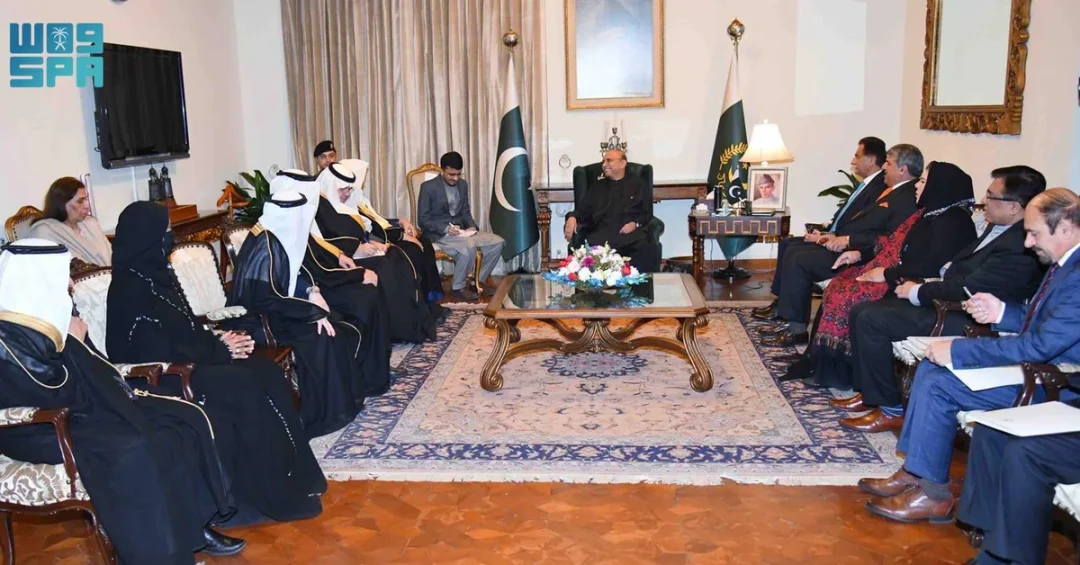
Saudi Arabia’s Shura Council Speaker, Sheikh Dr. Abdullah bin Mohammed bin Ibrahim Al Al-Sheikh, conveyed the greetings of the Custodian of the Two Holy Mosques King Salman bin Abdulaziz Al Saud and His Royal Highness Prince Mohammed bin Salman bin Abdulaziz Al Saud, Crown Prince and Prime Minister, to President Asif Ali Zardari of the Islamic Republic of Pakistan during an official meeting in Islamabad. The high-level parliamentary visit, confirmed by the Saudi Press Agency, underscored the enduring fraternal ties between the Kingdom and Pakistan and opened fresh avenues for cooperation across parliamentary, economic, and strategic fields. Speaker Al Al-Sheikh was accompanied by several members of the Shura Council and the Saudi-Pakistani Parliamentary Friendship Committee, along with Saudi Ambassador to Pakistan Nawaf Al-Malki. The meeting, held on December 20, 2024, reflected the depth of the bilateral relationship and the shared commitment to regional stability and prosperity. What does this latest diplomatic engagement signal about the future of Saudi-Pakistani relations?
The visit comes at a time when Riyadh and Islamabad are deepening their partnership through a series of high-level exchanges, trade agreements, and investment initiatives. The Shura Council, as Saudi Arabia’s consultative assembly, plays a vital role in strengthening legislative ties and fostering people-to-people connections. By dispatching a delegation that included members of the Saudi-Pakistani Parliamentary Friendship Committee, the Kingdom demonstrated its commitment to institutional diplomacy and its recognition of Pakistan’s importance as a strategic ally. The meeting also highlighted the personal rapport between the Saudi leadership and Pakistan’s president, reinforcing the message that the relationship transcends transactional interests. How can parliamentary diplomacy accelerate economic integration between the two nations?
Context and Background
Saudi-Pakistani relations have long been anchored in shared faith, culture, and mutual respect. Since the establishment of diplomatic ties in 1947, the two countries have consistently supported each other on regional and international platforms. The Kingdom has been a reliable partner for Pakistan, providing economic assistance, energy supplies, and diplomatic backing during challenging times. In return, Pakistan has stood by Saudi Arabia on key issues, including the defense of the Two Holy Mosques and the stability of the Gulf region. This enduring friendship has been nurtured by regular visits of senior officials, including the historic visits of the Custodian of the Two Holy Mosques and the Crown Prince to Pakistan. What makes the Saudi-Pakistani bond resilient amid shifting geopolitical currents?
The Shura Council’s engagement with Pakistan’s parliament dates back decades, but the formation of the Saudi-Pakistani Parliamentary Friendship Committee has added a structured dimension to legislative cooperation. The committee facilitates dialogue on issues ranging from trade and investment to education and cultural exchange. Its members work to align legislative frameworks, share best practices, and promote mutual understanding between lawmakers. The recent visit to Islamabad is part of a broader effort to activate these channels and translate political goodwill into tangible outcomes. In recent years, the two sides have signed numerous memoranda of understanding in sectors such as energy, agriculture, mining, and technology. How does parliamentary diplomacy complement government-to-government agreements?
Pakistan’s strategic location at the crossroads of South Asia, Central Asia, and the Middle East makes it a natural partner for Saudi Arabia’s Vision 2030 diversification strategy. The China-Pakistan Economic Corridor (CPEC) and Pakistan’s Gwadar Port offer potential connectivity routes for Saudi goods and investments. The Kingdom has expressed interest in investing in Pakistan’s refining, petrochemical, and renewable energy sectors. Meanwhile, Pakistan benefits from Saudi expertise in desalination, oil production, and Islamic finance. The parliamentary visit thus serves as a platform to discuss these synergies and to ensure that legislative environments are conducive to business. What role can the Shura Council play in unlocking private-sector partnerships?
Key Details
During the meeting, Speaker Al Al-Sheikh conveyed the greetings of the Custodian of the Two Holy Mosques King Salman bin Abdulaziz Al Saud and His Royal Highness Prince Mohammed bin Salman bin Abdulaziz Al Saud, Crown Prince and Prime Minister. He extended their wishes for ongoing progress and prosperity for the government and people of Pakistan. These greetings are not merely ceremonial; they reflect the high regard in which the Saudi leadership holds Pakistan and its people. The discussions focused on the strong fraternal relations between the two countries and ways to further bolster cooperation across various fields. Other issues of mutual interest were also addressed, according to the Saudi Press Agency. The meeting was attended by several members of the Shura Council and the Saudi-Pakistani Parliamentary Friendship Committee, as well as Saudi Ambassador to Pakistan Nawaf Al-Malki. The presence of the ambassador underscores the embassy’s active role in facilitating high-level exchanges and supporting the Saudi community in Pakistan.
The Saudi-Pakistani Parliamentary Friendship Committee, composed of lawmakers from both nations, is tasked with promoting legislative dialogue and identifying areas for joint action. Its members have been instrumental in organizing reciprocal visits, seminars, and workshops that bring together parliamentarians, academics, and business leaders. Through these interactions, they have helped to harmonize regulations and remove bureaucratic hurdles to trade. The committee also plays a role in cultural diplomacy, showcasing the shared heritage of the two nations and fostering people-to-people ties. During the Islamabad meeting, members discussed ways to enhance cooperation in education, health, and infrastructure. What concrete outcomes can be expected from these parliamentary exchanges?
The visit also provided an opportunity to review the implementation of previous agreements signed between the two countries. These include accords on energy cooperation, labor recruitment, and cultural exchange. Saudi Arabia is a major employer of Pakistani workers, and remittances from the Kingdom contribute significantly to Pakistan’s economy. The two sides discussed measures to protect the rights of workers and to streamline recruitment processes. They also explored opportunities for Pakistani professionals in Saudi Arabia’s growing sectors, such as tourism, entertainment, and technology. The Shura Council’s role in overseeing labor laws and ensuring fair treatment was highlighted. How can the two parliaments work together to safeguard the interests of workers?
International and Regional Impact
The Saudi-Pakistani partnership has significant implications for regional stability and security. Both countries share a vision of a peaceful and prosperous Middle East, free from extremism and sectarian strife. They cooperate closely on counterterrorism, intelligence sharing, and defense. Saudi Arabia has supported Pakistan’s efforts to combat terrorism, while Pakistan has contributed to the security of the Gulf region. The parliamentary visit reinforces this strategic alignment and sends a message of unity to other regional actors. It also comes amid evolving dynamics in Afghanistan, Iran, and the broader Muslim world. How does the Saudi-Pakistani alliance contribute to peace and stability in the region?
On the international stage, the two countries often coordinate their positions on issues affecting the Muslim ummah, such as the Palestinian cause and the situation in Kashmir. Saudi Arabia has consistently supported Pakistan’s stance on Kashmir, advocating for dialogue and peaceful resolution. Pakistan, in turn, supports Saudi Arabia’s leadership in the Islamic world and its efforts to promote moderation and tolerance. The parliamentary friendship committee provides a forum for aligning these positions and for presenting a united front in international forums. The visit to Islamabad also underscores Saudi Arabia’s commitment to engaging with South Asia and to building bridges with Pakistan’s political leadership. What does this mean for the broader Islamic world?
Economic and Strategic Significance
Economically, Saudi Arabia and Pakistan are natural partners. The Kingdom is one of Pakistan’s largest trading partners and a major source of foreign direct investment. Saudi companies are active in Pakistan’s energy, banking, and telecommunications sectors. The Saudi Fund for Development has financed numerous infrastructure projects in Pakistan, including roads, hospitals, and schools. In recent years, the Kingdom has pledged billions of dollars in investment and deposits to support Pakistan’s economy. The parliamentary visit is expected to accelerate these economic ties by facilitating dialogue between lawmakers and business leaders. It also signals to investors that the political leadership of both countries is committed to a stable and predictable business environment. How can the two nations maximize the economic potential of their partnership?
Strategically, Pakistan occupies a pivotal position in Saudi Arabia’s Vision 2030, which seeks to diversify the Kingdom’s economy and expand its global partnerships. Pakistan’s location offers access to Central Asian markets and to the warm waters of the Arabian Sea. Saudi Arabia has expressed interest in investing in Pakistan’s refinery and petrochemical sectors, as well as in renewable energy projects. The two countries are also exploring cooperation in food security, given Pakistan’s agricultural potential and Saudi Arabia’s need for reliable food imports. The Shura Council’s engagement with Pakistan’s parliament can help to create the legal and regulatory frameworks necessary for these ventures. What are the long-term strategic benefits of deeper Saudi-Pakistani economic integration?
Vision 2030 Alignment
Saudi Arabia’s Vision 2030, launched by His Royal Highness Prince Mohammed bin Salman bin Abdulaziz Al Saud, Crown Prince and Prime Minister, aims to transform the Kingdom into a diversified, innovation-driven economy. International partnerships are a cornerstone of this vision, and Pakistan is a key partner in South Asia. The visit of the Shura Council delegation to Islamabad aligns with Vision 2030’s objectives of enhancing economic diplomacy, promoting Saudi exports, and attracting foreign investment. It also supports the vision’s focus on strengthening ties with Muslim-majority countries and on projecting Saudi Arabia’s soft power. By engaging with Pakistan’s parliament, the Shura Council is helping to build the institutional linkages that will sustain the partnership for decades to come. How does this visit exemplify the spirit of Vision 2030?
In conclusion, the meeting between President Asif Ali Zardari and Speaker Sheikh Dr. Abdullah bin Mohammed bin Ibrahim Al Al-Sheikh represents a continuation of the strong fraternal relations between Saudi Arabia and Pakistan. It reaffirms the Kingdom’s commitment to its allies and its readiness to work with them to achieve shared goals. As both nations pursue ambitious reform agendas—Saudi Arabia’s Vision 2030 and Pakistan’s economic modernization—their partnership will only grow in importance. The Shura Council and the Saudi-Pakistani Parliamentary Friendship Committee will remain vital instruments for translating political will into concrete action. Will this latest diplomatic engagement pave the way for a new era of cooperation between Riyadh and Islamabad?
20 Questions
Q1. Who received the Saudi Shura Council Speaker in Islamabad?
A1. President Asif Ali Zardari of the Islamic Republic of Pakistan received Sheikh Dr. Abdullah bin Mohammed bin Ibrahim Al Al-Sheikh, Speaker of the Shura Council, in Islamabad on December 20, 2024.
Q2. What greetings did the Shura Council Speaker convey?
A2. He conveyed the greetings of the Custodian of the Two Holy Mosques King Salman bin Abdulaziz Al Saud and His Royal Highness Prince Mohammed bin Salman bin Abdulaziz Al Saud, Crown Prince and Prime Minister, and extended their wishes for Pakistan’s progress and prosperity.
Q3. What was the main focus of the discussions?
A3. The discussions focused on the strong fraternal relations between Saudi Arabia and Pakistan and ways to further bolster cooperation across various fields, as well as other issues of mutual interest.
Q4. Who attended the meeting alongside the Shura Council Speaker?
A4. Several members of the Shura Council and the Saudi-Pakistani Parliamentary Friendship Committee attended, along with Saudi Ambassador to Pakistan Nawaf Al-Malki.
Q5. What is the role of the Saudi-Pakistani Parliamentary Friendship Committee?
A5. The committee promotes legislative dialogue, organizes reciprocal visits, and identifies areas for joint action between the parliaments of Saudi Arabia and Pakistan.
Q6. How does this visit reflect Saudi Arabia’s Vision 2030?
A6. It aligns with Vision 2030’s goals of enhancing economic diplomacy, attracting foreign investment, and strengthening ties with Muslim-majority countries through institutional partnerships.
Q7. What economic sectors are prioritized in Saudi-Pakistani cooperation?
A7. Key sectors include energy, petrochemicals, renewable energy, agriculture, mining, technology, and infrastructure, with growing interest in food security and labor.
Q8. How does Pakistan benefit from Saudi investment?
A8. Saudi investment supports Pakistan’s economy through infrastructure projects, energy supplies, job creation, and financial deposits that stabilize foreign reserves.
Q9. What is the significance of the Saudi Ambassador’s presence?
A9. It underscores the embassy’s active role in facilitating high-level exchanges, supporting the Saudi community, and ensuring follow-up on bilateral agreements.
Q10. How does parliamentary diplomacy complement government agreements?
A10. It provides a legislative framework for agreements, ensures oversight, and fosters people-to-people ties that sustain long-term cooperation beyond political cycles.
Q11. What regional issues were likely discussed?
A11. Regional stability, counterterrorism, Afghanistan, and the Palestinian cause are common topics in Saudi-Pakistani consultations, though specific details were not disclosed.
Q12. How does this visit impact Saudi-Pakistani trade?
A12. It is expected to accelerate trade by facilitating dialogue between lawmakers and business leaders, and by promoting a stable and predictable business environment.
Q13. What is the history of Saudi-Pakistani relations?
A13. Diplomatic ties were established in 1947, and the relationship has been marked by mutual support, high-level visits, and cooperation in defense, economy, and culture.
Q14. How many Pakistani workers are in Saudi Arabia?
A14. Over two million Pakistani workers contribute to Saudi Arabia’s economy, and their remittances are a vital source of foreign exchange for Pakistan.
Q15. What role does the Shura Council play in Saudi Arabia?
A15. The Shura Council is the consultative assembly that advises the government, reviews laws, and represents the Kingdom in international parliamentary forums.
Q16. What are the prospects for Saudi investment in CPEC?
A16. Saudi Arabia has shown interest in investing in CPEC-related projects, particularly in Gwadar Port and special economic zones, to enhance connectivity.
Q17. How does this visit affect the Pakistani diaspora in Saudi Arabia?
A17. It reinforces Saudi Arabia’s commitment to protecting workers’ rights and improving recruitment processes, benefiting the large Pakistani diaspora.
Q18. What cultural ties exist between the two nations?
A18. Shared Islamic heritage, language, and traditions foster strong cultural ties, with exchanges in education, arts, and religious tourism.
Q19. What is the expected outcome of the parliamentary visit?
A19. The visit is expected to strengthen legislative cooperation, boost economic ties, and pave the way for new agreements in priority sectors.
Q20. How does this meeting reflect Saudi Arabia’s global role?
A20. It demonstrates Saudi Arabia’s leadership in fostering alliances, promoting moderation, and supporting stability and development in the Islamic world.
Reader Feedback
We value your thoughts. Please share your feedback on this article.
Your feedback helps us improve our coverage.
Related articles
 Arab League Chief Welcomes UN Vote on UNRWA Resolution
 Saudi Crown Prince Calls Morocco’s King to Check Health
 False Cobra Sighting Highlights Northern Borders Wildlife
 KSrelief Builds 114 Homes for Flood Victims in Yemen
 Vibrant Rainbow Dazzles Rafha Sky After Rain
 GACA Issues Air Carriers, Airports Classifications