


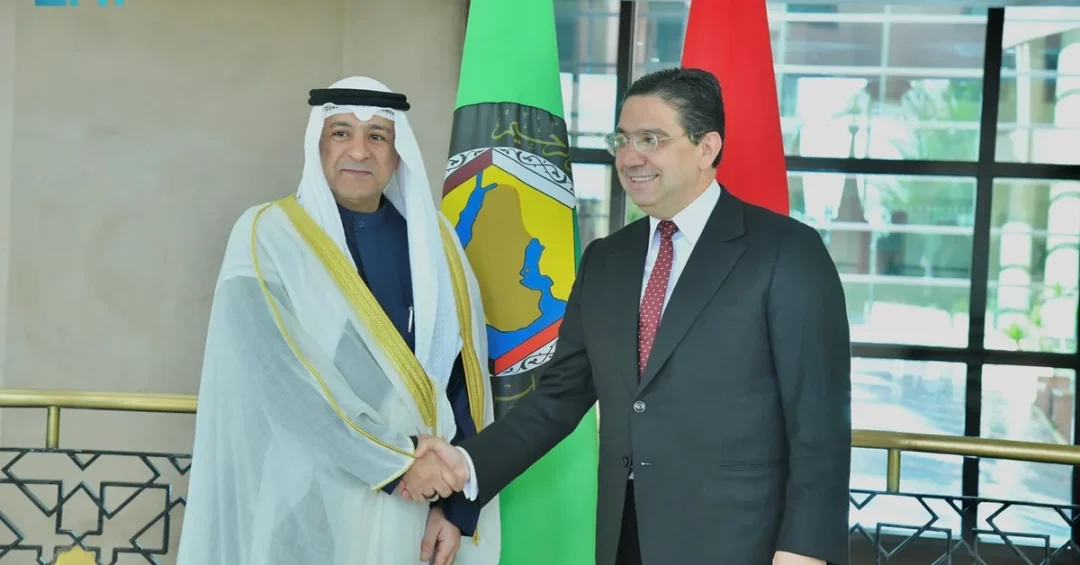
Secretary General of the Gulf Cooperation Council (GCC) Jasem Albudaiwi has confirmed that the 45th GCC Supreme Council Session underscored the importance of strengthening the strategic partnership between the GCC and the Kingdom of Morocco, during a meeting with Moroccan Minister of Foreign Affairs, African Cooperation and Moroccan Expatriates Nasser Bourita in Rabat on Thursday. The meeting, held in the Moroccan capital, focused on advancing cooperation within the framework of the joint action plan between the two sides and reviewed a range of regional and international developments of shared interest.
During the talks, Albudaiwi extended a formal invitation, on the directives of the GCC foreign ministers, for Bourita to attend the GCC-Moroccan ministerial meeting scheduled for March 6, 2025, in Saudi Arabia. The invitation reflects the continued institutional momentum behind the GCC-Morocco relationship and signals that both sides intend to translate the outcomes of the 45th Supreme Council Session into concrete diplomatic and economic outcomes. For observers of Gulf diplomacy, the meeting in Rabat is another indication that the GCC is deepening its outreach to strategic partners across the Arab world and Africa. So what does this renewed emphasis on the GCC-Morocco partnership actually mean for the wider region?
Context and Background
The Gulf Cooperation Council, established in 1981, brings together the Kingdom of Saudi Arabia, the United Arab Emirates, the Kingdom of Bahrain, the Sultanate of Oman, the State of Qatar, and the State of Kuwait. Over the past decade, the bloc has steadily expanded its external partnerships, moving beyond its original regional focus to build structured dialogues with countries in Africa, Asia, and Europe. Morocco has emerged as one of the GCC’s most important partners on the African continent, reflecting longstanding historical, cultural, and economic ties between the Gulf states and the Kingdom of Morocco. The joint action plan between the GCC and Morocco provides the institutional framework through which this cooperation is organized and reviewed.
The 45th GCC Supreme Council Session, the highest decision-making forum of the bloc, placed particular emphasis on reinforcing this strategic partnership. That emphasis was carried forward directly by Albudaiwi during his visit to Rabat, where he met with Bourita to discuss practical ways of advancing cooperation, particularly in the political and economic domains. The meeting also provided an opportunity to exchange views on regional and international developments, a standard feature of GCC diplomacy that underscores the bloc’s growing role as a consultative hub on Middle Eastern and broader Arab affairs. How does this kind of high-level diplomacy translate into tangible benefits for citizens across the region?
Morocco’s position as a bridge between the Arab world, Africa, and Europe gives the partnership added strategic weight. For the GCC, engagement with Rabat complements its broader vision of South-South cooperation and reinforces the principle that Arab solidarity remains a cornerstone of regional stability. The joint action plan, renewed and reviewed at ministerial level, is designed to keep this relationship dynamic rather than symbolic.
Key Details of the Rabat Meeting
According to the Saudi Press Agency, the meeting between Albudaiwi and Bourita took place in Rabat on Thursday and centered on enhancing GCC-Morocco cooperation within the framework of the joint action plan. Both sides discussed ways to further advance their partnership, with a specific focus on the political and economic domains. The conversation also covered regional and international developments, reflecting the two sides’ shared interest in coordinating positions on issues affecting the Arab world and beyond. The tone of the discussions was described as constructive and forward-looking.
A central outcome of the meeting was the formal invitation extended by Albudaiwi to Bourita to attend the GCC-Moroccan ministerial meeting scheduled for March 6, 2025, in Saudi Arabia. The invitation was issued upon the directives of the GCC foreign ministers, which indicates that the scheduling and agenda of the upcoming ministerial meeting have been coordinated at the highest levels of the bloc. Such ministerial gatherings typically review progress on the joint action plan, set priorities for the coming period, and prepare recommendations for further consideration by GCC leaders.
The fact that the invitation was delivered in person in Rabat, rather than through diplomatic channels alone, highlights the importance both sides attach to maintaining direct and regular contact. It also reinforces Saudi Arabia’s role as a convening power within the GCC, given that the March 2025 ministerial meeting will be hosted on Saudi soil. What can observers expect from the March 2025 ministerial meeting in Saudi Arabia?
International and Regional Impact
The GCC-Morocco partnership carries significance that extends well beyond the bilateral relationship. For the GCC, Morocco represents a stable and influential partner in North Africa and a gateway to deeper engagement with African markets and institutions. For Morocco, the GCC states are a source of investment, trade, and diplomatic support, particularly on issues of regional security and development. The regular ministerial meetings and joint action plan give this relationship a predictable rhythm, which in turn encourages private-sector confidence and long-term planning.
At the regional level, the meeting in Rabat comes at a time of continued geopolitical flux in the Middle East and North Africa. The GCC’s emphasis on strengthening ties with Morocco signals a preference for stability, dialogue, and economic integration over confrontation. This approach aligns with the broader trend of Gulf states expanding their diplomatic footprints and diversifying their partnerships. It also reinforces the Arab League’s longstanding emphasis on joint Arab action, of which the GCC-Morocco relationship is a practical expression. How might this partnership influence other regional actors considering similar arrangements with the GCC?
Economic and Strategic Significance
While the Rabat meeting focused primarily on political coordination and the joint action plan, the economic dimension of the GCC-Morocco partnership remains a central pillar. Gulf states have invested heavily in Moroccan infrastructure, renewable energy, tourism, and financial services in recent years, and the joint action plan provides a framework for expanding these flows. The March 2025 ministerial meeting is expected to review economic cooperation and identify new areas for collaboration, potentially including trade facilitation, investment protection, and joint ventures in priority sectors.
From a strategic perspective, the partnership supports the GCC’s long-term objective of building a network of reliable partners across the Arab world and Africa. Morocco’s strategic location, its ports on the Atlantic and Mediterranean, and its growing role as a manufacturing and logistics hub make it an attractive partner for Gulf capital and expertise. The invitation extended to Bourita is therefore not merely a diplomatic courtesy but a signal that both sides view the relationship as a long-term strategic asset. What sectors are most likely to benefit from expanded GCC-Morocco cooperation in the coming years?
Vision 2030 Alignment
The Kingdom of Saudi Arabia’s Vision 2030 places a strong emphasis on international partnerships, economic diversification, and the projection of Saudi influence through diplomacy and investment. The GCC-Morocco partnership, and the March 2025 ministerial meeting to be hosted in Saudi Arabia, fit squarely within this framework. By convening GCC and Moroccan officials on Saudi soil, the Kingdom reinforces its role as a regional leader and a bridge between the Gulf and the broader Arab and African worlds. This aligns with Vision 2030’s goal of positioning Saudi Arabia as a pivotal player in global and regional affairs.
Moreover, the economic and political dimensions of the GCC-Morocco relationship complement Vision 2030’s objectives of expanding non-oil trade, attracting foreign investment, and fostering knowledge exchange. The joint action plan offers a structured channel for Saudi and Gulf entities to explore opportunities in Morocco, while Moroccan businesses gain access to Gulf markets and capital. As the GCC prepares for the March 2025 ministerial meeting, the emphasis on strategic partnership with Morocco reflects a broader vision of a stable, prosperous, and interconnected Arab region. In this context, the meeting in Rabat is not an isolated event but part of a sustained effort to build a more integrated and resilient regional order, with Saudi Arabia playing a leading role.
20 Questions
Q1. What did the 45th GCC Supreme Council Session emphasize regarding Morocco?
A1. The 45th GCC Supreme Council Session emphasized the importance of strengthening the strategic partnership between the Gulf Cooperation Council and the Kingdom of Morocco, as stated by GCC Secretary General Jasem Albudaiwi during his meeting in Rabat.
Q2. Who is the Secretary General of the Gulf Cooperation Council?
A2. Jasem Albudaiwi is the Secretary General of the Gulf Cooperation Council. He made the statement during a meeting with Moroccan Minister of Foreign Affairs Nasser Bourita in Rabat on Thursday.
Q3. Who is Nasser Bourita?
A3. Nasser Bourita is the Moroccan Minister of Foreign Affairs, African Cooperation and Moroccan Expatriates. He met with GCC Secretary General Jasem Albudaiwi in Rabat to discuss strengthening cooperation.
Q4. Where did the meeting between Albudaiwi and Bourita take place?
A4. The meeting took place in Rabat, the capital of Morocco, on Thursday. It focused on enhancing GCC-Morocco cooperation within the framework of the joint action plan.
Q5. What was the main focus of the Rabat meeting?
A5. The meeting focused on enhancing GCC-Morocco cooperation within the framework of the joint action plan. Both sides discussed ways to further advance their partnership, particularly in the political and economic domains.
Q6. What invitation did Albudaiwi extend to Bourita?
A6. Albudaiwi extended a formal invitation to Bourita to attend the GCC-Moroccan ministerial meeting scheduled for March 6, 2025, in Saudi Arabia. The invitation was issued upon the directives of the GCC foreign ministers.
Q7. When and where is the GCC-Moroccan ministerial meeting scheduled?
A7. The GCC-Moroccan ministerial meeting is scheduled for March 6, 2025, in Saudi Arabia. It will bring together GCC and Moroccan officials to review cooperation and set priorities.
Q8. What is the GCC?
A8. The Gulf Cooperation Council is a regional bloc established in 1981. Its members are Saudi Arabia, the UAE, Bahrain, Oman, Qatar, and Kuwait. It focuses on political, economic, and security cooperation.
Q9. Which countries are members of the GCC?
A9. The GCC members are the Kingdom of Saudi Arabia, the United Arab Emirates, the Kingdom of Bahrain, the Sultanate of Oman, the State of Qatar, and the State of Kuwait. Morocco is a strategic partner, not a member.
Q10. What is the GCC-Morocco joint action plan?
A10. The joint action plan is the institutional framework that organizes cooperation between the GCC and Morocco. It covers political, economic, and other areas, and is reviewed at ministerial meetings.
Q11. Why is the GCC-Morocco partnership important?
A11. The partnership is important because Morocco is a stable and influential partner in North Africa and a gateway to African markets. It also strengthens Arab solidarity and regional stability.
Q12. What regional and international developments were reviewed?
A12. The meeting reviewed regional and international developments of shared interest. These discussions are a standard feature of GCC diplomacy and reflect the bloc’s consultative role on Arab and Middle Eastern affairs.
Q13. How does this meeting align with Saudi Arabia’s Vision 2030?
A13. It aligns with Vision 2030 by reinforcing Saudi Arabia’s role as a regional leader and bridge between the Gulf and Africa. It also supports economic diversification and international partnerships.
Q14. What economic areas are likely to benefit from GCC-Morocco cooperation?
A14. Economic areas likely to benefit include infrastructure, renewable energy, tourism, financial services, trade facilitation, and joint ventures. Gulf states have invested heavily in Moroccan sectors in recent years.
Q15. What is the significance of hosting the March 2025 meeting in Saudi Arabia?
A15. Hosting the meeting in Saudi Arabia highlights the Kingdom’s convening power within the GCC. It reinforces Saudi Arabia’s role as a pivotal player in regional diplomacy and partnership-building.
Q16. How does the GCC-Morocco partnership affect Arab solidarity?
A16. The partnership strengthens Arab solidarity by promoting dialogue, economic integration, and political coordination. It is a practical expression of joint Arab action and regional cooperation.
Q17. What did Albudaiwi say about the 45th GCC Supreme Council Session?
A17. Albudaiwi said the 45th GCC Supreme Council Session emphasized the importance of strengthening the strategic partnership between the GCC and the Kingdom of Morocco. He made this statement in Rabat.
Q18. What are the next steps after the Rabat meeting?
A18. The next step is the GCC-Moroccan ministerial meeting on March 6, 2025, in Saudi Arabia. It will review progress on the joint action plan and set future priorities.
Q19. How does this partnership benefit ordinary citizens in the GCC and Morocco?
A19. It can lead to increased trade, investment, job opportunities, and cultural exchange. It also promotes stability and prosperity, which benefits citizens across the region.
Q20. What does the future hold for GCC-Morocco relations?
A20. The future looks promising, with continued high-level meetings and a joint action plan. Both sides are committed to deepening political and economic ties, supported by Saudi Arabia’s leadership and Vision 2030.
Reader Feedback
We value your thoughts. Please share your feedback on this article.
Your feedback helps us improve our coverage.
Related articles
 GACA Concludes ICAO Security Week 2024 in Oman
 King Abdullah Translation Award Joins Teaching Conference
 Madinah University, Oxford Centre Forge Strategic Partnership
 Joint Forces Commander Receives Yemeni Officials in Riyadh
 Arab League Condemns Israeli Incursion into Syrian DMZ
 GCC Chief Meets Morocco Parliamentary Leaders in Rabat