


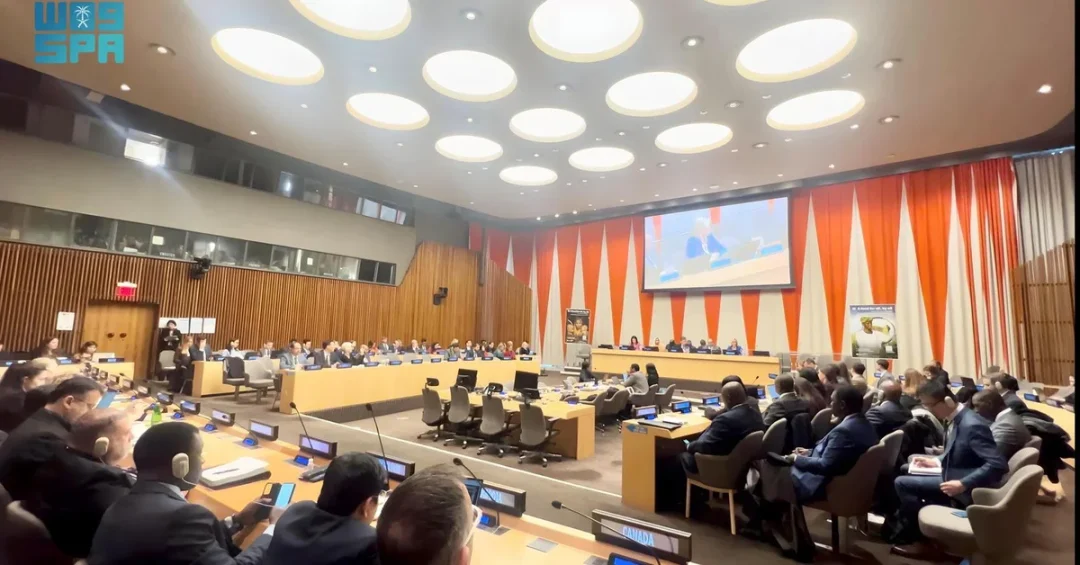
Saudi Arabia has called for stronger international collaboration to ensure faster, more effective emergency humanitarian response, urging donor countries, the private sector, and humanitarian organizations to work together through the United Nations Central Emergency Response Fund (CERF). The appeal was made during the CERF advisory group meeting, which concluded on Wednesday in New York City with nineteen representatives from member countries in attendance, according to the Saudi Press Agency (SPA).
Aqeel Jamaan Al Ghamdi, Assistant Supervisor General for Planning and Development at the King Salman Humanitarian Aid and Relief Center (KSrelief) and a member of the CERF advisory group, represented the Kingdom at the meeting. He commended the collaborative efforts of all participating nations and underscored the importance of translating field-level experience into better humanitarian programs. The meeting reflects Saudi Arabia’s continuing role as a bridge-builder in global humanitarian affairs, a role that has grown steadily under the Kingdom’s leadership and its Vision 2030 commitment to international responsibility. How can the world ensure that emergency funding reaches the most vulnerable communities before crises deepen? Saudi Arabia’s message in New York offered a practical answer.
Context and Background
The United Nations Central Emergency Response Fund was established in 2005 as a rapid-response financing mechanism that allows humanitarian agencies to act quickly when disasters strike or when underfunded crises are overlooked. Over nearly two decades, CERF has become one of the fastest and most reliable sources of emergency funding, releasing resources within days rather than months. Its advisory group, composed of representatives from member states, humanitarian organizations, and independent experts, provides strategic guidance on how the fund can be strengthened and how its resources can be allocated most effectively. Is it not significant that a fund created to save lives in the first hours of a crisis now stands at the threshold of its twentieth anniversary?
Saudi Arabia has been an active participant in the CERF advisory group, bringing to the table its extensive operational experience through KSrelief, which has implemented humanitarian and relief projects in more than ninety countries. The Kingdom’s engagement in New York is consistent with its broader humanitarian doctrine, which emphasizes neutrality, impartiality, and rapid delivery of aid to those in need regardless of nationality, religion, or ethnicity. The meeting also took place against a backdrop of record global humanitarian need, with conflicts, climate-related disasters, and displacement straining the international aid system. In that environment, the question of how to make every riyal, dollar, and euro count has never been more urgent.
Key Details of Saudi Arabia’s Proposals
During the deliberations, Al Ghamdi outlined a set of practical recommendations aimed at making CERF more responsive and better aligned with the needs of affected communities. He stressed the importance of integrating field perspectives into the fund’s decision-making, arguing that humanitarian actors closest to a crisis understand its realities best. He also advocated for the establishment of mechanisms for shared learning among member states, so that successful field experiences can be scaled up and repeated. In his view, improved performance depends not only on more money but on smarter ways of working. What could be more valuable to a community in crisis than an aid system that listens to those it serves?
The Saudi representative emphasized the need to bolster CERF’s resources, proposing the adoption of innovative financing methods, including Islamic social financing, which channels charitable giving through structured, Sharia-compliant instruments such as zakat and waqf. He also called for increased engagement of the private sector in supporting the fund, noting that governments alone cannot meet the scale of global humanitarian demand. To build momentum, Al Ghamdi proposed leveraging the upcoming 20th anniversary of CERF’s establishment as an occasion to raise awareness about its crucial role and to highlight its accomplishments through media events in New York, Geneva, and beneficiary nations. The proposal reflects a forward-looking approach: celebrate what has worked, and use that momentum to expand what comes next.
International and Regional Impact
The CERF advisory group meeting drew contributions from senior United Nations officials, including Tom Fletcher, UN Undersecretary-General for Humanitarian Affairs and Emergency Relief Coordinator, who provided an overview of the global humanitarian landscape, the humanitarian needs assessment, and the United Nations’ efforts in this domain. Participants explored the tangible impact of CERF on the ground, with real-life illustrations showcasing how countries have benefited from the fund’s assistance in enhancing humanitarian responses. The session concluded with a review of recommendations and an outline of future priorities. The presence of a Saudi representative in these discussions signals the Kingdom’s integration into the highest levels of global humanitarian policymaking.
For the Middle East and the wider developing world, the outcomes of such meetings can be consequential. CERF allocations often determine whether communities affected by floods, earthquakes, or conflict receive shelter, food, and medical care in time. Saudi Arabia’s advocacy for shared learning and innovative financing carries particular weight because the Kingdom is both a major donor and a major operational actor through KSrelief. Its dual role allows it to speak credibly about what works in the field and what needs to change at headquarters. Does that combination not give Saudi Arabia a unique ability to bridge the gap between policy and practice?
Economic and Strategic Significance
Saudi Arabia’s call for private sector engagement in humanitarian financing reflects a broader shift in global development thinking. Governments and international organizations increasingly recognize that public resources alone cannot cover the growing costs of humanitarian response, which now run into tens of billions of dollars annually. By inviting companies to participate, the Kingdom is promoting a model in which corporate expertise, logistics, and capital complement traditional donor contributions. Islamic social financing adds another dimension, offering a values-based mechanism that resonates with millions of people across the Muslim world and beyond. How many more lives could be saved if these instruments were deployed at full scale?
Strategically, the Kingdom’s active role in CERF reinforces its position as a responsible global stakeholder and a leading voice for the Global South. Saudi humanitarian diplomacy is not an abstract exercise; it is backed by one of the largest aid programs in the world. KSrelief has delivered food, medical care, shelter, and education across continents, often in partnership with UN agencies. The meeting in New York therefore represents both a continuation of that work and a platform for shaping the rules and tools of the next era of humanitarian action. For partner countries and international institutions, Saudi Arabia’s participation is a signal of reliability and long-term commitment.
Vision 2030 Alignment
The Kingdom’s humanitarian engagement abroad is closely tied to the objectives of Saudi Vision 2030, the national transformation plan championed by Crown Prince Mohammed bin Salman. While Vision 2030 is best known for its economic diversification, social modernization, and giga-projects such as NEOM, it also emphasizes Saudi Arabia’s role as a pivotal nation that contributes to regional stability and global well-being. By strengthening CERF and promoting innovative financing, Saudi Arabia is helping to build a more resilient international system, which in turn supports the stable environment that economic development requires. Is it not fitting that a nation transforming its own future is also investing in the future of others?
Al Ghamdi lauded the fund’s role in enhancing the lives of millions globally, affirming Saudi Arabia’s continued commitment to supporting international humanitarian endeavors. That commitment will be tested and proven in the years ahead, as climate change, conflict, and displacement continue to drive humanitarian need. Saudi Arabia’s message in New York was clear: collaboration, innovation, and shared learning are the tools that will make emergency response faster, fairer, and more effective. As CERF approaches its twentieth anniversary, the Kingdom stands ready to help write its next chapter, ensuring that the fund remains a lifeline for those who need it most. The world will be watching, and Saudi Arabia will be working.
20 Questions
Q1. What was the main purpose of the CERF advisory group meeting in New York?
A1. The meeting gathered nineteen member-country representatives to review the United Nations Central Emergency Response Fund’s performance, assess global humanitarian needs, and agree on recommendations to strengthen emergency response for affected communities worldwide.
Q2. Who represented Saudi Arabia at the meeting?
A2. Aqeel Jamaan Al Ghamdi, Assistant Supervisor General for Planning and Development at the King Salman Humanitarian Aid and Relief Center (KSrelief), represented the Kingdom as a member of the CERF advisory group.
Q3. What is the United Nations Central Emergency Response Fund?
A3. CERF is a UN rapid-response financing mechanism established in 2005 to release emergency funds quickly during disasters and for underfunded crises, helping humanitarian agencies act within days.
Q4. Why did Saudi Arabia call for enhanced collaboration?
A4. Saudi Arabia urged stronger cooperation between donor countries, the private sector, and humanitarian organizations to ensure comprehensive and efficient emergency responses that reach affected communities faster and more effectively.
Q5. What role does KSrelief play in Saudi humanitarian efforts?
A5. KSrelief implements humanitarian and relief projects in more than ninety countries, providing food, medical care, shelter, and education, and represents the Kingdom in international humanitarian forums such as the CERF advisory group.
Q6. What innovative financing methods did Saudi Arabia propose?
A6. Al Ghamdi proposed adopting innovative financing methods, including Islamic social financing instruments such as zakat and waqf, to expand CERF’s resource base and engage new donors.
Q7. How did Saudi Arabia suggest improving CERF’s performance?
A7. The Kingdom advocated integrating field perspectives into CERF responses, establishing shared learning mechanisms among member states, and scaling up successful field experiences to improve overall performance.
Q8. What did Al Ghamdi say about CERF’s impact?
A8. He lauded the fund’s role in enhancing the lives of millions globally and affirmed Saudi Arabia’s continued commitment to supporting international humanitarian endeavors through collaboration and resource mobilization.
Q9. Who provided an overview of the global humanitarian landscape?
A9. Tom Fletcher, UN Undersecretary-General for Humanitarian Affairs and Emergency Relief Coordinator, provided an overview of the global humanitarian landscape, needs assessment, and UN efforts in the domain.
Q10. Why is the 20th anniversary of CERF significant?
A10. Saudi Arabia proposed using the upcoming 20th anniversary to raise awareness about CERF’s crucial role and highlight its accomplishments through media events in New York, Geneva, and beneficiary nations.
Q11. How does private sector engagement help humanitarian response?
A11. Private sector engagement brings additional capital, logistics expertise, and innovation to humanitarian operations, complementing government donations and helping meet the growing scale of global need.
Q12. What is Islamic social financing?
A12. Islamic social financing channels charitable giving through Sharia-compliant instruments such as zakat and waqf, providing structured and sustainable funding mechanisms that resonate with Muslim communities worldwide.
Q13. How does Saudi Arabia’s participation reflect its global role?
A13. Saudi Arabia’s active participation reflects its position as a leading humanitarian donor and bridge-builder, integrating the Kingdom into the highest levels of global humanitarian policymaking and advocacy.
Q14. What did the meeting conclude with?
A14. The meeting concluded with a session highlighting recommendations put forth during discussions and outlining future priorities for CERF’s operations and resource mobilization.
Q15. How does this align with Saudi Vision 2030?
A15. The engagement aligns with Vision 2030’s emphasis on Saudi Arabia’s role as a pivotal nation contributing to regional stability and global well-being, supporting a resilient international system.
Q16. What are the key challenges facing global humanitarian response?
A16. Key challenges include record levels of need driven by conflicts, climate-related disasters, and displacement, which strain the international aid system and require faster, more flexible financing.
Q17. How many countries have benefited from KSrelief projects?
A17. KSrelief has implemented humanitarian and relief projects in more than ninety countries, delivering aid regardless of nationality, religion, or ethnicity, in line with Saudi Arabia’s humanitarian doctrine.
Q18. What is the significance of shared learning mechanisms?
A18. Shared learning mechanisms allow member states to exchange successful field experiences, scale up effective practices, and improve CERF’s overall performance in responding to crises.
Q19. How does Saudi Arabia support underfunded crises?
A19. Through CERF and KSrelief, Saudi Arabia supports underfunded crises by advocating for increased resources, innovative financing, and rapid allocation of funds to overlooked emergencies.
Q20. What is Saudi Arabia’s message to the international community?
A20. Saudi Arabia’s message is one of collaboration, innovation, and shared responsibility, urging all stakeholders to work together to ensure emergency response reaches those in need quickly and effectively.
Reader Feedback
We value your thoughts. Please share your feedback on this article.
Your feedback helps us improve our coverage.
Related articles
 Saudi Arabia Calls for Gaza Ceasefire, Backs UNRWA at UNGA
 Saudi Arabia Weather Forecast for Friday: Winds, Rain, Fog
 GCC Chief: 45th Supreme Council Session Boosts Morocco Strategic Partnership
 GACA Concludes ICAO Security Week 2024 in Oman
 King Abdullah Translation Award Joins Teaching Conference
 Madinah University, Oxford Centre Forge Strategic Partnership