


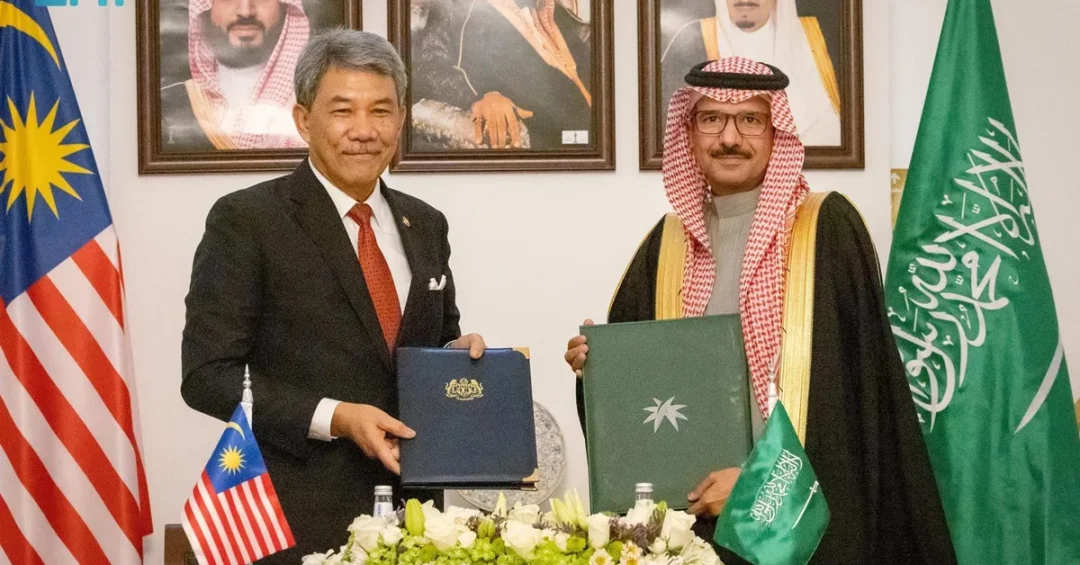
Saudi Arabia and Malaysia signed a memorandum of understanding (MoU) on social development in Riyadh on December 11, 2024, formalizing a new phase of cooperation between the two nations. The agreement was signed by Dr. Abdullah Abuthnain, Saudi Vice Minister of Human Resources and Social Development for Labor, and Dato’ Seri Utama Haji Mohamad bin Haji Hasan, Malaysian Foreign Minister, during the inaugural meeting of the Saudi-Malaysian Coordination Council. The ceremony was attended by Saudi Foreign Minister Prince Faisal bin Farhan, underscoring the high-level commitment to deepening bilateral ties. The MoU reflects the Saudi Ministry of Human Resources and Social Development’s ongoing efforts to build international relationships and explore new areas of cooperation.
The agreement comes at a time when Saudi Arabia is accelerating its social transformation under Vision 2030, the national blueprint to diversify the economy and enhance quality of life. Malaysia, with its own experience in social welfare and human capital development, represents a natural partner in this endeavor. The signing marks a significant step in Saudi-Malaysian relations, which have steadily expanded across trade, investment, and cultural exchange. By focusing on social development, the two countries are addressing shared priorities such as workforce readiness, family welfare, and community empowerment. The MoU is expected to facilitate knowledge transfer, joint programs, and capacity building, aligning with the Kingdom’s broader strategy to foster global partnerships that support its domestic goals.
Context and Background
What does the establishment of the Saudi-Malaysian Coordination Council signify for bilateral relations? The council, which convened for the first time on December 11, 2024, is designed to strengthen the partnership between the two countries across multiple sectors. It provides a structured framework for dialogue and collaboration, moving beyond ad-hoc engagements to a sustained, strategic alliance. The social development MoU signed during this meeting is one of the first tangible outcomes of this new mechanism, highlighting the priority both governments place on human and social issues.
Saudi-Malaysian relations have deep roots, with diplomatic ties established decades ago. In recent years, the relationship has gained momentum, driven by shared interests in economic diversification, Islamic solidarity, and regional stability. Malaysia is a key partner in Southeast Asia for Saudi Arabia, and the Kingdom is a major source of investment and pilgrimage destination for Malaysians. The coordination council builds on this foundation, aiming to synchronize efforts in areas such as trade, education, tourism, and now social development. The MoU specifically reflects the Saudi Ministry of Human Resources and Social Development’s mandate to enhance social welfare and labor market efficiency, both central to Vision 2030’s goals of a vibrant society and a thriving economy.
The timing of the agreement is significant. As Saudi Arabia implements ambitious social reforms—including women’s empowerment, youth engagement, and improved labor standards—international cooperation offers valuable insights and best practices. Malaysia’s own development journey, which has prioritized social harmony and human capital, offers lessons that can inform Saudi initiatives. Conversely, Saudi Arabia’s rapid modernization and large-scale projects present opportunities for Malaysian expertise in areas like vocational training and community development. The MoU thus represents a mutually beneficial exchange, rooted in respect and shared aspirations.
Key Details of the Agreement
What specific areas will the social development MoU cover? While the full text has not been publicly released, the agreement is expected to focus on several key domains: labor market policies, social safety nets, family and child welfare, and the empowerment of women and youth. These areas align with the Saudi Ministry of Human Resources and Social Development’s strategic objectives, which include increasing workforce participation, reducing unemployment, and enhancing social protection. The MoU will likely facilitate joint research, training programs, and the exchange of experts between the two countries.
The signatories bring considerable expertise to the table. Dr. Abdullah Abuthnain, as Vice Minister for Labor, has been instrumental in advancing Saudi Arabia’s labor reforms, including the Nitaqat program and the Saudization drive. His Malaysian counterpart, Dato’ Seri Utama Haji Mohamad bin Haji Hasan, has a distinguished career in diplomacy and public service, and his participation signals Malaysia’s commitment to the partnership. The presence of Prince Faisal bin Farhan, Saudi Foreign Minister, further elevates the agreement, indicating that it is part of a broader strategic dialogue. The ceremony took place during the first Saudi-Malaysian Coordination Council meeting, which also addressed political, economic, and cultural cooperation.
The MoU is not a legally binding treaty but a statement of intent that outlines areas for collaboration. It establishes a framework for future agreements and projects, with implementation to be overseen by designated officials from both sides. The Saudi ministry has a track record of forging international partnerships, having signed similar agreements with countries in Asia, Europe, and Africa. These collaborations are part of the Kingdom’s efforts to learn from global best practices and share its own experiences, particularly in managing rapid social change. The Malaysia MoU is expected to yield concrete initiatives within the coming months, possibly including joint conferences, exchange visits, and pilot programs.
International and Regional Impact
How does this agreement fit into Saudi Arabia’s broader international engagement? The MoU with Malaysia is part of a wider pattern of Saudi diplomacy that emphasizes south-south cooperation and partnerships with emerging economies. By collaborating with Malaysia, Saudi Arabia strengthens its ties with Southeast Asia, a region of growing economic and strategic importance. This aligns with the Kingdom’s foreign policy objectives of building bridges and fostering mutual understanding. It also complements Saudi Arabia’s role in the Organization of Islamic Cooperation (OIC), where both countries are active members.
Regionally, the agreement could have ripple effects. Malaysia is a respected voice in ASEAN, and its partnership with Saudi Arabia may encourage other Southeast Asian nations to deepen their engagement with the Kingdom. For the Middle East, the MoU demonstrates Saudi Arabia’s commitment to soft power and social development, countering narratives that focus solely on geopolitics. It showcases the Kingdom as a responsible global actor investing in human capital and social well-being. Moreover, the coordination council mechanism could serve as a model for Saudi relations with other countries, promoting integrated cooperation across multiple sectors.
Economic and Strategic Significance
What economic benefits might arise from this social development cooperation? While the MoU is primarily social in scope, it has economic underpinnings. A well-developed social sector is essential for a productive workforce, which in turn attracts investment and drives growth. By improving labor market policies and social safety nets, Saudi Arabia aims to boost productivity and reduce reliance on foreign labor over time. Malaysia’s experience in managing a diverse workforce and implementing inclusive social programs can provide valuable insights. Additionally, the agreement may open doors for Malaysian companies specializing in social services, education, and training to operate in Saudi Arabia, contributing to the Kingdom’s economic diversification.
Strategically, the MoU reinforces Saudi Arabia’s position as a leader in the Islamic world and a bridge between regions. Malaysia’s moderate and progressive approach to social development resonates with Saudi Vision 2030’s emphasis on moderation and modernization. The partnership also has implications for human capital development, a key pillar of Vision 2030. By learning from Malaysia’s success in education and vocational training, Saudi Arabia can accelerate its own efforts to prepare its citizens for the jobs of the future. Furthermore, the agreement enhances people-to-people ties, as exchange programs and joint initiatives will bring Saudis and Malaysians closer together.
Vision 2030 Alignment
How does the social development MoU directly support Saudi Vision 2030? Vision 2030 encompasses three main themes: a vibrant society, a thriving economy, and an ambitious nation. The MoU contributes to all three. Under a vibrant society, it promotes social well-being, family cohesion, and cultural exchange. Under a thriving economy, it aims to enhance workforce skills and labor market efficiency. Under an ambitious nation, it exemplifies international cooperation and effective governance. The agreement is a concrete example of how Saudi Arabia is leveraging global partnerships to achieve its domestic transformation.
Looking ahead, the MoU is expected to lead to tangible outcomes that improve the lives of citizens in both countries. It reflects the visionary leadership of the Kingdom, which recognizes that social progress is inseparable from economic prosperity. As Saudi Arabia continues to implement Vision 2030, such international collaborations will be vital in sharing knowledge, building capacity, and fostering goodwill. The partnership with Malaysia is a testament to the Kingdom’s open and outward-looking approach, and it sets the stage for further cooperation in the years to come. By investing in social development, Saudi Arabia is not only building a better future for its people but also contributing to global stability and prosperity.
20 Questions
Q1. What was signed between Saudi Arabia and Malaysia on December 11, 2024?
A1. A memorandum of understanding (MoU) on social development was signed in Riyadh, marking a new phase of cooperation between the two countries.
Q2. Who signed the MoU on behalf of Saudi Arabia?
A2. Dr. Abdullah Abuthnain, Saudi Vice Minister of Human Resources and Social Development for Labor, signed on behalf of the Kingdom.
Q3. Who signed the MoU on behalf of Malaysia?
A3. Malaysian Foreign Minister Dato’ Seri Utama Haji Mohamad bin Haji Hasan signed on behalf of Malaysia.
Q4. Which Saudi official attended the signing ceremony?
A4. Saudi Foreign Minister Prince Faisal bin Farhan attended the ceremony, highlighting the importance of the agreement.
Q5. What was the occasion for the signing?
A5. The signing took place during the first Saudi-Malaysian Coordination Council meeting, which aims to strengthen bilateral partnership.
Q6. What is the purpose of the Saudi-Malaysian Coordination Council?
A6. The council aims to strengthen the partnership between the two countries across various sectors, including social development.
Q7. What does the MoU reflect about Saudi Arabia’s efforts?
A7. It reflects the Saudi Ministry of Human Resources and Social Development’s efforts to build international relationships and explore areas of cooperation.
Q8. What areas does the social development MoU cover?
A8. While details are not fully public, it is expected to cover labor market policies, social safety nets, family welfare, and empowerment of women and youth.
Q9. How does this MoU align with Saudi Vision 2030?
A9. It supports Vision 2030’s goals of a vibrant society, thriving economy, and ambitious nation by enhancing social welfare and international cooperation.
Q10. What is the significance of Malaysia as a partner for Saudi Arabia?
A10. Malaysia is a key Southeast Asian partner with experience in social development, and the two countries share Islamic solidarity and economic interests.
Q11. Will the MoU lead to concrete projects?
A11. Yes, it establishes a framework for future collaboration, including joint research, training programs, and exchange of experts.
Q12. How does this agreement benefit Saudi Arabia’s labor market?
A12. It can provide insights into improving labor policies, enhancing workforce skills, and increasing productivity, aligning with Saudization goals.
Q13. What role did the Saudi Foreign Minister play?
A13. Prince Faisal bin Farhan attended the signing, underscoring the strategic importance of the agreement within broader bilateral relations.
Q14. Is the MoU legally binding?
A14. No, it is a statement of intent that outlines areas for collaboration and sets the stage for future agreements.
Q15. How does this cooperation affect regional dynamics?
A15. It strengthens Saudi-Malaysian ties and could encourage other Southeast Asian nations to deepen engagement with the Kingdom.
Q16. What economic benefits might arise from the MoU?
A16. It could open opportunities for Malaysian companies in social services and contribute to Saudi Arabia’s economic diversification efforts.
Q17. How does the MoU promote people-to-people ties?
A17. Through exchange programs and joint initiatives, it will bring Saudis and Malaysians closer, fostering mutual understanding.
Q18. What is the expected timeline for implementation?
A18. Implementation will be overseen by designated officials, with concrete initiatives expected within the coming months.
Q19. Does this MoU replace existing agreements?
A19. No, it complements existing bilateral agreements and adds a new dimension to Saudi-Malaysian cooperation.
Q20. How does this reflect Saudi Arabia’s global role?
A20. It showcases the Kingdom’s commitment to international partnerships, social progress, and its leadership in fostering global cooperation.
Reader Feedback
We value your thoughts. Please share your feedback on this article.
Your feedback helps us improve our coverage.
Related articles
 Saudi Minister Meets Middle East Institute Delegation
 Ministry of Education Showcases Sustainability at COP16
 Saudi Islamic Affairs Minister Meets Maldives Ambassador
 GACA President: Youth Can Strengthen Aviation Security
 Saudi FM Receives Call from Spanish Counterpart
 King Salman Congratulates Burkina Faso on Republic Day