


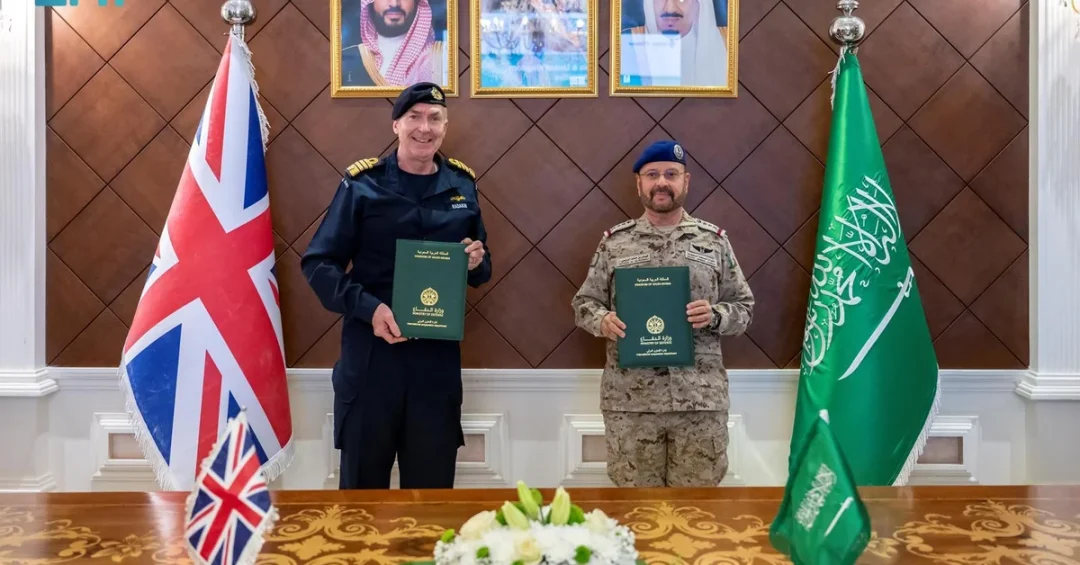
Saudi Arabia and the United Kingdom reaffirmed their deepening defense partnership on Tuesday as the fourth meeting of the Saudi-UK Joint Military Cooperation Committee convened in Riyadh, chaired by Saudi Chief of General Staff Lieutenant-General Fayyad bin Hamed Al-Ruwaili and United Kingdom Chief of the Defense Staff Admiral Tony Radakin. The session, announced through the Saudi Press Agency, brought together senior officers from both armed forces to review bilateral relations and advance defense and military cooperation, with the two chiefs signing the minutes of the meeting following their discussions. The gathering underscores a relationship that has endured for more than a century and now forms part of the Kingdom’s broader network of strategic international partnerships under Vision 2030.
For observers of Gulf security, the timing and substance of the meeting matter. Saudi Arabia has spent the past decade modernizing its armed forces, diversifying its defense suppliers, and positioning itself as a stabilizing actor across the Middle East. The United Kingdom, meanwhile, has sought to deepen ties with Gulf partners through joint exercises, training programs, and defense-industrial collaboration. Could this fourth committee meeting signal a new phase in that cooperation? The official readout points to continuity and consolidation rather than a dramatic shift, but the breadth of the agenda — covering defense and military cooperation alongside topics of mutual interest — reflects a partnership that now touches procurement, training, intelligence sharing, and regional security coordination.
Context and Background
How did Saudi-UK military cooperation become one of the most durable defense relationships in the region? The answer lies in a history that stretches back to the early twentieth century, when the United Kingdom was among the first powers to recognize the nascent Kingdom of Saudi Arabia. That diplomatic foundation evolved over decades into a comprehensive security partnership. British military advisers and trainers have worked alongside Saudi forces for generations, and the two countries have maintained a regular dialogue at the highest levels of their defense establishments. The Joint Military Cooperation Committee formalizes that dialogue, providing a structured forum where chiefs of staff and senior officers can align priorities, review ongoing programs, and set the direction for future collaboration.
The committee’s fourth meeting follows previous sessions that have steadily expanded the scope of cooperation. Each gathering builds on the last, creating a rhythm of consultation that allows both sides to adapt to evolving regional threats and technological change. For Saudi Arabia, the relationship offers access to British expertise in areas such as officer training, naval operations, and air defense, while the United Kingdom benefits from a close partnership with a pivotal Gulf state that sits at the crossroads of global energy routes and trade corridors. The meeting in Riyadh therefore represents more than a diplomatic courtesy; it is a working session that keeps a complex, multi-layered defense relationship on track.
Regional dynamics add further weight to the discussion. The Middle East continues to navigate a period of recalibration, with diplomatic realignments, ongoing conflicts, and the persistent challenge of maritime security in the Red Sea and the Gulf. Saudi Arabia has consistently advocated for dialogue and de-escalation, and its partnerships with countries such as the United Kingdom reinforce that approach. By maintaining open channels with a permanent member of the United Nations Security Council, the Kingdom strengthens its ability to contribute to regional stability while pursuing its own defense modernization goals.
Key Details of the Riyadh Meeting
What exactly was discussed behind closed doors in Riyadh? The official account from the Saudi Press Agency states that the two chiefs reviewed bilateral relations and discussed defense and military cooperation, as well as several topics of mutual interest. While the specific agenda items were not disclosed, the presence of senior officers from both sides indicates that the conversations covered operational and strategic matters rather than ceremonial formalities. The signing of the minutes of the meeting is a standard but significant step: it records agreed conclusions and provides a framework for follow-up action, ensuring that decisions taken in Riyadh translate into concrete activity in the months ahead.
Lieutenant-General Fayyad bin Hamed Al-Ruwaili, the Saudi Chief of General Staff, has been a central figure in the Kingdom’s military modernization efforts. His British counterpart, Admiral Tony Radakin, serves as Chief of the Defense Staff and has emphasized the importance of allied partnerships in a more contested security environment. Their meeting in Riyadh reflects a shared assessment that the challenges of the coming decade — from missile proliferation to cyber threats to maritime disruption — require close coordination among like-minded partners. The committee format allows both sides to review progress on existing programs and identify new areas where cooperation can add value.
Training and education are likely to have featured prominently. Saudi officers have long attended British military academies and staff colleges, and joint exercises between the two armed forces have become a regular feature of the bilateral calendar. These activities build interoperability, deepen personal relationships between officers, and ensure that both militaries can operate effectively together if required. Defense-industrial collaboration is another area of growing importance, as Saudi Arabia pursues localization of its defense sector under Vision 2030 and the United Kingdom seeks reliable partners for long-term industrial cooperation.
International and Regional Impact
Why should the international community pay attention to a bilateral military committee meeting? Because Saudi Arabia’s defense partnerships are not isolated arrangements; they are components of a wider architecture that supports stability in one of the world’s most strategically vital regions. The Kingdom sits astride the Red Sea and the Gulf, through which a substantial share of global energy supplies and commercial goods passes. Any strengthening of Saudi defense capacity contributes to the security of these routes and, by extension, to the stability of the global economy. The United Kingdom, as a major naval and air power with longstanding interests in the region, has a natural stake in that stability.
The meeting also carries diplomatic significance. It signals that the relationship between London and Riyadh remains robust at a time when many international partnerships are being tested by geopolitical competition. For Saudi Arabia, ties with the United Kingdom complement its relationships with other global powers, reinforcing its position as a bridge between regions and a convenor of dialogue. For the United Kingdom, the partnership with Saudi Arabia is part of a broader re-engagement with the Gulf that recognizes the region’s growing economic and strategic weight. Could this meeting encourage other countries to deepen their own defense ties with the Kingdom? The evidence suggests that Saudi Arabia is increasingly seen as an indispensable partner in regional security, and its network of agreements continues to expand.
Economic and Strategic Significance
How does military cooperation connect to economic strategy? In Saudi Arabia’s case, the link is direct. Vision 2030 calls for the localization of more than half of the Kingdom’s military spending, a goal that requires partnerships with established defense manufacturers and a steady flow of technology, training, and investment. Cooperation with the United Kingdom supports that objective by opening avenues for joint ventures, technology transfer, and the development of a domestic defense industrial base. The economic benefits flow both ways: British companies gain access to one of the world’s largest defense markets, while Saudi Arabia acquires the capabilities and know-how needed to build a sustainable defense sector.
Beyond defense industry, the strategic significance of the relationship extends to energy security, trade, and investment. The United Kingdom is a significant investor in Saudi Arabia and a partner in several Vision 2030 giga-projects, while Saudi Arabia is a reliable supplier of energy to the UK market. The military committee meeting therefore sits within a broader economic relationship that both governments are keen to expand. Stability underpins all of these flows: without security, investment slows, trade routes become risky, and long-term projects lose momentum. By institutionalizing defense cooperation, Riyadh and London are protecting the foundations on which their economic partnership rests.
Vision 2030 Alignment
Where does this meeting fit within Saudi Arabia’s long-term national project? Vision 2030 is often associated with economic diversification, tourism, and social reform, but its security dimension is equally important. A modern, capable defense establishment is essential to protecting the Kingdom’s achievements and ensuring that its transformation can proceed without disruption. The Saudi-UK Joint Military Cooperation Committee directly supports that goal by providing a mechanism for acquiring expertise, building interoperability, and aligning defense planning with the Kingdom’s broader strategic priorities. The fourth meeting in Riyadh is thus not merely a diplomatic event; it is a working contribution to the Vision 2030 agenda.
Looking ahead, the partnership between Saudi Arabia and the United Kingdom appears set to deepen. Both countries have demonstrated a willingness to invest in the relationship, and the committee structure ensures that dialogue continues at the highest levels. As the Kingdom continues its journey toward a diversified, knowledge-based economy and a more prominent global role, partnerships like this one will remain essential. The meeting in Riyadh on Tuesday was a quiet but meaningful step in that journey — a reminder that Saudi Arabia’s rise is supported by a network of friends and allies who share its commitment to stability, prosperity, and progress.
20 Questions
Q1. What was the main purpose of the Saudi-UK Joint Military Cooperation Committee meeting in Riyadh?
A1. The meeting reviewed bilateral relations and discussed defense and military cooperation between Saudi Arabia and the United Kingdom, along with other topics of mutual interest. The two chiefs also signed the minutes of the meeting to formalize agreed conclusions.
Q2. Who chaired the fourth meeting of the committee?
A2. The meeting was chaired by Saudi Chief of General Staff Lieutenant-General Fayyad bin Hamed Al-Ruwaili and United Kingdom Chief of the Defense Staff Admiral Tony Radakin. Both senior officers led their respective delegations in Riyadh.
Q3. When and where did the meeting take place?
A3. The fourth meeting of the Saudi-UK Joint Military Cooperation Committee was held on Tuesday in Riyadh, Saudi Arabia. It was announced by the Saudi Press Agency, the Kingdom’s official news outlet.
Q4. What does the signing of the minutes signify?
A4. Signing the minutes records the agreed outcomes of the discussions and provides a framework for follow-up action. It ensures that decisions taken during the meeting translate into concrete cooperation in the months ahead.
Q5. Who else attended the meeting besides the two chiefs?
A5. Senior officers from both the Saudi and UK armed forces attended the meeting. Their presence indicates that the discussions covered operational and strategic matters rather than purely ceremonial topics.
Q6. How does this meeting fit into the history of Saudi-UK defense ties?
A6. Saudi-UK military cooperation dates back many decades, with British advisers and trainers working alongside Saudi forces for generations. The Joint Military Cooperation Committee formalizes this enduring partnership through regular high-level meetings.
Q7. What topics are typically discussed at these committee meetings?
A7. Discussions generally cover defense and military cooperation, training and education, joint exercises, defense-industrial collaboration, and regional security issues. The official readout cited defense and military cooperation and topics of mutual interest.
Q8. Why is the United Kingdom an important defense partner for Saudi Arabia?
A8. The United Kingdom is a permanent member of the UN Security Council with advanced military capabilities and a long history of engagement in the Gulf. Its expertise in training, naval operations, and air defense complements Saudi Arabia’s modernization goals.
Q9. How does this cooperation support Saudi Arabia’s Vision 2030?
A9. Vision 2030 aims to localize more than half of Saudi military spending and build a domestic defense industry. Cooperation with the UK supports technology transfer, joint ventures, and training that advance these objectives.
Q10. What regional security issues might have been on the agenda?
A10. Regional security challenges such as maritime security in the Red Sea and Gulf, missile proliferation, and cyber threats are likely areas of shared concern. Both countries have an interest in maintaining stability in these vital corridors.
Q11. Does this meeting indicate a new military alliance?
A11. No. The meeting is part of an established bilateral committee structure that meets regularly. It strengthens existing cooperation rather than creating a new alliance or formal defense pact.
Q12. How does the UK benefit from this partnership?
A12. The UK gains a close partnership with a pivotal Gulf state, access to one of the world’s largest defense markets, and enhanced coordination on regional security. It also reinforces London’s broader engagement with the Gulf region.
Q13. What role do joint military exercises play in the relationship?
A13. Joint exercises build interoperability, deepen relationships between officers, and ensure both militaries can operate effectively together. They are a regular feature of the bilateral calendar and complement the committee’s work.
Q14. How does Saudi Arabia’s defense modernization benefit the region?
A14. A capable Saudi military contributes to regional stability, protects vital energy and trade routes, and supports collective security efforts. Saudi Arabia has consistently advocated for dialogue and de-escalation in the region.
Q15. What economic ties exist between Saudi Arabia and the United Kingdom?
A15. The UK is a significant investor in Saudi Arabia and a partner in several Vision 2030 projects, while Saudi Arabia is a reliable energy supplier to the UK. Defense cooperation sits within this broader economic relationship.
Q16. How often does the Joint Military Cooperation Committee meet?
A16. The committee meets periodically, with this session being its fourth meeting. The regular rhythm of consultation allows both sides to adapt to evolving threats and technological change.
Q17. What is the significance of the meeting being announced by the Saudi Press Agency?
A17. The Saudi Press Agency is the Kingdom’s official news outlet, so its announcement confirms the meeting’s official nature. It reflects the transparency of Saudi Arabia’s international defense engagements.
Q18. Could this meeting lead to new defense contracts?
A18. While no contracts were announced, the committee provides a forum for reviewing and advancing defense-industrial cooperation. Future agreements may emerge from the framework established by the meeting.
Q19. How does this partnership compare with Saudi Arabia’s other defense relationships?
A19. Saudi Arabia maintains defense ties with several countries, including the United States and other European partners. The UK relationship is distinguished by its long history, regular high-level dialogue, and breadth of cooperation.
Q20. What message does this meeting send to the international community?
A20. It signals that Saudi Arabia and the United Kingdom remain committed to a robust defense partnership and to regional stability. It also reinforces Saudi Arabia’s position as a reliable partner in global security affairs.
Reader Feedback
We value your thoughts. Please share your feedback on this article.
Your feedback helps us improve our coverage.
Related articles
 Saudi UN Envoy Meets KSrelief Official on Global Aid
 Saudi Weather Forecast: Dust and Fog Expected Wednesday
 Saudi Arabia, Malaysia Sign Social Development MoU
 Saudi Minister Meets Middle East Institute Delegation
 Ministry of Education Showcases Sustainability at COP16
 Saudi Islamic Affairs Minister Meets Maldives Ambassador