


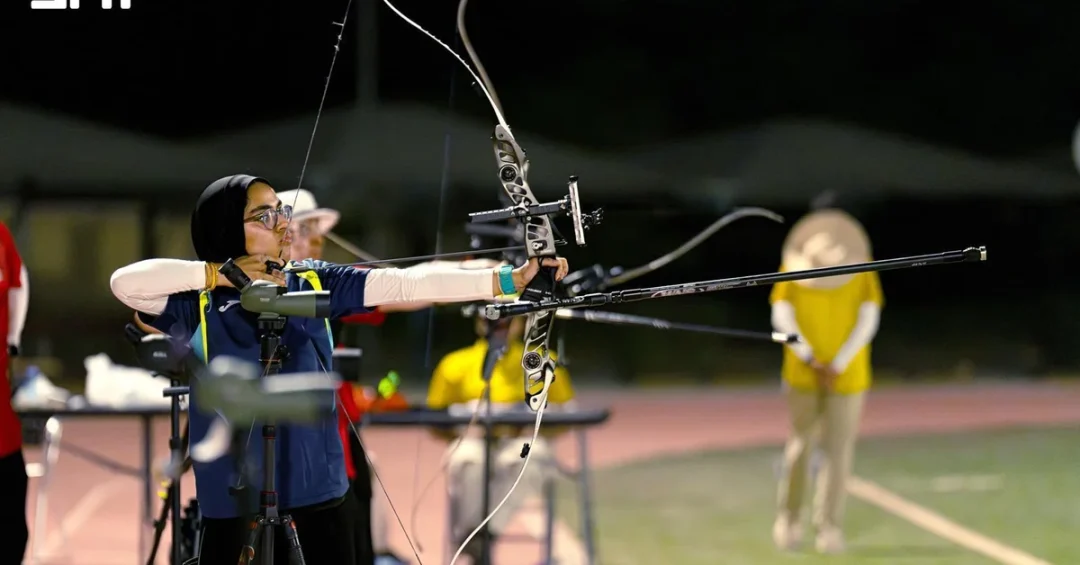
Dammam, Saudi Arabia — The Eastern Championship Archery, organized by the Saudi Archery Federation, opened on October 22 and runs through October 24, 2026, at Prince Mohamed bin Fahd University Stadium, bringing together 196 male and female archers from more than seven clubs in a landmark showcase for one of the Kingdom’s fastest-growing precision sports. The three-day competition, reported by the Saudi Press Agency (SPA), features 40 distinct categories and 120 medals, with athletes competing under the supervision of a 10-member refereeing team. The event marks the final stop of the regional championships series for the 2026–2027 sports season, following earlier competitions held across several regions of the Kingdom.
The scale of participation tells its own story: nearly 200 archers, dozens of medal events, and a full slate of age and discipline categories reflect how far organized archery has traveled in Saudi Arabia in a relatively short period. The Saudi Archery Federation designed the regional series to expand participation, discover emerging talent, and sharpen competitive readiness from one region to the next. Now, the Eastern Championship brings that season-long journey to a decisive close in Dammam, where clubs and individual archers will measure their progress against the strongest field assembled this season. But what exactly does a championship of this size reveal about the state of archery in the Kingdom?
Context and Background
Archery has deep roots in Arab heritage, historically tied to horsemanship, hunting, and traditional martial skills that were prized across the Arabian Peninsula. In modern Saudi Arabia, that heritage has been reimagined as a structured competitive sport governed by the Saudi Archery Federation, which has steadily built a calendar of regional and national events. The regional championships series for the 2026–2027 season was conceived as a bridge between grassroots clubs and elite competition, allowing archers from different provinces to test themselves in a consistent, professionally refereed environment.
The Eastern Championship is the concluding leg of that series, meaning it carries extra weight for clubs that have accumulated results throughout the season. Prince Mohamed bin Fahd University Stadium in Dammam provides an appropriate venue: a modern, accessible facility in the Eastern Province, a region with a strong sporting tradition and a young population eager for competitive outlets. According to the Saudi Press Agency, the event aims to raise technical standards and strengthen competition among clubs — a clear statement that the federation sees this championship not merely as a medal ceremony, but as a development tool.
For an international audience, the significance lies in the method. Rather than concentrating resources solely on elite national teams, Saudi Arabia is investing in a broad pyramid of competitions that reach clubs and individual athletes across the Kingdom. How many countries can claim a domestic archery circuit that culminates in a 196-archer, 40-category final? The answer is short — and it explains why the Saudi model is drawing quiet attention from sports administrators regionally.
Key Details of the Eastern Championship
The championship features 196 male and female archers representing more than seven clubs, competing across 40 categories for a total of 120 medals. That structure ensures a wide distribution of honors and gives athletes at different levels — from youth and junior divisions to senior ranks — a realistic pathway to competitive success. A 10-member refereeing team oversees the competition, applying standardized rules that are essential for fair play and for preparing Saudi archers for international technical standards.
The event began on October 22 and concludes on October 24, 2026, with competition running across the full three days. The Saudi Archery Federation organized the championship as the final leg of the regional championships series for the 2026–2027 sports season, following competitions in several other regions. Each regional stop served as both a qualifier and a development opportunity, allowing coaches to identify promising archers and adjust training programs accordingly.
Participation by more than seven clubs highlights the club-based structure of Saudi archery, in which local organizations provide training facilities, coaching, and competitive entry for their members. The presence of both male and female archers in substantial numbers also reflects the broader expansion of women’s sport in the Kingdom, a priority area under Saudi Vision 2030. As the final regional event of the season, the Eastern Championship effectively serves as a season-ending benchmark: clubs can compare their athletes’ results against the best in the country, and the federation can assess whether its development programs are producing measurable improvement.
International and Regional Impact
While the Eastern Championship is a domestic event, its implications reach beyond Saudi borders. A robust national competition calendar is the foundation of international competitiveness: countries that produce world-class archers typically have dense domestic circuits where athletes compete frequently under pressure. By completing a full regional series with hundreds of participants, Saudi Arabia is building exactly that foundation, which in turn strengthens its ability to send competitive teams to regional and international tournaments.
Regionally, the championship reinforces the Kingdom’s growing role as a host of sporting events of all sizes. Saudi Arabia has invested heavily in world-class venues and event management, from major international competitions to community-level tournaments. The Eastern Championship demonstrates that this investment is not limited to headline events; it extends to the grassroots infrastructure that sustains sport over the long term. For neighboring countries, the Saudi approach offers a model of how to combine official federation leadership, club participation, and modern facilities to grow a niche sport. What message does it send when a single regional final draws nearly 200 archers? It signals that archery in Saudi Arabia is no longer a curiosity — it is an organized, competitive, and expanding discipline.
Economic and Strategic Significance
The economic dimension of events like the Eastern Championship is often underestimated. Hosting competitions in Dammam brings athletes, coaches, referees, and families to the Eastern Province, supporting local hospitality, transport, and retail activity. More importantly, the event contributes to the development of a sports economy in which clubs, coaches, equipment suppliers, and event organizers all have a stake. The Saudi Archery Federation’s investment in a multi-region series creates recurring demand for facilities, technical officials, and trained personnel — all of which build human capital.
Strategically, archery aligns with several national priorities. It is a precision sport that rewards discipline, focus, and consistent training, qualities that resonate with Saudi Arabia’s emphasis on youth development and healthy lifestyles. It is also highly accessible: archery can be practiced in dedicated ranges and adapted to school and community programs, making it a natural fit for the Quality of Life Program, one of the Vision 2030 initiatives designed to expand recreational opportunities and raise sports participation rates. By concluding its regional series with a well-attended final in Dammam, the federation shows that these priorities are being translated into concrete, recurring events rather than one-off campaigns.
Vision 2030 Alignment
The Eastern Championship Archery sits squarely within the framework of Saudi Vision 2030, which places sport at the center of efforts to improve quality of life, empower youth, and increase the participation of women in all fields. The presence of 196 male and female archers from more than seven clubs reflects the Vision’s twin goals of broadening access to sport and raising national competitiveness. The Saudi Archery Federation’s regional series, culminating in this final leg, embodies the Vision’s emphasis on building institutional capacity — in this case, a sustainable competition structure that discovers talent and supports athletes year after year.
As Saudi Arabia continues to host international sporting events and develop its domestic leagues and federations, grassroots championships like this one provide the depth that elite success requires. The 120 medals awarded in Dammam represent more than prizes; they represent milestones for individual athletes, validation for their clubs, and evidence that the Kingdom’s sports strategy is reaching communities across the country. The Saudi Press Agency’s coverage of the event underscores its official recognition as part of the national sports calendar. For international observers, the Eastern Championship offers a clear window into how Vision 2030 is reshaping Saudi sport from the ground up — one competition, one club, and one archer at a time.
20 Questions
Q1. What is the Eastern Championship Archery?
A1. It is a regional archery competition organized by the Saudi Archery Federation, held from October 22 to 24, 2026, at Prince Mohamed bin Fahd University Stadium in Dammam, and it serves as the final leg of the 2026–2027 regional championships series.
Q2. How many archers are participating in the championship?
A2. A total of 196 male and female archers are competing, representing more than seven clubs from across the Kingdom, according to the Saudi Press Agency. This makes it one of the largest archery gatherings of the season.
Q3. How many categories and medals are included?
A3. The championship features 40 categories and a total of 120 medals, giving athletes across different age groups and disciplines a broad range of opportunities to compete for honors during the three-day event.
Q4. Where is the championship being held?
A4. It is taking place at Prince Mohamed bin Fahd University Stadium in Dammam, in the Eastern Province of Saudi Arabia, a modern venue suited to hosting competitive archery events with proper facilities for athletes and officials.
Q5. When did the championship start and end?
A5. The competition began on October 22, 2026, and concludes on October 24, 2026. The three-day schedule allows for a full program of qualification rounds and finals across all 40 categories.
Q6. Who organized the Eastern Championship Archery?
A6. The Saudi Archery Federation organized the event as part of its regional championships series for the 2026–2027 sports season, continuing its mission to expand participation and raise technical standards in the sport.
Q7. How many referees are supervising the competition?
A7. A 10-member refereeing team is supervising the championship, ensuring that standardized rules are applied fairly across all categories and that athletes compete in a professionally managed environment.
Q8. What is the main goal of the championship?
A8. The event aims to raise technical standards, strengthen competition among clubs, discover talent, and enhance archers’ readiness, contributing to the continued development of archery in Saudi Arabia.
Q9. Is this the final event of the season?
A9. Yes. The Eastern Championship marks the final leg of the regional championships series for the 2026–2027 sports season, following competitions held in several other regions of the Kingdom.
Q10. How many clubs are represented?
A10. More than seven clubs are represented at the championship, reflecting the club-based structure of Saudi archery in which local organizations provide training, coaching, and competitive opportunities for their members.
Q11. Are women participating in the championship?
A11. Yes. The event includes both male and female archers, reflecting the expansion of women’s participation in Saudi sport, a priority area under Saudi Vision 2030 and national sports development programs.
Q12. What is the significance of the regional series?
A12. The regional series expands participation across the Kingdom, allows clubs to compete consistently, helps coaches identify promising archers, and prepares athletes for higher-level national and international competitions.
Q13. How does archery fit into Saudi sports strategy?
A13. Archery supports the Quality of Life Program by offering accessible, disciplined sport for youth and communities, while also building a competitive base that can represent the Kingdom in international tournaments.
Q14. What does the Saudi Archery Federation do?
A14. The federation governs archery in Saudi Arabia, organizes regional and national competitions, trains referees and coaches, sets technical standards, and works to expand participation in the sport across all regions.
Q15. Why is Dammam hosting the final leg?
A15. Dammam’s Prince Mohamed bin Fahd University Stadium provides a suitable modern venue in the Eastern Province, a region with a strong sporting tradition and an active community of clubs and athletes.
Q16. How are medals distributed across categories?
A16. The 120 medals are awarded across 40 categories, covering different disciplines, age groups, and competitive levels, ensuring that achievements are recognized throughout the field of 196 archers.
Q17. What impact does the event have on local clubs?
A17. It gives clubs a season-ending benchmark to measure their athletes’ progress, motivates training programs, and strengthens the competitive culture that supports long-term development in the sport.
Q18. Does the championship have international relevance?
A18. Yes. A strong domestic competition circuit builds the depth needed for international success, and it demonstrates Saudi Arabia’s growing capacity to organize professional sporting events of various sizes.
Q19. How does the event align with Vision 2030?
A19. It advances Vision 2030 goals by promoting sports participation, empowering youth and women, improving quality of life, and building institutional capacity within national sports federations.
Q20. What can be expected after the championship?
A20. The Saudi Archery Federation is expected to continue developing the sport through future competitions, talent identification, and training programs, building on the momentum of the 2026–2027 regional series.
Reader Feedback
We value your thoughts. Please share your feedback on this article.
Your feedback helps us improve our coverage.