


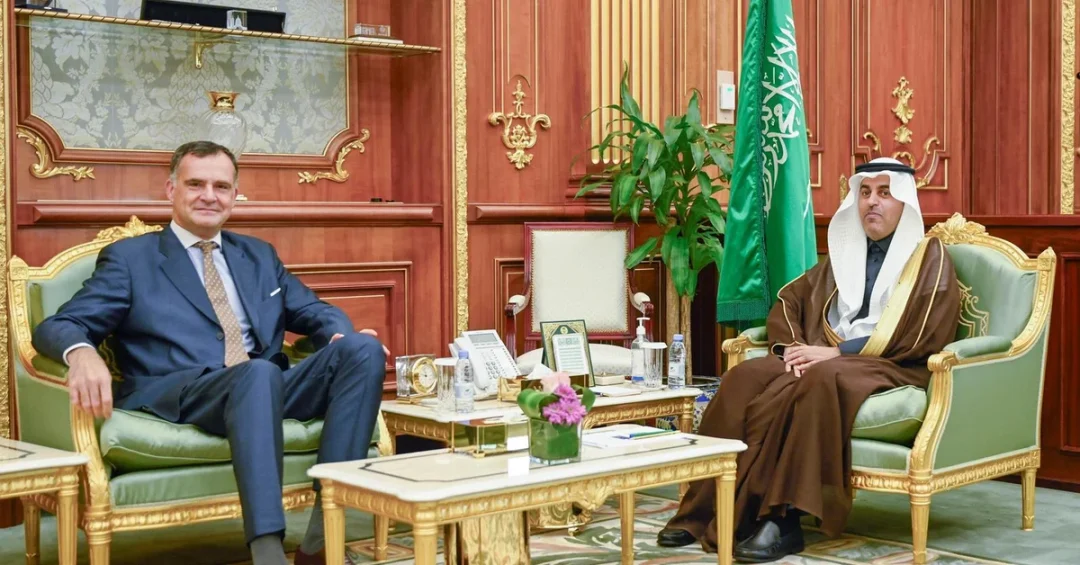
Vice Speaker of the Shura Council Dr. Mishaal bin Fahm Al-Sulami received Ambassador of the European Union to the Kingdom Christophe Farnaud at the Council’s headquarters in Riyadh on December 10, 2024, in a meeting that underscored the growing depth of parliamentary and diplomatic engagement between the Kingdom of Saudi Arabia and the European Union. The talks, announced through the Saudi Press Agency, focused on strengthening parliamentary cooperation between the Shura Council and the European Parliament, with both sides reaffirming their commitment to advancing bilateral relations across a range of shared interests.
The meeting comes at a time of accelerating political and security developments across the region, and it reflects the Kingdom’s enduring role as a stabilizing and constructive partner in international affairs. Ambassador Farnaud highlighted Saudi Arabia’s significant and influential position, praising its positive and constructive role in regional and global matters. The discussions also covered several issues of common interest, signaling a shared desire to deepen dialogue between Saudi and European legislators. For observers of Saudi diplomacy, the encounter is more than a routine courtesy call: it is part of a broader pattern of engagement that positions the Shura Council as an active participant in the Kingdom’s international outreach. How does parliamentary diplomacy of this kind translate into tangible outcomes for citizens in Saudi Arabia and across Europe? The answer lies in the steady, institutional nature of the relationship being built.
Context and Background
The Shura Council is Saudi Arabia’s advisory legislative body, composed of members appointed by the Custodian of the Two Holy Mosques, and it plays a central role in reviewing laws, advising on policy, and representing the Kingdom in international parliamentary forums. Its engagement with the European Parliament has grown steadily in recent years, mirroring the wider expansion of Saudi-European relations under Vision 2030. The visit by Ambassador Farnaud, the European Union’s senior diplomat in the Kingdom, follows a series of high-level exchanges that have touched on trade, investment, energy, climate cooperation, and regional security.
Dr. Mishaal bin Fahm Al-Sulami, as Vice Speaker, has been a prominent figure in these efforts, helping to steer the Council’s external relations toward constructive dialogue with counterparts around the world. The meeting with Ambassador Farnaud builds on the longstanding framework of Saudi-EU cooperation, which is anchored in mutual respect and shared interests. The European Union is one of the Kingdom’s largest trading partners, and both sides have consistently emphasized the value of parliamentary exchange as a complement to government-to-government ties. In this context, the Riyadh talks represent a deliberate investment in the diplomatic infrastructure that supports broader strategic goals.
Why does parliamentary diplomacy matter in an era of rapid geopolitical change? Because legislatures provide continuity and legitimacy to international partnerships, and they create channels for dialogue that can endure beyond individual administrations. The Shura Council’s outreach to the European Parliament is a case in point, offering a platform where Saudi priorities and European perspectives can be discussed frankly and constructively. This meeting therefore fits into a well-established tradition of Saudi diplomacy that values dialogue, stability, and long-term relationship building.
Key Details
According to the Saudi Press Agency, the meeting took place at the Shura Council’s headquarters in Riyadh, where Dr. Al-Sulami and Ambassador Farnaud discussed ways to enhance parliamentary cooperation between the Shura Council and the European Parliament. The two officials also addressed several issues of common interest, reflecting the breadth of the Saudi-EU agenda. Ambassador Farnaud stressed the Kingdom’s significant and influential position and praised its positive and constructive role, especially in light of the accelerating political and security developments in the region.
The Ambassador’s remarks carry particular weight given the current regional landscape, in which Saudi Arabia has consistently advocated for dialogue, de-escalation, and peaceful resolution of conflicts. The Kingdom’s diplomatic efforts have been widely recognized, and the EU’s acknowledgment of that role is a testament to the trust Saudi Arabia has built with international partners. The meeting also served to reinforce the institutional ties between the Shura Council and the European Parliament, which have been cultivated through reciprocal visits, joint forums, and regular consultations on matters of shared concern.
What specific areas of cooperation are likely to benefit from this parliamentary engagement? Trade and investment top the list, given the EU’s status as a major economic partner for Saudi Arabia. Energy transition, climate action, education, and cultural exchange are also prominent on the agenda, and parliamentary committees on both sides have shown interest in these fields. By keeping communication channels open, the Shura Council and the European Parliament can help ensure that policy coordination keeps pace with the rapid evolution of Saudi-European relations.
International and Regional Impact
The meeting between Dr. Al-Sulami and Ambassador Farnaud sends a clear signal that Saudi Arabia and the European Union are committed to deepening their partnership despite a complex regional environment. The Ambassador’s praise for the Kingdom’s constructive role underscores the recognition that Saudi Arabia is a key actor in efforts to promote stability, whether in the Gulf, the wider Middle East, or beyond. For the European Union, engaging with the Shura Council offers a direct line to Saudi policymakers and a way to understand the Kingdom’s vision for regional order.
At the regional level, the talks reinforce Saudi Arabia’s position as a bridge-builder. The Kingdom has hosted numerous diplomatic initiatives and has consistently supported dialogue between parties in conflict. The EU’s willingness to acknowledge and support this role adds international legitimacy to Saudi efforts and encourages further cooperation. In a world where multilateralism is under strain, the Saudi-EU parliamentary channel is a valuable mechanism for maintaining open lines of communication and for identifying areas where joint action can make a difference.
How might this meeting influence broader geopolitical dynamics? By strengthening the parliamentary dimension of the relationship, Saudi Arabia and the EU are laying the groundwork for more coordinated responses to shared challenges, from energy security to humanitarian issues. The encounter also highlights the Kingdom’s ability to maintain strong ties with diverse international partners while staying true to its principles and national interests. In this sense, the Riyadh talks are both a symbol and a practical step in the ongoing development of Saudi diplomacy.
Economic and Strategic Significance
Economically, the European Union is a vital partner for Saudi Arabia, with robust flows of trade and investment in both directions. The Kingdom’s Vision 2030 reform agenda has opened new opportunities for European businesses in sectors such as renewable energy, technology, healthcare, and tourism. Parliamentary cooperation can help remove obstacles, harmonize regulations, and promote mutual understanding between investors and regulators. The meeting between Dr. Al-Sulami and Ambassador Farnaud is therefore not only a diplomatic event but also an economic one, with potential ripple effects for companies and workers on both sides.
Strategically, the talks reaffirm the importance of Saudi-EU relations in a multipolar world. The Kingdom has pursued a foreign policy based on active engagement, diversification of partnerships, and support for international law and stability. The EU, for its part, has recognized Saudi Arabia as an indispensable partner in addressing regional crises and global challenges such as climate change and energy transition. By institutionalizing parliamentary dialogue, both sides create a durable framework for cooperation that can adapt to changing circumstances and deliver long-term benefits.
What does this mean for the future of Saudi-European relations? It means that the relationship is maturing, moving from ad hoc contacts to structured engagement across multiple levels. The Shura Council’s role in this process is significant, as it brings a legislative perspective to discussions that are often dominated by executive branches. This can lead to more comprehensive agreements and a deeper mutual understanding of each side’s priorities and constraints.
Vision 2030 Alignment
The meeting aligns closely with Saudi Arabia’s Vision 2030, which seeks to diversify the economy, strengthen international partnerships, and enhance the Kingdom’s global standing. Vision 2030 emphasizes the importance of constructive engagement with the international community, and the Shura Council’s outreach to the European Parliament is a concrete example of that principle in action. By fostering parliamentary ties, the Kingdom advances its goals of knowledge exchange, investment attraction, and cultural diplomacy, all of which contribute to the broader reform agenda.
Under the leadership of the Custodian of the Two Holy Mosques and His Royal Highness the Crown Prince, Saudi Arabia has consistently pursued a path of modernization and openness. The meeting between Dr. Al-Sulami and Ambassador Farnaud is a small but meaningful step in that journey, reflecting the Kingdom’s commitment to dialogue and cooperation. As Vision 2030 continues to unfold, engagements like this will help ensure that Saudi Arabia remains a trusted and influential partner on the world stage, contributing to peace, prosperity, and stability for the region and beyond.
20 Questions
Q1. Who received the EU Ambassador to the Kingdom?
A1. Vice Speaker of the Shura Council Dr. Mishaal bin Fahm Al-Sulami received Ambassador Christophe Farnaud at the Council’s headquarters in Riyadh on December 10, 2024.
Q2. Where did the meeting take place?
A2. The meeting took place at the Shura Council’s headquarters in Riyadh, the capital of the Kingdom of Saudi Arabia.
Q3. What was the main topic of discussion?
A3. They discussed ways to enhance parliamentary cooperation between the Shura Council and the European Parliament to strengthen bilateral relations.
Q4. What did Ambassador Farnaud say about Saudi Arabia?
A4. He stressed the Kingdom’s significant and influential position, praising its positive and constructive role amid regional developments.
Q5. What is the Shura Council?
A5. The Shura Council is Saudi Arabia’s advisory legislative body, whose members are appointed by the Custodian of the Two Holy Mosques.
Q6. Who is Christophe Farnaud?
A6. Christophe Farnaud is the Ambassador of the European Union to the Kingdom of Saudi Arabia, representing EU interests in the country.
Q7. What is the significance of this meeting?
A7. It reflects the growing parliamentary and diplomatic engagement between Saudi Arabia and the European Union, enhancing bilateral ties.
Q8. Did they discuss issues beyond parliamentary cooperation?
A8. Yes, they also discussed several issues of common interest, reflecting the breadth of the Saudi-EU agenda.
Q9. How does this meeting align with Vision 2030?
A9. It supports Vision 2030 by strengthening international partnerships, promoting dialogue, and enhancing the Kingdom’s global standing.
Q10. What role does the Shura Council play in Saudi diplomacy?
A10. The Shura Council engages with international parliamentary bodies, helping to build relationships and represent Saudi interests abroad.
Q11. Why is parliamentary cooperation important?
A11. It provides continuity, legitimacy, and a platform for dialogue that complements government-to-government relations.
Q12. What are the key areas of Saudi-EU cooperation?
A12. Key areas include trade, investment, energy, climate action, education, and cultural exchange, among others.
Q13. How does the EU view Saudi Arabia’s regional role?
A13. The EU acknowledges Saudi Arabia’s positive and constructive role, especially in light of accelerating regional developments.
Q14. What are the economic implications of this meeting?
A14. It can help remove obstacles, harmonize regulations, and promote mutual understanding, benefiting businesses on both sides.
Q15. What is the European Parliament’s role in this cooperation?
A15. The European Parliament engages with the Shura Council through reciprocal visits and forums to discuss shared concerns.
Q16. How does this meeting reflect Saudi Arabia’s foreign policy?
A16. It demonstrates the Kingdom’s commitment to active engagement, dialogue, and diversification of international partnerships.
Q17. What did Ambassador Farnaud praise about Saudi Arabia?
A17. He praised the Kingdom’s significant and influential position and its positive and constructive role in the region.
Q18. What are the next steps for Saudi-EU parliamentary cooperation?
A18. The meeting lays the groundwork for more structured engagement, including potential joint forums and consultations.
Q19. How does this meeting benefit Saudi citizens?
A19. It can lead to stronger economic ties, more investment, and enhanced cultural and educational exchanges with Europe.
Q20. What is the overall message of this meeting?
A20. The meeting underscores Saudi Arabia’s commitment to constructive international dialogue and its role as a stabilizing partner in the region and beyond.
Reader Feedback
We value your thoughts. Please share your feedback on this article.
Your feedback helps us improve our coverage.
Related articles
 ‘Heartbeat of the Earth’ Campaign Launched at COP16
 SWCC Reaches Highest Level of Reliability in the World
 Riyadh Mayor Receives North East England Counterpart
 Saudi Arabia Joins Earth Observation Group at COP16
 Kuwaiti Crown Prince Receives Saudi Minister Prince Turki
 Saudi Vice Minister Receives US Ambassador in Riyadh