


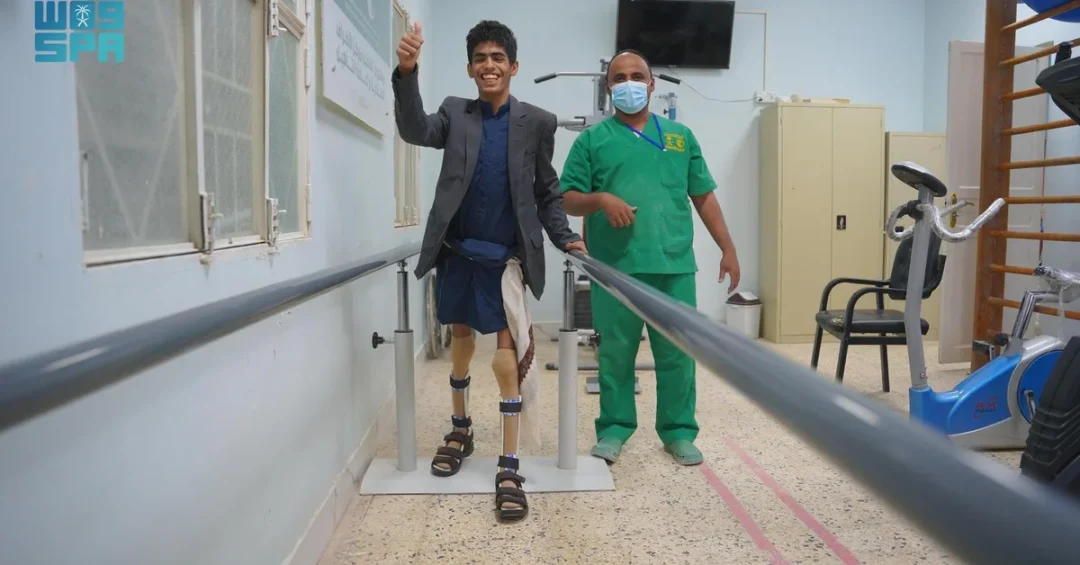
The Prosthetics and Rehabilitation Center in the Seiyun district of Yemen’s Hadhramaut governorate provided medical services to 523 Yemenis who lost limbs during December 2024, with support from the King Salman Humanitarian Aid and Relief Center (KSrelief), according to an official announcement carried by the Saudi Press Agency. The center delivered a total of 1,738 individual services over the month, spanning the fitting and rehabilitation of prosthetic limbs, physical therapy, and specialized medical consultations. Males accounted for 55 percent of beneficiaries and females 45 percent, while 21 percent of those treated were displaced individuals and 79 percent were residents of the surrounding communities.
The figures, released through official Saudi channels, offer a concrete measure of how the Kingdom’s humanitarian arm continues to operate inside Yemen at a time when the country’s healthcare system remains under severe strain. For families in Hadhramaut, a governorate that has absorbed large numbers of displaced people over the past decade, the center represents more than a medical facility. It is a point of access to mobility, dignity, and the chance to return to work, school, and daily life. How many people in Yemen still wait for a prosthetic limb that could restore their independence? The December data suggests the need remains substantial, and that the program is designed to meet it month after month rather than through one-off interventions.
Context and Background
Yemen’s humanitarian crisis has been described by international agencies as one of the most severe in the world, and its effects are felt acutely in the health sector. Years of conflict and economic disruption have left many hospitals short of equipment, medicines, and specialized staff, while patients requiring long-term rehabilitation often face travel distances and costs that put care out of reach. In this environment, the Prosthetics and Rehabilitation Center in Seiyun has become a vital node in the wider network of services supported by the King Salman Humanitarian Aid and Relief Center, the Kingdom’s dedicated humanitarian agency.
KSrelief has operated across Yemen for years, delivering food assistance, medical care, shelter, and rehabilitation programs in coordination with Yemeni authorities and local partners. The prosthetics project in Hadhramaut reflects a deliberate focus on patients whose needs persist long after an emergency ends: amputees require repeated fittings, adjustments, and therapy sessions over months or years. Why does long-term rehabilitation matter as much as emergency relief? Because without sustained follow-up, even a successful initial intervention can fail to deliver lasting mobility. The December service figures indicate that the center is structured to provide that continuity, not merely episodic treatment.
Hadhramaut itself occupies a distinctive place in Yemen’s geography and society. It is a large, sparsely populated governorate in the country’s east, with a long history of trade, scholarship, and diaspora connections. Its relative stability has made it a destination for displaced families from other parts of Yemen, which helps explain why displaced individuals made up 21 percent of the center’s beneficiaries in December. The mix of residents and displaced patients underlines how the facility serves both the host community and those who have arrived seeking safety. Does that dual role place extra pressure on a single center? It does, and the monthly totals suggest the demand is being met through consistent service delivery.
Key Details
According to the official announcement, the center provided 1,738 services to 523 beneficiaries during December 2024. The services covered three main categories: the fitting and rehabilitation of prosthetic limbs, physical therapy, and specialized consultations. Male beneficiaries represented 55 percent of the total, while female beneficiaries accounted for 45 percent, a distribution that indicates the program reaches households across the community rather than a single demographic group. Displaced individuals made up 21 percent of those served, with residents of Hadhramaut forming the remaining 79 percent.
The number of services relative to beneficiaries is significant. With 1,738 services delivered to 523 people, the average beneficiary received more than three separate service interactions during the month. That pattern is consistent with the nature of prosthetic care, which typically involves assessment, measurement, fitting, adjustment, and rehabilitation exercises across multiple visits. Physical therapy is essential to helping patients adapt to a new limb, build strength, and learn to walk or use the prosthesis effectively. Specialized consultations address related medical needs and help identify patients who may require additional support or referral.
The gender breakdown also carries practical meaning. In many crisis settings, women face additional barriers to accessing care, including travel restrictions, caregiving responsibilities, and cost. A 45 percent share of female beneficiaries suggests that the center’s outreach and operating model are succeeding in reaching women as well as men. What does that balance tell us about the program’s design? It points to a service model attentive to accessibility, one that treats the whole patient population rather than the easiest to reach. The inclusion of displaced and resident patients in a single monthly total further reflects an approach based on need rather than status.
International and Regional Impact
The center’s work forms part of a broader pattern of Saudi humanitarian engagement in Yemen that is documented through official channels and reported by the Saudi Press Agency. KSrelief’s programs are implemented in coordination with Yemeni authorities and international partners, and they are intended to complement rather than duplicate existing services. In the health sector, that means supporting facilities that provide specialized care which would otherwise be unavailable or unaffordable for many patients. The prosthetics center in Seiyun is one example of this model, delivering a defined set of services with measurable monthly outputs.
For the wider region, such projects contribute to stability in tangible ways. A person who regains mobility can return to work, support a family, and participate in community life. Rehabilitation also reduces the long-term burden on households and on whatever health infrastructure remains functional. How does a single center’s monthly output connect to larger regional dynamics? By restoring livelihoods and reducing dependence, it addresses some of the secondary effects of the crisis that can persist for years. The December figures, while specific to one facility, illustrate how sustained humanitarian investment translates into individual outcomes that aggregate into community-level resilience.
Internationally, the Kingdom’s humanitarian record is a core element of its foreign policy narrative, and KSrelief is the institutional expression of that commitment. The agency publishes regular updates on its projects across Yemen and other countries, providing transparency about scope and delivery. For observers tracking humanitarian flows into Yemen, the prosthetics center’s monthly service data offers a verifiable data point amid a complex operating environment. It also demonstrates that Saudi assistance extends beyond emergency food and medical aid into specialized rehabilitation, a category of care that is often underfunded in crisis settings.
Economic and Strategic Significance
The economic dimension of prosthetic and rehabilitation services is often overlooked. A person who loses a limb and cannot access a prosthesis faces sharply reduced earning capacity, and the household may lose its primary income. Restoring mobility therefore has an economic effect that extends beyond the individual. In Hadhramaut, where many families depend on trade, farming, fishing, and small business, the ability to work is directly tied to physical capability. The center’s services help patients re-enter productive life, which in turn supports local markets and reduces reliance on coping strategies that can deepen poverty.
From a strategic perspective, the project reflects Saudi Arabia’s emphasis on long-term development alongside emergency relief. Rehabilitation requires trained technicians, physical therapists, and a supply chain for prosthetic components, all of which build local capacity when delivered consistently. Over time, such programs can leave behind skills and infrastructure that outlast any single funding cycle. Why is capacity-building significant in a humanitarian context? Because it strengthens the ability of Yemeni institutions to serve their own communities, which is a more durable outcome than repeated short-term interventions. The center’s monthly operations are a working example of that principle.
The project also aligns with the Kingdom’s broader approach to regional engagement, which combines diplomatic, developmental, and humanitarian instruments. Saudi Arabia has consistently stated its support for Yemen’s stability and for the well-being of its people, and KSrelief’s programs are the operational channel for that commitment. The prosthetics center’s output in December 2024, covering 523 beneficiaries with 1,738 services, is a concrete measure of delivery. It shows that the assistance reaches individuals with specific, identifiable needs and that the services are recorded and reported through official Saudi channels.
Vision 2030 Alignment
Saudi Arabia’s Vision 2030 is primarily a domestic transformation agenda, but its emphasis on humanitarian leadership, international cooperation, and institutional excellence shapes the Kingdom’s role abroad as well. KSrelief embodies that outward-facing dimension, operating as a professional humanitarian agency with published data, defined programs, and partnerships across the region. The prosthetics center in Hadhramaut is one expression of this institutional approach, delivering specialized medical services with measurable results. The December figures, reported through the Saudi Press Agency, reflect the transparency and accountability that Vision 2030 promotes across the Kingdom’s public institutions.
Looking ahead, the center’s continued operation will depend on sustained support and coordination with Yemeni health authorities. Each month of service adds to a cumulative record of patients fitted, rehabilitated, and reintegrated into their communities. For Saudi Arabia, such projects reinforce its position as a leading humanitarian donor and a stabilizing partner in the region. For the people of Hadhramaut, they offer something more immediate: the ability to stand, walk, and work again. As the Kingdom pursues its long-term vision at home and abroad, initiatives like this demonstrate how national transformation and international responsibility can advance together, one patient and one service at a time.
20 Questions
Q1. What did the Prosthetics and Rehabilitation Center in Seiyun provide in December 2024?
A1. The center provided medical services to 523 Yemenis who lost limbs, delivering a total of 1,738 services including prosthetic limb fitting, rehabilitation, physical therapy, and specialized consultations, with support from KSrelief.
Q2. Which organization supported the center’s work?
A2. The King Salman Humanitarian Aid and Relief Center, known as KSrelief, supported the center. KSrelief is the Kingdom of Saudi Arabia’s dedicated humanitarian agency, operating relief and development programs across Yemen and other countries.
Q3. Where is the Prosthetics and Rehabilitation Center located?
A3. The center is located in the Seiyun district of Yemen’s Hadhramaut governorate, a large governorate in eastern Yemen that has hosted many displaced families and maintains relative stability compared with other areas.
Q4. How many total services were delivered in December 2024?
A4. The project delivered 1,738 services during December 2024. This figure is higher than the number of beneficiaries because prosthetic care typically involves multiple visits per patient, including assessment, fitting, adjustment, and therapy.
Q5. What percentage of beneficiaries were male and female?
A5. Males comprised 55 percent of beneficiaries and females 45 percent. This distribution indicates that the center’s services reached both men and women across the community, reflecting an accessible service model.
Q6. What share of beneficiaries were displaced individuals?
A6. Displaced individuals accounted for 21 percent of beneficiaries, while residents made up 79 percent. This shows the center serves both the host community in Hadhramaut and families who have relocated there.
Q7. What types of services were included in the project?
A7. Services included the fitting and rehabilitation of prosthetic limbs, physical therapy, and specialized consultations. Together, these address the medical, functional, and follow-up needs of patients who have lost limbs.
Q8. Why is physical therapy important for prosthetic patients?
A8. Physical therapy helps patients adapt to a new limb, build strength, and learn to walk or use the prosthesis effectively. Without rehabilitation, even a well-fitted prosthetic may not deliver full mobility.
Q9. How does the center fit into Saudi Arabia’s humanitarian efforts in Yemen?
A9. The center is part of the Kingdom’s ongoing humanitarian and relief efforts carried out through KSrelief. These programs aim to strengthen Yemen’s healthcare capacity and alleviate suffering amid the country’s humanitarian crisis.
Q10. Why is Hadhramaut significant for this project?
A10. Hadhramaut is a large eastern governorate that has absorbed many displaced families, making it a key location for services that serve both residents and displaced individuals. Its relative stability supports sustained humanitarian operations.
Q11. What does the average number of services per beneficiary indicate?
A11. With 1,738 services for 523 beneficiaries, each person received more than three service interactions on average. This is consistent with prosthetic care, which requires multiple visits over time.
Q12. How does the project support Yemen’s healthcare sector?
A12. The project enhances the healthcare sector’s capabilities by providing specialized rehabilitation services that are often unavailable or unaffordable. It also builds practical skills among local staff involved in patient care.
Q13. What economic benefits follow from prosthetic and rehabilitation services?
A13. Restoring mobility allows patients to return to work, school, and daily activities, which supports household income and local economic activity. It reduces long-term dependence on coping strategies that can deepen poverty.
Q14. How is information about the project released?
A14. Information is released through official Saudi channels, including the Saudi Press Agency, which reported the December 2024 figures. This provides verifiable data about the project’s scope and delivery.
Q15. What role does KSrelief play across the region?
A15. KSrelief implements humanitarian and relief programs across Yemen and other countries, coordinating with local authorities and partners. It is the institutional expression of Saudi Arabia’s humanitarian commitment abroad.
Q16. Why is long-term rehabilitation as important as emergency relief?
A16. Emergency relief addresses immediate needs, while rehabilitation addresses needs that persist for months or years. Prosthetic patients require repeated fittings and therapy, so sustained care is essential to lasting mobility and independence.
Q17. How does the project reflect Saudi Arabia’s Vision 2030?
A17. Vision 2030 emphasizes institutional excellence, transparency, and international cooperation. KSrelief’s published programs and measurable outputs, such as the December figures, reflect these principles in the Kingdom’s humanitarian work.
Q18. What does the gender balance among beneficiaries suggest?
A18. The 55 percent male and 45 percent female split suggests the center reaches women as well as men, despite barriers women often face in accessing care during crises. It points to an accessible service model.
Q19. How does the center’s work contribute to regional stability?
A19. By restoring mobility and livelihoods, the center helps individuals and families rebuild their lives, reducing the secondary effects of the crisis. This contributes to community resilience and longer-term stability in the region.
Q20. What is the outlook for the center’s operations?
A20. The center is expected to continue providing monthly services with KSrelief support, adding to its cumulative record of patients fitted and rehabilitated. Continued coordination with Yemeni health authorities will remain essential to delivery.
Reader Feedback
We value your thoughts. Please share your feedback on this article.
Your feedback helps us improve our coverage.
Related articles
 Saudi WEF Role Boosts Global AI and Innovation Efforts
 Sri Lanka Quran Competition Strengthens Saudi Ties
 KSrelief Distributes Relief Supplies in Syria’s Homs Governorate
 UN Appoints Sigrid Kaag as Interim Middle East Peace Coordinator
 Northern Colombia Struck by 4.5-Magnitude Earthquake
 Saudi Arabia Weather Forecast for Sunday: Cooler North, Rain Possible in Southwest