


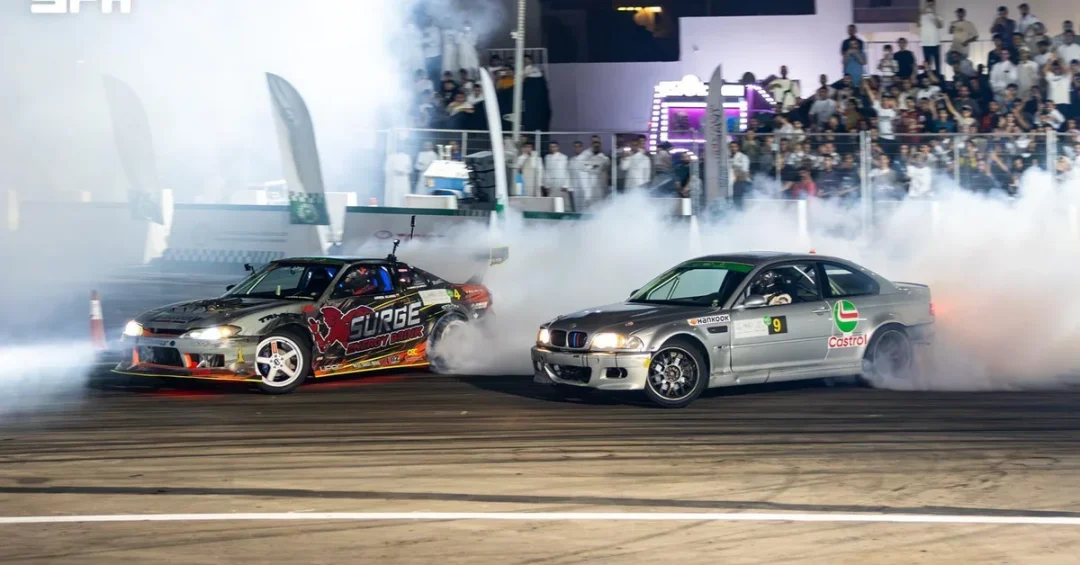
Mohammed Al-Arabi won the Professional category at the second round of the 2026 Saudi Toyota Drift Championship in Al-Ahsa, according to an announcement carried by the Saudi Press Agency (SPA), reversing the opening-round result and setting up a decisive title showdown with Oman’s Ahmed Al-Amri at the final round in Jeddah. The victory, confirmed in the official SPA bulletin dated October 24, 2026, places Al-Arabi level with his Omani rival on round wins as the national championship enters its closing chapter. Al-Amri finished second in Al-Ahsa, with Saudi driver Yousef Bahuwairth completing the Professional podium in third place.
The result carries real weight in a season that has developed into a straight fight between two of the region’s most consistent drifters. Al-Amri had taken the opening round ahead of Al-Arabi, so the Al-Ahsa outcome restores parity and turns the Jeddah finale into a winner-takes-the-crown contest. For a championship still building its international profile, that kind of narrative is exactly what organizers want: two drivers, one round left, and a title that will be settled on the track rather than by arithmetic. With 47 drivers entered across three categories, the event also demonstrated the depth of the national grid.
Context and Background
Can a single weekend of sideways racing tell us something meaningful about how Saudi Arabia is building its sporting economy? In the case of the Saudi Toyota Drift Championship, the answer is yes. The series is organized under the supervision of the Saudi Automobile and Motorcycle Federation (SAMF), the national governing body responsible for motorsport development in the Kingdom, and is managed operationally by Bakhashab Motorsport, one of the country’s most established racing organizations, in partnership with Jameel Motorsport. That three-way structure — a national federation, a specialist promoter, and a commercial partner — reflects the professional model Saudi Arabia has adopted across its growing motorsport portfolio.
The championship sits within a broader calendar that now includes Formula 1, the Dakar Rally, Extreme E, and the Saudi Pro League of motorsport disciplines that have drawn global audiences to the Kingdom. Drifting occupies a distinctive place in that lineup. It is accessible to local competitors, relatively affordable to enter compared with circuit racing, and intensely visual, which makes it well suited to live crowds and digital broadcast. The Al-Ahsa round drew a large audience to the venue, according to SPA, continuing a pattern of strong attendance at Saudi motorsport events.
Al-Ahsa itself is significant. The governorate in the Eastern Province is home to the UNESCO-listed Al-Ahsa Oasis, the largest oasis in the world, and has been positioned as a heritage and tourism destination under national development plans. Hosting a national motorsport round there connects the Kingdom’s sporting ambitions with its regional development agenda, bringing visitors, media attention, and economic activity to an area better known internationally for its date palms and archaeological sites than for motorsport.
Key Details from the Al-Ahsa Round
Who exactly stood on the podium, and what does the full results sheet reveal about the health of Saudi drifting? The Professional category delivered the headline story. Mohammed Al-Arabi took first place, Ahmed Al-Amri of Oman finished second, and Yousef Bahuwairth claimed third. The finishing order reversed the first round of the season, which Al-Amri had won ahead of Al-Arabi, leaving the championship perfectly balanced before the finale.
In the Semi-Professional category, Fahad bin Rubayyi secured victory, finishing ahead of Sultan Al-Aqili in second and Saud Al-Abbasi in third. The Amateur category was won by Qaswara Hammam, with Amir Al-Aqili second and Osama Al-Asiri third. The spread of winners across different names in each category underlines that the championship is not dependent on a handful of star drivers; new talent is emerging at every level of the grid.
The entry list itself is telling: 47 drivers in total, comprising 19 in the Professional category, 19 in Semi-Professional, and nine in Amateur. Those numbers matter for a national series. A full professional field of 19 means qualification and elimination battles are genuinely competitive, while the nine-driver Amateur class provides a realistic entry point for newcomers. SPA reported that the round attracted a large crowd, reinforcing the commercial case for continuing to invest in the discipline.
International and Regional Impact
Why should an Omani driver finishing second in a Saudi national championship interest anyone beyond the Gulf? Because cross-border competition is one of the clearest signs that a regional motorsport ecosystem is maturing. Al-Amri’s participation — and his round win earlier in the season — shows that the Saudi championship is attracting drivers from neighboring countries and functioning as a genuinely regional platform. That raises the standard of competition for Saudi drivers and gives the series a natural audience in Oman and across the Gulf Cooperation Council states.
It also fits the wider pattern of Saudi sporting diplomacy. The Kingdom has hosted international events across football, boxing, tennis, golf, and motorsport, using sport as a channel for cultural exchange and economic diversification. A national drift championship with an Omani title contender is a small but meaningful example of that approach: competitive, open to regional participation, and broadcast to audiences who might otherwise never engage with Saudi Arabia’s sporting scene.
For international drifting fans, the series offers something increasingly rare — a national championship with a clear sporting narrative and accessible formats. The Professional, Semi-Professional, and Amateur tiering creates a pyramid that rewards progression, and the two-round deadlock between Al-Arabi and Al-Amri gives the Jeddah finale a storyline that global motorsport media can follow without deep prior knowledge of the series.
Economic and Strategic Significance
What does a drift championship actually contribute to the Saudi economy? The direct effects are modest compared with mega-events, but the strategic value is real. Motorsport events generate spending on hospitality, transport, fuel, vehicle preparation, tires, and parts — a supply chain that supports small businesses and specialist workshops. They also create employment for stewards, marshals, medics, timing officials, media crews, and event staff, building a skilled workforce that can service larger international events later.
The partnership model behind the championship is equally important. SAMF provides governance, licensing, and safety oversight; Bakhashab Motorsport brings operational expertise; Jameel Motorsport contributes commercial and logistical capacity. That division of labor allows the series to scale without the federation carrying every cost and risk itself, and it mirrors the public-private approach used elsewhere in Saudi sport and entertainment. Toyota’s title sponsorship signals corporate confidence in the property, and manufacturer involvement tends to raise technical standards across the field.
There is also a safety dimension that has economic consequences. SAMF’s stated efforts to develop motorsport include strengthening safety standards, which protects participants and makes the sport more attractive to insurers, sponsors, and families considering youth participation. A championship that is visibly well-run and safety-conscious is easier to expand, easier to insure, and easier to sell to international partners.
Developing National Talent and the Road to Jeddah
How does a national series turn spectators into competitors? The Amateur category is the entry gate, and its nine-driver field in Al-Ahsa suggests the pipeline is active. Drivers who succeed there can progress to Semi-Professional, where 19 competitors fought for position, and eventually to the Professional class, which now features a full field of 19. Each tier has its own champion, meaning a driver can measure progress against peers rather than being thrown immediately against the country’s best.
The federation’s stated objectives — developing motorsport in the Kingdom, supporting national talent, and strengthening safety standards — map directly onto this structure. Talent development in motorsport is expensive and slow; it requires licensed venues, trained officials, coaching, and a competitive calendar. A stable national championship provides the competitive calendar, and the presence of experienced organizers such as Bakhashab Motorsport provides the operational know-how.
All of this now converges on Jeddah. The third and final round of the 2026 Saudi Toyota Drift Championship will be held in the city on November 26 and 27, and it will decide the champions in all three categories. For Al-Arabi and Al-Amri, the mathematics are simple: whoever performs better over the final weekend takes the Professional title. For bin Rubayyi, Hammam, and the other category leaders, Jeddah is a chance to convert a strong season into a championship. And for the series itself, a sold-out, high-stakes finale would be the strongest possible argument for further investment.
Vision 2030 Alignment
Does a drift round in Al-Ahsa really connect to Saudi Vision 2030? The connection runs through sport, tourism, and youth. Vision 2030 sets out to diversify the economy, expand entertainment and sporting opportunities, and improve quality of life for citizens and residents. A national championship that travels to different regions — Al-Ahsa in the east, Jeddah in the west — distributes those opportunities geographically rather than concentrating them in one city, and it gives young Saudis a visible pathway into a professional sport.
The championship also supports the tourism and events economy that Vision 2030 has prioritized. Motorsport weekends bring visitors, fill hotel rooms, and generate media coverage that showcases Saudi regions to international audiences. Al-Ahsa’s inclusion is particularly notable given its UNESCO World Heritage status; pairing a modern sporting event with a heritage destination creates the kind of layered visitor experience the Kingdom’s tourism strategy is designed to promote.
Finally, the series demonstrates the institutional capacity that Vision 2030 depends on: a national federation setting standards, private operators delivering events, corporate sponsors providing funding, and regional participation raising the competitive bar. As the championship heads to Jeddah for its decisive final round on November 26 and 27, it carries more than a title race. It carries a working example of how Saudi Arabia is building sport as an industry — and inviting the region to take part.
20 Questions
Q1. Who won the Professional category at the second round of the 2026 Saudi Toyota Drift Championship in Al-Ahsa?
A1. Mohammed Al-Arabi of Saudi Arabia won the Professional category at the Al-Ahsa round, according to the Saudi Press Agency. His victory reversed the opening-round result and set up a title decider with Oman’s Ahmed Al-Amri in the final round in Jeddah.
Q2. Who finished second and third in the Professional category?
A2. Oman’s Ahmed Al-Amri finished second and Saudi driver Yousef Bahuwairth finished third. The podium order meant Al-Amri and Al-Arabi each had one round win going into the season finale, leaving the championship finely balanced.
Q3. What happened in the first round of the championship?
A3. Ahmed Al-Amri won the first round ahead of Mohammed Al-Arabi. The Al-Ahsa result reversed that finishing order, which is why the two drivers now head to Jeddah level on round victories with the title still undecided.
Q4. Who won the Semi-Professional category in Al-Ahsa?
A4. Fahad bin Rubayyi won the Semi-Professional category. Sultan Al-Aqili finished second and Saud Al-Abbasi finished third, completing a competitive podium in a class that featured 19 drivers on the entry list.
Q5. Who won the Amateur category?
A5. Qaswara Hammam took first place in the Amateur category. Amir Al-Aqili finished second and Osama Al-Asiri finished third. The Amateur class is the entry level of the championship and featured nine competitors in Al-Ahsa.
Q6. How many drivers took part in the Al-Ahsa round?
A6. A total of 47 drivers competed: 19 in the Professional category, 19 in the Semi-Professional category, and nine in the Amateur category. The full grids reflect the growing depth of Saudi drifting and the series’ tiered structure.
Q7. Which organization supervises the Saudi Toyota Drift Championship?
A7. The championship is supervised by the Saudi Automobile and Motorcycle Federation, the national governing body for motorsport in the Kingdom. The federation oversees governance, licensing, and safety standards for the series and its competitors.
Q8. Who manages the championship’s operations?
A8. The series is managed by Bakhashab Motorsport, an established Saudi racing organization, and is held in partnership with Jameel Motorsport. This structure combines federation oversight with specialist event promotion and commercial support.
Q9. Where and when will the final round take place?
A9. The third and final round will be held in Jeddah on November 26 and 27. It will decide the 2026 champions in the Professional, Semi-Professional, and Amateur categories, making it the most important weekend of the season.
Q10. What is at stake in the Jeddah finale for Al-Arabi and Al-Amri?
A10. Both drivers have won one round each, so the Jeddah result will decide the Professional title directly. Whoever finishes ahead of the other over the final weekend will be crowned 2026 champion of the Saudi Toyota Drift Championship.
Q11. Did the Al-Ahsa round attract a large audience?
A11. Yes. The Saudi Press Agency reported that the round drew a large crowd, continuing the strong attendance seen at Saudi motorsport events. The atmosphere added to the occasion for drivers competing across all three categories.
Q12. Why is Al-Ahsa a significant location for the championship?
A12. Al-Ahsa is home to the UNESCO-listed Al-Ahsa Oasis, the largest oasis in the world, and is a developing heritage and tourism destination. Hosting a national motorsport round there connects sport with regional development and visitor promotion.
Q13. What are the stated aims of the Saudi Automobile and Motorcycle Federation?
A13. The federation aims to develop motorsport in the Kingdom, support national talent, and strengthen safety standards. The championship is part of those efforts, providing a competitive platform and a structured pathway for drivers at different levels.
Q14. How does the championship support national talent?
A14. The three-tier structure allows drivers to progress from Amateur to Semi-Professional and then Professional competition. Each category has its own champion, so emerging drivers can develop against peers before competing at the highest national level.
Q15. Is the championship open to drivers from outside Saudi Arabia?
A15. Yes. Oman’s Ahmed Al-Amri competes in the Professional category and won the opening round, showing that the series attracts regional drivers. Their participation raises the competitive standard and broadens the championship’s audience across the Gulf.
Q16. Who is the title sponsor of the championship?
A16. Toyota is the title sponsor of the Saudi Toyota Drift Championship. Manufacturer backing of this kind supports the series financially and technically, and it reflects corporate confidence in the growth of Saudi motorsport.
Q17. What economic benefits does a drift championship bring?
A17. Events generate spending on hospitality, transport, vehicle preparation, tires, and parts, supporting specialist businesses. They also create jobs for officials, medics, media crews, and event staff, building a skilled workforce for larger international events.
Q18. How does the championship relate to Saudi Vision 2030?
A18. Vision 2030 seeks to diversify the economy, expand sporting and entertainment opportunities, and improve quality of life. A national championship that travels to different regions supports those goals by spreading events and creating pathways for young Saudis.
Q19. What role do private partners play in the series?
A19. Bakhashab Motorsport manages the championship and Jameel Motorsport partners in delivering it, while the federation provides governance and safety oversight. This public-private model allows the series to scale efficiently and professionally.
Q20. What should fans expect from the final round in Jeddah?
A20. Fans can expect a decisive weekend on November 26 and 27, with champions crowned in all three categories. The Professional title fight between Al-Arabi and Al-Amri is the headline attraction, alongside close battles in the Semi-Professional and Amateur classes.
Reader Feedback
We value your thoughts. Please share your feedback on this article.
Your feedback helps us improve our coverage.