


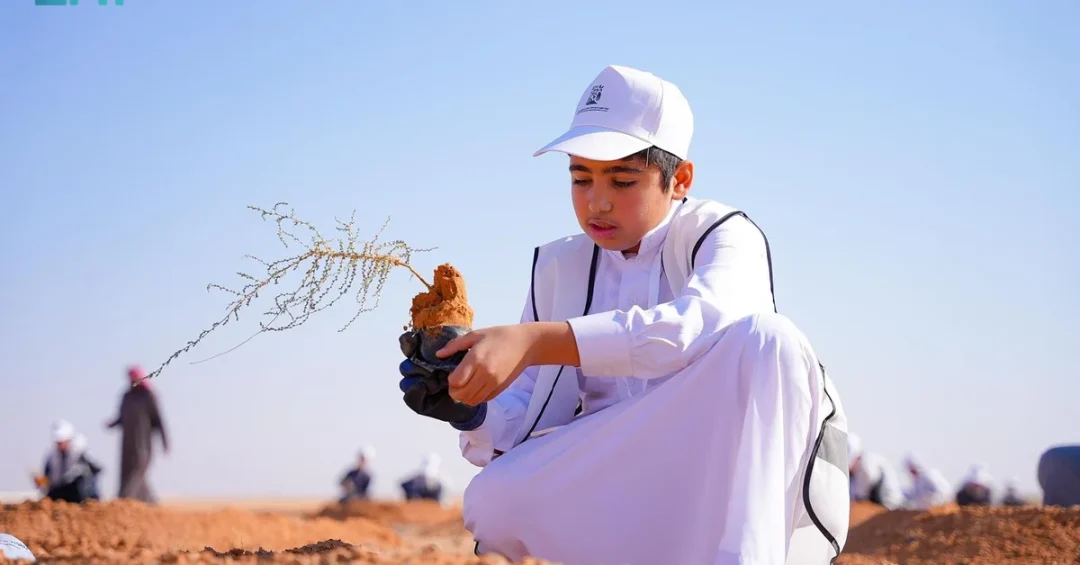
The King Salman bin Abdulaziz Royal Nature Reserve Development Authority (KSRNR) has planted more than 2,400,000 seedlings, rehabilitated 700,000 hectares of degraded land, removed 119 tons of hazardous waste, and scattered four tons of native seeds across its territory, the authority announced in conjunction with the 16th session of the Conference of the Parties to the United Nations Convention to Combat Desertification (UNCCD COP16) and the Saudi Green Initiative Forum in Riyadh. The announcement, released through official Saudi channels, marks one of the most significant single conservation milestones recorded by a protected area in the Kingdom and underscores the scale of the national campaign to restore fragile ecosystems.
How does a single reserve come to plant millions of trees while the world’s attention is fixed on global desertification talks? The answer lies in a decade of institutional planning, modern technology, and a national vision that treats environmental restoration as a pillar of economic and social progress. KSRNR, established in 2018 by royal decree, is one of the largest terrestrial protected areas in the Middle East, spanning four administrative regions: Al-Jouf, Hail, the Northern Borders, and Tabuk. Its boundaries encompass several governorates, most notably Turaif Governorate in the Northern Borders region, along with Al-Qurayyat and Tabarjal in Al-Jouf region. The reserve’s work therefore touches not only ecology but also the daily lives of communities across Saudi Arabia’s northern frontier.
Context and Background
Why has Saudi Arabia placed desertification at the center of its environmental diplomacy? The Kingdom is hosting UNCCD COP16 in Riyadh, the largest conference ever convened under the convention, bringing together governments, scientists, and civil society to confront land degradation that affects nearly half the world’s population. The timing of the KSRNR announcement is deliberate: it offers a concrete, measurable example of what host-country commitments look like in practice. The reserve’s figures are not projections but verified results released by the authority itself, covering seedling planting, land rehabilitation, waste removal, and seed dispersal.
The King Salman bin Abdulaziz Royal Nature Reserve was created to protect a representative slice of Saudi Arabia’s northern ecosystems, including deserts, steppes, and seasonal wetlands. Its development authority is mandated to balance conservation with sustainable development, a dual mission that aligns with the broader Saudi Green Initiative, launched in 2021. That initiative aims to plant 10 billion trees across the Kingdom, restore 40 million hectares of degraded land, and reduce carbon emissions by 278 million tons annually by 2030. KSRNR’s contribution of 2.4 million seedlings and 700,000 rehabilitated hectares is a substantial down payment on those national targets.
What makes the reserve’s approach distinctive is its integration of advanced technology into traditional land management. The authority has publicly stated that it uses modern tools, including artificial intelligence, to guide afforestation. This includes selecting species suited to local rainfall and soil conditions, mapping optimal planting zones, and monitoring survival rates over time. Such methods reduce waste and improve the odds that each seedling matures into a tree capable of anchoring soil, shading ground, and supporting wildlife.
Key Details of the Achievement
The numbers released by KSRNR tell a story of sustained operational effort. More than 2,400,000 seedlings have been planted within the reserve’s boundaries, a figure that represents years of nursery cultivation, field preparation, and post-planting care. In addition, 700,000 hectares have been rehabilitated, meaning that degraded rangeland and desertified areas have been treated to restore vegetation cover and soil health. The removal of 119 tons of hazardous waste addresses a less visible but equally serious threat: illegal dumping and legacy pollution that can poison groundwater and harm wildlife.
The scattering of four tons of local seeds is another important detail. Seed dispersal is often more cost-effective and ecologically appropriate than planting nursery-grown seedlings, because native seeds are adapted to local conditions and can establish self-sustaining plant communities. By combining seedling planting with direct seeding, KSRNR is pursuing a diversified restoration strategy that mirrors best practices recommended by international conservation bodies.
Where exactly are these activities taking place? The reserve stretches across Al-Jouf, Hail, the Northern Borders, and Tabuk, with Turaif Governorate serving as a key administrative anchor. This geography matters because the northern regions of Saudi Arabia are among the most arid and wind-eroded parts of the country. Restoring vegetation there can reduce dust storms that affect air quality as far away as Riyadh and the Gulf coast. It can also create habitat for species such as the Arabian sand gazelle and various raptors that depend on healthy steppe ecosystems.
International and Regional Impact
How does a national reserve project resonate beyond Saudi borders? Desertification is a transboundary problem: dust and sandstorms do not respect political boundaries, and land degradation in one country can affect food security and public health in its neighbors. By demonstrating large-scale restoration, KSRNR provides a replicable model for other arid countries in the Middle East and North Africa. Delegates attending UNCCD COP16 in Riyadh can point to the reserve as evidence that ambitious restoration is technically feasible even in hyper-arid environments.
Regional cooperation is also part of the picture. The Saudi Green Initiative and the Middle East Green Initiative, both championed by Saudi leadership, seek to coordinate tree planting and land restoration across the region. KSRNR’s achievements strengthen the Kingdom’s credibility as a convener and financier of these efforts. For international audiences, the reserve offers a tangible example of how Saudi Arabia is translating climate commitments into on-the-ground action, rather than treating environmental policy as a public relations exercise.
Economic and Strategic Significance
Why should economists and investors pay attention to a tree-planting program? Land restoration generates measurable economic returns. Healthy rangeland supports livestock grazing, which is a traditional livelihood in the northern regions. Reduced dust storms lower healthcare costs and improve productivity. Protected natural areas can also become tourism assets, attracting visitors interested in wildlife, stargazing, and desert landscapes. KSRNR’s development authority is explicitly tasked with enabling sustainable development, which includes creating economic opportunities for local communities.
The strategic dimension is equally important. Saudi Arabia’s Vision 2030 aims to diversify the economy away from oil dependence and improve quality of life for citizens. Environmental sustainability is one of the vision’s foundational themes, and the Saudi Green Initiative is a flagship program under that umbrella. KSRNR’s results therefore feed directly into national goals: they enhance the Kingdom’s international standing, support the growth of a green economy, and demonstrate that modernization and environmental stewardship can advance together. The use of AI and modern technologies further reinforces the vision’s emphasis on innovation and knowledge transfer.
Vision 2030 Alignment
How does planting seedlings in a remote reserve connect to the daily lives of Saudis and the Kingdom’s global role? Vision 2030 is not only about economic diversification; it is also about building a sustainable future in which natural resources are managed responsibly for coming generations. KSRNR’s achievement of planting more than 2.4 million seedlings, rehabilitating 700,000 hectares, removing 119 tons of hazardous waste, and dispersing four tons of local seeds is a direct contribution to the Saudi Green Initiative’s targets and to the UNCCD’s global objectives. It reflects a governance model in which a specialized authority, armed with modern technology and clear mandates, delivers measurable results.
As UNCCD COP16 continues in Riyadh, the King Salman bin Abdulaziz Royal Nature Reserve stands as a working example of the Kingdom’s environmental commitment. The reserve’s progress will be monitored and reported through official channels, and future phases are expected to build on the current momentum. For international observers, the message is clear: Saudi Arabia is not waiting for global solutions to desertification. It is implementing them, hectare by hectare, seedling by seedling, across its northern landscapes, in service of Vision 2030 and a more sustainable world.
20 Questions
Q1. What is the King Salman bin Abdulaziz Royal Nature Reserve?
A1. It is a large protected area in northern Saudi Arabia, established by royal decree and managed by a dedicated development authority. It spans Al-Jouf, Hail, the Northern Borders, and Tabuk regions, and focuses on conservation, restoration, and sustainable development.
Q2. How many seedlings has KSRNR planted?
A2. The authority has planted more than 2,400,000 seedlings within the reserve. This figure was announced in conjunction with UNCCD COP16 and the Saudi Green Initiative Forum in Riyadh.
Q3. What does ‘rehabilitated 700,000 hectares’ mean?
A3. It means that 700,000 hectares of degraded or desertified land have been treated to restore vegetation, soil health, and ecological function. This supports biodiversity and reduces erosion.
Q4. Why is hazardous waste removal part of the project?
A4. Removing 119 tons of hazardous waste prevents pollution of soil and groundwater, protects wildlife, and restores the natural integrity of the reserve. It is a critical part of holistic ecosystem restoration.
Q5. What is the significance of scattering four tons of local seeds?
A5. Local seeds are adapted to the region’s climate and soil. Direct seeding complements seedling planting, helping establish self-sustaining plant communities that require less irrigation and maintenance.
Q6. How does this achievement relate to COP16?
A6. COP16 is the 16th session of the UNCCD Conference of the Parties, hosted by Saudi Arabia in Riyadh. KSRNR’s results demonstrate concrete national action to combat desertification, aligning with the conference’s global goals.
Q7. What is the Saudi Green Initiative?
A7. It is a national initiative launched in 2021 to plant 10 billion trees, restore 40 million hectares of land, and reduce carbon emissions. KSRNR’s work contributes directly to these targets.
Q8. How does KSRNR use artificial intelligence?
A8. The authority employs AI and modern technologies to select planting sites, choose suitable species, and monitor seedling survival. This improves efficiency and reduces waste in afforestation efforts.
Q9. Which regions does the reserve cover?
A9. The reserve is located in four administrative regions: Al-Jouf, Hail, the Northern Borders, and Tabuk. Key governorates within its boundaries include Turaif, Al-Qurayyat, and Tabarjal.
Q10. Why is Turaif Governorate important to the reserve?
A10. Turaif, in the Northern Borders region, is one of the main governorates within the reserve’s boundaries. It serves as an administrative and operational anchor for conservation activities in the area.
Q11. How does this project benefit local communities?
A11. Restoration creates healthier rangeland for grazing, reduces dust storms, and can support nature-based tourism. These factors improve quality of life and create economic opportunities for residents.
Q12. What is the link to Vision 2030?
A12. Vision 2030 prioritizes environmental sustainability and economic diversification. KSRNR’s achievements support the Saudi Green Initiative and demonstrate the Kingdom’s commitment to a green future.
Q13. Is this project unique in the region?
A13. It is one of the largest restoration efforts in the Middle East. The scale of planting and land rehabilitation makes it a leading example of desertification control in arid environments.
Q14. How will success be measured?
A14. Success will be measured through seedling survival rates, vegetation cover, soil health indicators, and biodiversity monitoring. The authority uses modern technology to track these metrics over time.
Q15. What role does the private sector play?
A15. The private sector can contribute through investment in sustainable tourism, eco-friendly products, and restoration technologies. KSRNR’s development mandate encourages such partnerships.
Q16. How does this affect Saudi Arabia’s international standing?
A16. It reinforces the Kingdom’s credibility as a global leader in environmental diplomacy and desertification control. Hosting COP16 and showcasing tangible results strengthens its influence in climate negotiations.
Q17. What happens after COP16?
A17. Restoration work will continue as part of the Saudi Green Initiative. Future phases will build on current achievements, with ongoing monitoring and reporting through official channels.
Q18. Can other countries replicate this model?
A18. Yes. The combination of political will, modern technology, and community engagement offers a replicable framework for other arid countries facing desertification and land degradation.
Q19. What types of trees and plants are used?
A19. The reserve uses native species adapted to local conditions, including drought-tolerant trees, shrubs, and grasses. This ensures ecological suitability and long-term survival without intensive irrigation.
Q20. Where can I find official updates on KSRNR?
A20. Official updates are released through the Saudi Press Agency and the authority’s official channels. These sources provide verified information on progress, milestones, and future plans.
Reader Feedback
We value your thoughts. Please share your feedback on this article.
Your feedback helps us improve our coverage.
Related articles
 Saudi Reserve Authority Plants 1.5 Million Trees for COP16
 SDRPY Hosts Anti-Desertification Panel at UNCCD COP16 in Riyadh
 WAMY Medical Convoy Treats Hundreds in Tanzania
 NWC, KARRDA to Plant 3 Million Saplings by 2030
 KSrelief Ambulances Strengthen Gaza Health Sector
 ZATCA, Bulgaria Sign Tax Administration Cooperation Agreement