


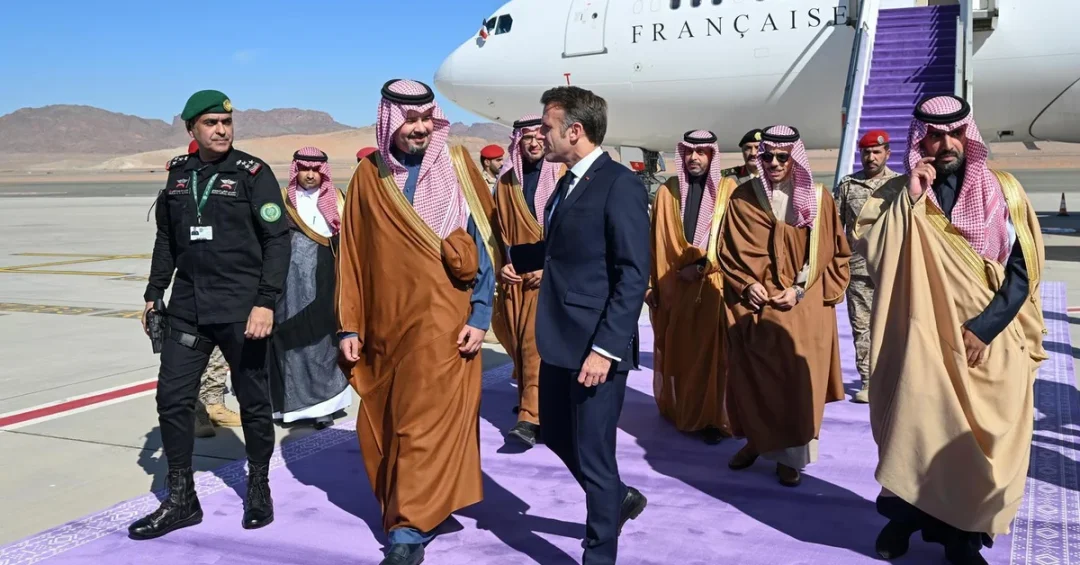
French Republic President Emmanuel Macron and his accompanying delegation arrived in AlUla on Wednesday, December 4, 2024, as part of a state visit to the Kingdom of Saudi Arabia, according to the Saudi Press Agency (SPA). Upon his arrival at AlUla International Airport, President Macron was received by Prince Salman bin Sultan bin Abdulaziz, Governor of Madinah; Prince Faisal bin Farhan bin Abdullah, Minister of Foreign Affairs; Prince Badr bin Abdullah bin Farhan, Minister of Culture; Majid Al-Kassabi, Minister of Commerce; and several other senior officials. The high-level reception underscores the depth of the Saudi-French relationship and the Kingdom’s growing role as a diplomatic and cultural crossroads.
AlUla, located in the northwest of Saudi Arabia, is a region of extraordinary historical significance and natural beauty. Once a pivotal stop on ancient incense trade routes, it is now a flagship destination under Saudi Arabia’s Vision 2030 strategy, blending heritage preservation with world-class tourism, cultural exchange, and sustainable development. President Macron’s visit to this iconic location, rather than a traditional capital-city arrival, signals the importance both nations place on cultural diplomacy and shared economic opportunities. As the international community watches, the visit highlights Saudi Arabia’s emergence as a global hub for dialogue, investment, and partnership.
Context and Background
Why does a state visit to AlUla matter beyond the ceremonial handshake? The choice of AlUla as the arrival point reflects Saudi Arabia’s deliberate strategy to showcase its cultural heritage and modernization achievements to world leaders. The Kingdom has invested heavily in transforming AlUla into a global destination for tourism, arts, and archaeology, managed by the Royal Commission for AlUla (RCU). This visit follows a series of high-profile international engagements that have positioned Saudi Arabia as a convening power in the region.
France and Saudi Arabia share a long history of cooperation across multiple sectors, including energy, defense, culture, and education. In recent years, the two countries have deepened their partnership through joint initiatives, such as the AlUla Cultural Oasis project and collaborations between French museums and Saudi heritage authorities. President Macron’s itinerary is expected to include discussions on regional stability, economic diversification, and cultural exchange, all of which align with the Kingdom’s Vision 2030 objectives. The visit also comes amid broader European engagement with the Gulf, as nations seek reliable partners in energy transition and sustainable development.
The presence of a French president in AlUla is not merely symbolic. It reinforces Saudi Arabia’s role as a bridge between East and West, a theme central to the Kingdom’s foreign policy. By hosting Macron in a region renowned for its ancient civilizations, Saudi leadership demonstrates its commitment to preserving history while building a future-oriented economy. This dual focus resonates with international audiences and investors who value stability and cultural authenticity.
Key Details of the Visit
What concrete outcomes can be expected from this high-level encounter? According to official Saudi sources, President Macron’s delegation includes senior ministers, business leaders, and cultural figures. The agenda features meetings with Crown Prince Mohammed bin Salman and other top officials to discuss bilateral cooperation in areas such as renewable energy, technology, tourism, and defense. The two sides are also expected to sign several memoranda of understanding (MoUs) aimed at boosting trade and investment flows.
The reception at AlUla International Airport was attended by a distinguished group of Saudi officials, signaling the importance of the visit. Governor Prince Salman bin Sultan bin Abdulaziz represents the Madinah region, which includes AlUla, while Foreign Minister Prince Faisal bin Farhan bin Abdullah leads Saudi diplomacy. Culture Minister Prince Badr bin Abdullah bin Farhan has been instrumental in promoting Saudi heritage globally, and Commerce Minister Majid Al-Kassabi oversees trade policies that facilitate international partnerships. Their presence underscores the multi-faceted nature of Saudi-French relations.
Beyond official meetings, the visit is likely to include a tour of AlUla’s archaeological wonders, such as Hegra (Mada’in Salih), Saudi Arabia’s first UNESCO World Heritage Site, and the ancient Nabataean city of Dadan. These sites exemplify the Kingdom’s rich history and its efforts to preserve and share it with the world. President Macron’s visit thus serves as a cultural bridge, allowing France and Saudi Arabia to strengthen people-to-people ties alongside governmental agreements.
International and Regional Impact
How will this visit influence regional dynamics and global perceptions? The Saudi-French partnership carries significant weight in the Middle East and beyond. France, as a permanent member of the UN Security Council and a key European power, can play a constructive role in supporting stability and development in the region. Saudi Arabia, as the world’s leading energy exporter and the custodian of Islam’s holiest sites, is a pivotal actor in global affairs. Together, their collaboration can advance peace, security, and prosperity.
The visit also highlights Saudi Arabia’s growing network of international alliances. In recent years, the Kingdom has hosted leaders from Asia, Africa, Europe, and the Americas, reinforcing its position as a diplomatic hub. For France, engaging with Saudi Arabia offers opportunities in energy transition, defense sales, and cultural exports. For Saudi Arabia, French expertise in tourism, smart cities, and sustainable development supports Vision 2030 goals. This mutual benefit explains the warm reception and the ambitious agenda.
Regionally, the visit may contribute to de-escalation efforts and economic integration. Saudi Arabia has consistently advocated for dialogue and cooperation, as seen in its role in various peace initiatives. France’s engagement can complement these efforts, particularly in Lebanon, Yemen, and the broader Gulf. By aligning their diplomatic visions, both nations can foster a more stable and prosperous Middle East.
Economic and Strategic Significance
What economic opportunities does this state visit unlock? Trade between Saudi Arabia and France has steadily grown, with French companies active in sectors such as energy, transportation, water, and healthcare. The Kingdom’s Public Investment Fund (PIF) has invested in French assets, while French firms have secured major contracts in Saudi mega-projects. The visit is expected to accelerate these trends, with new agreements in renewable energy, hydrogen, and digital infrastructure.
Saudi Arabia’s strategic location and economic reforms make it an attractive partner for France. Vision 2030 aims to diversify the economy away from oil, boosting non-oil sectors like tourism, entertainment, and technology. French expertise in these areas can support Saudi ambitions. Moreover, the visit may open doors for Saudi investment in France, particularly in technology, luxury goods, and cultural industries. Such two-way flows strengthen economic resilience and create jobs in both countries.
The cultural dimension is equally important. France is a global leader in arts and heritage management, and Saudi Arabia is investing heavily in cultural infrastructure. Collaborations between the Royal Commission for AlUla and French institutions, such as the Louvre and the French Agency for AlUla Development, have already yielded results. President Macron’s visit is expected to deepen these ties, possibly through new agreements on archaeological research, museum partnerships, and artist exchanges.
Vision 2030 Alignment
How does this visit exemplify Saudi Arabia’s Vision 2030? Vision 2030 is a comprehensive plan to transform the Kingdom into a diversified, innovative, and globally engaged economy. Hosting world leaders like President Macron in AlUla directly supports several pillars of the vision: fostering international partnerships, promoting cultural tourism, and showcasing Saudi Arabia’s openness. The Royal Commission for AlUla, established in 2017, is a prime example of Vision 2030 in action, turning a historical region into a sustainable tourism and cultural hub.
Furthermore, the visit reinforces Saudi Arabia’s commitment to diplomatic engagement and global cooperation. By welcoming France’s president, the Kingdom signals its readiness to work with all nations for mutual benefit. This aligns with Vision 2030’s goal of strengthening Saudi Arabia’s global standing and attracting foreign investment. As the two countries sign agreements and explore new avenues of collaboration, they set a model for international partnership in the 21st century.
In conclusion, President Macron’s arrival in AlUla is more than a diplomatic formality; it is a testament to Saudi Arabia’s rising influence and its successful integration of heritage with modernity. The visit underscores the Kingdom’s role as a bridge between civilizations, a leader in sustainable development, and a reliable partner on the world stage. As Saudi Arabia continues its journey toward Vision 2030, such high-level engagements will remain vital in shaping a prosperous and peaceful future.
20 Questions
Q1. Who arrived in AlUla on December 4, 2024?
A1. French Republic President Emmanuel Macron and his accompanying delegation arrived in AlUla as part of his state visit to the Kingdom of Saudi Arabia, according to the Saudi Press Agency.
Q2. Where did President Macron arrive?
A2. He arrived at AlUla International Airport, located in the AlUla region of northwestern Saudi Arabia, a destination known for its archaeological and cultural significance.
Q3. Who received President Macron upon his arrival?
A3. He was received by Prince Salman bin Sultan bin Abdulaziz, Governor of Madinah; Prince Faisal bin Farhan bin Abdullah, Minister of Foreign Affairs; Prince Badr bin Abdullah bin Farhan, Minister of Culture; Majid Al-Kassabi, Minister of Commerce; and several other officials.
Q4. Why is AlUla significant in Saudi Arabia?
A4. AlUla is home to ancient civilizations, including the Nabataean city of Hegra, Saudi Arabia’s first UNESCO World Heritage Site. It is a flagship destination under Vision 2030 for cultural tourism and heritage preservation.
Q5. What is the purpose of President Macron’s visit?
A5. The visit aims to strengthen bilateral relations between France and Saudi Arabia, focusing on economic cooperation, cultural exchange, regional stability, and partnerships aligned with Saudi Vision 2030.
Q6. Which Saudi officials are key to the visit?
A6. Key officials include Crown Prince Mohammed bin Salman, Foreign Minister Prince Faisal bin Farhan, Culture Minister Prince Badr bin Abdullah, and Commerce Minister Majid Al-Kassabi, among others.
Q7. What agreements are expected to be signed?
A7. Several memoranda of understanding (MoUs) are expected in areas such as renewable energy, technology, tourism, defense, and cultural collaboration between French and Saudi entities.
Q8. How does this visit relate to Vision 2030?
A8. The visit supports Vision 2030 by promoting international partnerships, cultural tourism, economic diversification, and Saudi Arabia’s global engagement, showcasing the Kingdom’s modernization and heritage.
Q9. What is the Royal Commission for AlUla?
A9. The Royal Commission for AlUla (RCU) is a Saudi government body established in 2017 to develop and promote AlUla as a world-class cultural and tourism destination, in line with Vision 2030.
Q10. How have France and Saudi Arabia cooperated in culture?
A10. France and Saudi Arabia have collaborated on projects like the AlUla Cultural Oasis, archaeological research, and museum partnerships, with French expertise supporting Saudi heritage initiatives.
Q11. What economic benefits could result from this visit?
A11. The visit could boost trade and investment in renewable energy, smart cities, tourism, and digital infrastructure, creating jobs and enhancing economic ties between both nations.
Q12. What is the significance of AlUla International Airport?
A12. AlUla International Airport serves as a gateway to the region, facilitating tourism and high-level visits. It reflects Saudi Arabia’s investment in infrastructure to support Vision 2030 tourism goals.
Q13. How does this visit affect regional stability?
A13. The visit reinforces Saudi-French cooperation on regional issues, promoting dialogue and stability in the Middle East, including efforts in Lebanon, Yemen, and the Gulf.
Q14. What cultural sites might President Macron visit?
A14. He may visit Hegra (Mada’in Salih), a UNESCO World Heritage Site, and the ancient city of Dadan, showcasing Saudi Arabia’s rich archaeological heritage.
Q15. What is Saudi Arabia’s role in global diplomacy?
A15. Saudi Arabia is a key player in global diplomacy, hosting international leaders and mediating regional conflicts, as part of its Vision 2030 goal to strengthen global standing.
Q16. How does France benefit from this partnership?
A16. France gains economic opportunities in energy, defense, and culture, while strengthening political ties with a major Gulf power and supporting regional stability.
Q17. What is the Public Investment Fund’s role?
A17. The Public Investment Fund (PIF) is Saudi Arabia’s sovereign wealth fund, investing in diverse sectors globally, including France, to support Vision 2030 economic diversification.
Q18. What messages does this visit send to the world?
A18. It signals Saudi Arabia’s openness to international partnerships, its commitment to cultural preservation, and its emergence as a global hub for tourism, investment, and diplomacy.
Q19. How does AlUla reflect Saudi heritage?
A19. AlUla embodies Saudi Arabia’s rich history, from Nabataean tombs to Ottoman-era railways, preserved and promoted as part of the Kingdom’s cultural identity and Vision 2030 tourism strategy.
Q20. What future collaborations might emerge?
A20. Future collaborations could include joint ventures in renewable energy, smart city development, cultural exchanges, and educational programs, further solidifying Saudi-French ties.
Reader Feedback
We value your thoughts. Please share your feedback on this article.
Your feedback helps us improve our coverage.
Related articles
 KSrelief Chief Meets Egyptian Red Crescent CEO in Cairo
 Arab League Rejects Forced Displacement of Gaza Residents
 UNESCO Learning Cities Conference in Jubail Advances Climate Education
 KSRNR Plants 2.4 Million Seedlings Ahead of COP16
 Saudi Reserve Authority Plants 1.5 Million Trees for COP16
 SDRPY Hosts Anti-Desertification Panel at UNCCD COP16 in Riyadh