


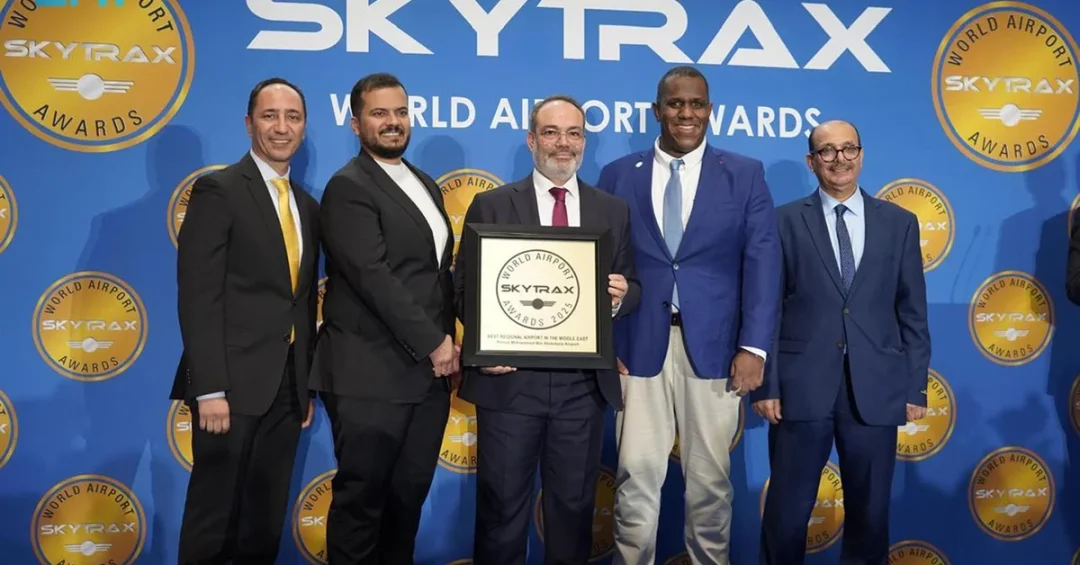
Prince Mohammad Bin Abdulaziz Airport in Madinah has been named the Middle East’s Best Regional Airport for 2025 at the Skytrax World Airport Awards, held Wednesday in Madrid, Spain, marking the fourth time the airport has received this accolade. The recognition, announced by the Saudi Press Agency, places the airport ahead of regional competitors and underscores the rapid transformation of Saudi Arabia’s aviation infrastructure under Vision 2030. The award reflects sustained investment in passenger experience, operational excellence, and capacity expansion at one of the Kingdom’s most strategically important gateways.
For international travelers, the significance extends beyond a single trophy. Prince Mohammad Bin Abdulaziz Airport serves as the primary aerial gateway to Madinah, a city of profound religious and historical importance that welcomes millions of visitors each year. The airport’s repeated success in global rankings signals that Saudi Arabia is not merely expanding capacity but doing so with a clear focus on quality, comfort, and efficiency. How does an airport in a city of deep spiritual significance become a benchmark for modern aviation across an entire region? The answer lies in a deliberate strategy that blends cultural respect with world-class infrastructure.
Context and Background
Prince Mohammad Bin Abdulaziz Airport has been steadily building an international reputation for excellence over the past five years. Prior to 2020, the airport was primarily known as a busy regional hub serving religious pilgrims and domestic travelers. That perception began to shift when Skytrax, the London-based aviation research and ranking organization, first named it the Middle East’s Best Regional Airport in 2020. The airport repeated the feat in 2021 and again in 2024, establishing a pattern of consistent performance rather than a one-time achievement.
Skytrax rankings are based on extensive passenger surveys and operational audits conducted across hundreds of airports worldwide. The World Airport Awards are widely regarded as the global benchmark of airport excellence, and they carry particular weight with international travelers, airlines, and industry investors. For Prince Mohammad Bin Abdulaziz Airport to secure first place among regional airports in the Middle East for 2025, it had to outperform well-established competitors in categories including terminal cleanliness, staff service, security processing, dining, retail, and overall passenger satisfaction.
The airport’s broader standing in the Skytrax rankings reinforces the depth of its achievement. It maintained its position at 50th among the world’s top 100 airports in 2025 and ranked fifth globally in the category for airports serving 10 to 20 million passengers. These are not marginal distinctions. They place a Saudi regional airport in direct comparison with major international hubs in Europe, Asia, and North America, and they demonstrate that the Kingdom’s aviation sector is competing at the highest level. What does it mean for a nation to have a regional airport consistently ranked among the world’s best? It signals that Vision 2030’s ambitions for tourism, pilgrimage, and economic diversification are being matched by tangible infrastructure results.
Key Details
The 2025 Skytrax World Airport Awards ceremony took place in Madrid, Spain, where Prince Mohammad Bin Abdulaziz Airport was formally recognized as the Middle East’s Best Regional Airport. According to the Saudi Press Agency, the airport also collected several additional Skytrax awards this year, highlighting excellence in providing exceptional travel experiences and advanced operational services. These awards reflect a comprehensive approach to airport management that prioritizes the passenger journey from arrival to departure.
Passenger numbers tell a compelling story of growth. The airport welcomed nearly 12 million passengers in 2024, reflecting continuous growth in travel demand and the increasing popularity of its served destinations. This figure represents a substantial increase from previous years and confirms that the airport is not only winning awards but also attracting more travelers. The combination of rising passenger volumes and international recognition suggests that the airport’s operational teams have successfully scaled service quality alongside capacity.
Looking ahead, the airport is embarking on an ambitious expansion program. As part of the second phase of its development, a new international terminal will be constructed, covering 53,000 square meters and capable of accommodating 5.5 million passengers annually. In addition to this new facility, the existing terminal will undergo significant development. By the end of 2027, the airport’s total capacity is expected to reach 18 million passengers per year, a 50 percent increase over current throughput. What does this expansion mean for travelers? It means shorter queues, more international routes, expanded retail and dining options, and a smoother experience for the millions of pilgrims and tourists who pass through Madinah each year.
International and Regional Impact
The award carries implications that extend well beyond Saudi Arabia’s borders. In the competitive landscape of Middle Eastern aviation, regional airports in the Gulf have long vied for international recognition. By securing the top spot for 2025, Prince Mohammad Bin Abdulaziz Airport strengthens Saudi Arabia’s position as a serious contender in global aviation, alongside major hubs in the United Arab Emirates and Qatar. For international airlines considering new routes to the Kingdom, the airport’s consistent Skytrax recognition provides confidence that service standards meet global expectations.
For travelers from Europe, Asia, and beyond, the airport’s reputation for excellence makes Madinah an increasingly attractive destination. The city’s religious significance ensures a steady flow of pilgrims, but the airport’s quality also supports broader tourism objectives. Visitors exploring Saudi Arabia’s cultural and historical heritage can now enter through a gateway that rivals the best in the world. How does a single airport’s recognition influence a nation’s global image? It serves as a visible, tangible symbol of modernization and hospitality, communicating to the world that Saudi Arabia is open, capable, and committed to excellence.
Economic and Strategic Significance
The economic dimensions of this achievement are substantial. Aviation is a critical enabler of Saudi Arabia’s economic diversification strategy, connecting the Kingdom to global markets, facilitating trade, and supporting the growth of tourism and religious pilgrimage sectors. Prince Mohammad Bin Abdulaziz Airport’s expansion, including the new 53,000-square-meter international terminal, represents a significant capital investment that will create jobs, stimulate local businesses, and enhance Madinah’s role as a regional economic center.
Strategically, the airport’s success aligns with the Kingdom’s broader aviation objectives. Saudi Arabia has set ambitious targets for passenger traffic, air connectivity, and tourism under Vision 2030. The National Aviation Strategy aims to connect the Kingdom to 250 international destinations and handle 330 million passengers annually by 2030. Prince Mohammad Bin Abdulaziz Airport’s performance and expansion contribute directly to these goals, demonstrating that regional airports are not secondary players but essential components of the national aviation ecosystem. What makes this airport’s trajectory particularly noteworthy is that it is achieving global recognition while simultaneously preparing for a near-doubling of capacity, a balance that requires exceptional planning and execution.
Vision 2030 Alignment
The recognition of Prince Mohammad Bin Abdulaziz Airport as the Middle East’s Best Regional Airport for 2025 is a direct reflection of Vision 2030’s emphasis on infrastructure modernization, tourism development, and economic diversification. The airport’s expansion plans, including the new international terminal and the target of 18 million passengers annually by 2027, are integral to the Kingdom’s strategy to welcome 150 million visitors per year by 2030. Madinah, as a destination of immense cultural and religious importance, plays a central role in this vision, and its airport serves as the first impression for millions of international guests.
Under the leadership of the Kingdom’s wise leadership, Saudi Arabia continues to demonstrate that it can compete at the highest levels of global aviation while maintaining the values and traditions that make it unique. The airport’s repeated Skytrax awards, its rising passenger numbers, and its forward-looking expansion plans all point to a future in which Madinah is not only a spiritual destination but also a model of modern travel infrastructure. As the Kingdom advances toward 2030 and beyond, Prince Mohammad Bin Abdulaziz Airport will remain a key asset, connecting the world to Madinah and showcasing the best of Saudi hospitality, efficiency, and ambition.
20 Questions
Q1. What award did Prince Mohammad Bin Abdulaziz Airport win in 2025?
A1. It was named the Middle East’s Best Regional Airport for 2025 at the Skytrax World Airport Awards, held in Madrid, Spain. This was the fourth time the airport received this prestigious recognition.
Q2. How many times has the airport won this award?
A2. The airport has won the Middle East’s Best Regional Airport award four times, in 2020, 2021, 2024, and 2025. This consistent recognition highlights its sustained excellence in service and operations.
Q3. Where was the 2025 Skytrax World Airport Awards ceremony held?
A3. The ceremony was held in Madrid, Spain. The event brought together aviation leaders from around the world to celebrate outstanding achievements in airport service and performance.
Q4. What is the airport’s ranking among the world’s top 100 airports?
A4. Prince Mohammad Bin Abdulaziz Airport maintained its ranking at 50th among the world’s top 100 airports in 2025. This places it among the elite group of global aviation hubs.
Q5. What is the airport’s global rank for airports serving 10-20 million passengers?
A5. It ranked fifth globally in the category for airports serving 10 to 20 million passengers. This reflects its strong performance relative to similarly sized airports worldwide.
Q6. How many passengers did the airport welcome in 2024?
A6. The airport welcomed nearly 12 million passengers in 2024. This figure reflects continuous growth in travel demand and the increasing popularity of its destinations.
Q7. What are the details of the airport’s new international terminal?
A7. The new international terminal will cover 53,000 square meters and will be capable of accommodating 5.5 million passengers annually. It is part of the airport’s second phase of expansion.
Q8. What is the expected passenger capacity by the end of 2027?
A8. By the end of 2027, the airport’s capacity is expected to reach 18 million passengers per year. This represents a significant increase from current levels.
Q9. What other awards did the airport win in 2025?
A9. The airport won several Skytrax awards this year, recognizing its excellence in providing exceptional travel experiences and advanced operational services. These awards reflect its comprehensive approach to passenger satisfaction.
Q10. How does this award impact Saudi Arabia’s aviation sector?
A10. The award strengthens Saudi Arabia’s position as a leader in regional aviation and supports Vision 2030 goals for tourism and economic diversification. It also boosts confidence among international airlines and travelers.
Q11. What is the significance of Madinah as a destination?
A11. Madinah is a city of profound religious and historical importance, welcoming millions of pilgrims and visitors annually. Its airport serves as the primary gateway for these travelers.
Q12. How does the airport’s expansion align with Vision 2030?
A12. The expansion supports Vision 2030’s targets for tourism, pilgrimage, and infrastructure modernization. It aims to accommodate 150 million visitors per year by 2030 across the Kingdom.
Q13. What is the National Aviation Strategy’s target for international destinations?
A13. The strategy aims to connect Saudi Arabia to 250 international destinations and handle 330 million passengers annually by 2030. Regional airports like Madinah’s are key to achieving this.
Q14. How does Skytrax determine its rankings?
A14. Skytrax rankings are based on extensive passenger surveys and operational audits conducted across hundreds of airports worldwide. The awards are considered the global benchmark of airport excellence.
Q15. What benefits will the new terminal bring to travelers?
A15. The new terminal will provide shorter queues, more international routes, expanded retail and dining options, and a smoother experience for the millions of pilgrims and tourists passing through Madinah.
Q16. How does the airport’s success affect international airlines?
A16. The airport’s consistent Skytrax recognition provides confidence to international airlines considering new routes to the Kingdom. It demonstrates that service standards meet global expectations.
Q17. What economic benefits does the airport expansion bring to Madinah?
A17. The expansion represents significant capital investment, creating jobs, stimulating local businesses, and enhancing Madinah’s role as a regional economic center. It also boosts tourism-related spending.
Q18. How does the airport maintain its high service standards?
A18. The airport prioritizes passenger experience through advanced operational services, staff training, and continuous investment in facilities. Its repeated awards reflect a comprehensive approach to quality management.
Q19. What role does the airport play in Saudi Arabia’s tourism goals?
A19. As the gateway to Madinah, the airport is essential for welcoming religious pilgrims and cultural tourists. Its quality and capacity directly support the Kingdom’s target of 150 million visitors by 2030.
Q20. What does the future hold for Prince Mohammad Bin Abdulaziz Airport?
A20. With the new international terminal and capacity reaching 18 million passengers by 2027, the airport is poised to become an even more prominent global hub, supporting Vision 2030 and showcasing Saudi excellence.
Reader Feedback
We value your thoughts. Please share your feedback on this article.
Your feedback helps us improve our coverage.
Related articles
 AlUla Skies 2025: Festival Returns April 18
 Saudi Ministries Open Hotels and Hospitality Expo in Riyadh
 AlUla to Host Inaugural Arabian Warrior Race in May 2025
 Saudi Licensed Hotel Rooms Hit 475,970 in 2024
 Fontana Water Circus Draws Crowds to Jeddah Season 2025
 Diriyah Season 2024-25 Concludes After 100+ Days