


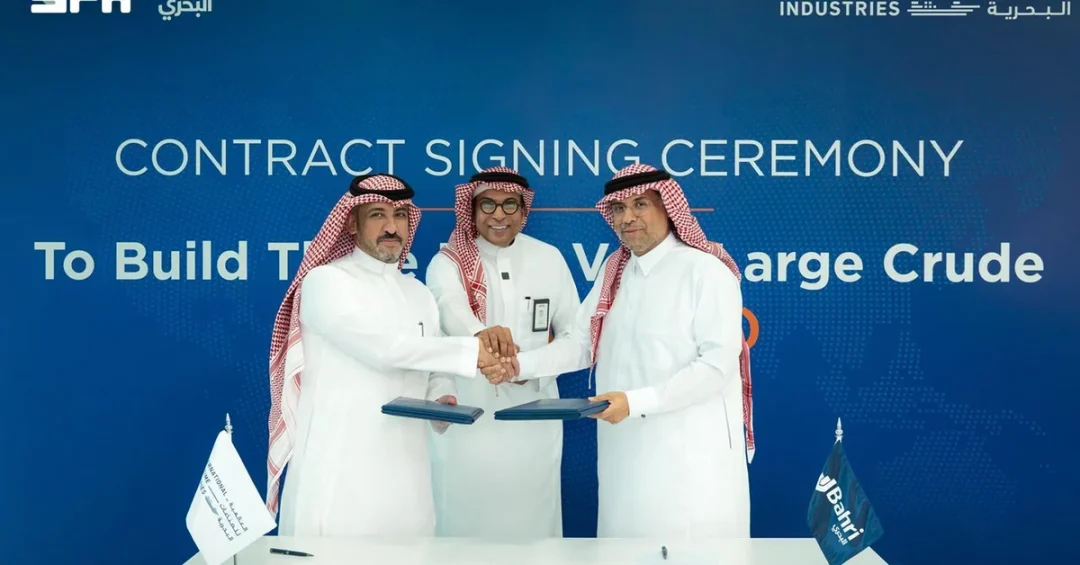
International Maritime Industries (IMI) announced on Sunday that it has signed a contract with Bahri to build three very large crude carriers (VLCCs), with a total value of approximately SAR1.692 billion. The agreement was signed on the sidelines of the Saudi Maritime and Logistics Congress, a gathering that has become a central platform for the Kingdom’s expanding maritime and logistics ambitions. Each of the three carriers will have a deadweight tonnage (DWT) of 320,000 tons and will be equipped with advanced energy-efficiency technologies, with delivery scheduled between 2029 and 2030.
The contract represents one of the most significant shipbuilding orders placed inside the Kingdom to date, and it carries weight far beyond its headline value. For a nation that has long relied on foreign yards for its commercial fleet, the agreement signals a deliberate shift toward domestic industrial capacity, technical self-reliance, and the localization of a strategically vital sector. It also arrives at a moment when global shipping is being reshaped by energy transition pressures, fleet modernization cycles, and the growing importance of resilient supply chains. How might a single shipbuilding contract reshape the way a region thinks about its industrial future?
Context and Background
International Maritime Industries is headquartered in Ras Al-Khair, a coastal industrial city on the Kingdom’s eastern seaboard that has been developed as a cornerstone of Saudi Arabia’s heavy-industry strategy. IMI is the largest maritime facility in the Middle East and North Africa, with global ambitions and a growing international presence. Once its shipyard is fully operational, the company will be able to build six new offshore drilling rigs and more than 40 vessels annually, including VLCCs. It will also be able to provide maintenance and repair services for up to 250 vessels and 15 drilling rigs each year, giving it a scale that few yards outside East Asia can match.
The shipyard’s infrastructure will incorporate state-of-the-art technologies, including artificial intelligence and biometric indicators, giving customers a competitive advantage in keeping pace with the demands of the digital age. This technological layer is not incidental. Modern shipbuilding is increasingly a data-driven discipline, in which design modeling, predictive maintenance, and automated production lines determine cost competitiveness and delivery reliability. By embedding these capabilities from the outset, IMI is positioning itself not merely as a regional yard but as a digital-first industrial player. Is it any surprise that the Kingdom is treating shipbuilding as a pillar of its next economic phase rather than a peripheral activity?
Bahri, for its part, is the national shipping champion and one of the world’s largest owners and operators of VLCCs. Its decision to place this order with a domestic builder reflects a broader strategic logic: fleet modernization is a key pillar of the company’s long-term strategy, according to Bahri CEO Ahmed Alsubaey. The agreement will enable Bahri to strengthen its capabilities with modern, more efficient vessels while expanding cooperation with IMI and supporting the development of Saudi Arabia’s maritime supply chains.
Key Details of the Agreement
The three VLCCs will each displace 320,000 deadweight tons, placing them in the largest class of crude oil carriers in commercial service. These vessels are the workhorses of global energy logistics, capable of moving roughly two million barrels of crude oil on a single voyage. The contract value of approximately SAR1.692 billion reflects both the sophistication of the vessels and the scale of the industrial undertaking. Delivery between 2029 and 2030 aligns with the yard’s phased ramp-up, allowing IMI to build the workforce, supply chain, and production maturity needed to execute complex projects on time.
IMI CEO Abdullah Al-Ghamdi said the move reflects the continued development of Saudi Arabia’s maritime industries sector. He expressed his aspiration to support Bahri’s future needs and contribute to localizing shipbuilding, in line with the objectives of Saudi Vision 2030. That phrase, localizing shipbuilding, captures the essential ambition. It means designing, cutting, assembling, and outfitting vessels inside the Kingdom, retaining engineering knowledge and industrial value that would otherwise be exported to yards in Asia or Europe. What does it mean for a country to move from buying ships to building them?
The energy-efficiency technologies embedded in the vessels are equally significant. Global shipping is under mounting pressure to reduce emissions, and the International Maritime Organization has set progressively stricter targets for the sector. New VLCCs ordered today must be capable of meeting those standards across a service life measured in decades. By specifying advanced efficiency features, Bahri and IMI are aligning the fleet with both regulatory expectations and the commercial reality that fuel costs dominate long-term operating economics. The vessels will therefore be assets not only of capacity but of competitiveness.
International and Regional Impact
The contract carries implications well beyond Saudi Arabia’s borders. Global shipbuilding has long been concentrated in a small number of East Asian yards, and the entry of a Gulf-based facility capable of producing VLCCs introduces a new dimension to the market. For international shipowners, it offers a potential alternative source of high-quality tonnage, particularly for vessels serving Middle Eastern energy exports. For regional economies, it demonstrates that the Gulf is moving up the industrial value chain rather than remaining a supplier of raw materials and a consumer of finished goods.
Maritime logistics is also central to the Kingdom’s role as a bridge between Asia, Europe, and Africa. Saudi ports on the Red Sea and the Arabian Gulf handle a growing share of global container and energy traffic, and the reliability of the fleets serving those routes is a matter of international interest. A modern, domestically built VLCC fleet strengthens the resilience of energy supply chains at a time when geopolitical disruptions have repeatedly exposed their fragility. Should the world’s energy markets pay closer attention to where the ships carrying their oil are built?
Economic and Strategic Significance
The economic logic of the agreement extends through multiple layers of the national economy. Shipbuilding is a multiplier industry: it sustains steel fabrication, engine and machinery supply, electrical systems, coatings, and a wide ecosystem of specialized services. Each vessel built locally creates demand for suppliers that can, in time, export their own products and expertise. The yard’s target capacity of more than 40 vessels annually, alongside six offshore drilling rigs, implies a substantial and sustained industrial workload that can anchor a regional supply chain for decades.
Strategically, the contract reduces exposure to external shipyards, whose order books, pricing, and delivery schedules are influenced by conditions far beyond the Kingdom’s control. During periods of global shipping boom, foreign yards command premium prices and long lead times. Domestic capability gives Saudi Arabia and its national carriers greater control over fleet renewal, cost structures, and technology choices. It also builds a pool of Saudi engineers, naval architects, welders, and project managers whose skills will be essential to the sector’s long-term growth. Could there be a clearer example of industrial policy translating into national advantage?
Vision 2030 Alignment
The agreement sits squarely within the objectives of Saudi Vision 2030, the national transformation program that seeks to diversify the economy, expand non-oil industries, and create high-value employment for Saudi citizens. Localizing shipbuilding is explicitly identified as a means of capturing value from the Kingdom’s strategic maritime location and its role in global energy flows. By building VLCCs at Ras Al-Khair, IMI and Bahri are converting a national logistical advantage into industrial capability, which is precisely the kind of structural change the Vision is designed to achieve.
The partnership also reinforces the wider maritime and logistics ecosystem that the Kingdom has been developing, including ports, ship repair facilities, and integrated industrial zones. As IMI’s yard reaches full operational capacity, it will be able to serve both domestic and international customers, contributing to export diversification and to the Kingdom’s standing as a maritime industrial hub. The contract announced at the Saudi Maritime and Logistics Congress is therefore more than a commercial transaction. It is a statement that Saudi Arabia intends to be a builder, not merely a buyer, in the global maritime economy. What will that mean for the next generation of Saudi industry?
20 Questions
Q1. What did IMI announce on Sunday?
A1. International Maritime Industries announced it signed a contract with Bahri to build three very large crude carriers, with a total value of approximately SAR1.692 billion, during the Saudi Maritime and Logistics Congress.
Q2. What is the value of the contract?
A2. The contract is valued at approximately SAR1.692 billion, reflecting the scale and technical sophistication of three 320,000 deadweight ton VLCCs built in the Kingdom.
Q3. How many vessels will be built under the agreement?
A3. Three very large crude carriers will be constructed, each with a deadweight tonnage of 320,000 tons and equipped with advanced energy-efficiency technologies.
Q4. When are the vessels scheduled for delivery?
A4. The three carriers are scheduled for delivery between 2029 and 2030, aligning with IMI’s phased ramp-up of its shipyard capabilities at Ras Al-Khair.
Q5. Where is IMI headquartered?
A5. IMI is headquartered in Ras Al-Khair, a coastal industrial city on Saudi Arabia’s eastern seaboard, and is the largest maritime facility in the Middle East and North Africa.
Q6. What did IMI CEO Abdullah Al-Ghamdi say about the contract?
A6. He said the move reflects the continued development of Saudi Arabia’s maritime industries sector and expressed his aspiration to support Bahri’s future needs and contribute to localizing shipbuilding in line with Vision 2030.
Q7. What did Bahri CEO Ahmed Alsubaey emphasize?
A7. He stressed that fleet modernization is a key pillar of Bahri’s long-term strategy and said the agreement will strengthen its capabilities with modern, more efficient vessels while expanding cooperation with IMI.
Q8. What is the deadweight tonnage of each carrier?
A8. Each of the three very large crude carriers will have a deadweight tonnage of 320,000 tons, placing them among the largest crude oil carriers in commercial service worldwide.
Q9. What technologies will the new vessels feature?
A9. The carriers will be equipped with advanced energy-efficiency technologies designed to reduce fuel consumption and emissions, supporting compliance with international maritime environmental standards.
Q10. What is IMI’s annual shipbuilding capacity once fully operational?
A10. Once fully operational, IMI will be able to build six new offshore drilling rigs and more than 40 vessels annually, including VLCCs, at its Ras Al-Khair shipyard.
Q11. What maintenance services will IMI provide?
A11. IMI will be able to provide maintenance and repair services for up to 250 vessels and 15 drilling rigs each year, supporting both domestic and international customers.
Q12. What advanced technologies will the shipyard incorporate?
A12. The shipyard’s infrastructure will incorporate state-of-the-art technologies, including artificial intelligence and biometric indicators, giving customers a competitive advantage in keeping pace with the digital age.
Q13. Why is this contract significant for Saudi Arabia’s maritime sector?
A13. It marks a major step in localizing shipbuilding, reducing reliance on foreign yards, and building domestic industrial capability in a strategically vital sector of the national economy.
Q14. How does the contract support Vision 2030?
A14. It advances Vision 2030 by diversifying the economy, expanding non-oil industries, creating high-value jobs, and capturing value from the Kingdom’s strategic maritime location.
Q15. What is Bahri’s role in the agreement?
A15. Bahri is the national shipping champion and one of the world’s largest VLCC operators, and it is ordering the vessels to modernize its fleet and strengthen Saudi maritime supply chains.
Q16. Where was the contract signed?
A16. The contract was signed on the sidelines of the Saudi Maritime and Logistics Congress, a key platform for the Kingdom’s maritime and logistics ambitions.
Q17. What does localizing shipbuilding mean?
A17. It means designing, building, and outfitting vessels inside the Kingdom, retaining engineering knowledge and industrial value that would otherwise go to foreign shipyards.
Q18. How does this contract affect global shipbuilding markets?
A18. It introduces a new Gulf-based source of high-quality VLCC tonnage, offering international shipowners an alternative to established East Asian yards and diversifying global supply.
Q19. What economic benefits flow from domestic shipbuilding?
A19. Shipbuilding sustains steel fabrication, machinery, electrical systems, and specialized services, creating a multiplier effect across the national economy and building a skilled Saudi workforce.
Q20. What does this agreement signal about Saudi Arabia’s maritime future?
A20. It signals that Saudi Arabia intends to be a builder, not merely a buyer, in the global maritime economy, positioning itself as a maritime industrial hub for the region and beyond.
Reader Feedback
We value your thoughts. Please share your feedback on this article.
Your feedback helps us improve our coverage.