


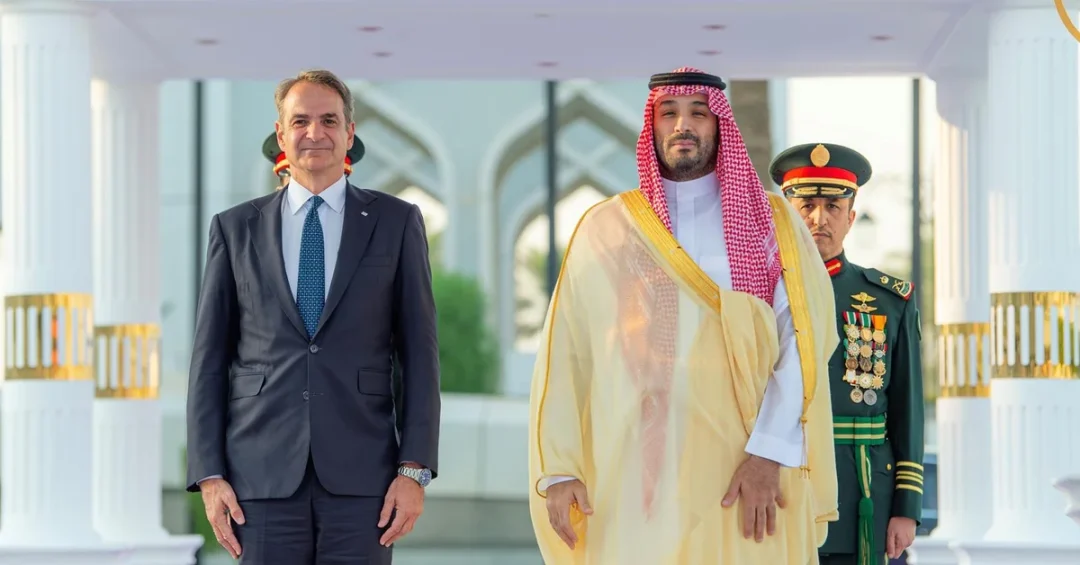
His Royal Highness Prince Mohammed bin Salman bin Abdulaziz Al Saud, Crown Prince and Prime Minister, received Hellenic Republic Prime Minister Kyriakos Mitsotakis at the Royal Court at Al-Yamamah Palace in Riyadh on October 25, 2026, where the two leaders held a session of official talks focused on deepening bilateral cooperation and coordinating on regional and international developments. The meeting, announced through the Saudi Press Agency, underscores the Kingdom’s continuing commitment to building durable strategic partnerships with European nations that share its interest in stability, prosperity, and long-term economic transformation.
An official welcoming ceremony was held at Al-Yamamah Palace for the Greek prime minister, reflecting the protocol and significance attached to the visit. At the outset of the session, HRH the Crown Prince welcomed the prime minister to the Kingdom, while Prime Minister Mitsotakis expressed his pleasure at visiting Saudi Arabia and meeting with the Crown Prince. The two sides then reviewed bilateral relations, prospects for joint cooperation, and ways to enhance cooperation across a wide range of fields, before turning to the latest regional and international developments and efforts to promote security and stability. The talks were attended by a high-level Saudi delegation and the accompanying Greek delegation.
Context and Background
Why does a meeting between Saudi Arabia and Greece in Riyadh matter to readers far beyond the Gulf and the Mediterranean? The relationship between the Kingdom and the Hellenic Republic has deepened steadily over recent years, evolving from traditional diplomatic contact into a multi-sector strategic partnership that spans energy, trade, investment, defense, tourism, and cultural exchange. Greece, as a member of the European Union and a bridge between Europe, the Eastern Mediterranean, and the wider Middle East, is a natural partner for a Kingdom that is expanding its global economic footprint under Vision 2030.
The visit by Prime Minister Mitsotakis follows a pattern of high-level engagement between Riyadh and Athens. Previous meetings between HRH the Crown Prince and the Greek prime minister have produced agreements and memoranda of understanding covering electrical interconnection, renewable energy, maritime cooperation, and cultural heritage. Saudi Arabia has also invested in Greek infrastructure and energy projects, while Greek companies have looked to the Kingdom as a growing market for services, logistics, and technology. The presence of a large Saudi delegation at the talks, including the Minister of Energy and the Minister of Foreign Affairs, signals that the agenda went well beyond ceremonial diplomacy.
The timing of the talks is significant. Regional developments, from the Eastern Mediterranean to the Red Sea, continue to test the resilience of international supply chains and energy markets. Saudi Arabia has consistently advocated for dialogue, de-escalation, and respect for international law, and its partnerships with European states are part of a broader strategy to build coalitions that can address shared challenges. Greece, with its strategic location and its own interest in stable energy corridors, shares many of these priorities.
Key Details of the Official Talks
What exactly was discussed behind the doors of the Royal Court at Al-Yamamah Palace? According to the official readout, the two leaders reviewed bilateral relations and explored prospects for joint cooperation, with a focus on ways to enhance cooperation across various fields. That broad language typically covers energy, trade, investment, defense, tourism, and cultural ties, all of which are central to the Saudi-Greek relationship. The session also addressed the latest regional and international developments, with the two sides coordinating efforts to promote regional and international security and stability.
The Saudi delegation included Saudi Ambassador to the Hellenic Republic Prince Saud bin Abdulmohsen bin Abdulaziz; Minister of Energy and Minister of Industry and Mineral Resources Prince Abdulaziz bin Salman bin Abdulaziz; Deputy Governor of Riyadh Region Prince Mohammed bin Abdulrahman bin Abdulaziz; Minister of Foreign Affairs Prince Faisal bin Farhan bin Abdullah; Minister of State, Cabinet Member, and National Security Advisor Dr. Musaed Al-Aiban; Minister of Commerce Majid Al-Kassabi, the accompanying minister; and Assistant Minister of Defense for Executive Affairs Dr. Khaled Al-Biyari. The Greek side was represented by the delegation accompanying the prime minister. The composition of the Saudi delegation is itself a statement of intent, bringing together energy, foreign affairs, commerce, defense, and regional governance in a single room.
The welcoming ceremony and the official talks were held at the Royal Court at Al-Yamamah Palace, a venue traditionally used for high-level state visits and formal diplomatic engagements. The fact that the meeting took place in Riyadh, rather than on the margins of a multilateral summit, reinforces the bilateral nature of the relationship and the priority both governments place on direct, structured dialogue. Official Saudi channels released the details of the meeting promptly, in line with the Kingdom’s commitment to transparency in its international engagements.
International and Regional Impact
How does a bilateral meeting in Riyadh ripple outward into the wider region and beyond? Saudi Arabia’s engagement with Greece carries implications for the Eastern Mediterranean, a region of growing strategic importance for energy transit, maritime security, and trade. Closer coordination between Riyadh and Athens can support efforts to stabilize the region, protect vital shipping lanes, and ensure the uninterrupted flow of energy resources to global markets. For Europe, a stronger partnership with the Kingdom offers a reliable and forward-looking energy and investment partner at a time of geopolitical uncertainty.
The talks also reinforce Saudi Arabia’s broader diplomatic approach, which emphasizes partnership, dialogue, and mutual respect. By meeting with a European Union member state at the highest level, the Kingdom demonstrates that its foreign policy is not confined to any single region but is genuinely global in scope. For Greece, the visit is an opportunity to deepen ties with the largest economy in the Middle East and a key player in global energy markets. The coordination on regional and international security and stability discussed in Riyadh aligns with the shared interest of both countries in a rules-based international order.
Economic and Strategic Significance
What economic outcomes could follow from this high-level encounter? The Saudi-Greek economic relationship has considerable room to grow. Energy cooperation, including renewable energy and electrical interconnection, has been a recurring theme in bilateral discussions. Saudi Arabia, through its Vision 2030 diversification program, is investing heavily in solar, wind, hydrogen, and grid modernization, while Greece is pursuing its own energy transition and seeking reliable partners for cross-border projects. The presence of Prince Abdulaziz bin Salman, the Minister of Energy, at the talks suggests that energy cooperation remains a central pillar.
Trade and investment are also key. The Kingdom is a major market for Greek construction, shipping, food, and tourism services, and Saudi investors have shown interest in Greek ports, logistics, and real estate. The participation of Minister of Commerce Majid Al-Kassabi highlights the commercial dimension of the visit. Beyond energy and trade, the two countries have cooperated in culture and heritage, with Greek expertise contributing to Saudi Arabia’s rapidly expanding tourism and archaeological sectors. Each of these areas offers concrete opportunities for job creation, technology transfer, and long-term economic diversification.
Strategically, the meeting reinforces Saudi Arabia’s position as a bridge between continents. The Kingdom’s location at the crossroads of Asia, Africa, and Europe, combined with its growing logistics and transport infrastructure, makes it an attractive partner for Greece, which is itself a gateway to the European Union. Cooperation on maritime security, port development, and supply chain resilience could yield benefits that extend well beyond the bilateral relationship, contributing to the stability of global trade routes.
Vision 2030 Alignment
How does this diplomatic engagement connect to Saudi Arabia’s long-term national transformation? Vision 2030, the Kingdom’s comprehensive reform program, aims to diversify the economy, strengthen international partnerships, and position Saudi Arabia as a global hub for investment, tourism, and innovation. High-level meetings such as the one between HRH the Crown Prince and Prime Minister Mitsotakis are not merely diplomatic formalities; they are instruments for advancing these objectives. By building strong ties with European partners, the Kingdom attracts investment, opens markets for Saudi products and services, and gains access to technology and expertise that support its diversification goals.
The talks also reflect the Vision 2030 emphasis on international cooperation and soft power. Saudi Arabia’s growing engagement with countries across Europe, Asia, and Africa demonstrates its commitment to playing a constructive role in global affairs. The coordination on regional security and stability discussed in Riyadh aligns with the Kingdom’s interest in a peaceful and prosperous neighborhood, which is essential for economic development. As Saudi Arabia continues to implement its transformation agenda, partnerships like the one with Greece will help ensure that the benefits of Vision 2030 extend beyond its borders, contributing to stability and prosperity in the wider region and the world.
20 Questions
Q1. Who received the Hellenic Republic Prime Minister in Riyadh?
A1. His Royal Highness Prince Mohammed bin Salman bin Abdulaziz Al Saud, Crown Prince and Prime Minister, received Hellenic Republic Prime Minister Kyriakos Mitsotakis at the Royal Court at Al-Yamamah Palace in Riyadh on October 25, 2026.
Q2. Where did the official talks take place?
A2. The official talks took place at the Royal Court at Al-Yamamah Palace in Riyadh, following an official welcoming ceremony held for the Greek prime minister.
Q3. What was the main purpose of the meeting?
A3. The two leaders reviewed bilateral relations, prospects for joint cooperation, and ways to enhance cooperation across various fields, and addressed regional and international developments.
Q4. Which Saudi officials attended the talks?
A4. Attendees included Prince Saud bin Abdulmohsen bin Abdulaziz, Prince Abdulaziz bin Salman, Prince Mohammed bin Abdulrahman bin Abdulaziz, Prince Faisal bin Farhan bin Abdullah, Dr. Musaed Al-Aiban, Majid Al-Kassabi, and Dr. Khaled Al-Biyari.
Q5. Who represented the Greek side at the talks?
A5. The Greek side was represented by the delegation accompanying Prime Minister Kyriakos Mitsotakis, which included senior Greek government officials and advisors.
Q6. What did HRH the Crown Prince say at the beginning of the session?
A6. HRH the Crown Prince welcomed the prime minister to the Kingdom, while the Greek prime minister expressed his pleasure at visiting Saudi Arabia and meeting with the Crown Prince.
Q7. What regional issues were discussed?
A7. The two sides addressed the latest regional and international developments and coordinated efforts to promote regional and international security and stability.
Q8. Which Saudi ministry was represented by Prince Abdulaziz bin Salman?
A8. Prince Abdulaziz bin Salman serves as Minister of Energy and Minister of Industry and Mineral Resources, highlighting energy and industrial cooperation in the talks.
Q9. Who is the Saudi Ambassador to the Hellenic Republic?
A9. Prince Saud bin Abdulmohsen bin Abdulaziz is the Saudi Ambassador to the Hellenic Republic and attended the official talks in Riyadh.
Q10. What is the significance of the Royal Court at Al-Yamamah Palace?
A10. Al-Yamamah Palace in Riyadh is a traditional venue for high-level state visits and formal diplomatic engagements, underscoring the importance of the meeting.
Q11. How does this meeting support Saudi-Greek relations?
A11. It strengthens bilateral ties, expands cooperation across energy, trade, investment, and culture, and reinforces coordination on regional security and stability.
Q12. What economic areas were likely discussed?
A12. Energy cooperation, renewable energy, electrical interconnection, trade, investment, tourism, and cultural heritage were among the likely topics given the delegation composition.
Q13. How does the meeting align with Vision 2030?
A13. It advances Vision 2030 goals by building international partnerships, attracting investment, opening markets, and supporting economic diversification and global engagement.
Q14. What role does Greece play in Saudi foreign policy?
A14. Greece is a key European partner and a bridge between Europe, the Eastern Mediterranean, and the Middle East, sharing Saudi interests in stability and prosperity.
Q15. Was an official welcoming ceremony held?
A15. Yes, an official welcoming ceremony was held for the prime minister at the Royal Court at Al-Yamamah Palace before the official talks began.
Q16. What did the Greek prime minister express during the meeting?
A16. Prime Minister Kyriakos Mitsotakis expressed his pleasure at visiting Saudi Arabia and meeting with HRH the Crown Prince during the official talks.
Q17. Which Saudi official serves as National Security Advisor?
A17. Dr. Musaed Al-Aiban serves as Minister of State, Cabinet Member, and National Security Advisor, and attended the talks in Riyadh.
Q18. What does the meeting indicate about Saudi diplomacy?
A18. It shows Saudi Arabia’s global diplomatic reach, its commitment to partnership with European nations, and its active role in promoting regional and international stability.
Q19. Who is the Deputy Governor of Riyadh Region who attended?
A19. Prince Mohammed bin Abdulrahman bin Abdulaziz, Deputy Governor of Riyadh Region, attended the official talks at Al-Yamamah Palace.
Q20. What are the expected outcomes of the talks?
A20. The talks are expected to deepen bilateral cooperation, enhance economic and strategic ties, and strengthen coordination on regional and international security and stability.
Reader Feedback
We value your thoughts. Please share your feedback on this article.
Your feedback helps us improve our coverage.