


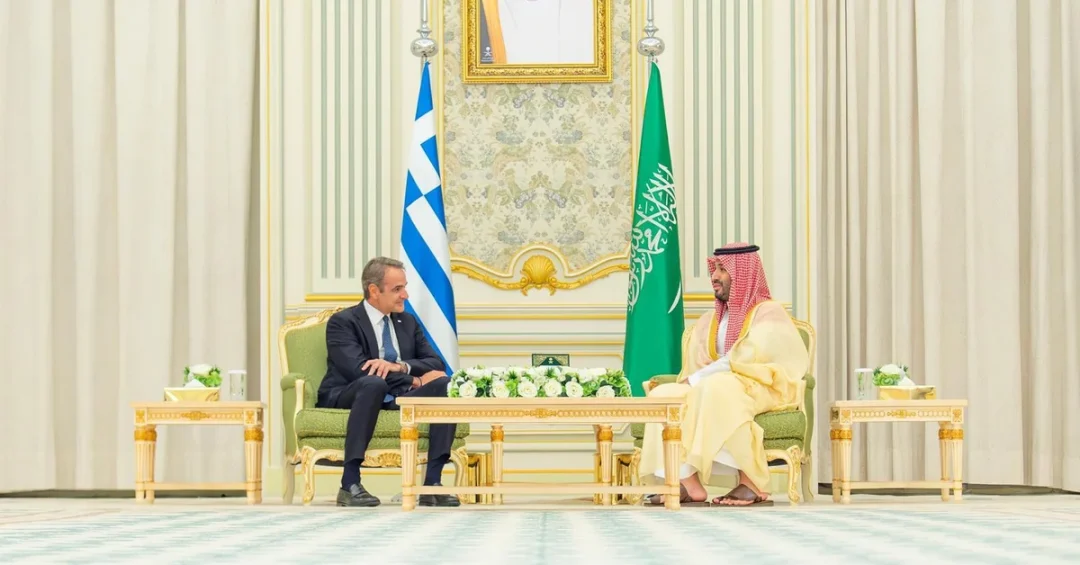
The Kingdom of Saudi Arabia and the Hellenic Republic issued a joint statement on Sunday, October 25, 2026, at the conclusion of the official visit of Prime Minister Kyriakos Mitsotakis of Greece to Riyadh, marking the centenary of diplomatic relations between the two countries and setting out an expanded agenda for strategic cooperation. The statement, released through official Saudi channels, confirmed that His Royal Highness Prince Mohammed bin Salman bin Abdulaziz Al Saud, Crown Prince and Prime Minister, received the Greek prime minister in Riyadh for talks that reviewed bilateral ties and explored new avenues for developing them across every field.
So why does a single bilateral visit, between two nations separated by sea and continent, carry weight far beyond the Mediterranean and the Gulf? Because the Saudi-Greek relationship has quietly become one of the more consequential partnerships of the decade, anchored by a Strategic Partnership Council, an energy interconnection vision, and a digital corridor designed to link East and West. The joint statement issued at the close of the visit is not merely ceremonial. It is a working document that confirms progress on subsea cables, electrical grids, clean hydrogen, trade, and defense coordination, and it comes as the Kingdom continues to position itself as a global hub for energy, logistics, and technology under Vision 2030.
Context and Background
What makes this moment in Saudi-Greek relations historically significant? The answer begins with the calendar. The two countries are marking 100 years of diplomatic relations in 2026, a centenary that both sides explicitly congratulated one another on during the official talks in Riyadh. That century of ties has been transformed in recent years from a conventional diplomatic relationship into a structured strategic partnership with institutions, committees, and a clear pipeline of joint initiatives.
The joint statement recalled two pivotal milestones. The first was HRH the Crown Prince’s visit to the Hellenic Republic in July 2022, during which the Saudi-Hellenic Strategic Partnership Council was announced. The second was Prime Minister Mitsotakis’s visit to the Kingdom in January 2025, which included the council’s first meeting. According to the statement, these visits have broadened cooperation between the two countries, and both sides stressed the council’s importance as an effective institutional framework for the strategic partnership, affirming their commitment to continuing work within it and implementing priority joint initiatives.
This institutional architecture matters because it converts intentions into timetables. The council gives both governments a standing mechanism to track commitments, coordinate ministries, and engage the private sector. For international observers, the visit signals that Saudi Arabia’s partnerships are increasingly built on durable structures rather than one-off agreements, a pattern consistent with the Kingdom’s broader approach to foreign engagement under Vision 2030.
Key Details of the Joint Statement
What did the two leaders actually agree on, and what does the text of the statement commit them to? On the economy, trade, and investment, both sides commended the strength of economic ties and agreed on the importance of strengthening them further, particularly in priority sectors, and of seizing the investment opportunities created by both countries’ strategic visions. The statement noted with appreciation that bilateral trade has grown since 2021, reaching about $1.7 billion in 2025.
The two sides welcomed progress made by the investment and trade committee under the Strategic Partnership Council and stressed the need to implement agreed initiatives to deliver tangible results. They also welcomed the recent meeting of the Saudi-Hellenic Business Council in Athens and agreed on the importance of strengthening investment in key sectors, including infrastructure, construction, energy, digital connectivity, logistics, and technology. The Saudi side welcomed Greek investors and companies, expressed interest in attracting high-quality investment and advanced expertise in promising sectors, and encouraged Greek firms to establish regional headquarters in the Kingdom and to explore opportunities in major projects, including those linked to the Kingdom’s hosting of Expo 2030 Riyadh and the 2034 FIFA World Cup.
The Greek side, in turn, encouraged Saudi companies to explore investment opportunities in Greece, highlighting its strategic location as a gateway to the European market and Southeast Europe, and pointing to opportunities in energy, transport, logistics, digital infrastructure, and advanced technologies. Both sides acknowledged progress on the East to Med Data Corridor (EMC) subsea cable project, which aims to enhance digital connectivity between East and West, and reaffirmed their commitment to completing it on schedule.
On energy, the Greek side commended the Kingdom’s leading role in enhancing the reliability and stability of global oil markets and its positive contribution to balancing energy markets in the interests of both producers and consumers, supporting sustainable economic growth. Both sides stressed the critical importance of safeguarding the security of international maritime corridors to ensure the safe, uninterrupted flow of energy supplies to global markets, and expressed concern over attacks on energy infrastructure, which affect supply availability and market stability. The Greek side commended the Kingdom’s efforts to ensure continuity of supplies and strengthen supply chain resilience, notably through alternative export routes such as the East-West Pipeline, which have helped mitigate market volatility and strengthen global energy security.
Energy Interconnection and the East to Med Corridor
How does a memorandum of cooperation signed in 2022 translate into a physical link between the Gulf and Europe? The joint statement placed the Saudi-Greek electrical interconnection project at the center of the bilateral energy agenda. Both sides stressed the importance of the 2022 memorandum of cooperation in the energy sector and committed to accelerating cooperation in this strategic field.
The Saudi side noted that the project is one of several interconnection initiatives the Kingdom is implementing as part of its ambition to become a global hub for electrical interconnection and energy exports. According to the statement, the project will enable the exchange and export of electricity, enhance the security and reliability of interconnected grids, and link the Kingdom’s grid to Europe via the Hellenic Republic. The Greek side highlighted Greece’s strategic location and existing infrastructure as pillars of its development into a regional hub for energy and digital connectivity, a vision that complements the interconnection project.
Both sides also emphasized the importance of cooperation on clean hydrogen, including exploring exports from the Kingdom to the Hellenic Republic and on to demand centers in other European Union member states. They stressed the importance of expanding bilateral investment in conventional energy, renewable energy, and petrochemicals to diversify global supply chains, develop the necessary technologies, and encourage partnerships between companies to make the most of local resources in both countries. They agreed to enhance cooperation on energy efficiency and conservation in the building, industrial, and transport sectors, including raising awareness, and to collaborate on energy services and related capacity building.
International and Regional Impact
Why should this partnership matter to readers far beyond Riyadh and Athens? Because the Saudi-Greek relationship now touches the architecture of global connectivity. The East to Med Data Corridor is designed to move data between East and West, complementing the Kingdom’s ambitions to become a digital bridge between Asia, Europe, and Africa. The electrical interconnection project, meanwhile, would create a physical pathway for electricity exports from Saudi Arabia to Europe via Greece, reinforcing the Kingdom’s stated ambition to be a global hub for electrical interconnection and energy exports.
On climate change, both sides stressed the importance of adhering to the principles of the United Nations Framework Convention on Climate Change (UNFCCC) and the Paris Agreement. They highlighted the value of cooperation on circular carbon economy applications as a tool for managing emissions and achieving climate mitigation and adaptation goals. The two sides also emphasized the importance of strengthening cooperation in the digital economy, artificial intelligence, emerging technologies, and space; transport, logistics, and civil aviation; the judiciary and justice; culture; tourism; sports and youth; science and education; media; advanced industries and supply chain integration; environment, water, and agriculture; and public health, health security, the pharmaceutical industry, and biotechnology.
They affirmed their determination to strengthen defense cooperation and coordination in a way that serves their mutual interests and contributes to regional and global peace and security. They also stressed their commitment to enhancing security cooperation on issues of common concern, including combating crime in all its forms, countering extremism, terrorism, and terrorist financing, and exchanging expertise and training. They agreed on the importance of strengthening cooperation in cybersecurity and information sharing to protect both countries’ core interests and national security.
Economic and Strategic Significance
What does the trade and investment dimension of this visit reveal about Saudi Arabia’s economic trajectory? The figure of approximately $1.7 billion in bilateral trade in 2025, up from 2021 levels, reflects a relationship that is growing but still far below its potential. The joint statement acknowledges this implicitly by emphasizing the need to implement agreed initiatives and deliver tangible results, and by directing attention to infrastructure, construction, energy, digital connectivity, logistics, and technology as priority sectors.
For Saudi Arabia, Greece offers more than a bilateral market. It offers a gateway to the European Union and Southeast Europe, precisely the kind of access that supports the Kingdom’s export diversification goals and its efforts to attract high-quality foreign investment. The invitation to Greek firms to establish regional headquarters in the Kingdom aligns with Saudi Arabia’s regional headquarters program, which is designed to deepen the Kingdom’s role as a corporate and commercial hub for the Middle East.
For Greece, Saudi Arabia offers capital, energy expertise, and access to Gulf markets, as well as participation in the Kingdom’s mega-projects tied to Expo 2030 Riyadh and the 2034 FIFA World Cup. The mutual encouragement of investment flows, documented in the joint statement, suggests both governments see the private sector as the engine of the next phase of the relationship.
Vision 2030 Alignment
How does the Saudi-Greek partnership connect to the Kingdom’s long-term national strategy? Vision 2030 aims to diversify the Saudi economy, expand non-oil exports, develop renewable and clean energy, and position the Kingdom as a global logistics and investment hub. Every major element of the joint statement maps onto those objectives: electrical interconnection supports the ambition to become a global hub for energy exports; the East to Med Data Corridor supports digital connectivity and the knowledge economy; cooperation on clean hydrogen, artificial intelligence, space, and advanced industries supports technology and innovation goals; and the invitation to Greek firms to invest in the Kingdom supports foreign direct investment and private sector growth targets.
The statement’s emphasis on tourism, culture, sports, youth, science, education, and public health also reflects Vision 2030’s quality-of-life dimensions, which aim to broaden exchange and deepen international partnerships beyond traditional sectors. At the conclusion of the visit, Prime Minister Mitsotakis thanked HRH the Crown Prince for the warm reception and generous hospitality extended to him and his delegation, and HRH the Crown Prince wished the prime minister good health and well-being and the friendly Greek people continued progress and prosperity. The centenary of Saudi-Greek diplomatic relations is thus not only a moment of reflection on a century past, but a foundation for a partnership that both governments expect to shape the next one.
20 Questions
Q1. When did Prime Minister Kyriakos Mitsotakis visit Saudi Arabia, and what was the occasion?
A1. Prime Minister Mitsotakis paid an official visit to the Kingdom of Saudi Arabia on October 25, 2026. The visit coincided with the centenary of diplomatic relations between Saudi Arabia and the Hellenic Republic, and it concluded with a joint statement released through official Saudi channels.
Q2. Who received the Greek prime minister in Riyadh?
A2. His Royal Highness Prince Mohammed bin Salman bin Abdulaziz Al Saud, Crown Prince and Prime Minister, received Prime Minister Kyriakos Mitsotakis in Riyadh. During official talks, the two leaders exchanged congratulations on the centenary of diplomatic relations and reviewed bilateral ties.
Q3. What is the Saudi-Hellenic Strategic Partnership Council?
A3. The council is an institutional framework for the strategic partnership between the two countries, announced during HRH the Crown Prince’s July 2022 visit to Greece. Its first meeting took place during the Greek prime minister’s January 2025 visit to the Kingdom, and both sides affirmed their commitment to continuing work within it.
Q4. How much did bilateral trade between Saudi Arabia and Greece reach in 2025?
A4. According to the joint statement, bilateral trade between the two countries grew since 2021 and reached about $1.7 billion in 2025. Both sides commended the strength of economic ties and agreed on the importance of strengthening them further in priority sectors.
Q5. What is the East to Med Data Corridor project?
A5. The East to Med Data Corridor (EMC) is a subsea cable project that aims to enhance digital connectivity between East and West. Both sides acknowledged progress made on the project and reaffirmed their commitment to completing it on schedule.
Q6. What did the statement say about the Saudi-Greek electrical interconnection project?
A6. Both sides stressed the importance of the 2022 memorandum of cooperation in the energy sector, which includes the electrical interconnection project, and committed to accelerating cooperation. It will enable electricity exchange and export and link the Kingdom’s grid to Europe via Greece.
Q7. How did Greece describe Saudi Arabia’s role in global oil markets?
A7. The Greek side commended the Kingdom’s leading role in enhancing the reliability and stability of global oil markets and its positive contribution to balancing energy markets in the interests of both producers and consumers, supporting sustainable economic growth.
Q8. What did both sides say about maritime corridor security?
A8. Both sides stressed the critical importance of safeguarding the security of international maritime corridors to ensure the safe, uninterrupted flow of energy supplies to global markets, and expressed concern over attacks on energy infrastructure that affect supply availability and market stability.
Q9. What role did the East-West Pipeline play in the discussion?
A9. The Greek side commended the Kingdom’s efforts to ensure continuity of supplies and strengthen supply chain resilience, notably through alternative export routes such as the East-West Pipeline, which have helped mitigate market volatility and strengthen global energy security.
Q10. What areas of clean energy cooperation were highlighted?
A10. Both sides emphasized cooperation on clean hydrogen, including exploring exports from the Kingdom to the Hellenic Republic and on to demand centers in other European Union member states. They also stressed expanding investment in renewable energy and petrochemicals.
Q11. What did the statement say about climate change commitments?
A11. Both sides stressed the importance of adhering to the principles of the United Nations Framework Convention on Climate Change and the Paris Agreement. They highlighted cooperation on circular carbon economy applications as a tool for managing emissions and achieving climate goals.
Q12. Which sectors did the two sides identify for expanded cooperation?
A12. The statement listed the digital economy, artificial intelligence, emerging technologies, space, transport, logistics, civil aviation, the judiciary, culture, tourism, sports, youth, science, education, media, advanced industries, supply chains, environment, water, agriculture, and public health.
Q13. What did the statement say about defense and security cooperation?
A13. Both sides affirmed their determination to strengthen defense cooperation and coordination in a way that serves mutual interests and contributes to regional and global peace and security, and stressed cooperation on combating crime, extremism, terrorism, and terrorist financing.
Q14. Was cybersecurity mentioned in the joint statement?
A14. Yes. Both sides agreed on the importance of strengthening cooperation in cybersecurity and information sharing to protect both countries’ core interests and national security, reflecting the growing digital dimension of the partnership.
Q15. What opportunities were Greek companies encouraged to explore in Saudi Arabia?
A15. The Saudi side encouraged Greek firms to establish regional headquarters in the Kingdom and to explore opportunities in major projects, including those linked to the Kingdom’s hosting of Expo 2030 Riyadh and the 2034 FIFA World Cup.
Q16. What opportunities were Saudi companies encouraged to explore in Greece?
A16. The Greek side encouraged Saudi companies to explore investment opportunities in Greece, highlighting its strategic location as a gateway to the European market and Southeast Europe, and opportunities in energy, transport, logistics, digital infrastructure, and advanced technologies.
Q17. What role did the Saudi-Hellenic Business Council play in the visit?
A17. The joint statement welcomed the recent meeting of the Saudi-Hellenic Business Council in Athens. Both sides agreed on the importance of strengthening investment in key sectors, including infrastructure, construction, energy, digital connectivity, logistics, and technology.
Q18. How does the partnership align with Saudi Vision 2030?
A18. The partnership supports Vision 2030 goals including economic diversification, non-oil exports, clean energy development, digital connectivity, foreign direct investment, and the Kingdom’s ambition to become a global hub for energy exports and logistics.
Q19. What did Prime Minister Mitsotakis say at the conclusion of the visit?
A19. At the conclusion of the visit, Prime Minister Mitsotakis thanked HRH the Crown Prince for the warm reception and generous hospitality extended to him and his delegation. HRH the Crown Prince wished the prime minister good health and the Greek people continued progress and prosperity.
Q20. What is the broader significance of the centenary for Saudi-Greek relations?
A20. The centenary marks 100 years of diplomatic relations and provides a foundation for an expanded strategic partnership. The joint statement confirms progress on trade, energy interconnection, digital corridors, and defense coordination, setting a forward-looking agenda for both countries.
Reader Feedback
We value your thoughts. Please share your feedback on this article.
Your feedback helps us improve our coverage.