


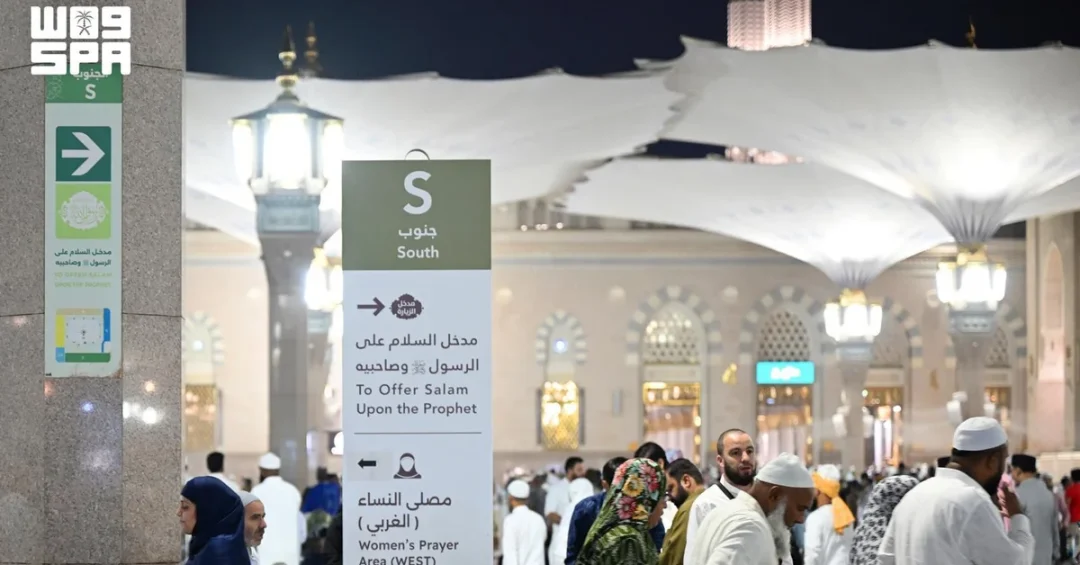
The General Authority for the Care of the Affairs of the Grand Mosque and the Prophet’s Mosque has deployed an integrated guidance system across the Prophet’s Mosque in Madinah, comprising 274 directional signs and 106 electronic screens designed to streamline the movement of worshippers and visitors throughout the sacred site and its surrounding facilities. The system, announced through official Saudi channels, uses a unified visual identity and color-coding scheme to make instructions easier to read and destinations easier to identify, reflecting the Kingdom’s broader commitment to enhancing the experience of the millions of pilgrims and visitors who travel to the Prophet’s Mosque each year.
Have you ever wondered how a site welcoming millions of visitors annually manages to guide each person smoothly to their destination? The answer lies in a carefully engineered combination of physical signage and digital display technology that together form one of the most sophisticated wayfinding networks ever installed in a religious landmark. The initiative forms part of a wider effort by the Authority to improve traffic flow, optimize the use of the mosque’s extensive facilities, and create a more accessible environment that enriches the spiritual experience of every visitor. The guidance system represents a tangible example of how Saudi Arabia is applying modern operational thinking to the service of sacred spaces.
Context and Background
The Prophet’s Mosque in Madinah holds a unique place in the Islamic world as the second holiest site in Islam, attracting millions of worshippers and visitors from across the globe every year. Managing the flow of such vast numbers of people through prayer halls, courtyards, gates, and ancillary facilities requires meticulous planning and coordination. The General Authority for the Care of the Affairs of the Grand Mosque and the Prophet’s Mosque, the government body responsible for the administration and upkeep of both holy sites, has progressively introduced modern systems to meet these demands. The guidance system is the latest in a series of enhancements that reflect the Authority’s mandate to serve visitors with efficiency and dignity.
Why does wayfinding matter so much in a place of worship? Because the ability to move confidently and calmly through a sacred space directly affects the quality of a visitor’s spiritual journey. When worshippers can locate entrances, prayer areas, ablution facilities, and exits without confusion, they arrive at their destination focused and at ease. The Authority has recognized that clear guidance is not merely a logistical convenience but an integral part of the hospitality that the Kingdom extends to guests of the Prophet’s Mosque. The new system builds on years of accumulated operational experience, incorporating lessons learned from previous pilgrimage seasons and from the continuous feedback of visitors and staff.
The introduction of the guidance system also aligns with the broader modernization of services at Saudi Arabia’s holy sites, where technology and tradition are carefully balanced. The Authority has consistently emphasized that innovation at the Prophet’s Mosque must always serve the spiritual purpose of the site, never distract from it. In this context, the 274 directional signs and 106 electronic screens are designed to be visually unobtrusive while remaining highly functional, blending into the architectural and spiritual character of the mosque. This approach ensures that the guidance infrastructure supports rather than intrudes upon the contemplative atmosphere that defines the visitor experience.
Key Details of the Guidance System
The integrated guidance system comprises two complementary components: a comprehensive network of 274 directional signs and a fleet of 106 electronic screens distributed throughout the Prophet’s Mosque and its facilities. The signs employ a unified visual identity and color-coding system that allows visitors to recognize destinations at a glance, regardless of the language they speak. This color-coded approach reduces reliance on text and makes navigation intuitive for the diverse international audience that visits the site. The electronic screens, meanwhile, display a range of dynamic information, including entry instructions, guidance on behaviors to avoid inside the mosque, and real-time updates on gate status and available entrances.
How do electronic screens improve on traditional signage? By providing information that changes with conditions on the ground. Static signs can indicate where a gate is, but only a digital display can tell a visitor whether that gate is currently open, busy, or temporarily closed. The real-time gate status feature is particularly valuable during peak periods, when the flow of worshippers can shift rapidly and certain entrances become congested. By directing visitors toward available entrances, the screens help distribute foot traffic more evenly across the mosque’s facilities, reducing bottlenecks and improving the overall experience for everyone present. This dynamic capability transforms the guidance system from a passive reference tool into an active traffic management instrument.
The system also plays an educational role by communicating guidance on behaviors to avoid inside the Prophet’s Mosque. This component supports the maintenance of a respectful and orderly environment, reminding visitors of the etiquette appropriate to the sacred setting. By combining practical navigation with gentle behavioral guidance, the screens reinforce the Authority’s dual mission of facilitating access and preserving the sanctity of the site. The unified visual identity across all signs and screens ensures that visitors encounter a consistent, recognizable guidance language from the moment they approach the mosque until they depart, creating a seamless informational experience.
International and Regional Impact
The Prophet’s Mosque welcomes visitors from every continent, making the effectiveness of its guidance system a matter of international significance. Pilgrims arriving from Southeast Asia, Africa, Europe, and the Americas often face language barriers and unfamiliar surroundings. The color-coded, visually intuitive design of the new system addresses these challenges directly, allowing visitors to navigate confidently even without fluency in Arabic. For international travelers, this represents a meaningful improvement in the accessibility and welcoming character of one of the world’s most visited religious sites. The system thus contributes to Saudi Arabia’s reputation as a gracious and capable host to millions of guests each year.
Regionally, the guidance system sets a benchmark for the management of large-scale religious and cultural sites across the Middle East and the wider Islamic world. The combination of physical signage and real-time digital information offers a model that other institutions may study and adapt. Within the Kingdom, the system complements similar enhancements at the Grand Mosque in Makkah, where the same Authority oversees operations. Together, these initiatives demonstrate a coherent, coordinated approach to serving pilgrims that spans both holy cities. The result is a more integrated pilgrimage experience that reflects the Kingdom’s commitment to continuous improvement in the services it provides to visitors.
Economic and Strategic Significance
While the guidance system is primarily a service enhancement, it carries broader economic and strategic significance. Efficient traffic flow at the Prophet’s Mosque supports the wider ecosystem of hospitality, transportation, and retail services that surrounds the site and serves its visitors. When worshippers can move smoothly and spend less time searching for entrances or facilities, they are better able to participate in the local economy, from hotels and restaurants to shops and transport providers. Improved accessibility also enhances the overall visitor experience, which in turn strengthens the Kingdom’s appeal as a destination for religious tourism and contributes to the growth of the sector.
Strategically, the initiative reflects Saudi Arabia’s recognition that world-class infrastructure and service delivery are essential to its role as the custodian of Islam’s holiest sites. The guidance system is one element of a much larger program of investment in the holy cities, encompassing expansion projects, crowd management technologies, and hospitality improvements. By continuously upgrading the visitor experience, the Kingdom reinforces its capacity to host increasing numbers of pilgrims in comfort and safety. This capability is a source of national pride and a cornerstone of the Kingdom’s international standing, demonstrating that Saudi Arabia can combine profound religious responsibility with operational excellence.
Vision 2030 Alignment
The integrated guidance system at the Prophet’s Mosque aligns closely with Saudi Vision 2030, the national transformation program that seeks to diversify the economy, enhance quality of life, and elevate the Kingdom’s global role. Vision 2030 places particular emphasis on improving services for pilgrims and visitors, recognizing the pilgrimage sector as a vital contributor to economic growth and cultural exchange. By investing in smart wayfinding technology and thoughtful infrastructure, the Authority is translating the vision’s objectives into concrete improvements that touch the lives of millions. The system exemplifies how Vision 2030’s commitment to innovation and service excellence can be applied in the most sacred and sensitive of contexts.
Looking ahead, the guidance system is expected to evolve alongside the growing number of visitors to the Prophet’s Mosque. The Authority’s ongoing program of enhancements suggests that further technological and infrastructural improvements will follow, each designed to make the visitor experience smoother, more accessible, and more spiritually rewarding. As Saudi Arabia continues its journey toward Vision 2030, initiatives like this one demonstrate that the Kingdom’s modernization is not confined to economic sectors but extends to the care of its most cherished religious institutions. The result is a pilgrimage experience that honors tradition while embracing the best of contemporary practice, ensuring that every visitor to the Prophet’s Mosque is received with clarity, comfort, and respect.
20 Questions
Q1. What is the integrated guidance system at the Prophet’s Mosque?
A1. It is a network of 274 directional signs and 106 electronic screens installed throughout the Prophet’s Mosque and its facilities to help visitors and worshippers find locations and services easily.
Q2. Which authority implemented this guidance system?
A2. The General Authority for the Care of the Affairs of the Grand Mosque and the Prophet’s Mosque, the Saudi government body responsible for administering both holy sites, implemented the system.
Q3. How many directional signs are part of the system?
A3. The system includes 274 directional signs distributed across the Prophet’s Mosque and its surrounding facilities to guide visitors to their destinations.
Q4. How many electronic screens are used in the guidance system?
A4. There are 106 electronic screens that display entry instructions, behavioral guidance, and real-time information about gate status and available entrances.
Q5. What is the purpose of the unified visual identity and color coding?
A5. The unified visual identity and color coding make instructions easier to read and destinations easier to identify, helping visitors navigate intuitively regardless of the language they speak.
Q6. What kind of information do the electronic screens display?
A6. The screens show entry instructions, guidance on behaviors to avoid inside the mosque, and real-time updates on gate status and available entrances.
Q7. How does the system improve traffic flow?
A7. By directing visitors toward available entrances and distributing foot traffic more evenly, the system reduces congestion and helps visitors choose appropriate routes through the mosque.
Q8. Who benefits from this guidance system?
A8. Worshippers and visitors to the Prophet’s Mosque benefit, including international pilgrims who may face language barriers and unfamiliarity with the site’s layout.
Q9. Does the system help during peak visitation periods?
A9. Yes, the real-time gate status information is especially valuable during peak periods when visitor flows shift rapidly and certain entrances become congested.
Q10. How does the guidance system enrich the spiritual experience?
A10. By enabling visitors to move confidently and calmly without confusion, the system allows them to focus on their spiritual journey rather than on finding their way.
Q11. Is the guidance system part of a larger program?
A11. Yes, it is part of the Authority’s broader efforts to enhance services at the holy sites, complementing similar improvements at the Grand Mosque in Makkah.
Q12. How does the system address language barriers?
A12. The color-coded, visually intuitive design reduces reliance on text, allowing visitors to recognize destinations at a glance without needing fluency in Arabic.
Q13. What behavioral guidance do the screens provide?
A13. The screens communicate guidance on behaviors to avoid inside the Prophet’s Mosque, supporting a respectful and orderly environment appropriate to the sacred setting.
Q14. How does the system optimize facility capacity?
A14. By improving traffic flow and directing visitors to available entrances, the system helps make better use of the mosque’s facilities and their capacity.
Q15. Does the guidance system support Saudi Vision 2030?
A15. Yes, it aligns with Vision 2030’s objectives of enhancing quality of life, improving pilgrim services, and elevating the Kingdom’s global role as host to millions of visitors.
Q16. What role does technology play in the system?
A16. Technology enables real-time information delivery through electronic screens, transforming the guidance system from static signage into an active traffic management tool.
Q17. How does the system reflect Saudi hospitality?
A17. By providing clear, accessible guidance to every visitor, the system embodies the Kingdom’s commitment to receiving guests of the Prophet’s Mosque with dignity and care.
Q18. Will the guidance system be expanded in the future?
A18. The Authority’s ongoing program of enhancements suggests further improvements will follow as visitor numbers grow and technology advances, though specific plans have not been announced.
Q19. How does the system compare to similar efforts in Makkah?
A19. The same Authority oversees both holy sites, ensuring a coordinated approach to visitor services that spans the Grand Mosque and the Prophet’s Mosque.
Q20. What is the overall significance of this initiative?
A20. It demonstrates Saudi Arabia’s ability to combine religious responsibility with operational excellence, enhancing the pilgrimage experience while supporting the Kingdom’s long-term development goals.
Reader Feedback
We value your thoughts. Please share your feedback on this article.
Your feedback helps us improve our coverage.