


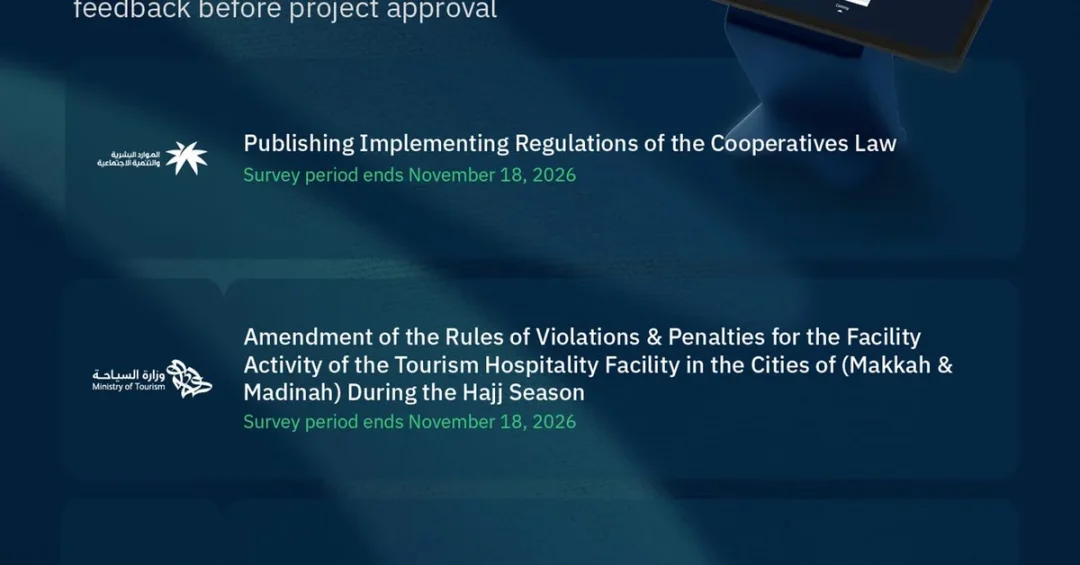
Saudi Arabia’s Competitiveness and Business Center has opened 44 economic and development projects to public feedback through the Istitlaa platform, in cooperation with 25 government entities, giving citizens, businesses, and experts a direct voice in shaping the regulations that will govern the Kingdom’s next phase of growth. Announced via the Saudi Press Agency, the consultation round invites stakeholders to submit comments and proposals before the drafts receive final approval, marking another step in the Kingdom’s drive to make lawmaking more transparent, predictable, and responsive to those it affects.
The projects span sectors that sit at the heart of daily life and business activity, from human resources and tourism to early childhood education. Each draft is published on Istitlaa, the unified electronic Public Consultation Platform overseen by the Saudi Competitiveness and Business Center, where members of the public, government bodies, and the private sector can review proposed rules and respond to them within fixed comment windows. For a global audience watching Saudi Arabia’s regulatory modernization, the exercise offers a concrete window into how the Kingdom now designs policy: openly, digitally, and in partnership with the people and companies it serves. Isn’t that precisely the kind of predictability international investors say they want?
Context and Background
Public consultation has become a defining feature of Saudi Arabia’s legislative process. Rather than approving regulations behind closed doors and issuing them fully formed, government entities now publish draft laws, bylaws, and implementing regulations on Istitlaa before they take effect. The platform is managed by the Saudi Competitiveness and Business Center, an institution whose mandate centers on improving the Kingdom’s business environment and removing friction between regulators and the private sector. By routing drafts through a single, accessible digital channel, the Center gives every interested party the same opportunity to read, analyze, and respond to proposed rules.
The current batch of 44 projects was prepared in cooperation with 25 government entities, a scale that reflects how broadly the consultation culture has spread across the Saudi state. Ministries no longer treat public feedback as an afterthought; it is built into the drafting timetable, with comment periods that typically run for several weeks. This round follows earlier consultation cycles on topics ranging from commercial regulations to social policy, and it continues a pattern in which draft texts are refined in response to submissions before receiving final sign-off. For international observers, the mechanism provides a rare, verifiable record of how Saudi regulation evolves.
The timing matters as well. Saudi Arabia is midway through the most ambitious economic transformation in its history, and every new bylaw either accelerates or slows that transformation. By consulting early, regulators reduce the risk of rules that look sound on paper but create unintended burdens in practice. The Istitlaa process therefore functions as a quality-control step for the entire legislative pipeline, and it explains why the Kingdom’s reform program has been able to move at unusual speed without sacrificing legal clarity.
Key Details
Among the published drafts is a project from the Ministry of Human Resources and Social Development titled “Publishing Implementing Regulations of the Cooperatives Law.” The project aims to develop the governance and oversight model for cooperatives, simplify regulatory procedures, ensure alignment with international cooperative principles, and enable cooperatives to carry out their activities effectively. Public feedback on this project is open until November 18, 2026. Cooperatives matter far beyond their traditional niches: they can channel community capital into housing, agriculture, retail, and services, and a clearer rulebook makes it easier for them to form, raise funds, and operate with confidence.
The Ministry of Tourism has presented a project titled “Amendment of the Rules of Violations and Penalties for the Facility Activity of the Tourism Hospitality Facility in the Cities of (Makkah and Madinah) During the Hajj Season.” The amendment seeks to enhance tourism service quality, improve compliance, and establish a balanced regulatory framework that supports sustainable development during the Hajj season in Makkah and Madinah. Feedback on this project is also open until November 18, 2026. The two holy cities host millions of pilgrims each year, and hospitality facilities there operate under intense seasonal pressure; proportionate, clearly defined penalties help raise service standards while protecting operators who meet their obligations.
The Ministry of Education published “The Kindergarten Stage Regulating Bylaw,” which aims to establish a comprehensive regulatory framework for providing educational and developmental services at the kindergarten stage. The bylaw is designed to improve education and care quality, enhance child safety, protect children’s rights, and support their holistic development and preparation for subsequent stages of education. Public feedback on this project is open until November 19, 2026. Early childhood education is a foundational investment, and a national quality framework for kindergartens supports both working families and the long-term development of the Kingdom’s human capital. The three examples illustrate the range of the consultation round: labor and social organization, pilgrimage-season tourism, and the earliest years of schooling.
International and Regional Impact
For foreign investors and multinational companies, the Istitlaa platform is more than a domestic administrative tool. It is a signal that Saudi regulation is consultative, published in advance, and open to reasoned input from anyone with a stake in the outcome. That predictability lowers perceived risk. When a company can read a draft bylaw, model its impact, and submit comments before the rules are fixed, the cost of compliance becomes easier to plan and the likelihood of abrupt surprises falls. Regional peers and international organizations have taken note of the model, which is unusual in its centralization: one platform, one process, and a single point of access for every ministry’s draft regulations.
The tourism amendment carries particular regional resonance. Makkah and Madinah receive pilgrims from virtually every country on earth, and the quality of hospitality facilities during Hajj season affects the experience of millions of international visitors. A balanced framework of violations and penalties supports sustainable development in the two cities while protecting the integrity of the pilgrimage experience. Similarly, the cooperatives regulations connect Saudi Arabia to a global cooperative movement with well-established international principles, and the kindergarten bylaw aligns with worldwide emphasis on early childhood development. In each case, the Kingdom is harmonizing domestic rules with international norms while retaining its own legal and cultural framework.
Economic and Strategic Significance
The economic logic behind the consultation round is straightforward. Regulations are infrastructure: they shape how quickly businesses can start, how confidently they can invest, and how fairly they compete. By exposing 44 drafts to public scrutiny before approval, the Saudi Competitiveness and Business Center and its 25 partner entities are effectively stress-testing that infrastructure. Feedback from the private sector can flag duplicative requirements, unclear definitions, or procedures that would slow licensing. Feedback from the public can reveal gaps in protection or service quality. The result, when the process works as intended, is regulation that achieves its policy goals at lower cost to the economy.
Strategically, the round reinforces Saudi Arabia’s position as a rule-maker rather than a rule-taker in the global economy. The cooperatives law implementing regulations, for instance, could unlock new forms of community-based enterprise and broaden participation in the economy. The kindergarten bylaw supports labor force participation by expanding reliable early education options, a factor that directly affects how many parents, particularly women, can join the workforce. The tourism penalties amendment protects one of the Kingdom’s most important service sectors during its busiest weeks. Together, these drafts touch employment, investment, education, and visitor experience, the same pillars on which the national transformation agenda rests.
Vision 2030 Alignment
The Istitlaa consultation round aligns directly with Vision 2030, Saudi Arabia’s national blueprint for economic diversification and social development. Transparency in the legislative environment is a core enabler of the Vision’s promise to build a thriving economy and an ambitious society. By promoting a culture of public consultation among citizens, government entities, and the private sector, the Kingdom engages all three in shaping projects related to the business environment. The introduction of draft laws and regulations through the platform reflects a continued commitment to openness, and it gives the reform program a legitimacy that comes from participation rather than decree.
Looking ahead, the 44 projects open for feedback represent only the current cycle. As more entities publish drafts and more stakeholders respond, the platform’s archive becomes a living record of how Saudi regulation is made. For readers around the world, the message is clear: the Kingdom is building not only new cities, industries, and tourist destinations, but also the legal foundations that let them flourish. Stakeholders who wish to contribute have until the published deadlines, including November 18 and November 19, 2026, for the projects highlighted here. The invitation is open, and the door to shaping Saudi Arabia’s next chapter of reform is, quite literally, online.
20 Questions
Q1. What is the Istitlaa platform?
A1. Istitlaa is the unified electronic Public Consultation Platform of the Saudi Competitiveness and Business Center. It publishes draft laws, regulations, and similar projects so that the public, government entities, and the private sector can review them and submit feedback before final approval.
Q2. How many projects are open for feedback in this round?
A2. The platform has put forward 44 projects related to economic and development affairs, prepared in cooperation with 25 government entities. Each project has its own published comment window, and stakeholders can respond to as many drafts as they wish.
Q3. Which government entities are involved?
A3. Twenty-five government entities contributed projects to this round, including the Ministry of Human Resources and Social Development, the Ministry of Tourism, and the Ministry of Education. The Saudi Competitiveness and Business Center coordinates the unified consultation process across all participating bodies.
Q4. What does the Cooperatives Law project cover?
A4. The Ministry of Human Resources and Social Development project, titled Publishing Implementing Regulations of the Cooperatives Law, aims to develop governance and oversight, simplify regulatory procedures, align with international cooperative principles, and enable cooperatives to carry out their activities. Feedback is open until November 18, 2026.
Q5. What is the tourism project about?
A5. The Ministry of Tourism presented an amendment to the rules of violations and penalties for tourism hospitality facilities in Makkah and Madinah during Hajj season. It aims to enhance service quality, improve compliance, and establish a balanced framework supporting sustainable development. Feedback is open until November 18, 2026.
Q6. What does the kindergarten bylaw aim to achieve?
A6. The Ministry of Education’s Kindergarten Stage Regulating Bylaw establishes a comprehensive framework for educational and developmental services at the kindergarten stage, improving quality, enhancing child safety, protecting children’s rights, and preparing children for later education. Feedback is open until November 19, 2026.
Q7. Why is public consultation important for Saudi Arabia?
A7. It enhances transparency in the legislative environment and promotes a culture of consultation among the public, government entities, and the private sector. This engagement helps shape projects related to the business environment and improves the quality of final regulations before approval.
Q8. Who can submit feedback through Istitlaa?
A8. The platform is open to the general public, government entities, and the private sector. Any stakeholder with an interest in a published draft, including businesses, experts, and community organizations, can review the text and submit comments through the electronic platform.
Q9. What are the deadlines for the highlighted projects?
A9. Public feedback on the cooperatives regulations and the tourism penalties amendment is open until November 18, 2026, while comments on the kindergarten bylaw are open until November 19, 2026. Each project on the platform lists its own closing date.
Q10. How does Istitlaa improve the business environment?
A10. By publishing draft regulations in advance, the platform lets companies identify compliance costs, flag unclear requirements, and propose practical improvements. This reduces regulatory friction, supports predictable rulemaking, and strengthens Saudi Arabia’s appeal as a place to invest and operate.
Q11. Does the platform cover social as well as economic topics?
A11. Yes. The current round includes education, social development, and tourism alongside economic affairs. This breadth reflects the government’s integrated approach, in which social policy and economic policy are developed together rather than in separate silos.
Q12. How does the tourism amendment affect Hajj season?
A12. It updates the rules on violations and penalties for hospitality facilities in Makkah and Madinah during Hajj, aiming to raise service quality and compliance while supporting sustainable development. The framework is designed to be balanced, protecting pilgrims and responsible operators alike.
Q13. What role does the Saudi Competitiveness and Business Center play?
A13. The Center operates the Istitlaa platform and coordinates consultation across government entities. Its mandate focuses on improving the Kingdom’s competitiveness and business environment, making it the natural home for a unified, transparent process for reviewing draft regulations.
Q14. How long do consultation periods typically last?
A14. Comment windows vary by project but generally run for several weeks, as seen in this round with deadlines of November 18 and November 19, 2026. The published dates give stakeholders adequate time to analyze drafts and prepare detailed submissions.
Q15. What happens to feedback submitted on the platform?
A15. Submissions are reviewed by the responsible government entity before the project is finalized. Feedback can lead to amendments that clarify language, adjust procedures, or address unintended consequences, ensuring the approved regulation reflects the input received during consultation.
Q16. How does this support Vision 2030?
A16. Vision 2030 calls for a thriving economy and an ambitious society, both of which depend on transparent, high-quality regulation. Public consultation engages citizens, government, and business in shaping the rules that support diversification, investment, and improved quality of life across the Kingdom.
Q17. Can foreign companies participate in consultations?
A17. The platform is designed for broad accessibility, and international stakeholders with an interest in Saudi regulation can review published drafts. Foreign investors and partners benefit from seeing proposed rules early, which supports informed planning and confident participation in the Saudi market.
Q18. Why do cooperatives matter to the Saudi economy?
A18. Cooperatives allow communities to pool resources for housing, agriculture, retail, and services. Clear implementing regulations for the Cooperatives Law make it easier to form and govern such entities, broadening economic participation and supporting local development in line with national goals.
Q19. How does the kindergarten bylaw support families?
A19. By setting quality and safety standards for early education, the bylaw gives parents confidence in kindergarten services and supports children’s development. Reliable early education also helps more parents participate in the workforce, contributing to economic growth and social progress.
Q20. What is the broader significance of this consultation round?
A20. It demonstrates Saudi Arabia’s continued commitment to open, participatory rulemaking. By publishing 44 drafts with 25 government entities, the Kingdom shows that transparency and public engagement are now standard practice in shaping the regulations that underpin its economic transformation.
Reader Feedback
We value your thoughts. Please share your feedback on this article.
Your feedback helps us improve our coverage.