


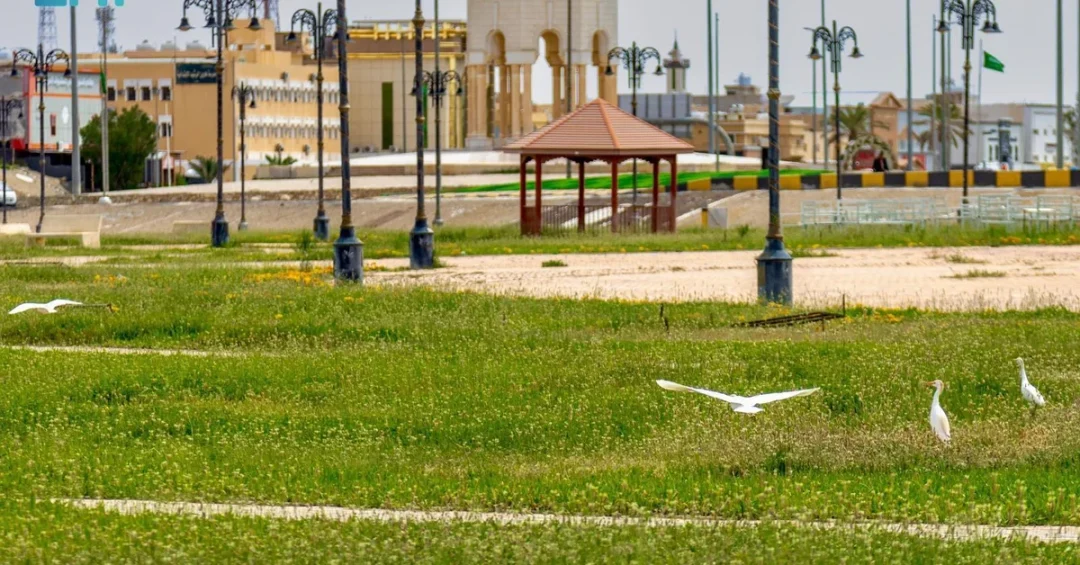
Common cranes (Grus grus) have arrived in the parks and wilderness areas of Rafha Governorate in northern Saudi Arabia, where Saudi Press Agency cameras documented the long-winged birds resting during their annual spring migration toward breeding grounds in northern Europe. The sighting, reported by the Saudi Press Agency on April 11, 2025, shows the cranes using several green spaces in Rafha as a temporary stopover, drawing wildlife enthusiasts and photographers to the area. The birds are traversing the Arabian Peninsula along one of the world’s most important avian flyways, a route that connects their wintering grounds in Africa and Asia with nesting sites across Europe. Their appearance in Rafha offers a visible reminder of the Kingdom’s position at the crossroads of three continents and of the environmental conditions that continue to support migratory wildlife.
Rafha, located in the Northern Borders Province near the Kingdom’s frontier with Iraq and Jordan, sits within a landscape of desert steppe, seasonal wetlands, and managed parks that can offer food and shelter to passing birds. For the cranes, the stopover is a chance to rest and refuel before continuing north. For Saudi Arabia, it is another demonstration that conservation measures, habitat protection, and wildlife monitoring are producing conditions in which rare migrants can safely pause. Have you ever considered how a single flock of birds can connect the ecosystems of Africa, Asia, and Europe through the skies above Saudi Arabia?
Context and Background
The common crane, known scientifically as Grus cranes in popular reference and formally as Grus grus, is a large migratory bird with a wide distribution across Europe and Asia. Each spring, populations that winter in parts of Africa, the Middle East, and South Asia move northward to breed in Scandinavia, the Baltic region, and other parts of northern Europe. The Arabian Peninsula forms a critical bridge on this journey, offering a landmass where birds can rest instead of attempting long crossings over open water. Saudi Arabia’s location at the junction of the Palearctic, Afrotropical, and Indomalayan realms gives it an unusually rich avian diversity, and the Kingdom has long been recognized as a crucial corridor for migratory species.
Within this corridor, northern Saudi Arabia plays a distinctive role. Areas such as Rafha Governorate combine open desert, scrubland, and pockets of greenery that can support insects, seeds, and small vertebrates on which cranes and other migrants feed. The Saudi Press Agency reported that the cranes landed in several local green spaces, a detail that underscores how parks and managed wilderness can function as stepping stones for wildlife. Environmental experts note that the presence of cranes reflects a healthy local ecosystem, particularly where suitable resting areas such as wetlands remain available. Why do these seasonal visitors matter so much to the broader health of the landscapes they pass through?
Historically, the common crane has faced pressures from habitat loss, hunting, and the draining of wetlands along its migration routes. Conservation efforts across Europe, the Middle East, and Africa have helped some populations recover, but the species is still classified as moderately threatened in parts of its range. Its appearance in Saudi Arabia therefore carries more than aesthetic value: it signals that conditions along at least part of the flyway remain viable. The Kingdom’s regulations and wildlife programs are designed to protect transient species, and the cranes’ arrival in Rafha provides a visible case study of those measures in action.
Key Details
The Saudi Press Agency reported that its cameras captured images of the cranes passing through the parks and wilderness of Rafha Governorate. The birds were described as long-winged and remarkable, with their landing in several local green spaces forming part of their regular spring migration to Europe. Wildlife enthusiasts and photographers were drawn to the area by the sighting, reflecting a growing interest in nature observation within the Kingdom. The cranes are rare migrants that traverse Saudi Arabia’s skies in both spring and autumn, using the Arabian Peninsula as a temporary stopover between their African or Asian wintering grounds and their breeding sites in northern Europe.
Environmental experts quoted in the report emphasized that the presence of these birds points to a healthy local ecosystem. Suitable resting areas, including wetlands, are essential for cranes, which need shallow water and open ground to roost safely and to feed. The birds provide vital environmental services while in transit: they disperse seeds across landscapes and help control insect populations, contributing directly to biodiversity. The crane is also a cultural symbol, associated in various traditions with purity and freedom, and its status as a moderately threatened species makes each confirmed stopover significant for monitoring. What does it tell us about a region when a rare and sensitive species chooses to pause there?
The report from Rafha follows a pattern of seasonal wildlife observations across northern Saudi Arabia. Spring and autumn migrations bring a succession of species through the Kingdom, from raptors and waders to songbirds and waterfowl. Each wave of arrivals offers researchers and conservationists an opportunity to assess the condition of habitats, the availability of food, and the effectiveness of protection measures. The cranes’ visit is thus part of a larger, ongoing natural cycle that Saudi authorities monitor through environmental programs and that the Saudi Press Agency documents for the public.
International and Regional Impact
The cranes’ journey connects Saudi Arabia to a network of countries across three continents. Their route links wintering areas in Africa and Asia with breeding grounds in northern Europe, meaning that the Kingdom’s habitats are part of an international system that depends on cooperation among many nations. When cranes rest successfully in Rafha, the benefits are shared: healthier birds are more likely to complete their migration and reproduce, sustaining populations that are valued across Europe and beyond. This interdependence gives Saudi Arabia a central role in conservation efforts that extend far beyond its borders.
Regional cooperation on migratory species is increasingly important as climate patterns shift and habitats face pressure. Saudi Arabia’s participation in international environmental frameworks and its domestic wildlife protections contribute to a broader effort to keep flyways functioning. The Kingdom’s strategic location between three continents explains its avian diversity, and that diversity in turn gives it a strong voice in conversations about biodiversity and sustainable land management. Could the protection of a single migration corridor in northern Saudi Arabia influence conservation outcomes thousands of kilometers away?
Economic and Strategic Significance
Wildlife tourism and nature observation are growing segments of the global travel market, and Saudi Arabia is positioning itself to benefit. The sighting of cranes in Rafha attracted photographers and enthusiasts, demonstrating that natural heritage can draw visitors to regions beyond the major cities. As the Kingdom develops its tourism sector, destinations that showcase wildlife, landscapes, and seasonal events can complement cultural and heritage sites. The presence of rare migrants adds a distinctive attraction to northern areas, supporting local economies and encouraging investment in hospitality and guiding services.
Strategically, environmental stewardship reinforces Saudi Arabia’s broader goals of sustainability and diversification. Healthy ecosystems are part of the Kingdom’s long-term vision for quality of life, and they support sectors from agriculture to tourism. The cranes’ arrival also highlights the value of protected areas and wetlands, which can serve as anchors for conservation and education. By safeguarding these habitats, Saudi Arabia strengthens its position as a responsible steward of shared natural resources and as a destination for travelers interested in authentic natural experiences. What economic opportunities can emerge when a region becomes known as a reliable stopover for spectacular wildlife?
Vision 2030 Alignment
The cranes’ visit to Rafha aligns closely with Saudi Vision 2030, the national transformation program that seeks to diversify the economy, improve quality of life, and promote environmental sustainability. Under Vision 2030, the Kingdom has expanded protected areas, launched afforestation and habitat restoration initiatives, and encouraged ecotourism as part of a broader effort to preserve natural heritage. The presence of a moderately threatened species in a well-managed landscape is a tangible indicator that these efforts are contributing to real ecological outcomes, not just policy targets.
For international audiences, the story of the cranes offers a window into a Saudi Arabia that is modernizing while honoring its natural environment. The Kingdom’s role as a global migratory bird corridor is a point of pride and a responsibility that officials take seriously through regulations and monitoring programs. As Vision 2030 progresses, investments in conservation, sustainable tourism, and environmental education are expected to deepen, ensuring that future generations of cranes, and the visitors who admire them, continue to find safe passage through Saudi skies. Will the next spring migration bring even greater numbers to the Kingdom’s northern parks and wetlands?
20 Questions
Q1. What birds were recently spotted in Rafha Governorate?
A1. Common cranes, scientifically known as Grus grus, were spotted in the parks and wilderness of Rafha Governorate in northern Saudi Arabia, according to the Saudi Press Agency.
Q2. When did the cranes arrive in Rafha?
A2. The Saudi Press Agency reported the sighting on April 11, 2025, during the birds’ regular spring migration toward breeding grounds in northern Europe.
Q3. Why are the cranes in Saudi Arabia?
A3. They use the Arabian Peninsula as a temporary stopover between their wintering grounds in Africa or Asia and their breeding sites in northern Europe.
Q4. What is the scientific name of the common crane?
A4. The common crane is scientifically known as Grus grus and is a large, long-winged migratory bird found across Europe and Asia.
Q5. Where exactly did the cranes land in Rafha?
A5. The cranes landed in several local green spaces within Rafha Governorate, including parks and wilderness areas that offer resting and feeding opportunities.
Q6. Who documented the cranes’ arrival?
A6. Saudi Press Agency cameras captured images of the cranes, and the sighting also attracted wildlife enthusiasts and photographers to the area.
Q7. What do environmental experts say about the cranes’ presence?
A7. Experts note that their presence reflects a healthy local ecosystem, with suitable resting areas such as wetlands available for the birds.
Q8. What environmental services do migratory birds like cranes provide?
A8. They provide vital services including seed dispersal and insect control, which contribute directly to biodiversity in the areas they visit.
Q9. What does the crane symbolize in various cultures?
A9. The crane is a symbol of purity and freedom in various cultures and is classified as a moderately threatened species in parts of its range.
Q10. Why is Saudi Arabia important for migratory birds?
A10. The Kingdom’s strategic location makes it a crucial global migratory bird corridor between three continents, explaining its rich avian diversity.
Q11. How does Saudi Arabia protect migratory species?
A11. The Kingdom actively protects transient species through regulations and programs, including habitat protection and wildlife monitoring efforts.
Q12. When do cranes typically pass through Saudi Arabia?
A12. Cranes traverse Saudi Arabia’s skies in both spring and autumn, using the Arabian Peninsula as a stopover during their seasonal migrations.
Q13. What makes Rafha a suitable stopover for cranes?
A13. Rafha offers parks, wilderness, and suitable resting areas such as wetlands that provide food and shelter for the long-winged birds.
Q14. Are common cranes endangered?
A14. The common crane is classified as moderately threatened, meaning it faces pressures but is not currently at the highest levels of extinction risk.
Q15. What is the significance of the cranes’ migration route?
A15. Their route connects Africa, Asia, and Europe, making the Arabian Peninsula a vital bridge for birds traveling between wintering and breeding grounds.
Q16. How does the sighting benefit local communities?
A16. It attracts wildlife enthusiasts and photographers, supporting nature tourism and highlighting the region’s environmental value for visitors.
Q17. What role do wetlands play for cranes?
A17. Wetlands provide shallow water and open ground where cranes can roost safely and feed, making them essential for successful migration.
Q18. How does this sighting relate to Vision 2030?
A18. It supports Vision 2030 goals for environmental sustainability, quality of life, and ecotourism, showing conservation efforts are producing results.
Q19. What can researchers learn from the cranes’ arrival?
A19. Researchers can assess habitat health, food availability, and the effectiveness of protection measures along the migration route through northern Saudi Arabia.
Q20. What does the cranes’ visit say about Saudi Arabia’s environment?
A20. It indicates that the Kingdom’s ecosystems remain healthy enough to support rare migrants, reflecting successful conservation and habitat management.
Reader Feedback
We value your thoughts. Please share your feedback on this article.
Your feedback helps us improve our coverage.