


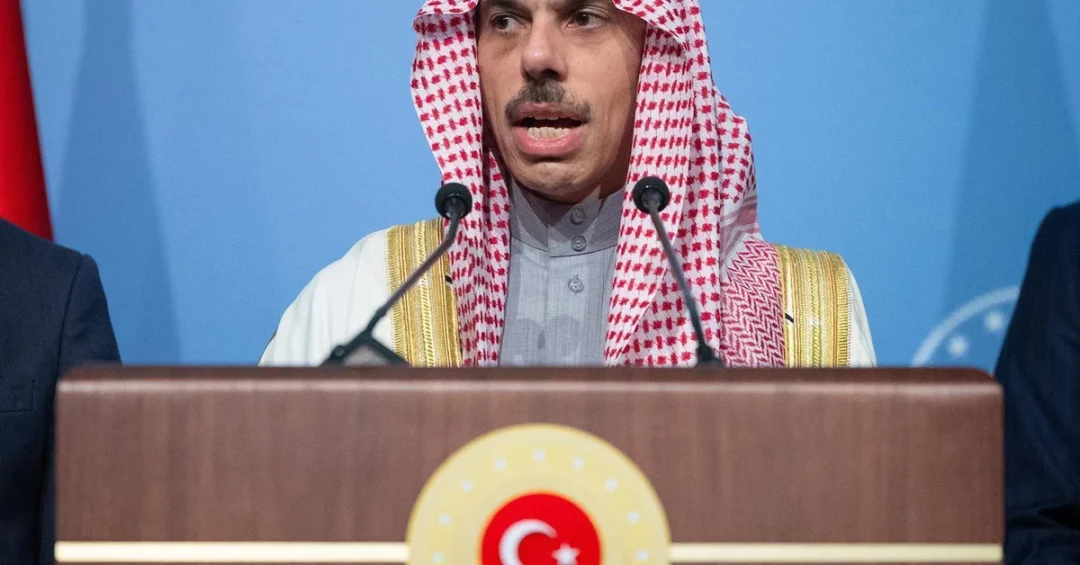
Saudi Minister of Foreign Affairs Prince Faisal bin Farhan bin Abdullah participated in the Antalya Ministerial Meeting on the Two-State Solution and Permanent Peace in the Middle East, held in the Republic of Türkiye on April 11, 2025, according to the Saudi Press Agency. The meeting brought together senior diplomats from Arab and Islamic nations to coordinate a unified international approach to ending the conflict in Gaza, securing a durable ceasefire, and advancing a credible political pathway toward a Palestinian state. Prince Faisal used the platform to deliver a firm and detailed Saudi position on humanitarian access, the protection of civilians, and the categorical rejection of any forced displacement of Palestinians from their lands.
Why does this diplomatic gathering in Antalya matter at a moment when the region stands at one of its most fragile crossroads in decades? The meeting reflects a sustained Saudi-led effort to translate concern into coordinated action, ensuring that the voices of Arab and Islamic states are heard clearly in international forums. The Kingdom’s participation underscores its longstanding commitment to Palestinian statehood and to a comprehensive peace that guarantees security, dignity, and a viable future for all peoples of the region. Saudi Arabia has consistently argued that lasting stability cannot be achieved through military means alone, but requires a just political settlement rooted in international law and the Arab Peace Initiative.
Context and Background
What has driven the Kingdom to place such sustained emphasis on the Palestinian question in its foreign policy? Saudi Arabia has for decades maintained that the establishment of an independent Palestinian state with East Jerusalem as its capital is a prerequisite for regional stability. The Antalya Ministerial Meeting follows a series of high-level diplomatic engagements in which the Kingdom has worked alongside partners in the Arab and Islamic world to build consensus. These efforts are consistent with the outcomes of the extraordinary joint Arab-Islamic summit hosted in Riyadh in November 2023, which tasked foreign ministers with maintaining international pressure for an immediate ceasefire and unimpeded humanitarian access.
The meeting in Türkiye also reflects the broader pattern of Saudi diplomacy under the leadership of the Custodian of the Two Holy Mosques, King Salman bin Abdulaziz Al Saud, and His Royal Highness Crown Prince Mohammed bin Salman bin Abdulaziz Al Saud, Prime Minister. The Kingdom has repeatedly emphasized that the humanitarian catastrophe in Gaza demands a collective response, not isolated gestures. Riyadh has worked through the Organization of Islamic Cooperation and the Arab League to ensure that the concerns of the region are presented with one voice, and it has engaged with European, Asian, and American counterparts to encourage a return to negotiations on a two-state solution.
Regional dynamics have made this coordination more urgent. The expansion of hostilities, the disruption of aid corridors, and the risk of wider escalation have all raised the stakes for diplomacy. Saudi Arabia has argued that only a credible political horizon for the Palestinian people can prevent further cycles of violence. In this context, the Antalya meeting served as a platform to reaffirm that the two-state solution remains the internationally recognized framework for peace, and that any attempt to sideline it would only prolong instability.
Key Details of the Antalya Ministerial Meeting
What exactly did Prince Faisal bin Farhan convey on behalf of the Kingdom? In his remarks during the news conference following the meeting, the foreign minister stressed the importance of an immediate return to the ceasefire in the Gaza Strip. He emphasized that the ceasefire must be sustainable, must serve as a path to alleviate the suffering of the people of Gaza, and must be the beginning of a final solution to the Palestinian cause through the establishment of a Palestinian state. His comments placed the humanitarian imperative at the center of the diplomatic conversation, while linking it directly to the political track.
The minister articulated a clear legal and moral position on humanitarian access. He stated that the entry of aid to Gaza cannot be linked to a ceasefire, as this violates the foundations of international law. He further noted that preventing aid from reaching the Gaza Strip and using it as a tool of war is a flagrant violation of all norms and the foundations of international law, and is rejected by all. Prince Faisal called on the international community to exert all pressure to ensure that humanitarian aid reaches civilians in the Gaza Strip without interruption and in sufficient quantities.
On the question of displacement, the foreign minister expressed the Kingdom’s categorical rejection of all forms of displacement of the brotherly Palestinian people from their lands, even if it is through voluntary departure. He considered that the Palestinians in Gaza are being deprived of most necessities of life. He explained that if aid is not entering, if the residents of Gaza are deprived of food, drink, and electricity, and if they are threatened every day with military bombardment, then even if one of them is forced to leave, that is not a voluntary leaving but a form of coercion. Therefore, it must be clear that any displacement of Palestinians in Gaza under any pretext is categorically rejected.
Prince Faisal also affirmed that the Arab and Islamic group is committed to a comprehensive peace that guarantees the security of all in the region and guarantees the rights, security, and future of the Palestinian people within the framework of their independent state. This statement captures the dual commitment that has defined the Saudi position: security for all states in the region, and legitimate rights for the Palestinian people. The minister’s remarks were delivered in a spirit of constructive diplomacy, aimed at bridging gaps and encouraging a renewed international push for peace.
International and Regional Impact
How will the outcomes of the Antalya meeting shape the broader international conversation on the Middle East? The gathering reinforced the position that the two-state solution is not merely one option among many, but the only viable framework for a lasting peace. By convening in Türkiye, the participants signaled that the issue transcends regional boundaries and requires sustained engagement from the wider international community. The meeting also provided an opportunity for Arab and Islamic states to coordinate their messaging ahead of further engagements with European and global partners.
The Kingdom’s participation carries particular weight because of its unique standing as the custodian of the Two Holy Mosques and its role as a leading voice in the Islamic world. Saudi Arabia’s diplomacy is rooted in a commitment to dialogue, humanitarian relief, and respect for international law. The Antalya meeting allowed Prince Faisal to reiterate these principles and to call for practical measures, including the uninterrupted delivery of aid and the protection of civilians. The message was clear: humanitarian assistance must never be conditioned on political or military calculations, and the suffering of civilians must not be used as leverage.
From a regional perspective, the meeting underscored the importance of unity among Arab and Islamic states. Divisions within the international community have often hampered progress, but the Antalya gathering demonstrated a shared determination to keep the two-state solution at the forefront of global diplomacy. The participants also highlighted the need to prevent any actions that could further destabilize the region or undermine the prospects for peace. Saudi Arabia has consistently advocated for de-escalation and for a return to negotiations, and its role in Antalya reinforced that approach.
Economic and Strategic Significance
Why does the pursuit of peace in the Middle East carry such profound economic and strategic implications? Stability in the region is a prerequisite for sustainable development, investment, and prosperity. Saudi Arabia’s Vision 2030, the Kingdom’s ambitious blueprint for economic diversification and social transformation, depends on a peaceful and secure regional environment. The conflict in Gaza and the broader tensions in the Middle East have the potential to disrupt trade routes, deter investment, and divert resources away from development priorities. A credible path to peace therefore serves not only humanitarian and moral imperatives but also the long-term economic interests of the entire region.
The Kingdom has been clear that it seeks a comprehensive peace that unlocks the region’s potential. Normalization of relations, economic integration, and cross-border cooperation can only flourish when the political foundations are secure. Saudi Arabia has linked the prospect of deeper regional integration to progress on the Palestinian question, affirming that a just resolution is essential for lasting stability. The Antalya meeting was thus part of a broader strategic effort to create the conditions for peace, which in turn can enable economic growth, innovation, and opportunity for the peoples of the Middle East.
From a strategic standpoint, the Kingdom’s diplomatic activism reflects its growing role as a bridge-builder and a responsible global actor. Saudi Arabia has hosted numerous diplomatic initiatives, supported humanitarian relief efforts, and engaged with a wide range of international partners to encourage dialogue. The Antalya meeting is one element of this sustained engagement. By working through multilateral forums and maintaining open channels of communication, the Kingdom aims to contribute to a resolution that safeguards the rights of the Palestinian people while ensuring the security and prosperity of all states in the region.
Vision 2030 Alignment
How does Saudi Arabia’s diplomatic engagement in Antalya connect to the objectives of Vision 2030? Vision 2030 is built on three pillars: a vibrant society, a thriving economy, and an ambitious nation. A vibrant society requires peace, security, and respect for human dignity, both at home and abroad. The Kingdom’s advocacy for humanitarian access in Gaza, its rejection of forced displacement, and its support for a two-state solution are expressions of these values. They also reflect the Kingdom’s commitment to international law and to the principles of justice and coexistence that underpin a stable world order.
A thriving economy depends on regional stability and global cooperation. By promoting peace and dialogue, Saudi Arabia helps to create an environment in which trade, investment, and innovation can flourish. The Kingdom’s diplomatic efforts are thus closely tied to its domestic transformation agenda, which seeks to diversify the economy, empower youth and women, and build a knowledge-based society. The Antalya meeting, and the broader diplomatic campaign of which it is a part, demonstrates that Saudi Arabia is not only focused on its own development but is also actively contributing to a more peaceful and prosperous region.
As the Kingdom continues to advance Vision 2030, its foreign policy will remain rooted in the principles of mutual respect, dialogue, and constructive engagement. The participation of Prince Faisal bin Farhan in the Antalya Ministerial Meeting is a testament to Saudi Arabia’s enduring commitment to these ideals. The road ahead is challenging, but the Kingdom’s resolve is clear: it will continue to work with its partners to achieve a just and comprehensive peace that guarantees the rights of the Palestinian people and the security of all nations in the Middle East. In doing so, Saudi Arabia reaffirms its role as a force for stability, moderation, and progress on the world stage.
20 Questions
Q1. What was the purpose of the Antalya Ministerial Meeting on the Two-State Solution?
A1. The meeting aimed to coordinate international efforts to achieve a sustainable ceasefire in Gaza and to advance a credible political pathway toward a two-state solution, ensuring lasting peace and security for all peoples in the Middle East.
Q2. Who represented Saudi Arabia at the Antalya Ministerial Meeting?
A2. Saudi Arabia was represented by Minister of Foreign Affairs Prince Faisal bin Farhan bin Abdullah, who participated in the meeting held in the Republic of Türkiye on April 11, 2025, according to the Saudi Press Agency.
Q3. What did Prince Faisal bin Farhan emphasize regarding the ceasefire in Gaza?
A3. He stressed the importance of an immediate return to a sustainable ceasefire that alleviates the suffering of the people of Gaza and serves as the beginning of a final solution to the Palestinian cause through the establishment of a Palestinian state.
Q4. What is Saudi Arabia’s position on linking aid entry to a ceasefire?
A4. Prince Faisal stated that the entry of aid to Gaza cannot be linked to a ceasefire, as this violates the foundations of international law, and preventing aid from reaching Gaza is a flagrant violation rejected by all.
Q5. How did the foreign minister describe the use of aid as a tool of war?
A5. He described it as a flagrant violation of all norms and the foundations of international law, and he called on the international community to exert all pressure to ensure that humanitarian aid reaches civilians without interruption and in sufficient quantities.
Q6. What is the Kingdom’s stance on the displacement of Palestinians from their lands?
A6. Prince Faisal expressed the Kingdom’s categorical rejection of all forms of displacement of the brotherly Palestinian people from their lands, even if it is through voluntary departure, considering that Palestinians in Gaza are deprived of most necessities of life.
Q7. How did Prince Faisal explain that departure under siege is not voluntary?
A7. He explained that if aid is not entering, if residents are deprived of food, drink, and electricity, and if they are threatened daily with bombardment, then even if one is forced to leave, that is not voluntary but a form of coercion, and any displacement under any pretext is categorically rejected.
Q8. What did the foreign minister say about the commitment of the Arab and Islamic group?
A8. He affirmed that the Arab and Islamic group is committed to a comprehensive peace that guarantees the security of all in the region and guarantees the rights, security, and future of the Palestinian people within the framework of their independent state.
Q9. What is the significance of the Antalya meeting for regional diplomacy?
A9. The meeting reinforced the two-state solution as the only viable framework for lasting peace, allowed Arab and Islamic states to coordinate their messaging, and highlighted the need for sustained international engagement to end the conflict.
Q10. How does Saudi Arabia’s participation reflect its broader foreign policy goals?
A10. It reflects the Kingdom’s commitment to dialogue, humanitarian relief, and respect for international law, and its role as a leading voice in the Islamic world working to build consensus and encourage a just and comprehensive peace.
Q11. What is the Kingdom’s position on the two-state solution?
A11. Saudi Arabia has consistently maintained that the establishment of an independent Palestinian state with East Jerusalem as its capital is a prerequisite for regional stability, and it supports the two-state solution as the internationally recognized framework for peace.
Q12. How does the Antalya meeting relate to previous Saudi diplomatic initiatives?
A12. It follows a series of high-level engagements, including the extraordinary joint Arab-Islamic summit hosted in Riyadh in November 2023, which tasked foreign ministers with maintaining international pressure for a ceasefire and unimpeded humanitarian access.
Q13. What role has Saudi Arabia played in supporting humanitarian relief for Gaza?
A13. Saudi Arabia has supported humanitarian relief efforts, advocated for the uninterrupted delivery of aid, and called on the international community to ensure that assistance reaches civilians in sufficient quantities without being used as a tool of war.
Q14. Why is a sustainable ceasefire important for the region?
A14. A sustainable ceasefire is essential to alleviate the suffering of civilians, prevent further loss of life, create conditions for humanitarian access, and open a political pathway toward a final solution and lasting regional stability.
Q15. What does Saudi Arabia mean by a comprehensive peace?
A15. A comprehensive peace guarantees the security of all states in the region and guarantees the rights, security, and future of the Palestinian people within the framework of their independent state, in accordance with international law and relevant resolutions.
Q16. How does the conflict in Gaza affect regional economic stability?
A16. The conflict has the potential to disrupt trade routes, deter investment, and divert resources away from development priorities, making a credible path to peace essential for long-term economic prosperity and integration.
Q17. What is the connection between the Antalya meeting and Saudi Vision 2030?
A17. Vision 2030 seeks a vibrant society, a thriving economy, and an ambitious nation, all of which depend on peace and regional stability. Saudi diplomacy in Antalya supports these goals by promoting dialogue, humanitarian values, and coexistence.
Q18. How has the Kingdom engaged with international partners on the Palestinian question?
A18. Saudi Arabia has worked through the Organization of Islamic Cooperation and the Arab League, and engaged with European, Asian, and American counterparts to encourage a return to negotiations on a two-state solution and to maintain pressure for a ceasefire.
Q19. What did Prince Faisal call on the international community to do?
A19. He called on the international community to exert all pressure to ensure that humanitarian aid reaches civilians in the Gaza Strip without interruption and in sufficient quantities, and to reject any use of aid as a tool of war.
Q20. What is the expected next step after the Antalya Ministerial Meeting?
A20. The participants are expected to continue coordinating diplomatic efforts, engaging with international partners, and pressing for a sustainable ceasefire and a credible political process leading to a two-state solution and permanent peace in the Middle East.
Reader Feedback
We value your thoughts. Please share your feedback on this article.
Your feedback helps us improve our coverage.
Related articles
 Saudi Arabia Apprehends 18,669 Law Violators in Nationwide Week
 Strong 6.2 Magnitude Earthquake Strikes off Papua New Guinea
 Magnitude 5.5 Earthquake Shakes Northern Pakistan
 Saudi Weather Forecast for Saturday: Rain, Winds, and Sea Conditions
 MWL Welcomes UNESCO Resolution on Gaza Situation
 Saudi Envoy Meets Tajik Transport Minister in Dushanbe