


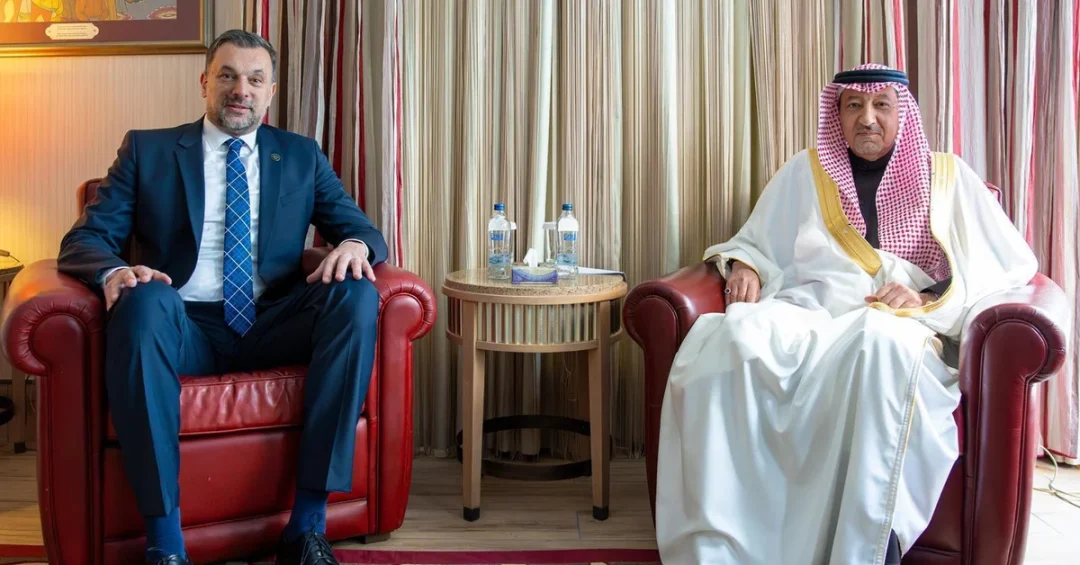
Saudi Vice Minister of Foreign Affairs Waleed Elkhereiji met with Bosnia and Herzegovina Minister of Foreign Affairs Elmedin Konakovic on the sidelines of the 4th Antalya Diplomacy Forum in Antalya, Republic of Türkiye, on April 11, 2025, to discuss ways to enhance bilateral relations across various fields. The meeting, confirmed by the Saudi Press Agency, underscores the Kingdom’s continued commitment to active diplomacy and constructive international engagement under the leadership of the Custodian of the Two Holy Mosques, King Salman bin Abdulaziz Al Saud, and His Royal Highness Crown Prince and Prime Minister Mohammed bin Salman bin Abdulaziz Al Saud.
The encounter brought together two nations that have steadily cultivated a relationship grounded in mutual respect, economic complementarity, and shared interests in regional stability. Saudi Ambassador to Türkiye Fahad Abualnasr attended the meeting, reflecting the coordinated nature of the Kingdom’s diplomatic apparatus. The Antalya Diplomacy Forum, now in its fourth edition, has become a significant platform for dialogue among policymakers, diplomats, and thought leaders. For Saudi Arabia, participation signals a continuing strategy of broadening partnerships, not only with major powers but also with nations such as Bosnia and Herzegovina that occupy important positions in Europe and the Balkans. How does a single diplomatic meeting in Türkiye translate into tangible benefits for both nations? The answer lies in the follow-through: agreements, investments, and people-to-people ties that emerge from such high-level discussions.
Context and Background
What makes the Saudi-Bosnian relationship significant in today’s geopolitical landscape? Bosnia and Herzegovina, a nation in the Western Balkans, has long maintained friendly ties with the Kingdom of Saudi Arabia, rooted in shared cultural and historical connections. Saudi Arabia has been a consistent supporter of Bosnia and Herzegovina’s sovereignty and territorial integrity, particularly since the 1990s. Over the years, the relationship has expanded beyond political solidarity into economic cooperation, humanitarian assistance, and cultural exchange. The Kingdom has funded reconstruction projects, supported educational initiatives, and provided aid during challenging periods. These efforts reflect Saudi Arabia’s broader foreign policy principle of supporting stability and development in friendly nations.
The 4th Antalya Diplomacy Forum provided a timely backdrop for this meeting. The forum gathers foreign ministers, academics, and business leaders to address pressing global issues, from conflict resolution to economic resilience. By participating, Saudi Arabia reinforces its role as a bridge-builder and a responsible stakeholder in international affairs. Vice Minister Elkhereiji’s meeting with Minister Konakovic is part of a series of engagements that Saudi diplomats undertake at such multilateral events. These encounters allow for focused bilateral discussions that might not occur otherwise, enabling officials to identify concrete areas for cooperation. The presence of Ambassador Fahad Abualnasr further highlights the importance Saudi Arabia places on its diplomatic mission in Türkiye, a key regional partner and a gateway to Europe.
For Bosnia and Herzegovina, engagement with Saudi Arabia offers access to investment, development expertise, and a partner committed to stability in the Balkans. The two countries have signed various agreements over the years, covering trade, education, and cultural cooperation. This meeting likely built on those foundations, exploring new avenues for collaboration. In a world where multilateralism is increasingly tested, such bilateral meetings serve as essential building blocks for a more interconnected and peaceful international order. Saudi Arabia’s active presence at the Antalya forum demonstrates its willingness to engage with nations of all sizes and regions, consistent with its Vision 2030 goal of becoming a globally influential and diversified economy.
Key Details
What specific topics were discussed during the meeting between Vice Minister Elkhereiji and Minister Konakovic? According to the official Saudi Press Agency report, the two sides discussed ways to enhance bilateral relations in various fields. While the precise details of the discussions remain confidential, the broad scope suggests a comprehensive review of the relationship. Typically, such meetings cover political coordination, economic and trade opportunities, investment prospects, cultural and educational exchanges, and regional developments. Given Saudi Arabia’s ongoing economic transformation, there is a natural interest in exploring how Bosnian companies and entrepreneurs might participate in the Kingdom’s growing market, particularly in sectors like tourism, agriculture, and technology.
Bosnia and Herzegovina, with its skilled workforce and strategic location in Europe, could serve as a partner in Saudi Arabia’s efforts to diversify its international economic ties. Conversely, Saudi investment and expertise could support infrastructure projects, renewable energy initiatives, and tourism development in Bosnia and Herzegovina. The meeting also likely addressed regional issues of mutual concern, including stability in the Balkans and the broader Middle East. Saudi Arabia has consistently advocated for peaceful resolution of conflicts and respect for international law, principles that resonate with Bosnia and Herzegovina’s own experiences. The two ministers may have discussed ways to coordinate positions in international organizations, such as the United Nations, where both countries are active members.
The attendance of Ambassador Fahad Abualnasr is noteworthy. As Saudi Arabia’s top diplomat in Türkiye, he plays a crucial role in maintaining strong ties with Ankara and facilitating Saudi diplomatic activities in the region. His presence at the meeting signals that the Kingdom’s diplomatic efforts are well-coordinated and that the embassy in Türkiye is fully engaged in supporting bilateral initiatives. The Antalya Diplomacy Forum itself is a key event on the diplomatic calendar, and Saudi Arabia’s participation demonstrates its commitment to dialogue and cooperation. The meeting between Elkhereiji and Konakovic is one of many that Saudi officials held during the forum, reflecting a busy schedule of engagements aimed at advancing the Kingdom’s foreign policy objectives.
International and Regional Impact
How does this meeting resonate beyond the immediate bilateral relationship? Saudi Arabia’s engagement with Bosnia and Herzegovina is part of a broader strategy to strengthen ties with European nations, particularly those in the Balkans. The region has historical and cultural connections to the Islamic world, and Saudi Arabia has long been a supportive partner. By maintaining and deepening these relationships, the Kingdom contributes to stability and prosperity in a part of Europe that has experienced conflict in the past. This aligns with Saudi Arabia’s vision of a peaceful and cooperative international order, where nations work together to address common challenges.
Furthermore, the meeting at the Antalya Diplomacy Forum highlights Türkiye’s role as a diplomatic hub. Türkiye has invested significantly in creating platforms for dialogue, and Saudi Arabia’s active participation underscores the strong relationship between Riyadh and Ankara. The two countries have cooperated on various regional issues, and their partnership is a stabilizing force in the Middle East. By meeting in Antalya, the Saudi and Bosnian foreign ministers also indirectly reinforced the importance of Türkiye as a facilitator of diplomacy. This trifecta of Saudi-Bosnian-Turkish engagement could yield benefits in terms of trade routes, energy cooperation, and cultural exchanges, further integrating the region.
Economic and Strategic Significance
What economic opportunities could arise from enhanced Saudi-Bosnian relations? Saudi Arabia is undergoing a historic economic transformation under Vision 2030, seeking to diversify away from oil dependence and build a knowledge-based economy. This creates opportunities for international partners to engage in sectors such as tourism, entertainment, renewable energy, technology, and manufacturing. Bosnia and Herzegovina, with its industrial heritage and educated workforce, could find niche areas for collaboration. For example, Bosnian companies could participate in Saudi Arabia’s growing construction and infrastructure projects, or supply agricultural products to the Kingdom’s expanding food market.
On the other side, Saudi Arabia’s Public Investment Fund (PIF) and other Saudi investors are actively seeking profitable opportunities abroad. Bosnia and Herzegovina offers a relatively untapped market with potential in tourism, real estate, and energy. Saudi investment could help develop Bosnia’s infrastructure, create jobs, and stimulate economic growth. The meeting between the two foreign ministers may have laid the groundwork for future business delegations, trade fairs, and investment forums. Such economic diplomacy is a key component of Saudi Arabia’s foreign policy, as it seeks to build mutually beneficial partnerships that support its own development goals while assisting friendly nations.
Strategically, Bosnia and Herzegovina’s position in the Balkans makes it a valuable partner for Saudi Arabia’s engagement with Europe. The Balkans is a region where multiple powers have interests, and Saudi Arabia’s constructive involvement is welcomed by many. By supporting Bosnia’s stability and prosperity, Saudi Arabia contributes to a more secure Europe, which in turn benefits global security. The meeting also demonstrates Saudi Arabia’s commitment to multilateral diplomacy, as it leverages events like the Antalya Diplomacy Forum to advance its interests and build coalitions. This approach is consistent with the Kingdom’s active role in international affairs, from hosting peace talks to providing humanitarian aid.
Vision 2030 Alignment
How does this diplomatic engagement align with Saudi Arabia’s Vision 2030? Vision 2030 is not only an economic blueprint but also a foreign policy guide. It seeks to position Saudi Arabia as a global leader, a hub for investment, and a bridge between cultures. The meeting between Vice Minister Elkhereiji and Minister Konakovic exemplifies these aspirations. By strengthening ties with Bosnia and Herzegovina, Saudi Arabia expands its network of partners, opens new channels for economic cooperation, and enhances its reputation as a responsible international actor. This is precisely the kind of proactive diplomacy that Vision 2030 encourages.
Moreover, the meeting reflects the Kingdom’s commitment to the values of peace, dialogue, and mutual respect. These are the same values that underpin Saudi Arabia’s efforts to resolve regional conflicts and promote stability. As the Kingdom continues its journey toward a diversified and dynamic future, it will rely on partnerships with nations around the world. Bosnia and Herzegovina, with its own aspirations for prosperity and integration into Euro-Atlantic structures, is a natural partner in this endeavor. The Antalya meeting is a step in a longer journey, one that promises to bring tangible benefits to both peoples and contribute to a more peaceful and prosperous world. Under the leadership of Crown Prince Mohammed bin Salman, Saudi Arabia is forging a new path, and its engagement with Bosnia and Herzegovina is a testament to that vision.
20 Questions
Q1. Who met with Bosnia and Herzegovina’s Foreign Minister in Antalya?
A1. Saudi Vice Minister of Foreign Affairs Waleed Elkhereiji met with Bosnia and Herzegovina Minister of Foreign Affairs Elmedin Konakovic on the sidelines of the 4th Antalya Diplomacy Forum in Türkiye.
Q2. When and where did the meeting take place?
A2. The meeting took place on April 11, 2025, in Antalya, Republic of Türkiye, during the 4th Antalya Diplomacy Forum, as reported by the Saudi Press Agency.
Q3. What was the main purpose of the meeting?
A3. The two sides discussed ways to enhance bilateral relations between Saudi Arabia and Bosnia and Herzegovina across various fields of mutual interest.
Q4. Who else attended the meeting?
A4. The meeting was attended by Saudi Ambassador to Türkiye Fahad Abualnasr, highlighting the coordinated nature of Saudi diplomatic efforts in the region.
Q5. What is the Antalya Diplomacy Forum?
A5. The Antalya Diplomacy Forum is a prominent international gathering that brings together diplomats, policymakers, and experts to discuss global and regional issues.
Q6. How does this meeting reflect Saudi Arabia’s foreign policy?
A6. It demonstrates Saudi Arabia’s commitment to active diplomacy, multilateral engagement, and building partnerships with nations across Europe and the Balkans.
Q7. What areas of cooperation were likely discussed?
A7. The discussions likely covered political coordination, economic and trade opportunities, investment, cultural exchange, and regional developments of mutual concern.
Q8. What is the significance of Saudi-Bosnian relations?
A8. Saudi Arabia has long supported Bosnia and Herzegovina’s sovereignty and provided humanitarian aid, fostering a relationship based on mutual respect and shared interests.
Q9. How does this meeting align with Vision 2030?
A9. Vision 2030 promotes global engagement and economic diversification, and this meeting advances those goals by strengthening international partnerships and opening new cooperation avenues.
Q10. What economic opportunities could arise for Saudi Arabia?
A10. Opportunities may include trade, investment in Bosnian infrastructure and tourism, and collaboration in sectors like renewable energy, agriculture, and technology.
Q11. What benefits could Bosnia and Herzegovina gain?
A11. Bosnia and Herzegovina could attract Saudi investment, benefit from development expertise, and expand its economic ties with a key Gulf partner.
Q12. How does Türkiye factor into this meeting?
A12. Türkiye hosted the forum and maintains strong ties with both Saudi Arabia and Bosnia, serving as a facilitator for diplomatic dialogue and regional cooperation.
Q13. What is Saudi Arabia’s role in the Balkans?
A13. Saudi Arabia supports stability and development in the Balkans through diplomacy, humanitarian aid, and economic cooperation, contributing to regional peace.
Q14. Did the meeting produce any agreements?
A14. The official report did not mention specific agreements, but the discussions aimed to enhance bilateral relations, which may lead to future cooperation.
Q15. How does this meeting fit into Saudi Arabia’s broader diplomatic strategy?
A15. It is part of Saudi Arabia’s efforts to diversify partnerships, engage with nations of all sizes, and promote peace and prosperity globally.
Q16. What is the historical context of Saudi-Bosnian ties?
A16. Saudi Arabia has supported Bosnia since the 1990s, providing aid during conflicts and assisting with post-war reconstruction and development projects.
Q17. What message does this meeting send to the international community?
A17. It signals Saudi Arabia’s commitment to constructive engagement, multilateralism, and building bridges with European nations for mutual benefit.
Q18. How might this meeting impact regional stability?
A18. By strengthening ties with Bosnia, Saudi Arabia contributes to stability in the Balkans and reinforces its role as a responsible global stakeholder.
Q19. What are the next steps following this meeting?
A19. Follow-up could include further diplomatic exchanges, business delegations, and agreements in areas like trade, investment, and cultural cooperation.
Q20. Why is this meeting important for ksa.com readers?
A20. It showcases Saudi Arabia’s active diplomacy and Vision 2030 progress, offering insight into how the Kingdom builds global partnerships for peace and prosperity.
Reader Feedback
We value your thoughts. Please share your feedback on this article.
Your feedback helps us improve our coverage.
Related articles
 Saudi FM Joins Antalya Meeting on Two-State Solution
 Saudi Arabia Apprehends 18,669 Law Violators in Nationwide Week
 Strong 6.2 Magnitude Earthquake Strikes off Papua New Guinea
 Magnitude 5.5 Earthquake Shakes Northern Pakistan
 Saudi Weather Forecast for Saturday: Rain, Winds, and Sea Conditions
 MWL Welcomes UNESCO Resolution on Gaza Situation