


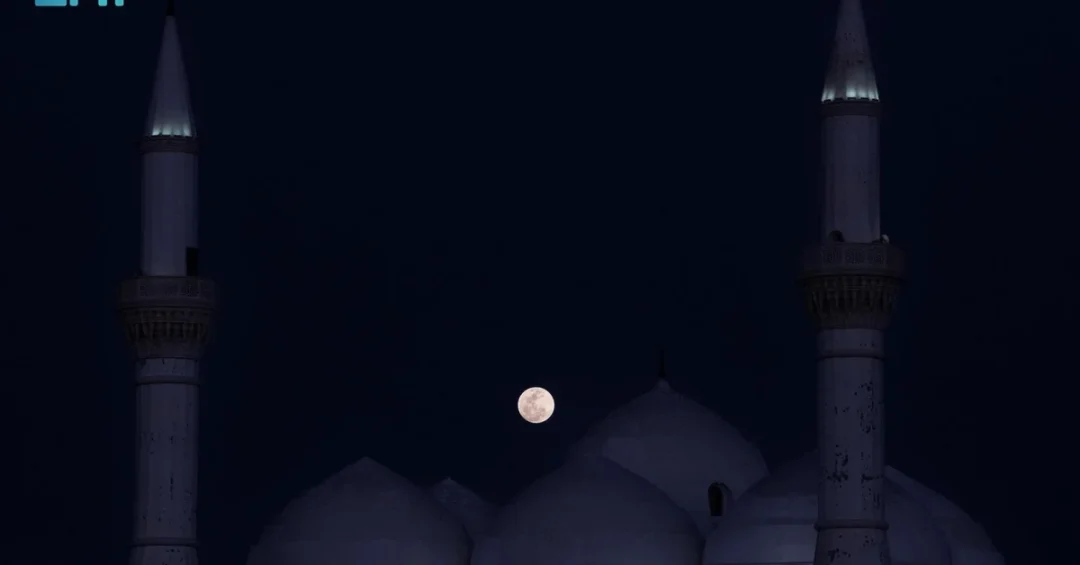
The Arab world witnessed a remarkable astronomical event on Saturday evening when the full moon of the month of Shawwal appeared in the sky, marking the first full moon following the spring equinox this year. The phenomenon was documented by the Jeddah Astronomy Society, which confirmed that observers across the region had a clear view of the lunar display. This alignment, occurring so soon after the spring equinox, offers astronomers and skywatchers alike a valuable opportunity to study the Moon’s behavior and the optical effects that shape how it appears from Earth. But what exactly makes this particular full moon so noteworthy for both scientists and the general public?
According to Eng. Majed Abu Zahrah, President of the Jeddah Astronomy Society, the moon was observed immediately after sunset from the southeastern horizon, providing a striking visual for residents of the Kingdom and the wider Arab world. The event was reported through official Saudi channels, including the Saudi Press Agency (SPA), underscoring the Kingdom’s active role in documenting and sharing astronomical observations with the global community. The clarity of the sighting reflects favorable atmospheric conditions across the region and the growing public interest in astronomy within Saudi Arabia.
Context and Background
Why does the timing of a full moon after the spring equinox capture the attention of astronomers? The spring equinox, which marks the moment when the Sun crosses the celestial equator, is a key reference point in the astronomical calendar. The full moon that follows it arrives during a period when the Earth’s axial tilt and orbital position create distinctive viewing conditions. This year, the Shawwal full moon fell into that window, making it a point of interest for observers tracking lunar cycles and their relationship to seasonal shifts.
The Jeddah Astronomy Society, a recognized Saudi scientific body dedicated to promoting astronomical knowledge, has long played a role in documenting such events for the public. Under the leadership of Eng. Majed Abu Zahrah, the society regularly provides detailed observations that help citizens and residents understand phenomena that might otherwise seem mysterious. This work aligns with a broader cultural appreciation for science and observation in the Kingdom, where astronomy has deep historical roots connected to the Islamic lunar calendar and the determination of significant dates such as Eid al-Fitr.
According to the observation, the moon appeared larger at its rise due to an optical illusion widely known as the “moon illusion,” a phenomenon in which the Moon seems bigger when it sits low on the horizon than when it is high overhead. The effect, though not fully explained by a single cause, is well documented and continues to fascinate both casual observers and researchers. Isn’t it curious how our own perception can transform something so distant into something so immediate and grand?
Key Details of the Observation
Eng. Abu Zahrah further noted that the moon may have appeared orange or pink in color due to the atmospheric effect on its reflected light, as the Moon’s rays passed through a thicker layer of the atmosphere near the horizon. This scattering of shorter wavelengths allows warmer tones to dominate, creating the characteristic hue often seen during moonrise. Such details are precisely the kind of information the Jeddah Astronomy Society shares to enrich public understanding of everyday celestial sights.
In a particularly notable detail, the Saturday evening moon was classified as a “mini moon,” because it occurred when the Moon was at its farthest point from Earth in its elliptical orbit. At this apogee, the Moon appears smaller and less bright than a typical full moon, offering a subtle contrast to the more celebrated “supermoon” events that occur near perigee. Does this not demonstrate how the Moon’s distance shapes what we see, even when the phase itself is full?
The society also confirmed that the Moon reached its peak at the full moon phase at 3:22 a.m. on Sunday, Makkah time, the exact moment when it stood directly opposite the Sun. This precise alignment is what defines a true full moon, and the timing allowed observers to plan their viewing around the event. The report, carried by the Saudi Press Agency, provided the public with accurate timing and descriptive detail, reflecting the Kingdom’s commitment to scientific transparency.
International and Regional Impact
How does a single lunar event resonate across the wider Arab world? The sighting was not confined to the Kingdom; observers throughout the region reported seeing the full moon, creating a shared experience that connects communities across borders. Such phenomena often inspire public gatherings, educational activities, and media coverage, reinforcing a sense of regional unity around scientific curiosity. The Arab world’s long tradition of astronomy, from ancient scholars to modern observatories, gives these moments added cultural weight.
Internationally, the event contributes to a global record of lunar observations that astronomers use to study atmospheric conditions, orbital mechanics, and optical phenomena. The documentation provided by the Jeddah Astronomy Society adds a valuable data point from the region, supporting collaborative scientific understanding. In a world where space science is increasingly collaborative, doesn’t the sharing of such observations strengthen the bonds between nations and disciplines?
Economic and Strategic Significance
What role does astronomy play in Saudi Arabia’s broader strategic ambitions? The Kingdom has been investing steadily in science, education, and technology as part of its long-term development plans, and astronomy sits at the intersection of these fields. Public engagement with celestial events nurtures interest in STEM education among young Saudis, encouraging the next generation of scientists and researchers. Institutions like the Jeddah Astronomy Society help channel that curiosity into structured learning and observation.
Beyond education, astronomical observation supports sectors such as tourism and cultural heritage, as visitors are drawn to stargazing experiences and scientific gatherings. Saudi Arabia’s clear desert skies offer exceptional conditions for observing events like the Shawwal full moon, positioning the Kingdom as a potential destination for astronomy tourism. Could this growing interest help diversify the economy and create new opportunities in the years ahead? The Kingdom’s leadership in documenting and promoting such events suggests a deliberate embrace of science as a pillar of national progress.
Vision 2030 Alignment
How does the observation of a full moon connect to the grand ambitions of Vision 2030? The Kingdom’s transformation agenda emphasizes knowledge, innovation, and a high quality of life for its citizens, and astronomy is a natural expression of those goals. By fostering scientific literacy and celebrating discoveries through official channels like the Saudi Press Agency, Saudi Arabia demonstrates its commitment to a modern, educated society that engages with the world on equal footing.
The Jeddah Astronomy Society’s work, led by Eng. Majed Abu Zahrah, reflects the spirit of Vision 2030 by inspiring young people, promoting research, and connecting the Kingdom’s scientific community with global partners. As Saudi Arabia continues to invest in space and science initiatives, events like the post-equinox full moon serve as reminders of the wonders that await both scientists and citizens. Will the next generation look to the stars and see not just distant worlds, but a future shaped by Saudi leadership and curiosity?
20 Questions
Q1. What astronomical event was observed on Saturday evening?
A1. The full moon of the month of Shawwal was observed, marking the first full moon after the spring equinox this year across the Arab world.
Q2. Who leads the Jeddah Astronomy Society?
A2. Eng. Majed Abu Zahrah serves as President of the Jeddah Astronomy Society, providing detailed observations of the event to the public.
Q3. From which direction was the moon observed?
A3. The moon was observed immediately after sunset from the southeastern horizon, offering a clear and striking view for residents.
Q4. What optical illusion made the moon appear larger?
A4. The “moon illusion” caused the moon to appear larger at its rise, a well-documented phenomenon where the Moon seems bigger near the horizon.
Q5. Why did the moon appear orange or pink?
A5. The color resulted from atmospheric effects on reflected light as the Moon’s rays passed through a thicker layer of atmosphere near the horizon.
Q6. What is a “mini moon”?
A6. A mini moon occurs when the Moon is at its farthest point from Earth, making it appear smaller and less bright than a typical full moon.
Q7. When did the moon reach its full phase?
A7. The moon reached its peak at the full moon phase at 3:22 a.m. on Sunday, Makkah time, when it stood directly opposite the Sun.
Q8. What defines a true full moon?
A8. A true full moon occurs when the Moon is exactly opposite the Sun, fully illuminated as seen from Earth, defining the peak of the lunar phase.
Q9. Through which official channel was the report released?
A9. The report was released through the Saudi Press Agency (SPA), reflecting the Kingdom’s commitment to accurate scientific communication.
Q10. Why is the spring equinox relevant to this event?
A10. The spring equinox is a key astronomical reference point, and the full moon following it arrives during distinctive viewing conditions tracked by observers.
Q11. What role does the Jeddah Astronomy Society play?
A11. The society documents astronomical events and shares detailed observations with the public, promoting scientific knowledge and public engagement.
Q12. How did the observation benefit the public?
A12. The observation provided accurate timing and descriptive detail, helping citizens plan their viewing and enrich their understanding of celestial phenomena.
Q13. What made the sighting conditions favorable?
A13. Favorable atmospheric conditions across the region allowed for a clear sighting of the full moon, benefiting observers throughout the Arab world.
Q14. How does this event connect to STEM education?
A14. Public engagement with celestial events nurtures interest in STEM among young Saudis, encouraging the next generation of scientists and researchers.
Q15. Why is astronomy important for Saudi Arabia?
A15. Astronomy sits at the intersection of science, education, and technology, supporting the Kingdom’s long-term development and knowledge-based ambitions.
Q16. How could astronomy support tourism?
A16. Saudi Arabia’s clear desert skies offer exceptional conditions for stargazing, positioning the Kingdom as a potential destination for astronomy tourism.
Q17. What is the significance of the Moon’s apogee?
A17. At apogee, the Moon is farthest from Earth in its elliptical orbit, appearing smaller and less bright, which classifies the event as a mini moon.
Q18. How does this connect to Vision 2030?
A18. The event reflects Vision 2030’s emphasis on knowledge, innovation, and quality of life by fostering scientific literacy and celebrating discovery.
Q19. What geographical area witnessed the event?
A19. The full moon was witnessed across the Arab world, creating a shared experience that connects communities across regional borders.
Q20. What does the event suggest about Saudi Arabia’s scientific future?
A20. It demonstrates the Kingdom’s growing embrace of science and its commitment to engaging with the global community on equal footing.
Reader Feedback
We value your thoughts. Please share your feedback on this article.
Your feedback helps us improve our coverage.
Related articles
 Najran University Wins Gold at Geneva Inventions 2025
 Prince Sultan University Hosts Eighth International Women in Data Science Conference
 Saudi Space Economy Reaches $8.7 Billion in 2024, CST Announces
 Tabuk Governor Patronizes 4th International Computing Conference
 Umm Al-Qura University Wins Three Medals in Geneva
 King Faisal University Wins 3 Medals at Geneva Inventions 2025