


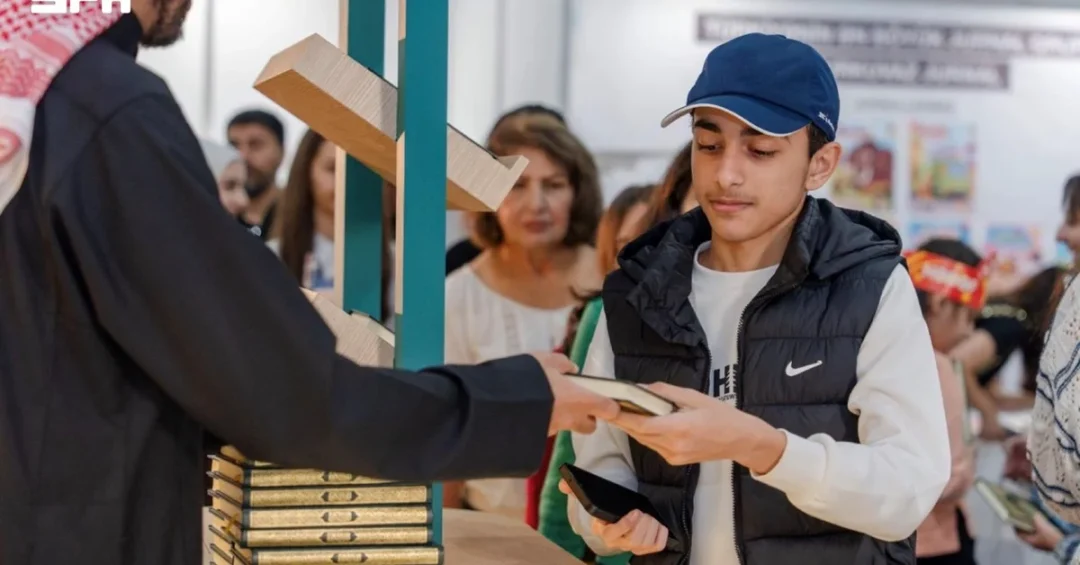
The King Fahd Glorious Quran Printing Complex showcased its printed and audio editions of the Holy Quran, alongside translations of the meanings into numerous languages, during its participation in the Baku International Book Fair 2026 in Azerbaijan, the Saudi Press Agency reported. The Complex’s exhibition, hosted within the pavilion of the Ministry of Islamic Affairs, Dawah and Guidance, introduced fair visitors to the Kingdom’s sustained efforts in printing, distributing, caring for, and delivering the Holy Quran to Muslims across the globe. The presentation highlighted a wide range of editions produced in various sizes and recitation styles.
Held in the Azerbaijani capital, the Baku International Book Fair draws publishers, cultural institutions, and readers from across the region and beyond, making it a significant platform for cross-cultural engagement. For the Kingdom, participation offers a chance to present the Quran as both a religious text and a subject of meticulous scholarly and technical craft. But what does it mean for a nation to present its most sacred text on an international stage?
Context and Background
The King Fahd Glorious Quran Printing Complex, based in Madinah, stands as one of the world’s most prominent institutions dedicated to the printing and distribution of the Holy Quran. Named after the late Custodian of the Two Holy Mosques, the Complex has for decades served as a cornerstone of the Kingdom’s service to the global Muslim community. Its mission extends far beyond the mechanics of printing to encompass verification, translation, and the careful preservation of recitation traditions.
Why does such an institution matter in an age when the Quran is widely accessible in digital form? The answer lies in accuracy and trust. The Complex is known for rigorous review processes that ensure every printed copy matches the authenticated text, and it produces audio editions that document recognized recitation styles. This combination of printing, audio recording, and translation gives the institution an unusual dual role: custodian of tradition and enabler of global reach.
Participation in the Baku International Book Fair builds on a long history of international outreach. The Complex regularly attends book fairs and exhibitions worldwide, placing Saudi-produced religious materials in the hands of readers far from the Arabian Peninsula. In Baku, the venue itself is meaningful, lying at the crossroads of the Caucasus and Central Asia, a region with deep cultural and religious ties that stretch back centuries.
Publications on Display in Baku
At the fair, the Complex displayed printed editions of the Holy Quran in a variety of sizes and recitation styles, along with audio editions that allow listeners to follow accurate recitation. Did you know that the same text can be presented in many formats without any change to its meaning? The variety on display reflects an awareness that readers have different needs, from large-format editions for study to compact copies designed for daily use.
The showcase also featured translations of the meanings of the Quran into numerous languages. These translations serve a distinct function: they help non-Arabic speakers understand the message of the text, while the original Arabic remains the reference. The presence of multiple language editions at an international book fair signals an intent to reach a broad, multilingual audience and to support Islamic understanding across linguistic boundaries.
Visitors to the pavilion, hosted by the Ministry of Islamic Affairs, Dawah and Guidance, were introduced to the Kingdom’s broader efforts in printing, distribution, and care for the Holy Quran. The Ministry’s role as host underscores the coordination between religious institutions and the state in delivering these materials internationally. For attendees, the exhibit offered both religious insight and a glimpse into the technical and editorial rigor behind each volume.
International and Regional Impact
The Baku fair provides a platform where Saudi religious publishing meets audiences from Azerbaijan, the wider Caucasus, Central Asia, and beyond. How does the exchange of printed texts contribute to mutual understanding between nations? Cultural exhibitions of this kind create space for dialogue, allowing visitors to encounter the Kingdom’s religious heritage firsthand rather than through secondhand accounts, and to see the care invested in the text’s preservation.
For the region, the availability of accurate editions in multiple languages supports Muslim communities seeking reliable materials for study and worship. The display of audio editions is especially significant in a context where oral recitation traditions remain influential. By offering both print and sound, the Complex addresses the ways people actually engage with scripture, blending traditional recitation culture with the printed word.
Beyond the fairgrounds, the publication and distribution network maintained by the Complex reaches mosques, libraries, and educational institutions around the world. Events such as the Baku exhibition enhance the visibility of that network and reinforce the Kingdom’s reputation as a steward of Islamic scholarship. The presence of these materials in Azerbaijan also reflects a broader pattern of cultural diplomacy that emphasizes shared heritage over commercial exchange.
Economic and Strategic Significance
While religious publishing is not typically framed in commercial terms, the logistics behind it carry real economic and strategic weight. What does it take to coordinate the production, translation, shipping, and display of religious texts at an international fair? The effort involves printing facilities, translation teams, audio production units, and distribution channels, all working in concert to deliver materials that meet high standards of accuracy.
Strategically, the Kingdom’s sponsorship of such initiatives aligns with its commitment to serving Muslims worldwide, a role that reinforces its position as the custodian of the Two Holy Mosques. This commitment is not new, but it continues to adapt, incorporating new formats and reaching new audiences. Participation in book fairs also strengthens bilateral cultural ties, as host countries welcome Saudi exhibitors and their contributions to shared religious and cultural life.
The Complex’s work fits within a broader ecosystem of Saudi institutions dedicated to religious affairs, education, and cultural outreach. By presenting its products internationally, the Complex highlights the Kingdom’s capacity to produce and distribute materials at a global scale. This capacity matters strategically because it demonstrates reliability and continuity, qualities that underpin the trust placed in Saudi-produced religious materials by Muslims around the world.
Vision 2030 Alignment
How does the printing of the Holy Quran connect to a national transformation agenda focused on economic diversification and modernization? Vision 2030, the Kingdom’s comprehensive development plan, emphasizes the preservation of Islamic heritage and the promotion of Saudi Arabia’s role as a global center of Islamic scholarship, even as it pursues economic and social modernization. Initiatives like the Complex’s international exhibitions advance this goal by projecting a positive, service-oriented image of the Kingdom abroad.
Vision 2030 also prioritizes cultural exchange and international engagement, values directly embodied in participation at fairs such as the one in Baku. The Kingdom’s religious and cultural institutions are increasingly active on the world stage, presenting Saudi heritage while engaging with partners across regions. This outreach complements broader efforts to strengthen cultural diplomacy and to build connections that extend beyond trade and investment.
As the Complex continues to develop new editions and translation efforts, its presence at international events will likely expand, connecting Saudi religious publishing with global audiences. Can these efforts deepen understanding between peoples while preserving the integrity of the text? The commitment to accuracy, the range of formats, and the coordination with the Ministry of Islamic Affairs suggest a considered, long-term approach. In doing so, the Complex reflects the Kingdom’s enduring dedication to serving the Quran and to sharing its message with the world, in step with Vision 2030’s vision of a globally engaged Saudi Arabia.
20 Questions
Q1. What event did the King Fahd Glorious Quran Printing Complex participate in?
A1. The Complex participated in the Baku International Book Fair 2026 in Azerbaijan, showcasing its printed and audio editions of the Holy Quran alongside translations of the meanings into numerous languages.
Q2. Where was the Complex’s exhibition hosted?
A2. It was hosted within the pavilion of the Ministry of Islamic Affairs, Dawah and Guidance, introducing fair visitors to the Kingdom’s efforts in printing, distributing, and caring for the Holy Quran.
Q3. Where is the King Fahd Glorious Quran Printing Complex based?
A3. The Complex is based in Madinah and is one of the world’s most prominent institutions dedicated to printing and distributing the Holy Quran, named after the late Custodian of the Two Holy Mosques.
Q4. What types of publications were displayed at the fair?
A4. The Complex displayed printed editions of the Holy Quran in various sizes and recitation styles, audio editions, and translations of the meanings into numerous languages to serve diverse readers.
Q5. Why are multiple language editions important?
A5. Translations of the meanings help non-Arabic speakers understand the message of the Quran while the original Arabic remains the reference, supporting Islamic understanding across linguistic boundaries.
Q6. What role does the Ministry of Islamic Affairs play?
A6. The Ministry of Islamic Affairs, Dawah and Guidance hosted the Complex within its pavilion, coordinating the presentation of the Kingdom’s religious materials to an international audience.
Q7. Why is Baku a meaningful venue for this exhibition?
A7. Baku lies at the crossroads of the Caucasus and Central Asia, a region with deep cultural and religious ties, making the fair a significant platform for cross-cultural engagement.
Q8. What does the Complex’s mission include beyond printing?
A8. Its mission encompasses verification, translation, and the preservation of recitation traditions, giving the institution a dual role as custodian of tradition and enabler of global reach.
Q9. Why does accuracy matter in Quran printing?
A9. The Complex uses rigorous review processes to ensure every printed copy matches the authenticated text, which builds trust among readers and communities worldwide.
Q10. How do audio editions support engagement with scripture?
A10. Audio editions document recognized recitation styles and allow listeners to follow accurate recitation, blending traditional oral recitation culture with the printed word.
Q11. What does participation in international book fairs achieve?
A11. It places Saudi-produced religious materials in the hands of readers far from the Arabian Peninsula and enhances the visibility of the Kingdom’s distribution network.
Q12. How does this reflect Saudi Arabia’s role in the Muslim world?
A12. It reinforces the Kingdom’s position as custodian of the Two Holy Mosques and demonstrates its commitment to serving Muslims worldwide with reliable materials.
Q13. What is the significance for regional Muslim communities?
A13. Accurate editions in multiple languages support communities seeking reliable materials for study and worship, particularly where oral recitation traditions remain influential.
Q14. What economic dimensions underlie religious publishing?
A14. Production, translation, shipping, and distribution involve printing facilities, translation teams, audio units, and logistics channels working together to meet high standards.
Q15. How does this initiative support cultural diplomacy?
A15. Participation strengthens bilateral cultural ties and reflects a pattern of outreach that emphasizes shared heritage, allowing host countries to welcome Saudi contributions to religious and cultural life.
Q16. How does the Complex’s work connect to Vision 2030?
A16. Vision 2030 emphasizes preserving Islamic heritage and promoting Saudi Arabia as a global center of Islamic scholarship, goals advanced by the Complex’s international exhibitions.
Q17. What values does Vision 2030 prioritize that this event embodies?
A17. Vision 2030 prioritizes cultural exchange and international engagement, which are directly embodied in participation at fairs such as the one held in Baku.
Q18. What formats help address different reader needs?
A18. Large-format editions suit study, compact copies serve daily use, and audio editions support recitation, showing awareness of the varied ways people engage with the text.
Q19. How do these efforts build trust internationally?
A19. The commitment to accuracy, the range of formats, and coordination with the Ministry of Islamic Affairs demonstrate reliability and continuity that underpin global trust.
Q20. What does the future hold for the Complex’s outreach?
A20. As the Complex develops new editions and translations, its presence at international events will likely expand, connecting Saudi religious publishing with global audiences while preserving the text’s integrity.
Reader Feedback
We value your thoughts. Please share your feedback on this article.
Your feedback helps us improve our coverage.