


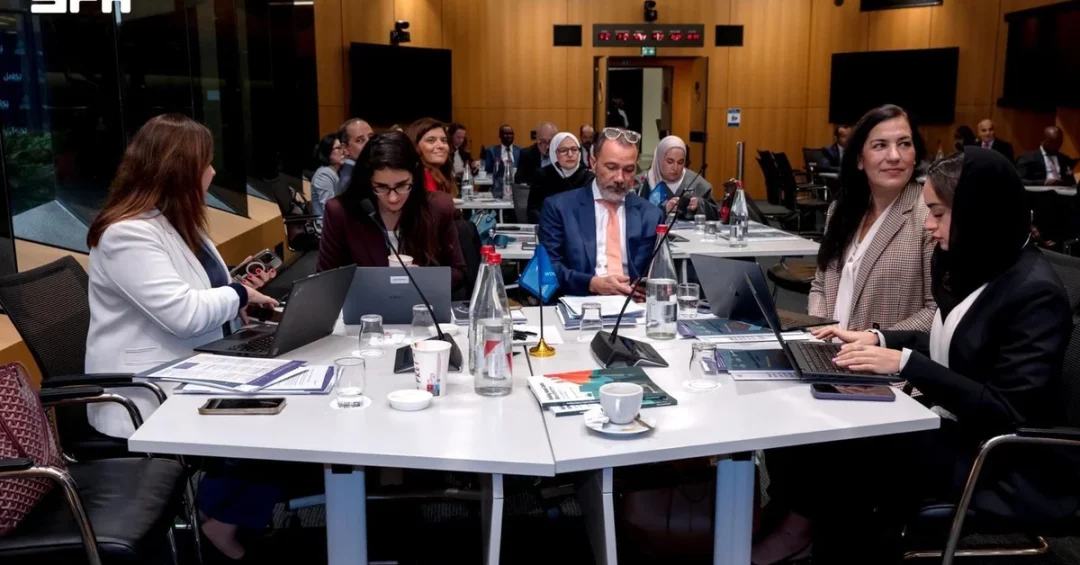
The training program for the second cohort of the Global Labor Market Academy (GLMA), an initiative of the Global Labor Market Conference (GLMC), commenced on Tuesday in Paris, gathering 31 policymakers and labor market specialists from 27 countries for an intensive three-day session. The program is being hosted at the World Bank Group headquarters from October 27 to 29, 2026, under the theme “Jobs Now: Advanced Strategies for Labor Market Transformation,” according to an announcement released via the Saudi Press Agency. The Paris convening marks the latest phase of a structured international capacity-building effort that began earlier this year in Riyadh and now extends across multiple continents.
The Paris program builds directly on the training phase that began in Riyadh in January 2026, during which participants studied Saudi Arabia’s experience in developing its labor market, including the Qiwa platform and the efforts of the Technical and Vocational Training Corporation to improve labor market services and develop workforce skills. The continuity between Riyadh and Paris is deliberate: participants first absorbed the Kingdom’s domestically tested approaches, and now bring that foundation to an international setting where they examine how other economies structure their own employment systems. It is a model of learning that travels in both directions.
What Does the Paris Phase of the Global Labor Market Academy Focus On?
The Paris program is organized around three main pillars, each designed to address a distinct dimension of modern labor market policy. The first pillar focuses on developing labor market strategies and strengthening their links to economic growth and productivity, ensuring that employment policy is treated as a core driver of national economic performance rather than a standalone social program. The second pillar addresses improving the efficiency of employment services through digital transformation and artificial intelligence, reflecting the growing role of technology in matching jobseekers with opportunities. The third pillar centers on developing workforce skills to meet labor market needs while enhancing youth employment opportunities and economic inclusion.
Participants engage in specialized training sessions and experience-sharing discussions with experts from the World Bank and other specialized international organizations. These sessions are structured to translate broad policy principles into concrete, applicable tools that participants can adapt to their home markets. The combination of expert-led instruction and peer exchange is a defining feature of the academy, allowing specialists from widely different economies to compare notes on shared challenges. Rather than a one-way lecture format, the program functions as a working laboratory for labor market policy.
The curriculum also features field visits to two offices of France Travail, France’s public employment service, where participants learn about its experience in delivering employment services and using data and modern technologies to connect jobseekers with employment opportunities. These site visits provide a practical counterpoint to classroom discussion, showing how a mature public employment system actually operates on the ground. For policymakers accustomed to designing frameworks in the abstract, observing service delivery in action offers insights that no briefing document can replicate.
How Does the Program Encourage International Cooperation on Skills?
A central element of the Paris agenda is a panel discussion under the GLMC 365 initiative on developing skills and connecting them across borders. Participants in this discussion include representatives from the Saudi Ministry of Human Resources and Social Development, the World Bank, the Organization for Economic Co-operation and Development (OECD), and the World Employment Confederation (WEC). The discussion explores ways to strengthen international cooperation in developing talent and aligning skills with labor market needs, a question of rising importance as economies become more interdependent and labor shortages emerge in specific sectors worldwide.
The GLMC 365 initiative reflects a recognition that skills development can no longer be treated as a purely domestic matter. When workers move across borders, and when employers recruit from international talent pools, the alignment of qualifications and competencies becomes a shared concern. By convening representatives from multilateral institutions, employer federations, and national ministries in a single forum, the panel seeks to identify practical mechanisms for mutual recognition and cooperation. This is the kind of quiet diplomatic work that rarely generates headlines but steadily shapes how global labor markets function.
Across its first and second cohorts, the GLMA’s network now includes participants from 50 countries, a figure that underscores the initiative’s growing reach and its efforts to promote the exchange of international expertise and build the capacities of labor market policymakers and specialists. The expansion from the first cohort to the second demonstrates a sustained commitment rather than a one-off event. Each new group of participants adds to an alumni network that can draw on shared experiences long after the formal training concludes, creating a durable community of practice among labor market professionals.
Why Does Saudi Arabia’s Labor Market Experience Matter Internationally?
Saudi Arabia’s role as a source of labor market expertise is a significant dimension of the GLMA story. The Riyadh phase introduced participants to the Kingdom’s own transformation journey, including digital platforms and institutional reforms that have reshaped how employment services are delivered. The Qiwa platform, developed to streamline labor market services for employers and workers alike, exemplifies how digital infrastructure can improve efficiency and transparency. The Technical and Vocational Training Corporation, meanwhile, has worked to align skills training with the actual demands of the private sector, a challenge facing virtually every economy.
Sharing this experience internationally positions Saudi Arabia as a constructive contributor to global policy dialogue, not merely a recipient of best practices from elsewhere. The Kingdom’s labor market reforms have been pursued in parallel with the broader Vision 2030 agenda, which seeks to diversify the economy, increase workforce participation, and expand opportunities for young people. That domestic context gives Saudi officials a practical grounding when they discuss these issues with counterparts from other countries. The exchange is most valuable when it moves in both directions, and the GLMA’s structure is designed to ensure exactly that.
The participation of 31 specialists from 27 countries in the Paris session also highlights the diversity of the academy’s reach. Participants come from economies at different stages of development, each with distinct labor market challenges. Some face high youth unemployment, others grapple with skills mismatches or the effects of rapid technological change. Bringing these perspectives together creates a richer learning environment than any single national model could provide, and it reinforces the principle that labor market policy benefits from international comparison.
What Are the Broader Implications for Global Labor Markets?
The Paris program arrives at a moment when labor markets worldwide are under pressure from technological change, demographic shifts, and evolving employer expectations. The emphasis on artificial intelligence and digital transformation in employment services reflects a practical reality: governments that fail to modernize how they connect workers with jobs risk falling behind. The GLMA’s focus on these themes positions it at the intersection of policy and technology, where many of the most consequential decisions about future employment will be made.
For the international audience observing Saudi Arabia’s engagement, the academy demonstrates a model of constructive global participation. Rather than confining its expertise to domestic applications, the Kingdom is helping to build capacity in dozens of other countries through a structured, multi-year initiative. This kind of cooperation strengthens relationships across regions and reinforces the principle that shared challenges demand shared responses. The network of 50 countries represented across the two cohorts is itself a testament to the appetite for this approach.
The program also has implications for how international organizations and national governments collaborate. By bringing the World Bank, OECD, WEC, and national ministries into a single conversation, the GLMC 365 panel creates space for coordination that might otherwise be difficult to achieve. Multilateral cooperation on skills and employment is notoriously complex, involving differing legal frameworks, qualification systems, and labor market priorities. Forums like this one help identify where alignment is possible and where flexibility is needed, gradually building the trust that underpins effective international cooperation.
How Does the Academy Connect to Vision 2030?
The Global Labor Market Academy aligns closely with the objectives of Saudi Vision 2030, the Kingdom’s comprehensive strategy for economic diversification and social development. Vision 2030 places significant emphasis on human capital development, workforce participation, and the creation of a knowledge-based economy. By hosting and co-developing an international academy that builds labor market policy capacity, Saudi Arabia extends the reach of these priorities beyond its own borders, contributing to a broader vision of regional and global prosperity.
The Kingdom’s labor market reforms, including platforms like Qiwa and the work of the Technical and Vocational Training Corporation, are integral to Vision 2030’s goals of increasing employment among Saudi citizens and enhancing the competitiveness of the private sector. Sharing these reforms through the GLMA reinforces the Kingdom’s position as a leader in labor market modernization and as a committed partner in international development. The academy is not an isolated initiative but part of a coherent strategy that links domestic reform with global engagement.
The Paris session, running through October 29, 2026, represents one milestone in a longer journey. As the GLMA continues to expand and its alumni network grows, the initiative is likely to influence labor market policy in an increasing number of countries. For Saudi Arabia, this represents an opportunity to shape international best practices while learning from the experiences of others, a mutually reinforcing dynamic that sits at the heart of Vision 2030’s approach to global partnership. The Kingdom’s investment in this academy reflects a long-term view: that building capacity in others strengthens the whole, and that leadership in the twenty-first century is exercised through cooperation as much as through national accomplishment.
20 Questions
Q1. What is the Global Labor Market Academy?
A1. The Global Labor Market Academy (GLMA) is an initiative of the Global Labor Market Conference (GLMC) that trains labor market policymakers and specialists from around the world through structured programs focused on employment strategy, digital transformation, and workforce skills development.
Q2. Where is the second cohort’s training program being held?
A2. The training program for the second cohort is being held at the World Bank Group headquarters in Paris, France, from October 27 to 29, 2026.
Q3. How many participants are in the Paris program?
A3. A total of 31 policymakers and labor market specialists are taking part in the Paris program, representing 27 different countries from various regions.
Q4. What is the theme of the Paris program?
A4. The program is held under the theme “Jobs Now: Advanced Strategies for Labor Market Transformation,” reflecting its focus on practical approaches to modernizing employment systems.
Q5. Where did the first training phase take place?
A5. The training phase for the second cohort began in Riyadh in January 2026, where participants learned about Saudi Arabia’s labor market development experience.
Q6. What Saudi labor market tools were highlighted in Riyadh?
A6. Participants learned about the Qiwa platform and the efforts of the Technical and Vocational Training Corporation to improve labor market services and develop workforce skills.
Q7. What are the three main focus areas of the program?
A7. The program focuses on developing labor market strategies linked to economic growth, improving employment services through digital transformation and AI, and developing workforce skills for youth employment and economic inclusion.
Q8. Which international organizations participate in the program?
A8. Experts from the World Bank and other specialized international organizations lead training sessions, while the GLMC 365 panel includes the OECD and the World Employment Confederation.
Q9. What site visits are included in the Paris program?
A9. Participants visit two offices of France Travail, France’s public employment service, to learn about delivering employment services and using data and modern technologies.
Q10. What is the GLMC 365 initiative?
A10. The GLMC 365 initiative is a year-round effort under the Global Labor Market Conference that promotes discussion on developing skills and connecting them across borders through cooperation among international stakeholders.
Q11. Who participates in the GLMC 365 panel discussion?
A11. The panel includes representatives from the Saudi Ministry of Human Resources and Social Development, the World Bank, the OECD, and the World Employment Confederation.
Q12. How many countries are represented across both cohorts?
A12. Across its first and second cohorts, the GLMA’s network includes participants from 50 countries, reflecting its expanding international reach and impact.
Q13. Why does Saudi Arabia share its labor market experience?
A13. Saudi Arabia shares its experience to contribute to global policy dialogue, build capacity in other countries, and reinforce international cooperation, consistent with its Vision 2030 commitment to global partnership.
Q14. What role does artificial intelligence play in the program?
A14. AI features prominently in the program’s focus on improving employment service efficiency, reflecting the growing role of technology in matching jobseekers with employment opportunities.
Q15. What is France Travail?
A15. France Travail is France’s public employment service, which participants visit to observe how a mature system delivers employment services using data and modern technologies.
Q16. How does the program support youth employment?
A16. One of the program’s three main pillars focuses on developing workforce skills to meet labor market needs while enhancing youth employment opportunities and economic inclusion.
Q17. What makes the GLMA a multi-year initiative?
A17. The GLMA operates through successive cohorts, with the first and second cohorts already completed or underway, building an expanding network of trained policymakers and specialists across 50 countries.
Q18. How does the program benefit participants from different economies?
A18. Participants from economies at different development stages exchange perspectives on shared challenges, creating a richer learning environment than any single national model could provide.
Q19. What is the duration of the Paris program?
A19. The Paris program runs for three days, from October 27 to 29, 2026, and includes training sessions, panel discussions, and field visits to France Travail offices.
Q20. How does the GLMA connect to Saudi Vision 2030?
A20. The academy advances Vision 2030’s emphasis on human capital development and global partnership by extending Saudi Arabia’s labor market expertise internationally and reinforcing the Kingdom’s role as a leader in modernization.
Reader Feedback
We value your thoughts. Please share your feedback on this article.
Your feedback helps us improve our coverage.