


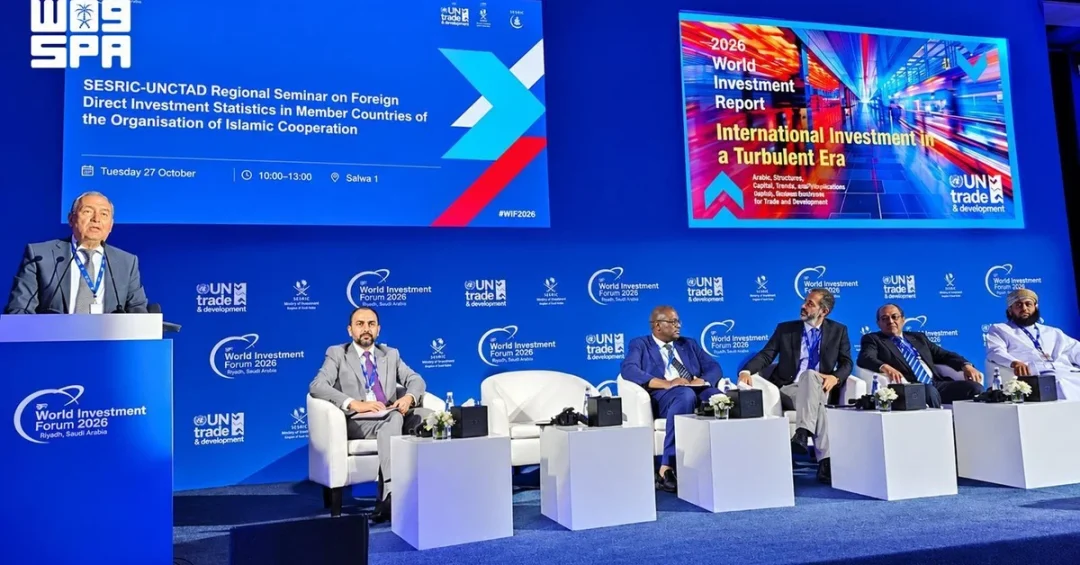
The Statistical, Economic and Social Research and Training Centre for Islamic Countries (SESRIC), an organ of the Organization of Islamic Cooperation (OIC), in collaboration with the United Nations Conference on Trade and Development (UNCTAD), convened a regional seminar on foreign direct investment (FDI) statistics in OIC member states, held on the sidelines of the ninth World Investment Forum 2026 in Doha, Qatar. The gathering brought together international experts, policymakers, and representatives of central banks and national statistical offices from several member states to review methodologies for collecting and analyzing FDI data and to explore more reliable ways of measuring the development impact of those investments.
The seminar, which also featured the participation of the Islamic Centre for Development of Trade (ICDT) and the Statistical Centre for the Cooperation Council for the Arab Countries of the Gulf (GCC-Stat), reflects a growing recognition across the Islamic world that high-quality statistics are not a technical afterthought but a foundation for sound economic decision-making. For an international audience, the session offers a window into how OIC member states are working to align their investment data with global standards and to position themselves more effectively in the competition for sustainable foreign investment. Why does the quality of an investment statistic matter so much to the future of a developing economy?
Context and Background
The seminar took place during the ninth World Investment Forum 2026, a major global platform convened by UNCTAD that brings together governments, international organizations, and the private sector to shape the future of investment for development. Holding the FDI statistics session on the sidelines of the forum allowed participants to connect technical statistical work with the broader policy conversation about how investment flows can be directed toward sustainable development priorities. The forum itself featured eight sessions and dialogues addressing key issues, including investment in artificial intelligence, sustainable finance, climate, the space economy, and entrepreneurship.
For decades, OIC member states have attracted and generated investment across a wide range of sectors, yet the data capturing these flows has often been fragmented, inconsistent, or incomplete. National statistical offices and central banks collect information using differing definitions and methodologies, which can make cross-country comparisons difficult and obscure the true scale and impact of investment. SESRIC, as the OIC’s statistical and research arm, has long worked to strengthen the statistical capacity of member states, and its partnership with UNCTAD on this seminar underscores the importance of harmonizing data collection frameworks across the Islamic world. How can a common statistical language help nations compete more effectively for global capital?
The participation of ICDT and GCC-Stat further broadened the scope of the discussion, bringing trade promotion and Gulf statistical perspectives into a conversation that spans continents. The involvement of central banks and national statistical offices is particularly significant because these institutions are the primary custodians of the raw data on which investment policy ultimately rests. Their presence signals that the drive to improve FDI statistics is being treated as a coordinated, institution-wide priority rather than an isolated academic exercise.
Methodological Innovation and Key Details
Discussions at the seminar reviewed the latest methodologies for collecting and analyzing FDI data and explored innovative approaches to measuring the actual development impact of these investments accurately and reliably. Working sessions highlighted the need to address data gaps and strengthen national statistical systems to improve data quality and ensure comparability across countries. Participants also examined ways to integrate supplementary datasets, including information on new investments and project financing, to enhance the analytical value of investment statistics.
These technical conversations matter because traditional FDI statistics often capture headline capital flows without revealing whether an investment generates jobs, transfers technology, builds local supply chains, or supports environmental goals. By integrating supplementary datasets on new investments and project financing, statisticians can move beyond simple totals toward a richer picture of what investment actually does on the ground. Emerging methodologies also allow analysts to track the sectoral destination of capital, the origin of investors, and the duration of projects, all of which inform more targeted policy incentives. Isn’t it time that investment data told us not just how much money arrived, but what that money achieved?
Participants stressed that improving data quality and availability is essential for evidence-based economic policymaking and informed investment decisions that support sustainable development across the Islamic world. They also underscored the importance of continued methodological innovation and stronger international partnerships. The emphasis on partnerships reflects a practical reality: no single statistical office can close data gaps alone, and collaboration among OIC institutions, UNCTAD, and national agencies offers a path to shared standards, shared training, and shared tools.
International and Regional Impact
The seminar’s outcomes extend well beyond the conference room. When OIC member states adopt comparable FDI statistics, they become more legible to international investors, multilateral lenders, and development partners who rely on reliable data to assess risk and opportunity. Consistent data also strengthens the position of member states in trade and investment negotiations, where credible figures can support a country’s case for favorable terms. For regional groupings such as the Gulf Cooperation Council, coordinated statistics can help demonstrate the scale and integration of investment activity across member economies.
The forum concluded in Doha with the announcement of the Doha Global Investment Framework, which produced more than 20 practical outcomes across six priority areas. Nine international strategic agreements and partnerships were also signed to translate global discussions into concrete, measurable development projects. The FDI statistics seminar feeds directly into this framework by ensuring that the outcomes announced in Doha can be tracked, measured, and evaluated over time. Without robust data, even the most ambitious investment framework risks becoming a statement of intent rather than a record of achievement. How else can the international community verify that promises made at global forums turn into real development gains?
The regional dimension is equally important. OIC member states span a vast geography, from the Gulf to Africa to Southeast Asia, and each faces distinct investment challenges. A shared statistical framework allows these diverse economies to learn from one another, benchmark their performance, and identify where investment is delivering the strongest development returns. For Saudi Arabia, which has positioned itself as a leading voice in global investment dialogue, the seminar reinforces the Kingdom’s commitment to cooperation and to the modernization of economic governance across the Islamic world.
Economic and Strategic Significance
High-quality investment statistics are a strategic asset in the modern global economy. They allow governments to design incentives that attract the right kind of investment, help central banks monitor capital flows and financial stability, and give businesses the confidence to commit capital to new markets. In an era when investors increasingly weigh sustainability and development impact alongside financial returns, the ability to measure impact becomes a competitive advantage. The seminar’s focus on measuring the development impact of investment therefore aligns with a broader shift in global investment priorities toward sustainable and inclusive growth.
The collaboration between SESRIC, UNCTAD, ICDT, and GCC-Stat also illustrates the value of institutional partnerships in an interconnected world. By pooling expertise, these organizations can develop shared methodologies, deliver training to national statisticians, and build digital infrastructure for data collection and dissemination. Such cooperation reduces duplication and accelerates the adoption of best practices across member states. For Saudi Arabia, whose Vision 2030 agenda places data-driven governance and international partnership at its core, these efforts reflect the Kingdom’s broader strategy of leveraging multilateral platforms to drive economic modernization and shared prosperity.
Vision 2030 Alignment
The seminar resonates strongly with the objectives of Saudi Vision 2030, which seeks to diversify the Kingdom’s economy, attract high-quality foreign investment, and strengthen the institutions that support evidence-based policymaking. Reliable FDI statistics are essential to measuring progress toward these goals, and the Kingdom’s active engagement in OIC and UNCTAD initiatives demonstrates its commitment to regional cooperation and global economic leadership. By supporting the harmonization of investment data across the Islamic world, Saudi Arabia helps create an environment in which capital can flow more efficiently toward productive, sustainable projects.
The forward-looking message from Doha is clear: the Islamic world is investing in the tools it needs to understand and shape its own economic future. As SESRIC, UNCTAD, and their partners continue to refine methodologies and close data gaps, OIC member states will be better equipped to attract responsible investment, track its impact, and demonstrate their contribution to global development. The Kingdom’s participation in this effort reflects its enduring role as a bridge between the Islamic world and the international community, and its determination to ensure that Vision 2030’s ambition is matched by the data and governance needed to achieve it.
20 Questions
Q1. What was the purpose of the SESRIC and UNCTAD regional seminar?
A1. The seminar aimed to improve foreign direct investment statistics in OIC member states by reviewing methodologies for collecting and analyzing FDI data and exploring ways to measure the development impact of investments accurately and reliably.
Q2. Where and when did the seminar take place?
A2. The seminar was held on the sidelines of the ninth World Investment Forum 2026 in Doha, Qatar, bringing together experts, policymakers, and representatives of central banks and national statistical offices from several member states.
Q3. Which organizations co-hosted the event?
A3. SESRIC, an organ of the Organization of Islamic Cooperation, hosted the seminar in collaboration with UNCTAD, with participation from the Islamic Centre for Development of Trade and the Statistical Centre for the GCC.
Q4. What does SESRIC stand for?
A4. SESRIC is the Statistical, Economic and Social Research and Training Centre for Islamic Countries, an institution of the Organization of Islamic Cooperation that supports statistical and research capacity across member states.
Q5. Why are reliable FDI statistics important?
A5. Reliable statistics support evidence-based economic policymaking and informed investment decisions, help countries compete for global capital, and allow governments and institutions to measure whether investment delivers real development impact.
Q6. What data gaps did participants discuss?
A6. Working sessions highlighted the need to address data gaps and strengthen national statistical systems to improve data quality and ensure comparability of investment figures across countries with differing methodologies.
Q7. What supplementary datasets were examined?
A7. Participants examined ways to integrate supplementary datasets, including information on new investments and project financing, to enhance the analytical value of investment statistics and capture the full picture of capital flows.
Q8. What was the World Investment Forum’s broader focus?
A8. The forum featured eight sessions and dialogues addressing key issues, including investment in artificial intelligence, sustainable finance, climate, the space economy, and entrepreneurship, connecting technical work with global investment policy.
Q9. What was the Doha Global Investment Framework?
A9. It was announced at the conclusion of the forum and produced more than 20 practical outcomes across six priority areas, translating global discussions into concrete, measurable development projects.
Q10. How many agreements were signed at the forum?
A10. Nine international strategic agreements and partnerships were signed to translate global discussions into concrete, measurable development projects aligned with the framework’s priority areas.
Q11. Why is comparability across countries important?
A11. Comparable data allows member states to benchmark performance, learn from one another, and present credible figures in trade and investment negotiations, strengthening their position in the global economy.
Q12. Which institutions collect FDI data in member states?
A12. National statistical offices and central banks are the primary custodians of investment data, and their representatives participated in the seminar to coordinate efforts to improve data collection and quality.
Q13. What role did GCC-Stat play?
A13. The Statistical Centre for the Cooperation Council for the Arab Countries of the Gulf participated in the seminar, bringing a Gulf statistical perspective to the effort to harmonize investment data across the Islamic world.
Q14. How does the seminar support sustainable development?
A14. By improving data quality and measuring the actual development impact of investments, the seminar helps channel capital toward projects that support sustainable and inclusive growth across OIC member states.
Q15. What did participants say about international partnerships?
A15. Participants underscored the importance of continued methodological innovation and stronger international partnerships, recognizing that collaboration among institutions is essential to closing data gaps and sharing best practices.
Q16. Why does measuring investment impact matter?
A16. Headline capital flows do not reveal whether investment creates jobs, transfers technology, or supports environmental goals, so measuring impact allows policymakers to design more effective and targeted investment incentives.
Q17. How does this seminar connect to Saudi Arabia’s goals?
A17. It aligns with Saudi Vision 2030’s emphasis on diversifying the economy, attracting high-quality foreign investment, and strengthening institutions that support evidence-based policymaking and regional cooperation.
Q18. What does the seminar mean for international investors?
A18. Improved, harmonized statistics make member states more legible to investors and development partners, providing reliable data to assess risk and opportunity and encouraging confident capital commitments to new markets.
Q19. What is the significance of the Doha forum’s timing?
A19. Holding the statistics seminar alongside the forum connected technical statistical work with high-level policy discussions, ensuring that the outcomes announced in Doha can be tracked, measured, and evaluated over time.
Q20. What is the forward-looking message of the seminar?
A20. The Islamic world is investing in the tools to understand and shape its economic future, and continued cooperation will help member states attract responsible investment and demonstrate their contribution to global development.
Reader Feedback
We value your thoughts. Please share your feedback on this article.
Your feedback helps us improve our coverage.