


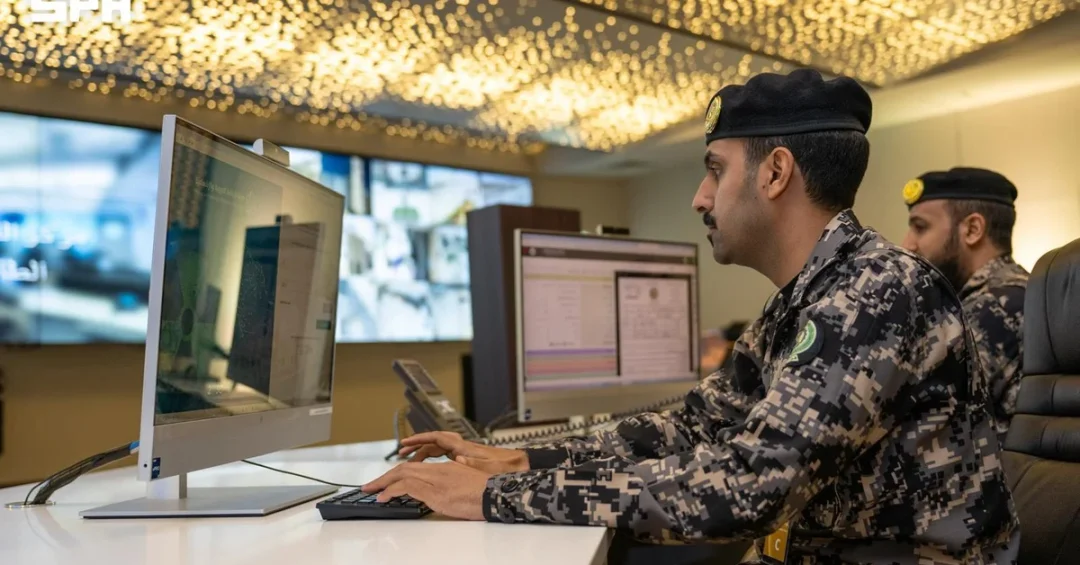
The Command and Control Center at the Facilities Security Forces Command is now operating through seven specialized units and is directly linked to 13 command and control centers across the forces’ branches throughout the Kingdom of Saudi Arabia, according to information released by the Saudi Press Agency (SPA). The integrated structure allows the center to receive reports, manage and monitor field operations, and exchange security information in real time, substantially enhancing response speed and coordination efficiency in cooperation with the National Center for Security Operations. The disclosure offers a rare, detailed look at how Saudi Arabia is modernizing the technological backbone of its protective security apparatus.
The Facilities Security Forces are responsible for protecting the Kingdom’s critical infrastructure, strategic installations, and vital facilities, a mandate that has grown in importance as Saudi Arabia expands its industrial, energy, and tourism footprint under Vision 2030. How does a country safeguard thousands of sensitive sites spread across vast geography while maintaining the speed and precision that modern threats demand? The answer, according to official Saudi channels, increasingly lies in centralized command, integrated electronic platforms, and artificial intelligence. The Command and Control Center sits at the heart of that effort, functioning as a digital nerve center that connects field personnel, branch commands, and national coordination bodies into a single operational picture.
Context and Background
Why has the Facilities Security Forces Command invested so heavily in a centralized command architecture? The answer lies in the scale and complexity of the Kingdom’s protective security mission. The forces oversee the safety of facilities that underpin the national economy, from energy installations and desalination plants to ports, airports, and major development sites. As Saudi Arabia’s infrastructure base expands, the number of facilities requiring protection and the volume of field reports generated each day have grown dramatically. A fragmented, paper-based or regionally isolated reporting system could not keep pace with such demand. The Command and Control Center was developed to solve precisely that problem by consolidating information flows into a single, integrated operational platform.
The center operates through seven specialized units, each responsible for a distinct function within the security workflow, ranging from report intake and monitoring to information exchange and field coordination. These units are linked to 13 command and control centers located at the forces’ branches across Saudi Arabia, creating a two-tier structure in which local branch centers handle on-the-ground operations while the central hub maintains a nationwide overview. According to the SPA report, this connectivity enables the forces to exchange security information rapidly and to coordinate responses with the National Center for Security Operations, the body responsible for unifying security operations across Saudi agencies. The architecture reflects a broader national trend in which Saudi security institutions are adopting integrated digital platforms to improve situational awareness and decision-making speed.
How does this centralized model change the nature of field security work? Rather than relying on delayed radio reports or separate databases, personnel at protected facilities can feed observations, alerts, and incident data into a shared system that is visible to both branch commands and the central center. This shared visibility reduces duplication, accelerates escalation, and allows commanders to allocate resources based on a real-time picture rather than after-the-fact summaries. For an international audience, the development illustrates how Saudi Arabia is applying modern command-and-control doctrine, long associated with advanced militaries, to the protection of civilian and economic infrastructure.
Key Details and Advanced Systems
What specific technologies underpin the center’s enhanced response capability? According to the official SPA information, the center relies on integrated, advanced electronic systems and platforms designed to receive reports, manage and monitor field operations, and exchange security information. These platforms serve as the connective tissue between the seven specialized units and the 13 branch centers, ensuring that data flows continuously in both directions. The systems are built to handle the volume and variety of information generated by protective security operations, from routine site checks and equipment status updates to urgent incident alerts. By centralizing this data, the center gives decision-makers a consolidated view that would be impossible to assemble through disconnected channels.
The center also employs unmanned aircraft systems equipped with artificial intelligence technologies to support field surveillance and improve the efficiency of security operations within the forces’ areas of responsibility. These aerial platforms extend the reach of ground-based monitoring, allowing the forces to observe areas that are difficult to access, to survey large facilities quickly, and to verify reports from multiple vantage points. Artificial intelligence contributes by helping process and interpret the imagery and sensor data collected, flagging anomalies and supporting human operators in prioritizing what requires attention. The combination of unmanned systems and AI is presented by official Saudi sources as a practical tool for enhancing surveillance coverage and operational efficiency rather than as a speculative future capability.
How significant is the linkage with the National Center for Security Operations? The coordination between the Facilities Security Forces Command and the national center means that information gathered at protected facilities can be shared with the wider security ecosystem when circumstances require it. This inter-agency connectivity is a defining feature of Saudi Arabia’s approach to national security, in which separate commands maintain their specialized mandates while remaining able to synchronize during major events or emergencies. The SPA report frames this cooperation as a means of enhancing response speed and coordination efficiency, two metrics that matter enormously in protective security, where minutes can determine outcomes.
International and Regional Impact
How should international observers interpret the modernization of Saudi Arabia’s facilities security apparatus? For global partners, the development signals that the Kingdom is investing in the sophisticated systems needed to protect the infrastructure on which international energy markets, shipping lanes, and investment relationships depend. Saudi Arabia is a leading exporter of energy and a hub for regional logistics, and the security of its facilities has direct implications for global economic stability. A faster, more coordinated protective security capability therefore contributes not only to domestic safety but also to the reliability that international markets and investors expect. The use of AI-enabled surveillance and integrated command platforms places Saudi Arabia alongside other advanced economies that are applying similar technologies to critical infrastructure protection.
Regionally, the center’s advanced capabilities reinforce the Kingdom’s position as a leader in security innovation within the Gulf and the broader Middle East. Neighboring states and partners observe Saudi Arabia’s adoption of unmanned aircraft systems and AI-assisted monitoring with interest, as these tools become increasingly relevant to protecting ports, pipelines, and large-scale development projects. The coordination model linking branch centers to a national hub also offers a reference point for countries seeking to modernize their own protective security structures. At the same time, official Saudi channels emphasize that these systems support field operations and surveillance within the forces’ defined areas of responsibility, underscoring a defensive and protective orientation consistent with the Kingdom’s stated security priorities.
Economic and Strategic Significance
Why does the speed of security response matter for Saudi Arabia’s economic ambitions? Vision 2030 envisions a diversified economy built on expanding industrial zones, new tourism destinations, logistics corridors, and major development projects such as those associated with NEOM and the Red Sea coast. Each of these undertakings depends on facilities that must be protected around the clock: construction sites, power and water infrastructure, data centers, and transport nodes. A command and control center capable of monitoring these assets in real time and coordinating a rapid response helps reduce operational risk and protect the substantial capital invested in national development. Reliable protective security is, in this sense, an enabler of economic growth rather than merely a defensive necessity.
The strategic significance extends to investor confidence and business continuity. International companies operating in the Kingdom, as well as Saudi enterprises, benefit from a security environment in which incidents can be detected quickly, communicated to the right authorities, and addressed efficiently. The center’s ability to exchange security information across the seven specialized units and 13 branch centers supports that continuity by ensuring that no single link in the chain becomes a bottleneck. How does this translate into tangible value? By shortening the interval between detection and response, the system helps limit disruption to operations, protect personnel, and preserve the assets on which economic activity depends. For a country positioning itself as a global investment destination, such reliability is a meaningful competitive advantage.
Vision 2030 Alignment
How does the Facilities Security Forces Command’s Command and Control Center connect to the broader goals of Vision 2030? The center embodies several core themes of the national transformation program: the adoption of advanced technology, the integration of government services, and the strengthening of institutional capabilities. Vision 2030 places heavy emphasis on digital transformation and on building a public sector that uses data and modern systems to deliver results efficiently. The center’s use of integrated electronic platforms, artificial intelligence, and unmanned aircraft systems reflects that commitment in the security domain, demonstrating that the Kingdom’s modernization agenda reaches across every sector, including the protection of critical infrastructure.
The development also supports the vision’s emphasis on safety, quality of life, and the attraction of global talent and investment. A secure environment is a precondition for the thriving cities, tourism destinations, and knowledge industries that Vision 2030 seeks to build. By enhancing response speed and coordination efficiency, the center contributes to a national security posture that is proactive rather than reactive, protecting the facilities on which the Kingdom’s future depends. As Saudi Arabia continues to expand its infrastructure and host major regional and global events, the role of integrated command and control will only grow, and the Facilities Security Forces Command appears positioned to meet that demand through continued technological investment aligned with the Kingdom’s long-term vision and its expanding global role.
20 Questions
Q1. What is the Command and Control Center at the Facilities Security Forces Command?
A1. It is the central coordination hub for the Facilities Security Forces, operating through seven specialized units and linked to 13 branch command and control centers across Saudi Arabia to receive reports, monitor field operations, and exchange security information in real time.
Q2. How many specialized units operate within the center?
A2. According to the Saudi Press Agency, the center operates through seven specialized units, each responsible for a distinct function such as report intake, field monitoring, information exchange, and operational coordination.
Q3. How many command and control centers are linked to the main center?
A3. The center is linked to 13 command and control centers located at the forces’ branches across the Kingdom, creating a nationwide network that connects local operations with central oversight.
Q4. What systems does the center use to manage operations?
A4. The center uses integrated, advanced electronic systems and platforms designed to receive reports, manage and monitor field operations, and exchange security information efficiently across its units and branch centers.
Q5. Which national body does the center cooperate with?
A5. The center cooperates with the National Center for Security Operations, coordinating security information and response efforts to enhance overall efficiency and speed across the national security ecosystem.
Q6. What role do unmanned aircraft systems play?
A6. The center uses unmanned aircraft systems equipped with artificial intelligence technologies to support field surveillance, extend monitoring coverage, and improve the efficiency of security operations within the forces’ areas of responsibility.
Q7. How does artificial intelligence support the center’s work?
A7. AI technologies help process and interpret imagery and sensor data collected by unmanned systems, flagging anomalies and supporting human operators in prioritizing surveillance tasks and field responses.
Q8. What is the main benefit of the center’s integrated structure?
A8. The integrated structure enhances response speed and coordination efficiency by consolidating information flows into a single operational picture visible to both branch commands and central decision-makers.
Q9. What kinds of facilities do the Facilities Security Forces protect?
A9. The forces protect critical infrastructure and vital facilities, including energy installations, industrial sites, ports, transportation nodes, and other strategic assets that support Saudi Arabia’s economy.
Q10. Why is centralized command important for protective security?
A10. Centralized command reduces duplication, accelerates escalation of incidents, and allows commanders to allocate resources based on a real-time nationwide picture rather than delayed, fragmented reports.
Q11. How does the center exchange security information?
A11. It uses integrated electronic platforms that allow data to flow continuously between the seven specialized units, the 13 branch centers, and cooperating national bodies such as the National Center for Security Operations.
Q12. What types of reports does the center receive and manage?
A12. The center receives and manages reports covering routine site checks, equipment status updates, incident alerts, and other field observations generated daily by protective security operations across the Kingdom.
Q13. How does real-time monitoring improve field security?
A13. Real-time monitoring gives commanders immediate visibility of conditions at protected facilities, enabling faster verification of alerts and quicker resource allocation when incidents occur.
Q14. What is the significance of the 13 branch centers?
A14. The 13 branch centers handle on-the-ground operations at the forces’ regional branches while feeding information to the central hub, which maintains a nationwide operational overview.
Q15. How does the center support coordination during major events?
A15. Through its link with the National Center for Security Operations, the center can synchronize information and responses with the wider security ecosystem during major events or emergencies.
Q16. Is the use of AI in surveillance presented as operational or speculative?
A16. Official Saudi sources describe the unmanned systems and AI technologies as practical tools currently used to support field surveillance and improve the efficiency of security operations.
Q17. How does the center relate to Saudi Arabia’s critical infrastructure protection?
A17. The center provides the technological backbone for protecting critical infrastructure, ensuring that threats or incidents at vital facilities are detected and addressed rapidly.
Q18. What does the development reveal about Saudi security modernization?
A18. It reflects a broader national trend of adopting integrated digital platforms, artificial intelligence, and centralized command models to strengthen situational awareness and decision-making speed.
Q19. How does faster response benefit the national economy?
A19. Faster response limits disruption to operations at protected facilities, helping preserve assets, protect personnel, and support business continuity that underpins economic growth and investor confidence.
Q20. How does the center align with Vision 2030 objectives?
A20. The center reflects Vision 2030’s emphasis on digital transformation, institutional capability building, and the secure environment needed for thriving cities, tourism, and investment.
Reader Feedback
We value your thoughts. Please share your feedback on this article.
Your feedback helps us improve our coverage.