


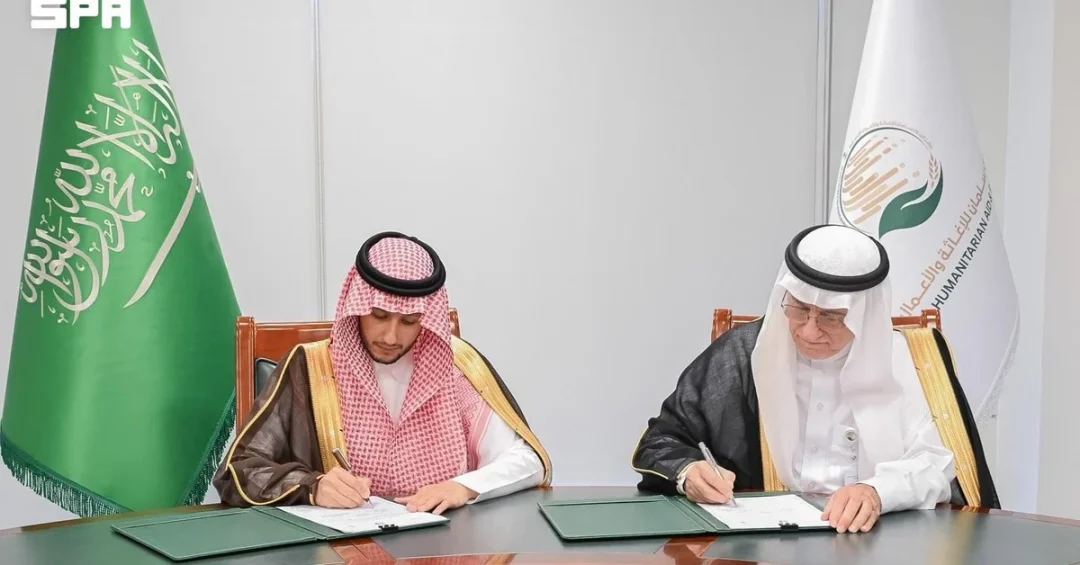
The King Salman Humanitarian Aid and Relief Center (KSrelief) signed a memorandum of cooperation with Mofarreh Group for Community Service on Tuesday at the center’s headquarters in Riyadh, formalizing a partnership aimed at expanding food assistance, healthcare, education, and social development programs for beneficiary communities. The agreement was signed by Dr. Salah Al-Mazrou, KSrelief Assistant Supervisor General of Administration and Finance Affairs, and Alaa Al-Ghamdi, Chief Executive Officer of Mofarreh Group for Community Service, in the presence of officials from both organizations.
The memorandum represents a further step in KSrelief’s broader strategy of building sustained partnerships with private-sector and civil-society entities to broaden the reach and quality of humanitarian and development work. By combining the center’s logistical, diplomatic, and operational capabilities with the community-service expertise of Mofarreh Group, the agreement seeks to deliver tangible improvements in the daily lives of families and individuals across beneficiary communities. The signing was reported by the Saudi Press Agency (SPA), the Kingdom’s official news authority, underscoring the transparency with which Saudi humanitarian efforts are announced to the public.
Context and Background
How does a single memorandum in Riyadh translate into measurable change for communities thousands of kilometers away? The answer lies in the institutional architecture that Saudi Arabia has built around humanitarian work over the past three decades. KSrelief, established in 2015 under the guidance of the Kingdom’s leadership, has grown into one of the world’s most active humanitarian donors, operating programs spanning food security, health, education, water, sanitation, and shelter in dozens of countries across Asia, Africa, and the Middle East. Its partnerships with specialized organizations allow it to channel resources efficiently and tailor interventions to local needs.
Mofarreh Group for Community Service brings a complementary profile to this collaboration. As an entity dedicated to community development, the group focuses on programs that address the social dimensions of well-being, from supporting families and vulnerable groups to strengthening local institutions. The pairing of a major humanitarian center with a community-focused partner reflects a growing recognition that durable development requires both large-scale relief capacity and close, on-the-ground engagement with the communities being served.
The signing also comes amid a wider regional context in which humanitarian needs remain significant, driven by conflict, displacement, and economic pressures. Saudi Arabia has consistently positioned itself as a stabilizing humanitarian actor, and agreements such as this one demonstrate how the Kingdom leverages partnerships to respond with speed and precision. The memorandum does not stand alone; it is one element in a portfolio of collaborations that KSrelief maintains with ministries, international agencies, and private-sector partners.
Scope of the Cooperation
What exactly does the memorandum commit the two parties to deliver? According to the official announcement, the cooperation covers a deliberately broad range of services. On food assistance, the agreement envisions coordinated efforts to provide essential nutrition to communities facing hardship. On healthcare, it includes preventive programs, medical and awareness campaigns, and support for health facilities through the provision of equipment and specialized personnel, allowing clinics and hospitals to extend quality care to more patients.
The education component is equally substantive. The two parties will cooperate on building, developing, and equipping schools to improve educational outcomes, ensuring that children in beneficiary communities gain access to safe and well-resourced learning environments. In parallel, the memorandum addresses social infrastructure by committing to the construction, rehabilitation, and maintenance of social facilities and the fulfillment of their operational needs, creating spaces where community life can thrive.
This multi-sector approach is significant because it recognizes that humanitarian challenges are interconnected. A family that receives food assistance but lacks access to healthcare or schooling for its children remains vulnerable. By addressing nutrition, health, education, and social services together, the partnership aims for a more holistic and lasting impact, one that strengthens the resilience of communities rather than merely alleviating immediate symptoms.
International and Regional Impact
Why should observers beyond Saudi Arabia’s borders pay attention to this agreement? Because the Kingdom’s humanitarian partnerships have global reach. KSrelief programs operate across multiple continents, and any expansion of its delivery capacity translates into benefits for communities in some of the world’s most underserved regions. The addition of a capable community-service partner enhances the center’s ability to identify needs, design locally appropriate interventions, and ensure that assistance reaches those who need it most.
The memorandum also reinforces Saudi Arabia’s reputation as a reliable and generous humanitarian actor at a time when global aid budgets face pressure. International organizations and donor governments have repeatedly acknowledged the Kingdom’s contributions to relief efforts, and partnerships of this kind demonstrate a model in which state agencies and private-sector entities share responsibility for global welfare. For regional neighbors, the agreement signals sustained Saudi commitment to stability and human dignity, values that underpin the Kingdom’s foreign policy.
Economic and Strategic Significance
Is this purely a humanitarian arrangement, or does it carry strategic weight as well? The two dimensions are deeply intertwined. Humanitarian and development work strengthens social stability, which in turn supports economic activity and investment. Communities with reliable access to food, healthcare, and education are more productive, more resilient to shocks, and better positioned to participate in the broader economy. In this sense, the memorandum contributes to the enabling conditions that underpin long-term prosperity.
Strategically, the partnership reflects Saudi Arabia’s emphasis on institutional collaboration and efficiency. By working with Mofarreh Group, KSrelief taps specialized expertise and local networks, potentially improving the cost-effectiveness and speed of program delivery. This model of public-private cooperation aligns with the Kingdom’s wider modernization agenda, in which the public and private sectors are encouraged to pool capabilities for the public good. The agreement also enhances transparency and accountability, since both parties have clear roles and responsibilities in delivering the promised services.
Vision 2030 Alignment
How does a humanitarian memorandum connect to Saudi Arabia’s long-term national vision? Vision 2030, the Kingdom’s comprehensive reform strategy, places human dignity, social responsibility, and international cooperation at its core. One of its central pillars is to build a vibrant society in which citizens and institutions contribute to the well-being of others, at home and abroad. KSrelief is a direct expression of this pillar, projecting Saudi generosity onto the global stage and demonstrating the Kingdom’s commitment to humanitarian values.
By strengthening partnerships with community-service organizations like Mofarreh Group, KSrelief advances the Vision 2030 objective of an empowered, responsible society in which collaboration between sectors multiplies positive impact. The agreement also supports the broader goal of enhancing Saudi Arabia’s global leadership role, showing that the Kingdom is not only an economic and diplomatic power but also a humanitarian leader. As Saudi Arabia continues to modernize and open to the world, partnerships of this kind will remain an important channel through which its values and capabilities reach those in need, reinforcing a forward-looking vision of shared prosperity and human dignity.
20 Questions
Q1. What organizations signed the memorandum of cooperation?
A1. The King Salman Humanitarian Aid and Relief Center (KSrelief) and Mofarreh Group for Community Service signed the memorandum at KSrelief’s headquarters in Riyadh, according to the Saudi Press Agency.
Q2. Who signed the memorandum on behalf of KSrelief?
A2. Dr. Salah Al-Mazrou, KSrelief Assistant Supervisor General of Administration and Finance Affairs, signed on behalf of the center, as reported by the Saudi Press Agency.
Q3. Who represented Mofarreh Group at the signing?
A3. Alaa Al-Ghamdi, Chief Executive Officer of Mofarreh Group for Community Service, signed the memorandum on behalf of the group during the ceremony in Riyadh.
Q4. Where did the signing ceremony take place?
A4. The memorandum was signed at KSrelief’s headquarters in Riyadh on Tuesday, according to the official announcement carried by the Saudi Press Agency.
Q5. What areas of assistance does the memorandum cover?
A5. It covers food assistance, healthcare and preventive programs, medical and awareness campaigns, support for health facilities with equipment and specialized personnel, education through school construction, and social facility development.
Q6. What healthcare support is included in the agreement?
A6. The cooperation includes preventive healthcare programs, medical and awareness campaigns, and support for health facilities through the provision of equipment and specialized personnel to improve care delivery.
Q7. How does the memorandum address education?
A7. The agreement includes cooperation on building, developing, and equipping schools to improve education and ensure students gain access to safe, well-resourced learning environments.
Q8. What social infrastructure commitments are part of the agreement?
A8. The memorandum covers constructing, rehabilitating, and maintaining social facilities and meeting their needs, creating spaces that support community life and social development.
Q9. Why is KSrelief partnering with a community-service group?
A9. The partnership supports KSrelief’s efforts to strengthen collaborations and expand humanitarian and development work, combining the center’s reach with the group’s community expertise.
Q10. What is the stated purpose of the memorandum?
A10. The memorandum supports KSrelief’s efforts to strengthen partnerships and expand humanitarian and development work to serve beneficiary communities effectively and efficiently.
Q11. Which official source reported the signing?
A11. The Saudi Press Agency (SPA), the Kingdom’s official news authority, reported the signing, reflecting the transparent communication of Saudi humanitarian activities.
Q12. What is KSrelief’s broader mission?
A12. KSrelief is Saudi Arabia’s humanitarian aid agency, delivering relief and development programs in food security, health, education, and other sectors to communities in need worldwide.
Q13. How does this agreement reflect Saudi humanitarian leadership?
A13. It demonstrates the Kingdom’s commitment to global welfare through institutional partnerships, extending Saudi generosity and humanitarian values to beneficiary communities internationally.
Q14. What role do partnerships play in KSrelief’s strategy?
A14. Partnerships allow KSrelief to expand its reach, tap specialized expertise, and deliver services more efficiently, forming a core element of its operational approach.
Q15. What kinds of campaigns are mentioned in the memorandum?
A15. The agreement includes medical and awareness campaigns aimed at promoting health, preventing disease, and improving health literacy among beneficiary communities.
Q16. How does the memorandum support health facilities?
A16. It provides equipment and specialized personnel to health facilities, enabling them to extend quality medical care to more patients in beneficiary communities.
Q17. What does the agreement mean for beneficiary communities?
A17. Beneficiary communities stand to gain improved access to food, healthcare, education, and social services, strengthening their resilience and overall well-being.
Q18. How does the memorandum align with Vision 2030?
A18. It reflects Vision 2030’s emphasis on social responsibility and international cooperation, advancing the Kingdom’s goal of a vibrant, responsible society and global humanitarian leadership.
Q19. Does the memorandum include maintenance of facilities?
A19. Yes, it includes the construction, rehabilitation, and maintenance of social facilities, along with meeting their needs, ensuring durable and functional community infrastructure.
Q20. When was the memorandum signed?
A20. The memorandum was signed on Tuesday, as reported by the Saudi Press Agency, at KSrelief’s headquarters in Riyadh, according to the official announcement.
Reader Feedback
We value your thoughts. Please share your feedback on this article.
Your feedback helps us improve our coverage.