


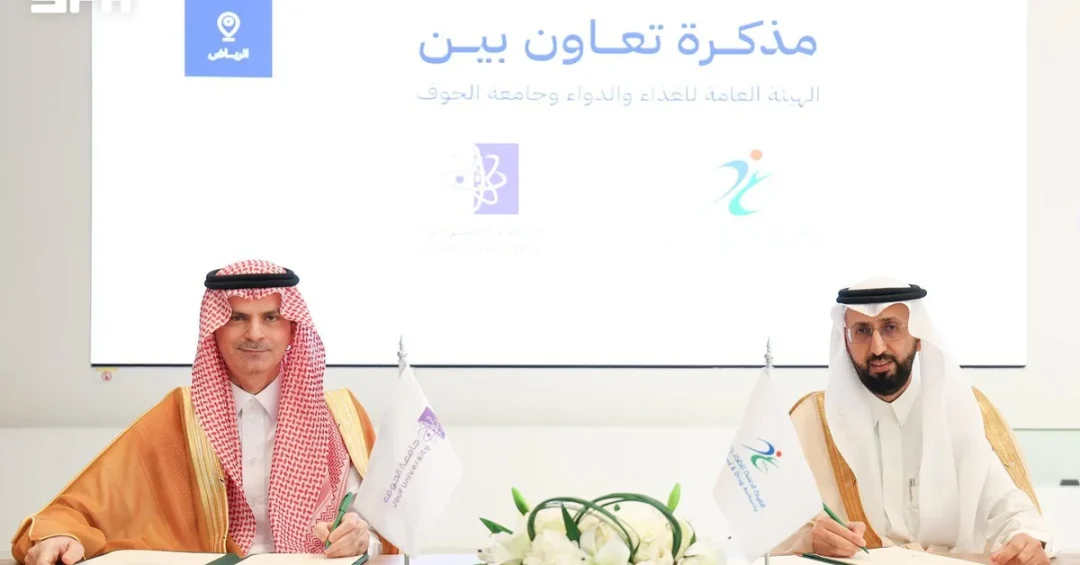
The Saudi Food and Drug Authority (SFDA) and Jouf University have signed a memorandum of cooperation at the SFDA headquarters in Riyadh, establishing a strategic partnership designed to strengthen collaboration between the Kingdom’s regulatory and academic sectors. The agreement, announced via the Saudi Press Agency, aims to facilitate the exchange of knowledge and expertise while advancing areas of mutual interest in scientific research, training, and professional development. The memorandum was signed by Dr. Hisham Aljadhey, Chief Executive Officer of the SFDA, and Prof. Dr. Mohammed Abdullah Alshaya, President of Jouf University, in a ceremony that underscores the growing integration between government institutions and higher education in Saudi Arabia.
The signing represents more than a routine administrative arrangement. It signals a deliberate effort by Saudi institutions to pool resources, share specialized knowledge, and build the national capabilities required for a diversified, knowledge-driven economy. For an international audience, the development offers a window into how the Kingdom is operationalizing its modernization agenda: not only through large-scale infrastructure and investment, but through the quieter, foundational work of connecting regulators, researchers, and educators in pursuit of shared national goals. Why does this kind of institutional cooperation matter so much at this stage of Saudi Arabia’s development? The answer lies in the way it multiplies expertise across sectors that are central to public wellbeing.
Context and Background
What drives a national regulator to formalize ties with an academic institution? The SFDA, which oversees food safety, pharmaceuticals, medical devices, and cosmetics across the Kingdom, has increasingly positioned itself as a science-led authority whose decisions rest on rigorous evidence. Jouf University, based in the northern Al-Jouf region, has built a growing reputation for research capacity and academic training that complements the regulator’s technical mandate. By codifying their relationship, both institutions create a durable framework through which data, statistics, and professional expertise can flow in both directions.
The memorandum aligns with a broader pattern across Saudi Arabia, where ministries, agencies, and universities are being encouraged to collaborate rather than operate in silos. This shift reflects the strategic priorities articulated under Saudi Vision 2030, which places human capital development, scientific research, and cross-sector integration at the heart of the national transformation. Regulators gain access to fresh research and academic talent, while universities gain practical exposure for their students and faculty to the real-world challenges of food and drug oversight. Doesn’t this kind of two-way exchange strengthen the entire national innovation ecosystem? It does, by ensuring that academic inquiry remains grounded in the needs of public policy and industry practice.
The agreement also reflects the SFDA’s evolving role on the world stage. As Saudi Arabia expands its pharmaceutical manufacturing, food production, and healthcare capabilities, the regulator’s credibility and scientific rigor have become assets of national importance. Partnerships with universities help maintain the authority’s scientific currency, ensuring its standards and methods keep pace with global best practice.
Key Details of the Agreement
What exactly does the memorandum commit the two parties to deliver? According to the official announcement, the agreement covers a wide range of cooperative activities. It provides for the exchange of data, statistics, and scientific and professional expertise between the SFDA and Jouf University. It supports joint research and studies, allowing academic researchers and regulatory scientists to work together on questions relevant to food safety, pharmaceutical quality, and public health protection.
The memorandum further provides for implementing collaborative training programs, giving university students and researchers structured opportunities to develop skills aligned with the regulator’s technical requirements. It also covers the provision of scientific consultations, through which SFDA specialists can support academic projects and university staff can contribute independent expertise to regulatory work. In addition, the two parties will cooperate in organizing training programs, exhibitions, seminars, and conferences, creating public platforms for knowledge dissemination and professional networking.
What makes these provisions practically significant? Taken together, they establish a comprehensive pipeline between academic research and regulatory practice. Students trained under these programs enter the workforce with direct exposure to national standards and procedures. Researchers gain access to real-world data that can inform their studies. The regulator benefits from a steady infusion of scientific insight and a future talent pool familiar with its mission. Each element reinforces the others, creating an ecosystem of mutual benefit rather than a one-off collaboration.
International and Regional Impact
How does a bilateral agreement between a regulator and a university resonate beyond Saudi Arabia’s borders? For international observers, the memorandum illustrates the Kingdom’s methodical approach to institutional capacity building. Countries across the region and beyond are watching how Saudi Arabia implements its transformation agenda, and science-led cooperation between government and academia is a model that travels well. It demonstrates that modernization is not solely about megaprojects and investment figures, but also about the everyday work of strengthening institutions and developing people.
The agreement also strengthens Saudi Arabia’s position in global scientific and regulatory networks. A regulator with strong academic ties is better equipped to engage international counterparts, participate in harmonization efforts, and contribute to global standards for food safety and pharmaceutical oversight. Jouf University’s participation adds a regional dimension, ensuring that the benefits of this cooperation extend to students and researchers outside the major metropolitan centers. Isn’t it significant that a northern university is positioned as a full partner in national scientific advancement? It reflects a deliberate effort to distribute opportunity and expertise across the Kingdom rather than concentrate it in a single location.
Economic and Strategic Significance
Why should the economic importance of this memorandum not be overlooked? Saudi Arabia’s food and drug sectors are expanding rapidly as part of the national push toward diversification. Domestic pharmaceutical manufacturing, food processing, and healthcare services all depend on reliable, science-based regulation that protects consumers while enabling growth. By strengthening its scientific foundation, the SFDA helps create the predictable, trustworthy environment that investors and industry require. Universities, in turn, supply the research and talent that make those industries sustainable.
The strategic significance extends to national talent development. The cooperative training and consultation provisions create pathways for Saudi graduates to enter specialized fields such as food science, pharmacology, and regulatory affairs. This directly supports the goal of developing a skilled national workforce capable of meeting the demands of a modern, diversified economy. When regulators and universities align their efforts, the result is a more efficient use of public resources and a stronger return on investment in education and research. Such alignment is precisely what a knowledge economy demands.
Vision 2030 Alignment
How does this memorandum connect to Saudi Arabia’s long-term vision for the future? The agreement explicitly reflects the SFDA and Jouf University’s ongoing efforts to strengthen integration between the government and academic sectors, leverage shared expertise and resources to advance scientific research, and develop national talent in line with the objectives of Saudi Vision 2030. Those objectives include building a diversified economy, enhancing the quality of public services, and investing in human capital as the Kingdom’s most valuable resource.
The cooperation also advances the vision’s emphasis on innovation and institutional excellence. By formalizing a partnership that promotes research, training, and knowledge exchange, the two institutions are contributing directly to a national culture of collaboration and continuous improvement. For the international audience seeking to understand Saudi Arabia’s trajectory, this agreement is a clear signal that the Kingdom’s transformation is being built from the ground up, institution by institution, partnership by partnership. What emerges is not simply a signed document, but a working model for how government and academia can achieve shared national ambitions together.
20 Questions
Q1. Which two institutions signed the memorandum of cooperation?
A1. The Saudi Food and Drug Authority (SFDA) and Jouf University signed the memorandum of cooperation. The agreement was formalized at the SFDA headquarters in Riyadh, bringing together the Kingdom’s national regulator and a leading academic institution.
Q2. Who signed the memorandum on behalf of the SFDA?
A2. The memorandum was signed by Dr. Hisham Aljadhey, Chief Executive Officer of the Saudi Food and Drug Authority. He signed on behalf of the regulator, highlighting its commitment to scientific collaboration with academic institutions.
Q3. Who signed the memorandum on behalf of Jouf University?
A3. Prof. Dr. Mohammed Abdullah Alshaya, President of Jouf University, signed the memorandum. His participation reflects the university’s dedication to advancing research and developing national talent through partnership with the public sector.
Q4. Where was the memorandum signed?
A4. The memorandum was signed at the SFDA headquarters in Riyadh. The ceremony marked a formal step toward stronger integration between Saudi Arabia’s regulatory and academic sectors.
Q5. What are the main areas covered by the agreement?
A5. The agreement covers the exchange of data, statistics, and scientific and professional expertise; support for joint research and studies; collaborative training programs; scientific consultations; and cooperation in organizing training programs, exhibitions, seminars, and conferences.
Q6. How does the agreement support scientific research?
A6. It supports joint research and studies between SFDA specialists and university researchers, provides scientific consultations, and enables the exchange of data and expertise. These provisions help advance research relevant to food safety, pharmaceuticals, and public health.
Q7. What role does data exchange play in the agreement?
A7. The agreement provides for the exchange of data and statistics between the two institutions. This flow of information supports evidence-based research and helps both parties make informed decisions in their respective fields.
Q8. How will training programs benefit students and researchers?
A8. Collaborative training programs give students and researchers structured opportunities to develop skills aligned with national standards. They gain practical exposure to regulatory practices and real-world challenges, improving their readiness for specialized careers.
Q9. What kinds of events will the two parties organize together?
A9. The memorandum provides for cooperation in organizing training programs, exhibitions, seminars, and conferences. These events create public platforms for knowledge dissemination, professional networking, and the sharing of scientific expertise.
Q10. How does the agreement reflect Saudi Vision 2030 objectives?
A10. The agreement aligns with Vision 2030 by strengthening integration between government and academia, advancing scientific research, and developing national talent. These goals support a diversified, knowledge-based economy and improved public services.
Q11. Why is cooperation between government and academia important?
A11. Cooperation pools resources and expertise, ensuring academic research remains grounded in public policy needs while regulators benefit from fresh scientific insight. It strengthens the entire national innovation ecosystem and improves efficiency.
Q12. What is the SFDA’s core mandate?
A12. The SFDA oversees food safety, pharmaceuticals, medical devices, and cosmetics across the Kingdom. It operates as a science-led regulator whose decisions rest on rigorous evidence and national standards.
Q13. Which region does Jouf University serve?
A13. Jouf University is based in the northern Al-Jouf region of Saudi Arabia. It has built a growing reputation for research capacity and academic training, contributing to regional development and national talent.
Q14. How might the agreement benefit Saudi Arabia’s pharmaceutical sector?
A14. By strengthening scientific foundations and developing skilled talent, the agreement supports growth in domestic pharmaceutical manufacturing. Reliable, science-based regulation protects consumers while enabling industry expansion and investor confidence.
Q15. Does the agreement involve financial commitments?
A15. The official announcement focuses on cooperation in research, data exchange, training, consultations, and events. It does not specify financial commitments, describing instead a framework for knowledge and expertise sharing between the two institutions.
Q16. How does this partnership support national talent development?
A16. Training and consultation provisions create pathways for Saudi graduates to enter specialized fields such as food science, pharmacology, and regulatory affairs. This directly supports building a skilled national workforce for a diversified economy.
Q17. What does the memorandum say about exhibitions and conferences?
A17. It includes cooperation in organizing exhibitions, seminars, and conferences. These activities allow both institutions to share findings, engage professionals, and raise public awareness of food safety and pharmaceutical standards.
Q18. How does this agreement strengthen the SFDA’s international standing?
A18. Strong academic ties help the SFDA maintain scientific currency and engage global counterparts in harmonization efforts. This bolsters its credibility and its contribution to international standards for food and drug oversight.
Q19. Why is this agreement relevant to an international audience?
A19. It illustrates Saudi Arabia’s methodical approach to institutional capacity building. Observers can see how the Kingdom connects regulators and educators to advance research, develop talent, and support its broader transformation agenda.
Q20. What is the overall significance of the memorandum?
A20. The memorandum represents a working model of government-academic collaboration. It advances scientific research, develops national talent, and supports Vision 2030 objectives, positioning both institutions as contributors to Saudi Arabia’s long-term development.
Reader Feedback
We value your thoughts. Please share your feedback on this article.
Your feedback helps us improve our coverage.