


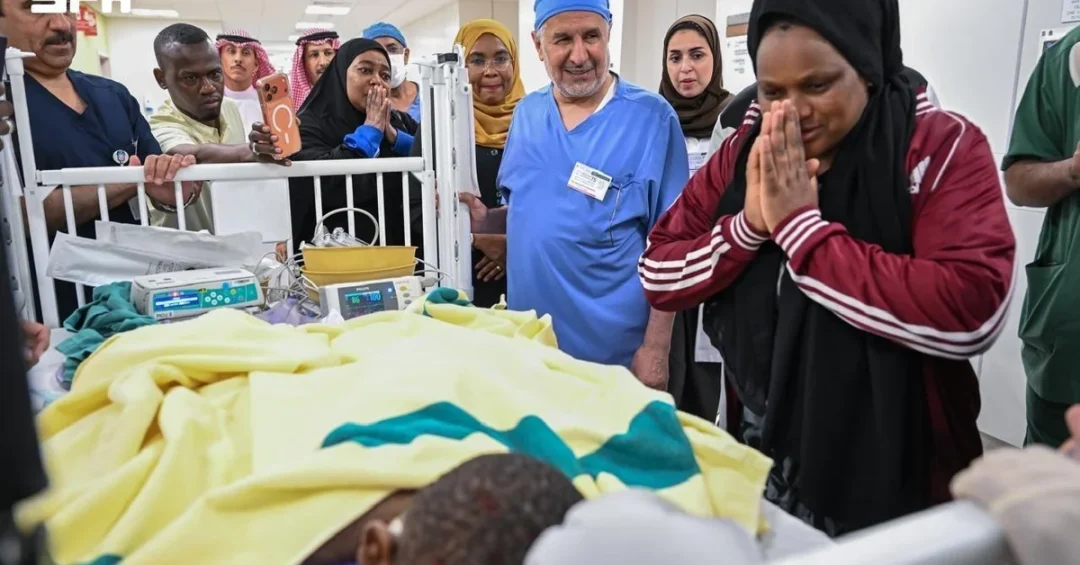
The Saudi Conjoined Twins Programme successfully separated Tanzanian conjoined twins Laityness and Loveness in a complex 14.5-hour operation at King Abdullah Specialist Children’s Hospital in Riyadh, marking the programme’s 75th procedure and its fourth separation of twins from the United Republic of Tanzania. The surgery, announced on October 30, 2026, by the Saudi Press Agency, was performed at King Abdulaziz Medical City, affiliated with the Ministry of National Guard, and involved 44 consultants, specialists, and nursing and technical staff from multiple medical disciplines. The twins, aged two years and two months, were joined at the pelvis and hips and shared the lower portion of the intestines, spinal column, lumbar vertebrae, and spinal cord, and had four lower limbs. The operation was led by Dr. Abdullah bin Abdulaziz Al Rabeeah, Advisor at the Royal Court, Supervisor General of the King Salman Humanitarian Aid and Relief Center (KSrelief), and head of the programme’s medical and surgical team.
This milestone underscores Saudi Arabia’s growing role as a global leader in specialized humanitarian medicine, a status cultivated over more than 35 years through the Saudi Conjoined Twins Programme. The programme has evaluated 160 cases from 29 countries and performed 75 separations, reflecting the Kingdom’s commitment to alleviating human suffering and advancing medical science. Under the direct support of Custodian of the Two Holy Mosques King Salman bin Abdulaziz Al Saud and His Royal Highness Prince Mohammed bin Salman bin Abdulaziz Al Saud, Crown Prince and Prime Minister, the programme has become a beacon of hope for families worldwide. How does such a remarkable achievement shape perceptions of Saudi Arabia’s humanitarian reach? It demonstrates that the Kingdom’s influence extends beyond economics and diplomacy into life-saving medical interventions that resonate across continents.
Context and Background
What drives a nation to invest decades of resources into separating conjoined twins from around the world? The Saudi Conjoined Twins Programme was established more than 35 years ago as a humanitarian initiative under the Saudi leadership, aiming to provide free, world-class surgical care to children born with this rare and life-threatening condition. Since its inception, the programme has evaluated 160 cases from 29 countries, performing 75 successful separations. The programme operates under the umbrella of KSrelief, which is led by Dr. Abdullah bin Abdulaziz Al Rabeeah, who also serves as Advisor at the Royal Court and head of the programme’s medical and surgical team. This dual role ensures seamless coordination between humanitarian aid and specialized medical expertise.
Conjoined twins occur in approximately one in every 50,000 to 100,000 births, with fusion typically occurring in the womb. Separation surgery is highly complex, requiring meticulous planning and multidisciplinary collaboration. The Saudi programme has become a global referral center, receiving cases from countries across Africa, Asia, and the Middle East. The case of Laityness and Loveness from Tanzania is the fourth from that nation, following previous successful separations. Each operation is tailored to the unique anatomy of the twins, and the programme’s track record of 75 procedures highlights its unmatched experience. The twins were joined at the pelvis and hips, sharing critical structures including the lower intestines, spinal column, lumbar vertebrae, and spinal cord, with four lower limbs—a configuration that demanded extraordinary precision.
The programme’s success is not merely measured in survival rates but in the quality of life restored to the children. Families from underserved regions receive not only surgery but also comprehensive postoperative care, rehabilitation, and follow-up. This holistic approach reflects Saudi Arabia’s humanitarian ethos, which prioritizes dignity and long-term well-being. The direct patronage of the Custodian of the Two Holy Mosques and the Crown Prince ensures that the programme remains fully funded and staffed with top-tier specialists. Such sustained commitment is rare globally and positions Saudi Arabia as a pioneer in pediatric surgical care.
Key Details of the Operation
How does a medical team orchestrate a 14.5-hour operation across nine distinct phases? According to Dr. Al Rabeeah, the separation of Laityness and Loveness was executed in nine carefully sequenced phases, each addressing specific anatomical challenges. The surgical team comprised 44 consultants, specialists, and nursing and technical staff from multiple disciplines, including pediatric surgery, orthopedic surgery, neurosurgery, plastic surgery, anesthesiology, and critical care. This multidisciplinary approach ensured that every aspect of the twins’ shared anatomy was managed with the highest precision and safety. The operation took place at King Abdullah Specialist Children’s Hospital in King Abdulaziz Medical City, a facility renowned for its advanced pediatric care and cutting-edge technology.
The twins, aged two years and two months, were joined at the pelvis and hips. They shared the lower portion of the intestines, spinal column, lumbar vertebrae, and spinal cord, and had four lower limbs. Such fusion is among the most complex forms of conjoined twinning, as it involves vital neural and gastrointestinal structures. The surgical team had to separate the spinal cord without causing paralysis, divide the intestines while preserving bowel function, and reconstruct the pelvic and hip structures to allow for independent mobility. The presence of four lower limbs required careful assessment of which limbs would be retained by each twin and how to reconstruct the pelvic ring. The nine phases likely included preparatory incisions, vascular control, separation of neural tissues, division of the gastrointestinal tract, orthopedic reconstruction, and closure.
Dr. Al Rabeeah expressed his gratitude to the Saudi leadership for its generous support, which has helped establish Saudi Arabia as a distinguished global center in this field. He also thanked the team members for their efforts in achieving the successful outcome. The twins’ mother expressed her gratitude to the Custodian of the Two Holy Mosques and HRH the Crown Prince for the high-quality medical care provided to her daughters, and praised the medical team’s extensive efforts. The successful outcome reflects not only technical skill but also the programme’s rigorous preoperative planning, which includes advanced imaging, 3D modeling, and simulation. The 14.5-hour duration underscores the complexity of the case; shorter operations are typical for less intricate fusions. The fact that the twins are now separated and in stable condition is a testament to the team’s expertise and the resilience of the children.
International and Regional Impact
What does the fourth successful separation of Tanzanian twins signify for Saudi-African relations? This milestone reinforces Saudi Arabia’s humanitarian diplomacy across Africa, a continent where the Kingdom has deepened ties through development aid, investment, and medical outreach. Tanzania, like many African nations, faces shortages of specialized pediatric surgical care. The Saudi Conjoined Twins Programme fills a critical gap by offering free, high-quality treatment that would otherwise be inaccessible. By successfully separating Laityness and Loveness, Saudi Arabia has not only saved two lives but also strengthened goodwill and people-to-people connections. The mother’s heartfelt thanks to the Saudi leadership highlight the profound impact on families. This case follows three prior separations of Tanzanian twins, demonstrating a sustained commitment to the region.
On the global stage, the 75th successful separation cements the programme’s reputation as the world’s foremost center for conjoined twin surgery. No other nation has performed as many separations with such a high success rate. The programme’s willingness to accept cases from 29 countries—many of them low- and middle-income—exemplifies the principles of medical neutrality and humanitarian solidarity. International media and medical journals frequently cite the Saudi programme as a model for cross-border health cooperation. For Saudi Arabia, this achievement aligns with its broader foreign policy objectives of promoting stability, prosperity, and compassion. It also showcases the Kingdom’s soft power, built on tangible contributions to human welfare rather than rhetoric. The operation’s success will likely encourage more referrals from African and Asian nations, further expanding the programme’s reach.
Economic and Strategic Significance
How does a humanitarian medical programme contribute to Saudi Arabia’s economic and strategic goals? While the Saudi Conjoined Twins Programme is purely humanitarian and free of charge to recipients, it generates significant strategic value. First, it enhances Saudi Arabia’s global image as a responsible and compassionate power, which can facilitate diplomatic and economic partnerships. Second, it builds a reservoir of specialized medical expertise within the Kingdom, contributing to the development of a knowledge-based economy under Vision 2030. The programme’s success attracts top medical talent and fosters research collaborations. Third, it strengthens ties with countries across Africa and Asia, many of which are key partners in trade, energy, and investment. The goodwill generated by saving children’s lives translates into intangible but real diplomatic capital.
Moreover, the programme supports the growth of Saudi Arabia’s healthcare sector, a priority under Vision 2030. The Kingdom aims to become a regional hub for medical tourism and advanced treatment. The expertise gained from complex separations like that of Laityness and Loveness elevates the standards of Saudi hospitals, making them more attractive to international patients. King Abdullah Specialist Children’s Hospital and King Abdulaziz Medical City are already centers of excellence, and their involvement in this high-profile case further validates their capabilities. The programme also aligns with the objectives of KSrelief, which has delivered aid worldwide. By integrating humanitarian medicine with strategic outreach, Saudi Arabia demonstrates a holistic approach to global engagement that benefits both recipients and the Kingdom.
Vision 2030 Alignment
How does the separation of Laityness and Loveness exemplify the goals of Saudi Vision 2030? Vision 2030 seeks to transform Saudi Arabia into a diversified, knowledge-driven economy with a prominent global role. The Saudi Conjoined Twins Programme directly supports several pillars of the vision: strengthening the healthcare sector, fostering innovation, and enhancing the Kingdom’s international standing. The programme’s 75 successful separations represent a cumulative investment in medical excellence that positions Saudi Arabia as a leader in specialized care. Under Vision 2030, the Kingdom is expanding its healthcare infrastructure, training local professionals, and embracing cutting-edge technology. The multidisciplinary team involved in this operation—44 experts from various fields—reflects the vision’s emphasis on collaboration and high-value skills.
Furthermore, the programme embodies the humanitarian dimension of Vision 2030, which aims to build a compassionate society and project Saudi values globally. The direct support of the Custodian of the Two Holy Mosques and the Crown Prince underscores the leadership’s commitment to alleviating human suffering. The twins’ mother’s gratitude is a powerful endorsement of these efforts. As Saudi Arabia continues to host and treat children from around the world, it reinforces its role as a beacon of hope and a catalyst for positive change. The success of this operation is not just a medical victory but a reaffirmation of the Kingdom’s dedication to humanity, a core tenet of Vision 2030. In the years ahead, the programme will undoubtedly save more lives and inspire further advancements, solidifying Saudi Arabia’s legacy as a global humanitarian leader.
20 Questions
Q1. What was the major medical achievement announced by the Saudi Conjoined Twins Programme?
A1. The programme successfully separated Tanzanian conjoined twins Laityness and Loveness in a 14.5-hour operation at King Abdullah Specialist Children’s Hospital in Riyadh, marking its 75th successful separation.
Q2. Where did the separation surgery take place?
A2. The operation was performed at King Abdullah Specialist Children’s Hospital in King Abdulaziz Medical City, affiliated with the Ministry of National Guard, in Riyadh, Saudi Arabia.
Q3. Who led the medical and surgical team?
A3. Dr. Abdullah bin Abdulaziz Al Rabeeah, Advisor at the Royal Court, Supervisor General of KSrelief, and head of the programme’s medical and surgical team, led the operation.
Q4. How long did the surgery last?
A4. The separation took 14.5 hours and was carried out across nine meticulously planned phases to ensure precision and safety.
Q5. How many medical professionals participated in the operation?
A5. A total of 44 consultants, specialists, and nursing and technical staff from multiple medical disciplines participated in the surgery.
Q6. What was the condition of the twins before surgery?
A6. Laityness and Loveness, aged two years and two months, were joined at the pelvis and hips, sharing the lower intestines, spinal column, lumbar vertebrae, and spinal cord, with four lower limbs.
Q7. How many conjoined twin separations has the Saudi programme performed?
A7. The programme has now performed 75 successful separations over more than 35 years, evaluating 160 cases from 29 countries.
Q8. How many separations have been performed for Tanzanian twins?
A8. This was the fourth separation of conjoined twins from the United Republic of Tanzania, demonstrating sustained Saudi humanitarian outreach to the region.
Q9. Who supports the Saudi Conjoined Twins Programme?
A9. The programme receives direct support from Custodian of the Two Holy Mosques King Salman bin Abdulaziz Al Saud and HRH Prince Mohammed bin Salman bin Abdulaziz Al Saud, Crown Prince and Prime Minister.
Q10. What did Dr. Al Rabeeah say about the operation?
A10. He stated that by God’s grace and through the team’s efforts, the twins were separated in 14.5 hours across nine phases, ensuring the highest levels of precision and safety.
Q11. How did the twins’ mother react?
A11. She expressed gratitude to the Custodian of the Two Holy Mosques and the Crown Prince for the high-quality care, and praised the medical team’s extensive efforts.
Q12. What is KSrelief’s role in this programme?
A12. KSrelief, led by Dr. Al Rabeeah, oversees the humanitarian aspects and coordination of the programme, integrating aid with specialized medical care.
Q13. Why is this operation considered complex?
A13. The twins shared critical structures including the spinal cord, lower intestines, and pelvic bones, requiring intricate separation and reconstruction to preserve function.
Q14. How does this achievement reflect Saudi Arabia’s global role?
A14. It reinforces the Kingdom’s position as a leader in humanitarian medicine, extending its influence beyond economics and diplomacy to life-saving interventions.
Q15. What is the significance for Saudi-African relations?
A15. The fourth successful separation of Tanzanian twins strengthens goodwill and people-to-people ties, showcasing Saudi Arabia’s commitment to Africa’s health and development.
Q16. How does the programme align with Vision 2030?
A16. It supports healthcare excellence, knowledge transfer, and international standing—key pillars of Vision 2030—while embodying the Kingdom’s humanitarian values.
Q17. What happens to the twins after surgery?
A17. They receive postoperative care, rehabilitation, and follow-up at the hospital to ensure full recovery and improved quality of life.
Q18. Has the programme treated cases from other countries?
A18. Yes, it has evaluated 160 cases from 29 countries across Africa, Asia, and the Middle East, offering free treatment to children in need.
Q19. What technology or methods were used?
A19. Advanced imaging, 3D modeling, and multidisciplinary surgical planning were employed to navigate the complex shared anatomy safely.
Q20. What does this milestone mean for future cases?
A20. It further establishes the Saudi programme as the world’s leading center for conjoined twin separation, encouraging more referrals and advancing medical science.
Reader Feedback
We value your thoughts. Please share your feedback on this article.
Your feedback helps us improve our coverage.
Related articles
 King Salman Medical City Delivers 1.6M Services in Q3 2026
 Qassim Cardiac Center Earns AHA Accreditation
 KFSH Madinah Launches Eye Truck for Community Eye Screening
 Taibah University Dental Conference to Host 15 Hands-On Workshops
 Saudi Team Begins Separation of Tanzanian Conjoined Twins
 Jazan Workshop Highlights Vitamins’ Role in Bodily Functions