


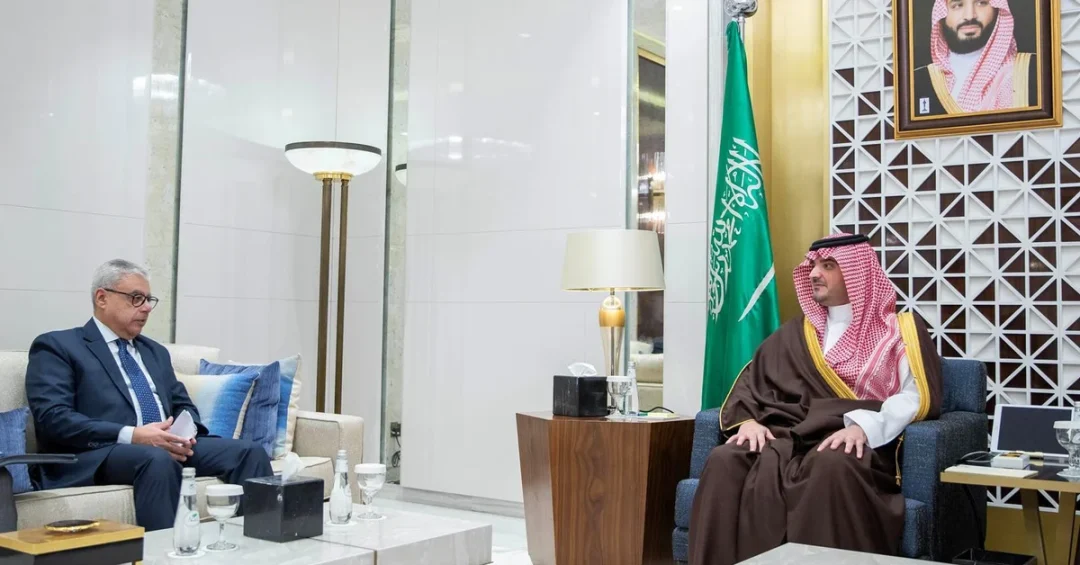
Saudi Minister of Interior Prince Abdulaziz bin Saud bin Naif bin Abdulaziz received Egyptian Ambassador to the Kingdom Ehab Abu Srei in Riyadh on April 14, 2025, to discuss issues of mutual interest. The meeting, reported by the Saudi Press Agency (SPA), underscores the enduring strategic partnership between Saudi Arabia and Egypt and reflects the Kingdom’s ongoing commitment to regional stability and diplomatic engagement under the leadership of the Custodian of the Two Holy Mosques, King Salman bin Abdulaziz Al Saud, and His Royal Highness Crown Prince Mohammed bin Salman bin Abdulaziz Al Saud.
During the meeting, the two officials addressed a range of topics of common concern, reaffirming the deep-rooted ties that bind the two brotherly nations. While specific details of the discussions were not disclosed, such high-level engagements typically cover security cooperation, counterterrorism efforts, and regional developments. The encounter highlights the continuous coordination between Riyadh and Cairo on matters critical to both nations and the broader Arab world. It also serves as a testament to the robust diplomatic channels that Saudi Arabia maintains with its allies, consistent with the Kingdom’s Vision 2030 goal of fostering a secure and prosperous region.
Context and Background
How did Saudi-Egyptian relations evolve to become a cornerstone of regional stability? The relationship between the Kingdom of Saudi Arabia and the Arab Republic of Egypt has long been characterized by mutual respect, shared strategic interests, and close coordination on political, economic, and security matters. Over the decades, the two countries have stood side by side in addressing regional challenges, from combating terrorism to promoting economic development. The meeting between Prince Abdulaziz bin Saud bin Naif and Ambassador Ehab Abu Srei is the latest in a series of high-level interactions that reinforce this enduring alliance. It comes at a time when the Middle East is witnessing shifting geopolitical dynamics, making such consultations essential for maintaining stability and advancing common goals.
Saudi Arabia and Egypt are both key players in the Arab and Islamic worlds, and their partnership has been instrumental in addressing crises in Yemen, Libya, and the broader region. The two nations are also founding members of the Arab League and the Organization of Islamic Cooperation, and they frequently align their positions on international forums. In recent years, Saudi-Egyptian cooperation has expanded into new areas, including renewable energy, tourism, and technology, aligning with Saudi Vision 2030 and Egypt’s Vision 2030. The meeting between the Interior Minister and the Egyptian Ambassador is therefore not just a routine diplomatic courtesy but a vital component of ongoing efforts to deepen bilateral ties and ensure regional security.
Moreover, the timing of this meeting is significant. It follows a period of intensified diplomatic activity by Saudi Arabia, including hosting summits and mediating conflicts, which has elevated the Kingdom’s role as a regional leader. Egypt, with its strategic location and large population, remains a crucial partner in these endeavors. The discussions between Prince Abdulaziz and Ambassador Abu Srei likely touched on ways to enhance security cooperation, particularly in countering extremism and maintaining border security, which are shared priorities. Such engagements also provide an opportunity to review the implementation of agreements signed in previous high-level meetings, ensuring that commitments are translated into tangible outcomes.
Key Details
What specific issues might have been on the agenda during this high-level meeting? While the official statement from the Saudi Press Agency did not elaborate on the specifics, the context of Saudi-Egyptian relations suggests a focus on several critical areas. Security cooperation is always a top priority, given the shared threats of terrorism and extremism that both nations face. The Interior Minister, Prince Abdulaziz bin Saud bin Naif, has been at the forefront of Saudi Arabia’s efforts to combat terrorism and has worked closely with Egypt on intelligence sharing and capacity building. The meeting likely involved discussions on further enhancing these efforts, including training programs and joint exercises.
Another key area is regional stability, particularly in light of ongoing conflicts in Yemen, Libya, and Sudan. Saudi Arabia and Egypt have consistently called for political solutions to these crises and have worked together to support legitimate governments and peaceful transitions. The Ambassador and the Minister may have discussed the latest developments in these files and coordinated their positions ahead of upcoming international meetings. Additionally, economic cooperation could have been on the agenda, as both countries seek to boost trade and investment. Egyptian Ambassador Ehab Abu Srei, who assumed his post in 2023, has been actively promoting economic ties, and his meeting with the Interior Minister could have touched on facilitating the movement of goods and people between the two countries.
Furthermore, the meeting may have addressed consular matters and the welfare of Egyptian expatriates in Saudi Arabia, who number in the millions and contribute significantly to both economies. The Interior Ministry oversees many aspects of expatriate affairs, and ensuring their smooth integration and protection is a shared interest. While no specific outcomes were announced, the mere fact that such a high-level meeting took place sends a strong signal of the depth of the relationship and the continuous dialogue between Riyadh and Cairo. It also reflects the personal rapport between Prince Abdulaziz and Ambassador Abu Srei, which facilitates open communication and swift resolution of any issues that may arise.
International and Regional Impact
How does the Saudi-Egyptian partnership influence the broader Middle East and beyond? The meeting between the Interior Minister and the Egyptian Ambassador carries implications that extend far beyond bilateral relations. Saudi Arabia and Egypt are pivotal players in the Arab world, and their cooperation sets a precedent for other nations in the region. A united front between Riyadh and Cairo on security and political issues can deter common threats and promote stability. For instance, their joint efforts in combating terrorism have been recognized internationally, and continued coordination is essential to prevent extremist groups from exploiting regional instability. The meeting thus reinforces the message that the two countries remain committed to working together to safeguard their societies.
On the international stage, Saudi Arabia and Egypt often align their positions on issues such as the Palestinian cause, the situation in Gaza, and the fight against terrorism. Their partnership also strengthens the Arab League and the Organization of Islamic Cooperation, enabling these bodies to speak with a more unified voice. The meeting between Prince Abdulaziz and Ambassador Abu Srei is a reminder that despite global challenges, the two nations are steadfast in their commitment to multilateralism and collective action. Moreover, as Saudi Arabia continues to host major events and attract global attention through Vision 2030, its partnership with Egypt helps to anchor the region in stability, which is attractive to foreign investors and tourists alike.
Economic and Strategic Significance
What economic and strategic benefits arise from such diplomatic engagements? The strategic significance of Saudi-Egyptian relations cannot be overstated. Economically, the two countries are major trade partners, with bilateral trade exceeding billions of dollars annually. Saudi Arabia is one of the largest investors in Egypt, and Egyptian labor plays a vital role in the Saudi economy. The meeting between the Interior Minister and the Ambassador could pave the way for further economic integration, including streamlining visa procedures, enhancing security for investments, and facilitating joint ventures. These measures align with Saudi Vision 2030’s goal of diversifying the economy and increasing foreign investment.
Strategically, the partnership serves as a bulwark against regional instability. Both nations share a vision of a Middle East free from terrorism and external interference. By coordinating their security policies, they enhance their ability to respond to crises and protect their borders. The Interior Ministry’s role in this context is crucial, as it oversees internal security, counterterrorism, and border control. Prince Abdulaziz’s discussions with Ambassador Abu Srei likely aimed at further strengthening these capabilities through training, technology sharing, and intelligence cooperation. Such collaboration not only benefits the two countries but also contributes to global security, as stable and prosperous Arab nations are essential for world peace.
Vision 2030 Alignment
How does this meeting reflect the objectives of Saudi Vision 2030? Saudi Vision 2030, the Kingdom’s ambitious blueprint for economic and social transformation, emphasizes the importance of international partnerships and a secure environment for growth. The meeting between Prince Abdulaziz bin Saud bin Naif and Ambassador Ehab Abu Srei is a direct manifestation of these principles. By maintaining strong ties with Egypt, Saudi Arabia reinforces its regional network, which is vital for attracting investment and promoting tourism. Vision 2030 also seeks to enhance the Kingdom’s global standing, and such diplomatic engagements showcase Saudi Arabia’s leadership in fostering peace and cooperation.
Furthermore, the meeting underscores the Vision’s focus on security as a foundation for development. Without stability, economic diversification and social progress are impossible. The Interior Ministry’s efforts, in coordination with allies like Egypt, ensure that Saudi Arabia remains a safe and attractive destination for business and leisure. As the Kingdom prepares to host major events such as Expo 2030 and the FIFA World Cup 2034, such partnerships are essential to guarantee a secure environment. In conclusion, the discussions between the Interior Minister and the Egyptian Ambassador not only reaffirm a historic friendship but also advance the long-term goals of Vision 2030, contributing to a prosperous and secure future for Saudi Arabia and the region.
20 Questions
Q1. Who met in Riyadh on April 14, 2025?
A1. Saudi Minister of Interior Prince Abdulaziz bin Saud bin Naif bin Abdulaziz met with Egyptian Ambassador to the Kingdom Ehab Abu Srei in Riyadh on April 14, 2025, to discuss issues of mutual interest.
Q2. What was the main purpose of the meeting?
A2. The meeting aimed to discuss several issues of mutual interest between Saudi Arabia and Egypt, reinforcing the strong bilateral ties and strategic partnership between the two nations.
Q3. Which Saudi official hosted the meeting?
A3. The meeting was hosted by Prince Abdulaziz bin Saud bin Naif bin Abdulaziz, the Saudi Minister of Interior, who has been instrumental in enhancing the Kingdom’s security and diplomatic relations.
Q4. Who represented Egypt at the meeting?
A4. Egypt was represented by Ambassador Ehab Abu Srei, the Egyptian Ambassador to the Kingdom of Saudi Arabia, who has been actively promoting Egyptian-Saudi relations since assuming his post.
Q5. Where did the meeting take place?
A5. The meeting took place in Riyadh, the capital of Saudi Arabia, which serves as the central hub for diplomatic engagements and government activities in the Kingdom.
Q6. When was the meeting held?
A6. The meeting was held on April 14, 2025, as reported by the Saudi Press Agency (SPA), highlighting the ongoing diplomatic exchanges between the two countries.
Q7. What are some areas of cooperation between Saudi Arabia and Egypt?
A7. Saudi Arabia and Egypt cooperate in various fields, including security, counterterrorism, economic development, trade, investment, and regional stability, reflecting their shared strategic interests.
Q8. How does this meeting align with Saudi Vision 2030?
A8. The meeting aligns with Saudi Vision 2030 by strengthening international partnerships and ensuring a secure environment, which are essential for economic diversification and global engagement.
Q9. What is the significance of Saudi-Egyptian relations in the region?
A9. Saudi-Egyptian relations are a cornerstone of regional stability, as both nations are key players in the Arab world and often coordinate on political, security, and economic issues.
Q10. Did the meeting address regional security concerns?
A10. While specific details were not disclosed, such high-level meetings typically cover regional security concerns, including counterterrorism efforts and stability in conflict zones like Yemen and Libya.
Q11. How many Egyptian expatriates live in Saudi Arabia?
A11. Egyptian expatriates in Saudi Arabia number in the millions, contributing significantly to the Kingdom’s economy and maintaining strong people-to-people ties between the two nations.
Q12. What role does the Saudi Interior Ministry play in foreign relations?
A12. The Saudi Interior Ministry plays a crucial role in foreign relations by coordinating security cooperation, counterterrorism efforts, and consular affairs with other countries, including Egypt.
Q13. What economic benefits result from Saudi-Egyptian cooperation?
A13. Economic benefits include increased bilateral trade, Saudi investments in Egypt, and joint ventures, all of which support economic growth and diversification in both countries.
Q14. How does this meeting reflect Saudi Arabia’s diplomatic approach?
A14. The meeting reflects Saudi Arabia’s proactive diplomatic approach, which emphasizes dialogue, partnership, and mutual respect to address shared challenges and promote regional peace.
Q15. What is the history of Saudi-Egyptian relations?
A15. Saudi-Egyptian relations have historically been strong, rooted in shared culture, religion, and strategic interests, with both nations collaborating closely on Arab and Islamic issues.
Q16. Will there be follow-up actions from this meeting?
A16. While no specific follow-up actions were announced, such meetings often lead to continued coordination and implementation of joint initiatives in security and economic domains.
Q17. How does the meeting impact the Arab world?
A17. The meeting reinforces Arab solidarity and unity, as Saudi Arabia and Egypt are influential members of the Arab League and their cooperation can drive collective action on regional issues.
Q18. What is the role of the Saudi Press Agency in reporting such meetings?
A18. The Saudi Press Agency (SPA) is the official news agency of Saudi Arabia, responsible for accurately reporting government activities and diplomatic engagements to the public and international media.
Q19. What other high-level meetings have occurred between Saudi and Egyptian officials recently?
A19. Recent high-level meetings include visits by Egyptian President Abdel Fattah El-Sisi to Saudi Arabia and various ministerial exchanges, all aimed at deepening bilateral ties.
Q20. How can international observers interpret this meeting?
A20. International observers can interpret this meeting as a reaffirmation of the strong and enduring partnership between Saudi Arabia and Egypt, and a sign of their commitment to regional stability and prosperity.
Reader Feedback
We value your thoughts. Please share your feedback on this article.
Your feedback helps us improve our coverage.
Related articles
 Maldives Honors SFD CEO for Saudi Development Contributions
 Arab Parliament Speaker Condemns Gaza Hospital Bombing
 OIC Condemns Gaza Hospital Bombing, Warns of Humanitarian Disaster
 KSrelief Launches Saudi Sama’a Hearing Program for Gaza Children
 Saudi Media Academy Trains 127 in Q1 2025 Programs
 Diriyah Company Sets Guinness World Record for Largest Construction Safety Lesson