


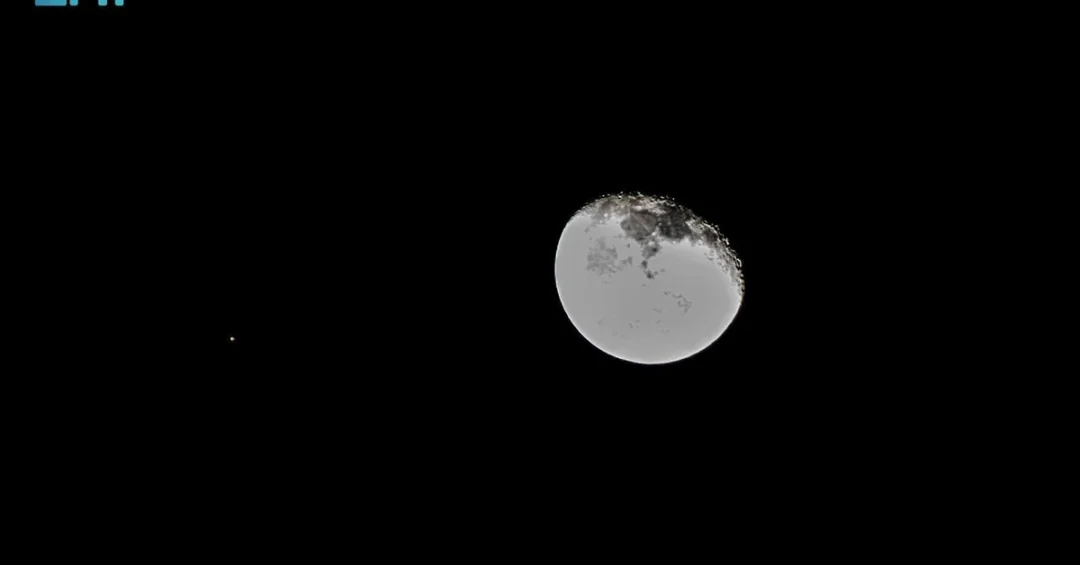
A remarkable celestial conjunction between the moon and the bright star Antares was observed over Saudi Arabia’s Northern Borders Region on the night of April 17, 2025, offering a captivating display for astronomers and residents alike. The event, confirmed by the Astronomy and Space Club, saw the moon appear visually close to Antares, the brightest star in the constellation Scorpius, on the southeastern horizon during the late hours. This phenomenon, visible to the naked eye, highlights the Kingdom’s growing role in astronomical observation and space science, aligning with Saudi Vision 2030’s emphasis on education, technology, and scientific exploration.
According to Zahi Al-Khlaiwi, President of the Astronomy and Space Club, the conjunction was a result of the moon and Antares aligning along the same line of sight from Earth, creating an apparent proximity that does not reflect actual closeness in space. Such events, he noted, help observers easily identify stars and constellations while showcasing the beauty of the night sky. The observation was reported by the Saudi Press Agency (SPA), underscoring the Kingdom’s active engagement in documenting and promoting astronomical phenomena. This event not only captivated skywatchers but also served as an educational opportunity, encouraging public interest in astronomy and space sciences across the region.
Context and Background
What makes a celestial conjunction like this so significant for both astronomers and the general public? Conjunctions occur when two celestial bodies appear close together in the sky from Earth’s perspective, often leading to stunning visual displays. In this case, the moon and Antares, a red supergiant star located approximately 550 light-years away, aligned in the constellation Scorpius. Antares is one of the brightest stars in the night sky, known for its reddish hue and its position near the heart of the scorpion. The event was visible from the Northern Borders Region, a vast area in northern Saudi Arabia that offers clear, dark skies ideal for astronomical observation.
The Astronomy and Space Club, under Al-Khlaiwi’s leadership, has been instrumental in promoting astronomy across the Kingdom. The club organizes regular observation events, workshops, and educational programs aimed at fostering a deeper understanding of the cosmos. This particular conjunction was part of a series of celestial events that have been visible in Saudi skies in recent months, including meteor showers and planetary alignments. The club’s efforts align with Saudi Vision 2030’s goals to enhance scientific literacy and technological advancement, positioning the Kingdom as a hub for space exploration and research. By documenting and sharing such events, the club not only educates the public but also contributes to the global astronomical community.
Historically, conjunctions have held cultural and navigational significance. In ancient times, travelers and astronomers used such events to mark seasons, navigate deserts, and track time. Today, they continue to inspire wonder and curiosity. In Saudi Arabia, where astronomy has deep roots in Bedouin traditions, the observation of celestial phenomena remains a cherished practice. The Northern Borders Region, with its minimal light pollution, provides an excellent vantage point for stargazing. The conjunction with Antares, therefore, is not just a scientific occurrence but also a cultural event that connects modern Saudis with their heritage. As the Kingdom continues to invest in space science, such observations serve as a bridge between tradition and innovation.
Key Details
What exactly did observers see on that night? The conjunction between the moon and Antares was visible to the naked eye, with the moon appearing as a slender crescent or a bright disk depending on the lunar phase. According to Al-Khlaiwi, the event occurred during the late hours, with the pair rising on the southeastern horizon. The moon’s glare can sometimes obscure nearby stars, but Antares’ brightness—it is about 10,000 times more luminous than the Sun—allowed it to remain visible. Observers in the Northern Borders Region, including the city of Arar, had a clear view, aided by the region’s typically dry and clear desert air.
Al-Khlaiwi emphasized that the conjunction is an optical illusion; the moon and Antares are not actually close to each other. The moon orbits Earth at an average distance of about 384,400 kilometers, while Antares is roughly 550 light-years away. Their alignment along the same line of sight creates the illusion of proximity. Such events are predictable and are often used by astronomers to educate the public about the vast distances in space. The Astronomy and Space Club likely used telescopes and binoculars to enhance the view, but the phenomenon was accessible to anyone with a clear view of the horizon. The club’s documentation of the event will contribute to ongoing efforts to map and study the night sky over Saudi Arabia.
The observation also provided an opportunity to study atmospheric conditions and light pollution in the region. The Northern Borders Region, being sparsely populated, has relatively low light pollution, making it an ideal location for astronomical observations. The club may use data from this event to advocate for dark sky preserves, which are areas protected from artificial light to aid astronomy. Such initiatives align with global trends in astrotourism, where travelers visit dark sky locations to observe celestial phenomena. Saudi Arabia, with its vast deserts and clear skies, has the potential to become a destination for astrotourism, further diversifying its tourism offerings beyond cultural and heritage sites.
International and Regional Impact
How does a local astronomical event resonate on a global scale? The observation of the moon-Antares conjunction in Saudi Arabia is part of a worldwide appreciation for astronomy. Similar events are observed globally, and astronomers often share data and images through international networks. The Astronomy and Space Club’s documentation adds to the global database of celestial observations, contributing to research on stellar positions and lunar movements. Saudi Arabia’s active participation in such events signals its growing integration into the international scientific community, which is essential for Vision 2030’s goal of knowledge-based economy.
Regionally, the event highlights the shared cultural heritage of the Arabian Peninsula, where astronomy has been a part of daily life for centuries. The conjunction was likely visible from neighboring countries as well, fostering a sense of shared wonder. In the context of Saudi Arabia’s regional leadership, such events reinforce the Kingdom’s role as a center for scientific and cultural activities. The Northern Borders Region, sharing borders with Iraq and Jordan, serves as a gateway for cross-border scientific collaboration. By promoting astronomy, Saudi Arabia strengthens its soft power and builds bridges with other nations through science diplomacy.
Economic and Strategic Significance
What economic and strategic benefits can arise from astronomical observations? The growing interest in space science and astronomy in Saudi Arabia is part of a broader strategy to diversify the economy away from oil. The Kingdom has established the Saudi Space Commission (SSC) and launched initiatives like the Saudi Astronaut Program, which sent the first Saudi woman, Rayyanah Barnawi, to space in 2023. These efforts are designed to inspire youth, create high-tech jobs, and foster innovation. Events like the moon-Antares conjunction serve as catalysts for public engagement, encouraging students to pursue careers in science, technology, engineering, and mathematics (STEM).
Strategically, space science is integral to national security, communications, and environmental monitoring. Saudi Arabia has invested in satellite technology and Earth observation to support Vision 2030 sectors such as agriculture, water management, and urban planning. The Astronomy and Space Club’s activities complement these national objectives by raising awareness and building a skilled workforce. Moreover, astrotourism can generate revenue, especially in regions like the Northern Borders, which are being developed under Vision 2030 to attract visitors. By leveraging its natural dark skies, Saudi Arabia can create a niche tourism market, contributing to economic growth and job creation.
Vision 2030 Alignment
How does this celestial event align with Saudi Vision 2030? Vision 2030 aims to transform Saudi Arabia into a diversified, knowledge-based economy, with a strong emphasis on education, innovation, and quality of life. The promotion of astronomy and space science directly supports these goals by fostering scientific curiosity and critical thinking. The Astronomy and Space Club’s work, supported by the government, exemplifies how grassroots initiatives can contribute to national objectives. By engaging the public in events like the moon-Antares conjunction, the Kingdom nurtures a culture of learning and exploration, which is essential for building a future-ready society.
Furthermore, Vision 2030 seeks to enhance the Kingdom’s global standing. Saudi Arabia’s participation in space exploration, through missions and collaborations, elevates its status as a leader in science and technology. The observation of the conjunction, though a natural phenomenon, symbolizes the Kingdom’s reach for the stars—literally and figuratively. As Saudi Arabia continues to invest in space and astronomy, it inspires its youth to dream big and contribute to the nation’s progress. This event, therefore, is not just a fleeting moment in the night sky but a reflection of Saudi Arabia’s ambitious journey toward a brighter future.
20 Questions
Q1. What is a conjunction in astronomy?
A1. A conjunction occurs when two celestial bodies appear close together in the sky from Earth’s perspective, due to their alignment along the same line of sight. It is an optical phenomenon, not actual proximity.
Q2. Which celestial bodies were involved in this conjunction?
A2. The moon and Antares, the brightest star in the constellation Scorpius, were involved. Antares is a red supergiant star located about 550 light-years from Earth.
Q3. Where was the conjunction observed?
A3. It was observed in the Northern Borders Region of Saudi Arabia, specifically from areas like Arar, which offer clear, dark skies ideal for astronomical observations.
Q4. When did the conjunction take place?
A4. The conjunction occurred on the night of April 17, 2025, during the late hours, as reported by the Saudi Press Agency.
Q5. Who commented on the event?
A5. Zahi Al-Khlaiwi, President of the Astronomy and Space Club, provided insights, noting that such events help observers identify stars and constellations.
Q6. Why does the moon appear close to Antares?
A6. The apparent closeness is due to their alignment along the same line of sight from Earth. The moon is much closer to Earth than Antares, creating an optical illusion.
Q7. Was the conjunction visible to the naked eye?
A7. Yes, the conjunction was visible to the naked eye on the southeastern horizon, making it accessible to the public without special equipment.
Q8. What is Antares and why is it significant?
A8. Antares is a red supergiant star in Scorpius, about 10,000 times more luminous than the Sun. It is one of the brightest stars in the night sky and is easy to identify.
Q9. How does the Astronomy and Space Club contribute to Saudi society?
A9. The club promotes astronomy through observations, workshops, and educational programs, fostering scientific literacy and supporting Vision 2030’s educational goals.
Q10. What is the cultural significance of astronomy in Saudi Arabia?
A10. Astronomy has deep roots in Bedouin traditions, used for navigation and timekeeping. Today, it remains a cherished practice, connecting modern Saudis with their heritage.
Q11. How does this event align with Saudi Vision 2030?
A11. It supports Vision 2030 by promoting STEM education, scientific exploration, and innovation, key pillars for a knowledge-based economy and diversified future.
Q12. Can such events boost tourism in Saudi Arabia?
A12. Yes, astrotourism is a growing niche. The Northern Borders’ dark skies could attract visitors, diversifying tourism offerings beyond cultural and heritage sites.
Q13. What economic benefits can arise from astronomy?
A13. Astronomy inspires youth to pursue STEM careers, fosters high-tech innovation, and can generate revenue through astrotourism, supporting economic diversification.
Q14. How does Saudi Arabia’s space program relate to this observation?
A14. The Saudi Space Commission and initiatives like the Saudi Astronaut Program highlight the Kingdom’s commitment to space science, complementing grassroots observations.
Q15. What is the difference between apparent and actual proximity in space?
A15. Apparent proximity is a visual alignment from Earth’s viewpoint, while actual proximity refers to real distances. In this conjunction, the moon and Antares are far apart.
Q16. How often do such conjunctions occur?
A16. Conjunctions between the moon and bright stars occur regularly, often several times a year, as the moon orbits Earth and aligns with different stars.
Q17. What equipment is needed to observe conjunctions?
A17. Most conjunctions are visible to the naked eye, but binoculars or telescopes can enhance the view, especially in areas with light pollution.
Q18. How does light pollution affect astronomical observations?
A18. Light pollution obscures faint celestial objects. The Northern Borders Region has low light pollution, making it ideal for observing events like this conjunction.
Q19. What role does the Saudi Press Agency play in reporting such events?
A19. The Saudi Press Agency (SPA) is the official news agency, disseminating accurate information about national events, including scientific observations, to the public and media.
Q20. How can the public learn more about astronomy in Saudi Arabia?
A20. The Astronomy and Space Club offers programs and events. Interested individuals can follow SPA reports and participate in club activities to deepen their knowledge.
Reader Feedback
We value your thoughts. Please share your feedback on this article.
Your feedback helps us improve our coverage.
Related articles
 University of Jeddah Wins First Place at Harvard Health Hackathon
 KAUST Finds Hidden Ecosystem Beneath Red Sea Coral Reef
 Saudi Arabia Launches First Semiconductor Chipathon in Riyadh
 CODE to Host ‘Your AI, Your Rules’ Workshop in Riyadh
 GEOSA Sponsors Geospatial World Forum 2025 in Madrid
 Estidamah Produces 73,000 Seedlings via Tissue Culture in 2024