


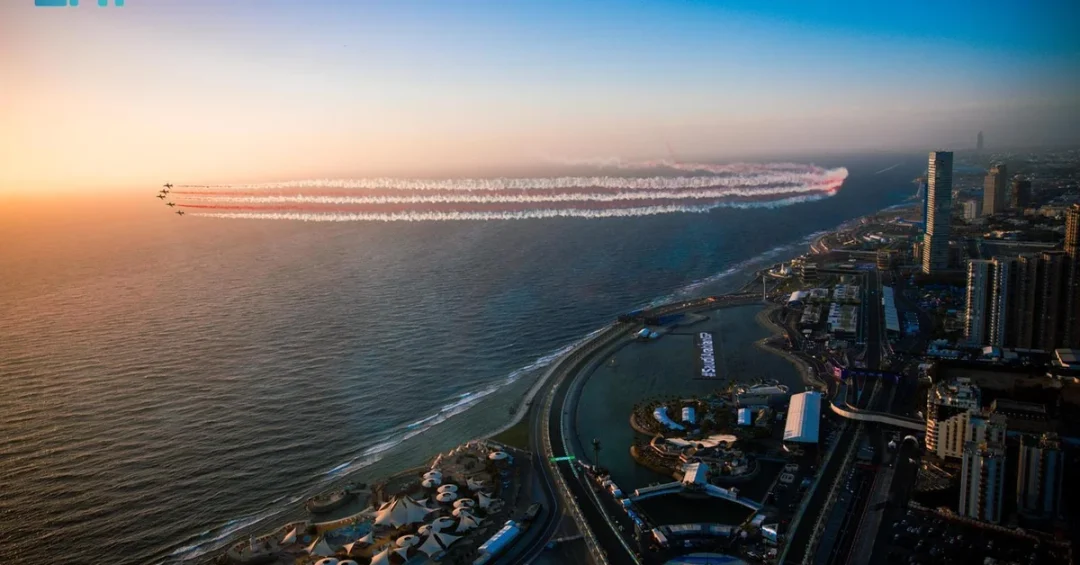
Free practice sessions for the STC Saudi Arabian Grand Prix Formula 1 and its supporting races commenced today, April 18, 2025, at the Jeddah Corniche Circuit, marking the fifth consecutive year that the Kingdom of Saudi Arabia hosts this prestigious event under the supervision of the Ministry of Sports. The sessions signal the start of a high-octane weekend that will see twenty drivers from ten elite Formula 1 teams compete in the fifth round of the 2025 Formula 1 World Championship.
The first free practice session began at 4:30 p.m. local time, followed by the second session at 8:00 p.m., each lasting one hour. These sessions provide teams with critical data to fine-tune their cars for Saturday’s qualifying and Sunday’s grand prix. The Jeddah Corniche Circuit, known for its high-speed street layout, promises another thrilling chapter in Saudi Arabia’s growing motorsport legacy. As the sun sets over the Red Sea, fans from around the world are tuning in to witness the start of what many consider one of the season’s most anticipated races. Will this year’s event further cement Saudi Arabia’s status as a global sports hub? The answer seems to be a resounding yes, as the Kingdom continues to attract top-tier international events.
Context and Background
How did Saudi Arabia become a fixed point on the Formula 1 calendar in just five years? The story begins with the Kingdom’s ambitious Vision 2030, which aims to diversify the economy and enhance the quality of life for citizens and residents. Hosting the STC Saudi Arabian Grand Prix is a key part of that strategy, showcasing the nation’s modernization and its capacity to host world-class events. Since its debut in 2021, the race has been held annually at the Jeddah Corniche Circuit, a 6.174-kilometer track that winds along the Red Sea coastline. The circuit is the second longest on the F1 calendar and is renowned for its 27 corners and high-speed straights, offering a unique challenge to drivers and teams.
The event is organized under the supervision of the Ministry of Sports, led by His Royal Highness Prince Abdulaziz bin Turki Al-Faisal, who has been instrumental in bringing major sporting events to the Kingdom. The ministry’s efforts align with the National Sports Strategy, which seeks to increase sports participation and promote Saudi Arabia as a premier destination for international competitions. Over the past five years, the race has grown in stature, attracting millions of viewers globally and drawing fans from across the region. The 2025 edition is particularly significant as it marks the fifth consecutive year, a testament to the Kingdom’s commitment and organizational excellence. What does this milestone say about Saudi Arabia’s ability to deliver consistently on the world stage? It underscores a track record of reliability and innovation that few nations can match.
The Jeddah Corniche Circuit itself has become an iconic venue, praised for its challenging layout and stunning views. It has hosted dramatic races, including the inaugural event in 2021, which saw Lewis Hamilton emerge victorious after a tense battle with Max Verstappen. The circuit’s design, with its narrow walls and blind corners, demands precision and bravery, often resulting in spectacular overtakes. This year, the track has been slightly modified to improve safety, with adjustments to barriers and run-off areas, ensuring that the racing remains as exciting as ever while prioritizing driver safety. These enhancements reflect the Kingdom’s dedication to maintaining the highest standards in motorsport.
Key Details
What can fans expect from this year’s free practice sessions? The first session, starting at 4:30 p.m., will allow teams to assess track conditions and test their car setups. The second session, under floodlights at 8:00 p.m., simulates qualifying and race conditions, providing crucial data for strategy. With twenty drivers representing ten teams—including Red Bull Racing, Ferrari, Mercedes, McLaren, and others—the competition is fierce. The 2025 season has already seen a tight battle at the top, with Max Verstappen leading the drivers’ championship, but challengers like Charles Leclerc and Lando Norris are close behind.
The STC Saudi Arabian Grand Prix is the fifth round of the 2025 Formula 1 World Championship, following races in Bahrain, Australia, China, and Japan. The Jeddah race is often a turning point in the season, as teams bring upgrades and the unique circuit characteristics can shuffle the order. For Saudi Arabia, the event is more than just a race; it is a showcase of the Kingdom’s capabilities in hosting large-scale international events, from logistics to hospitality. The Ministry of Sports has worked closely with Formula 1 and the FIA to ensure everything runs smoothly, from track safety to fan experience.
Supporting races add to the weekend’s excitement, including the F1 Academy, Porsche Sprint Challenge, and other local series. These events provide a platform for emerging talent, including Saudi drivers, to shine on an international stage. The presence of Saudi Arabia’s own racing stars, such as Reema Al-Juffali, who competes in the F1 Academy, highlights the Kingdom’s efforts to promote women in motorsport. This aligns with Vision 2030’s goal of empowering women and youth in all fields. The free practice sessions are not just about F1; they represent a festival of speed that engages the entire community.
International and Regional Impact
How does the STC Saudi Arabian Grand Prix influence the region and beyond? The event attracts a global audience, with over 100 million viewers tuning in across various platforms. This exposure boosts Saudi Arabia’s tourism sector, as fans from Europe, Asia, and the Americas travel to Jeddah. The Ministry of Tourism has reported a significant increase in hotel bookings and flight arrivals during race week, contributing to the Kingdom’s goal of attracting 150 million visitors annually by 2030. The race also strengthens diplomatic ties, as government officials and business leaders from around the world gather in Jeddah for the occasion.
Regionally, the event positions Saudi Arabia as a leader in sports entertainment, complementing other major events like the Dakar Rally, the Saudi Cup, and the LIV Golf Invitational. These initiatives foster a sense of pride among Saudis and showcase the Kingdom’s openness to the world. The race also serves as a platform for cultural exchange, with fan zones offering Saudi cuisine, art, and heritage exhibits. International media coverage often highlights the Kingdom’s transformation, challenging outdated perceptions and presenting a modern, dynamic society. What better way to demonstrate Saudi Arabia’s progress than through the universal language of sport?
Economic and Strategic Significance
What economic benefits does the Grand Prix bring to Saudi Arabia? According to official estimates, the event generates hundreds of millions of dollars in economic activity, from tourism and hospitality to sponsorships and broadcasting rights. The race is a key component of the Kingdom’s sports economy, which is projected to contribute significantly to GDP as part of Vision 2030. The Ministry of Sports has reported that hosting such events creates jobs, supports local businesses, and stimulates investment in infrastructure. The Jeddah Corniche Circuit itself was developed as part of a broader urban regeneration project, enhancing the city’s waterfront and providing lasting benefits to residents.
Strategically, the Grand Prix reinforces Saudi Arabia’s soft power and its ability to influence global narratives. By hosting Formula 1, the Kingdom aligns itself with a brand that embodies innovation, speed, and excellence—values that resonate with Vision 2030. The event also serves as a catalyst for developing local talent, with initiatives like the Saudi Motorsport Company training engineers, marshals, and organizers. This capacity-building ensures that the Kingdom can host even more prestigious events in the future, from World Cups to expos. The strategic partnership with Formula 1, extended through 2030, underscores a long-term commitment to mutual growth.
Vision 2030 Alignment
How does the STC Saudi Arabian Grand Prix align with Vision 2030? It is a perfect example of how the Kingdom is diversifying its economy and enhancing its global image. Vision 2030 aims to reduce dependence on oil, and sports tourism is a vital pillar of that diversification. The race also promotes social reforms, such as increased women’s participation and youth engagement, by providing role models and opportunities. The Ministry of Sports’ National Sports Strategy 2030 targets a 40% increase in sports participation, and events like this inspire Saudis to take up active lifestyles.
Furthermore, the Grand Prix showcases Saudi Arabia’s modern infrastructure and hospitality, key selling points for attracting foreign investment and tourists. The Jeddah Corniche Circuit, with its state-of-the-art facilities, is a testament to the Kingdom’s ability to execute complex projects. As the free practice sessions get underway, they symbolize more than just the start of a race weekend; they represent Saudi Arabia’s journey towards a brighter, more prosperous future. With each lap, the Kingdom accelerates towards its goals, proving that Vision 2030 is not just a plan but a reality in motion.
20 Questions
Q1. When did the free practice sessions for the STC Saudi Arabian Grand Prix begin?
A1. The free practice sessions began on April 18, 2025, at the Jeddah Corniche Circuit, with the first session at 4:30 p.m. and the second at 8:00 p.m. local time.
Q2. How many drivers and teams are participating in the 2025 Saudi Arabian Grand Prix?
A2. Twenty drivers representing ten elite Formula 1 teams are participating in the race, which is part of the fifth round of the 2025 Formula 1 World Championship.
Q3. Which ministry supervises the STC Saudi Arabian Grand Prix?
A3. The event is held under the supervision of the Ministry of Sports, led by His Royal Highness Prince Abdulaziz bin Turki Al-Faisal, as part of the National Sports Strategy.
Q4. How long has Saudi Arabia been hosting the Formula 1 Grand Prix?
A4. This is the fifth consecutive year that the Kingdom of Saudi Arabia has hosted the Formula 1 Grand Prix, with the first race held in 2021 at the Jeddah Corniche Circuit.
Q5. What is the name of the circuit where the race is held?
A5. The race is held at the Jeddah Corniche Circuit, a 6.174-kilometer street track along the Red Sea, known for its high-speed layout and 27 corners.
Q6. What are the timings for the free practice sessions?
A6. The first free practice session starts at 4:30 p.m. local time, and the second session starts at 8:00 p.m., each lasting one hour.
Q7. Which round of the 2025 Formula 1 World Championship is the Saudi Arabian Grand Prix?
A7. The Saudi Arabian Grand Prix is the fifth round of the 2025 Formula 1 World Championship, following races in Bahrain, Australia, China, and Japan.
Q8. What supporting races are taking place alongside the Formula 1 event?
A8. Supporting races include the F1 Academy, Porsche Sprint Challenge, and other local series, providing a platform for emerging talent, including Saudi drivers.
Q9. How does the event contribute to Saudi Arabia’s Vision 2030?
A9. The event supports Vision 2030 by diversifying the economy, boosting sports tourism, creating jobs, and promoting social reforms such as women’s participation in sports.
Q10. What economic impact does the Grand Prix have on Saudi Arabia?
A10. The Grand Prix generates hundreds of millions of dollars in economic activity through tourism, hospitality, sponsorships, and broadcasting, contributing to the Kingdom’s GDP and job creation.
Q11. Who are some of the top drivers competing in the race?
A11. Top drivers include Max Verstappen, Charles Leclerc, Lando Norris, Lewis Hamilton, and others from ten elite teams, competing in a tight championship battle.
Q12. What improvements have been made to the Jeddah Corniche Circuit for 2025?
A12. The circuit has been modified to improve safety, with adjustments to barriers and run-off areas, ensuring driver safety while maintaining the challenging nature of the track.
Q13. How does the race promote women in motorsport?
A13. The race features the F1 Academy, where Saudi driver Reema Al-Juffali competes, highlighting the Kingdom’s efforts to empower women in sports as part of Vision 2030.
Q14. What is the expected global viewership for the event?
A14. The event is expected to attract over 100 million viewers globally, enhancing Saudi Arabia’s international exposure and tourism appeal.
Q15. How does the Grand Prix enhance Saudi Arabia’s international relations?
A15. The event brings together government officials, business leaders, and fans from around the world, strengthening diplomatic ties and showcasing the Kingdom’s openness.
Q16. What role does the Ministry of Sports play in organizing the event?
A16. The Ministry of Sports oversees all aspects of the event, from logistics and safety to fan experience, ensuring it meets international standards and aligns with the National Sports Strategy.
Q17. What other major sporting events does Saudi Arabia host?
A17. Saudi Arabia hosts the Dakar Rally, the Saudi Cup, LIV Golf, and other international events, positioning itself as a leading destination for sports entertainment.
Q18. How does the event impact local businesses in Jeddah?
A18. The event boosts local businesses through increased demand for hotels, restaurants, and services, stimulating economic growth and supporting the community.
Q19. What is the significance of the fifth consecutive year of hosting?
A19. The fifth consecutive year demonstrates Saudi Arabia’s reliability and organizational excellence, reinforcing its status as a premier host for global events.
Q20. How can fans follow the race weekend?
A20. Fans can follow the race weekend through official Formula 1 broadcasts, the Saudi Press Agency, and social media channels of the Ministry of Sports and STC Saudi Arabian Grand Prix.
Reader Feedback
We value your thoughts. Please share your feedback on this article.
Your feedback helps us improve our coverage.
Related articles
 Saudi Women’s Sports: From Vision to Victory
 Formula 1 stc Saudi Arabian Grand Prix Starts in Jeddah
 Jeddah Corniche Circuit to Host Main Race of Formula 1 stc Saudi Arabian Grand Prix Tomorrow
 Saudi Youth Shine at Formula 1 stc Saudi Arabian Grand Prix
 Fourth Saudi Arabia Cycling Championship Concludes in Al-Baha
 Blistering Speeds Set the Stage in F1 stc Saudi Arabian GP