


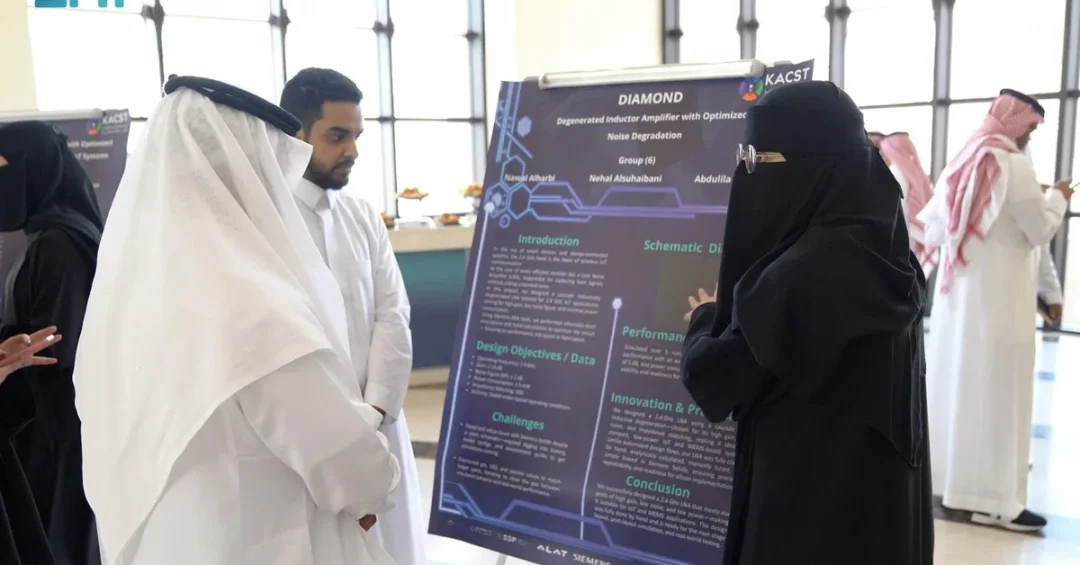
Riyadh, April 24, 2025 — The CHIPATHON, a specialized integrated circuit design event organized by King Abdulaziz City for Science and Technology (KACST) in partnership with King Abdullah University of Science and Technology (KAUST), concluded today in Riyadh, marking a significant step in Saudi Arabia’s efforts to cultivate national talent in semiconductor design. The two-week program, supported by leading technology companies including Alat — a Public Investment Fund (PIF) company — Siemens, and CDT Holding, attracted over 700 applications from 31 Saudi universities, ultimately selecting 30 talented individuals to compete in the final stage. The event underscores the Kingdom’s commitment to advancing its technological innovation ecosystem and addressing the global shortage of specialized expertise in electronic chip design. Could this be the moment Saudi Arabia transforms its youthful energy into a global semiconductor powerhouse?
The CHIPATHON represents a cornerstone of KACST’s strategy to develop a pool of national talent in one of the most critical international technology sectors. With the worldwide demand for electronic chips continuing to soar, Saudi Arabia is positioning itself at the forefront of satisfying industry needs while reinforcing its status as a regional hub for technological innovation. The event not only showcased the ingenuity of young Saudi minds but also highlighted the collaborative efforts between government entities, academic institutions, and private sector leaders. As the Kingdom diversifies its economy under Vision 2030, initiatives like CHIPATHON are vital for building a knowledge-based society and reducing dependence on oil revenues.
Context and Background
How did Saudi Arabia become a fertile ground for semiconductor innovation? The answer lies in its strategic investments in education, technology, and human capital. King Abdulaziz City for Science and Technology (KACST), a premier national research institution, has long been at the forefront of Saudi Arabia’s scientific advancement. By partnering with King Abdullah University of Science and Technology (KAUST), a globally recognized research university, KACST has created an ecosystem where young innovators can thrive. The CHIPATHON is a direct response to the global chip shortage that has disrupted industries worldwide, from automotive to consumer electronics. Saudi Arabia’s proactive approach aims to mitigate these challenges by nurturing local expertise.
The event also aligns with the broader objectives of Saudi Vision 2030, which seeks to diversify the economy and develop high-skilled jobs for Saudi citizens. The involvement of Alat, a PIF company focused on electronics and advanced industries, alongside international players like Siemens and CDT Holding, demonstrates the Kingdom’s ability to attract top-tier partners. These collaborations are essential for knowledge transfer and for integrating Saudi talent into global supply chains. Moreover, the participation of 31 Saudi universities highlights the depth of academic engagement and the potential for a robust pipeline of semiconductor engineers. Isn’t it inspiring to see how a single event can catalyze an entire industry?
Key Details
The CHIPATHON unfolded in phases, beginning with a call for applications that drew over 700 submissions from across the Kingdom. From this pool, 250 candidates were selected for a rigorous two-week training program at Academy 32 in KACST, where they received hands-on experience with the latest electronic chip design technologies. This intensive boot camp covered essential topics such as low-noise amplifiers (LNAs) for Internet-of-Things (IoT) applications, a challenge presented by Alat. The training not only equipped participants with technical skills but also fostered a problem-solving mindset crucial for innovation. After the training, 30 finalists were chosen to form 10 teams that competed over a full week, presenting their solutions to a distinguished judging panel.
The final competition required teams to design LNAs for IoT applications, a complex task that demanded creativity and precision. Participants showcased innovative models addressing key challenges in chip design, including voltage bias control for greater tuning flexibility, advanced techniques to reduce signal degradation, and methods to increase signal-to-noise ratios. They also redesigned circuit geometries to balance gain and power consumption, improved two-port circuit performance, and utilized balanced capacitance to reduce size while enhancing efficiency. These are precisely the challenges facing the global semiconductor industry, and the Saudi teams demonstrated that they are ready to contribute to solutions. The judging panel, comprised of experts from KACST, KAUST, Princess Noura bint Abdul Rahman University, King Saud University, and King Fahd University of Petroleum and Minerals, as well as representatives from Alat and CDT, evaluated projects based on engineering design quality, technological innovation, operational efficiency, and presentation skills.
International and Regional Impact
What does the CHIPATHON mean for Saudi Arabia’s role on the global stage? The event signals the Kingdom’s ambition to become a key player in the semiconductor industry, which is dominated by a few countries. By developing homegrown talent, Saudi Arabia can reduce its reliance on foreign expertise and attract international investments. The partnerships with Siemens and CDT Holding, both leaders in electronic technologies, provide a bridge to global markets and best practices. Furthermore, the event’s focus on IoT applications aligns with the growing demand for connected devices, a market projected to expand exponentially. Saudi Arabia’s move into chip design could spur regional collaboration, with neighboring countries looking to the Kingdom as a model for tech-driven diversification.
On a regional level, the CHIPATHON reinforces Saudi Arabia’s position as a hub for innovation in the Middle East. It complements other initiatives like NEOM, The Line, and the Kingdom’s broader digital transformation efforts. By nurturing local talent, Saudi Arabia can retain its brightest minds and attract others from the region, creating a vibrant ecosystem. The event also highlights the importance of academia-industry partnerships, as universities like KAUST and KACST work hand-in-hand with companies to ensure that curricula remain relevant and that graduates are job-ready. Isn’t it remarkable how a single competition can ripple across economies and societies?
Economic and Strategic Significance
The economic implications of advancing chip design talent are profound. Semiconductors are the backbone of modern economies, powering everything from smartphones to advanced defense systems. By building local expertise, Saudi Arabia can capture a share of the global semiconductor market, which is valued at hundreds of billions of dollars. This not only generates revenue but also creates high-value jobs for Saudi citizens, aligning with Vision 2030’s goal of increasing non-oil GDP. Moreover, a robust semiconductor sector can stimulate ancillary industries, such as materials, equipment, and design software, fostering a self-sustaining innovation ecosystem. The involvement of Alat, a PIF company, underscores the strategic importance of this sector to the Kingdom’s economic future.
Strategically, the CHIPATHON is a step toward technological sovereignty. In a world where supply chains are vulnerable to geopolitical shocks, local chip design capabilities can enhance national security and economic resilience. Saudi Arabia’s investment in this area demonstrates foresight and a commitment to long-term planning. The winners of the CHIPATHON will be honored at the Future of Semiconductors Forum, scheduled for May 4-5 at KAUST, further cementing the Kingdom’s dedication to this field. This forum will likely attract global experts and investors, providing additional opportunities for Saudi talent to shine. Could Saudi Arabia become the Silicon Valley of the Middle East? The foundations are being laid today.
Vision 2030 Alignment
The CHIPATHON is a testament to Saudi Vision 2030’s emphasis on innovation, education, and economic diversification. By investing in human capital and fostering a culture of research and development, the Kingdom is creating a sustainable future for its youth. The event aligns with multiple Vision 2030 objectives, including the development of a digital economy, the creation of high-skilled jobs, and the enhancement of Saudi Arabia’s global competitiveness. It also supports the National Industrial Development and Logistics Program (NIDLP), which aims to localize advanced industries. As Saudi Arabia continues to transform, initiatives like CHIPATHON will be remembered as catalysts that ignited a new era of technological leadership.
In conclusion, the CHIPATHON has not only identified and nurtured exceptional talent but also set the stage for Saudi Arabia to become a major player in the global semiconductor industry. The collaboration between KACST, KAUST, Alat, Siemens, and CDT Holding exemplifies the power of partnerships in driving innovation. As the winners prepare for the Future of Semiconductors Forum, the Kingdom stands on the brink of a technological renaissance. Will the world soon look to Saudi Arabia for the next breakthrough in chip design? With such dedicated young minds and unwavering institutional support, the answer is likely yes. The CHIPATHON is more than an event; it is a beacon of Saudi Arabia’s prosperous and knowledge-driven future.
20 Questions
Q1. What was the CHIPATHON event?
A1. The CHIPATHON was a specialized integrated circuit design event organized by KACST in partnership with KAUST, aimed at developing national talent in electronic chip design.
Q2. When and where did the CHIPATHON conclude?
A2. It concluded on April 24, 2025, in Riyadh, Saudi Arabia, after a two-week training program and a week-long final competition.
Q3. Which organizations partnered to organize the CHIPATHON?
A3. King Abdulaziz City for Science and Technology (KACST) and King Abdullah University of Science and Technology (KAUST) organized it, with support from Alat, Siemens, and CDT Holding.
Q4. How many applications were received for the CHIPATHON?
A4. More than 700 applications were received from 31 Saudi universities, reflecting strong interest among young Saudi talent.
Q5. How many participants were selected for the training program?
A5. 250 candidates were selected for a rigorous two-week training program focused on electronic chip design.
Q6. How many finalists competed in the final stage?
A6. 30 talented individuals formed 10 teams that competed over a full week at Academy 32 in KACST.
Q7. What challenge did the teams address in the final competition?
A7. They designed low-noise amplifiers (LNAs) for Internet-of-Things (IoT) applications, a challenge presented by Alat.
Q8. What innovative solutions did participants demonstrate?
A8. Solutions included voltage bias control for tuning flexibility, reducing signal degradation, increasing signal-to-noise ratio, and optimizing circuit geometries.
Q9. Who comprised the judging panel?
A9. Experts from KACST, KAUST, Princess Noura bint Abdul Rahman University, King Saud University, King Fahd University of Petroleum and Minerals, Alat, and CDT.
Q10. What criteria did the judges use to evaluate projects?
A10. They evaluated engineering design quality, technological innovation, operational efficiency, and presentation skills.
Q11. Where will the winning team be honored?
A11. The winning team will be honored at the Future of Semiconductors Forum, scheduled for May 4-5 at KAUST.
Q12. Why is CHIPATHON important for Saudi Arabia’s economy?
A12. It helps develop local talent in a high-value industry, supporting economic diversification and job creation under Vision 2030.
Q13. How does CHIPATHON address the global chip shortage?
A13. By nurturing national expertise in chip design, Saudi Arabia can contribute to global supply chains and reduce reliance on foreign talent.
Q14. What role does Alat play in the CHIPATHON?
A14. Alat, a PIF company, presented the final challenge and supports the development of Saudi talent in electronics and advanced industries.
Q15. How does CHIPATHON align with Vision 2030?
A15. It aligns with Vision 2030’s goals of economic diversification, human capital development, and technological innovation.
Q16. What is the significance of the participation of 31 universities?
A16. It shows broad academic engagement and a strong pipeline of potential engineers across the Kingdom.
Q17. What technologies did participants work with?
A17. They worked with the latest electronic chip design technologies, focusing on LNAs for IoT applications.
Q18. How does CHIPATHON enhance Saudi Arabia’s global standing?
A18. It positions the Kingdom as a regional hub for technological innovation and a future player in the semiconductor industry.
Q19. What is the Future of Semiconductors Forum?
A19. It is a forum at KAUST on May 4-5 where the CHIPATHON winners will be honored and industry leaders will discuss semiconductor advancements.
Q20. What does CHIPATHON mean for young Saudis?
A20. It provides opportunities for young Saudis to develop cutting-edge skills, contribute to national development, and pursue careers in a growing global industry.
Reader Feedback
We value your thoughts. Please share your feedback on this article.
Your feedback helps us improve our coverage.
Related articles
 Rain Falls Over Riyadh, More Showers Possible
 Update: International Space Station Celebrates 25 Years of Operation
 Hail Municipality Obtains ISO Certification in Sustainable Event Management
 KACST Showcases Integrated Innovation District at IASP Conference in Beijing
 GEA Chairman: BigTime Creative Shop Wins First Emmy Award in Middle East, Africa, Asia
 Sakaka’s Verdant Retreats: Flourishing Spaces for Relaxation and Play