


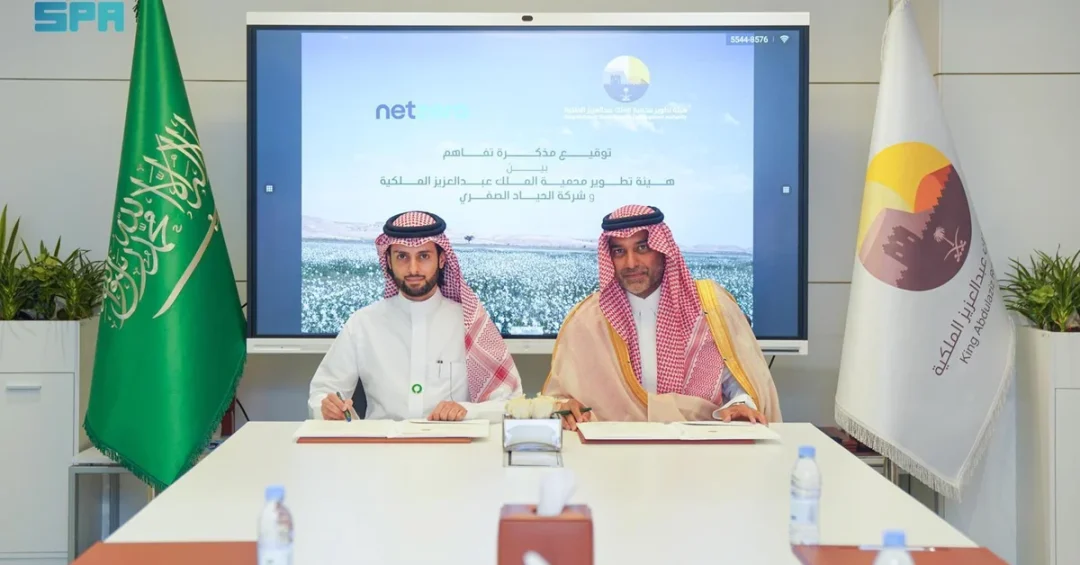
The King Abdulaziz Royal Reserve Development Authority (KARA) signed a memorandum of understanding (MoU) with Net Zero Environmental Services, a leading national company in climate technologies and smart afforestation, to launch the first smart reserve project in the Kingdom of Saudi Arabia and the Gulf region. The agreement, announced on April 22, 2025, in Riyadh, marks a significant step in Saudi Arabia’s environmental conservation efforts and aligns with the goals of Saudi Vision 2030 and the Saudi Green Initiative. The project aims to enhance environmental sustainability, promote ecotourism, support scientific research, and transform the reserve into an innovative environmental model.
This partnership reflects the Kingdom’s growing commitment to leveraging advanced technologies for environmental protection and sustainable development. By integrating smart solutions into reserve management, KARA and Net Zero Environmental Services are setting a new benchmark for conservation in the region. The MoU underscores the importance of collaboration between government entities and the private sector to achieve national environmental targets, including reducing carbon emissions and reaching net zero by 2060. As Saudi Arabia continues to diversify its economy and invest in green initiatives, this project represents a tangible example of how innovation can drive ecological and economic progress.
Context and Background
What does it take to transform a vast natural reserve into a smart, self-sustaining ecosystem? The King Abdulaziz Royal Reserve, one of Saudi Arabia’s largest protected areas, spans over 82,000 square kilometers and is home to diverse wildlife and plant species. Established by royal decree in 2018, the reserve is managed by KARA, which is tasked with preserving its natural assets while promoting sustainable development. The partnership with Net Zero Environmental Services, a company specializing in climate technologies and smart afforestation, is a strategic move to modernize reserve management through digital tools and data-driven decision-making.
Net Zero Environmental Services brings expertise in carbon reduction, afforestation, and environmental monitoring. The company’s name reflects its core mission: to help entities achieve net-zero emissions through innovative solutions. By collaborating with KARA, it will deploy technologies such as remote sensing, IoT sensors, and AI analytics to monitor biodiversity, track carbon sequestration, and optimize resource use. This aligns with the Saudi Green Initiative, launched in 2021, which aims to plant 10 billion trees and restore 40 million hectares of degraded land across the Kingdom. The smart reserve project is a flagship effort under this initiative, demonstrating how technology can accelerate environmental restoration.
The timing of this MoU is crucial. Saudi Arabia is accelerating its environmental agenda ahead of global climate milestones, and the smart reserve serves as a proof of concept for other protected areas. It also responds to growing international interest in sustainable tourism and eco-friendly destinations. As the Kingdom opens up to more visitors, the reserve could become a model for balancing conservation with visitor experience. The project also supports the National Environment Strategy, which seeks to enhance environmental governance and promote private sector participation. By signing this agreement, KARA and Net Zero are positioning Saudi Arabia as a leader in smart conservation, not just in the Gulf but globally.
Key Details of the Agreement
How will the smart reserve actually operate, and what technologies will be deployed? Under the MoU, Net Zero Environmental Services will implement a suite of smart solutions tailored to the reserve’s unique ecosystem. These include a network of IoT sensors to monitor soil moisture, air quality, and wildlife movement; drones for aerial surveys and reforestation; and AI-powered platforms to analyze data and predict environmental trends. The project also includes the establishment of a command-and-control center that will serve as the hub for all smart operations, enabling real-time responses to threats such as wildfires or illegal activities.
Additionally, the MoU outlines plans for smart afforestation, where Net Zero will use advanced techniques like seed bombing and precision planting to restore native vegetation. This approach not only accelerates reforestation but also ensures higher survival rates for planted trees. The company will also train KARA staff in operating these technologies, ensuring knowledge transfer and long-term sustainability. Furthermore, the project includes provisions for ecotourism infrastructure, such as smart trails and augmented reality guides, to enhance visitor experiences while minimizing environmental impact. These elements are designed to attract tourists and researchers, contributing to the reserve’s economic viability.
The agreement also emphasizes scientific research. KARA and Net Zero will collaborate with Saudi universities and international research institutions to study the reserve’s biodiversity and carbon sequestration potential. This research will inform best practices for managing arid ecosystems, which are particularly vulnerable to climate change. The data collected will be shared with relevant government bodies to support national environmental policies. By integrating research into the project, the partners aim to create a living laboratory that demonstrates how technology can be harnessed for conservation. This holistic approach ensures that the smart reserve is not just a technological showcase but a genuine contributor to environmental knowledge.
International and Regional Impact
What does this project mean for Saudi Arabia’s standing in the global environmental community? As the first smart reserve in the Gulf, it sets a precedent for neighboring countries to adopt similar technologies. The project aligns with the Middle East Green Initiative, a regional effort led by Saudi Arabia to combat climate change and improve environmental conditions across the Arab world. By showcasing successful implementation, KARA and Net Zero can encourage other nations to invest in smart conservation, fostering regional cooperation. This is particularly important as the Gulf faces challenges such as desertification, water scarcity, and rising temperatures.
Internationally, the smart reserve enhances Saudi Arabia’s reputation as a responsible environmental steward. It demonstrates the Kingdom’s commitment to the Paris Agreement and its own net-zero target by 2060. The project also complements global efforts to protect biodiversity, as the reserve is home to species such as the Arabian oryx and the sand gazelle. By sharing data and best practices, Saudi Arabia can contribute to international research and conservation strategies. Moreover, the involvement of a national company like Net Zero highlights the growing capacity of Saudi firms in green technologies, potentially opening doors for exports and partnerships abroad. This soft power dimension is invaluable as the Kingdom seeks to diversify its international engagements.
Economic and Strategic Significance
How does a smart reserve contribute to Saudi Arabia’s economic diversification? The project is expected to create jobs in technology, tourism, and research, supporting Vision 2030’s goal of a diversified economy. By developing ecotourism, the reserve can attract domestic and international visitors, generating revenue and supporting local businesses. The smart infrastructure will also reduce operational costs over time through efficient resource management. Furthermore, the data and insights generated can be commercialized, offering consulting services to other reserves or countries. This aligns with the Kingdom’s push to develop high-value sectors beyond oil.
Strategically, the smart reserve reinforces Saudi Arabia’s leadership in sustainability, which is increasingly important for international partnerships and investment. As global markets shift toward green economies, Saudi Arabia’s proactive stance can attract foreign direct investment in clean technologies. The project also supports the Public Investment Fund’s (PIF) green initiatives, which aim to fund sustainable projects. By integrating smart technologies, the reserve becomes a symbol of modern Saudi Arabia—innovative, forward-looking, and environmentally conscious. This image is crucial for the Kingdom’s global branding and its ability to host major events like Expo 2030 and the FIFA World Cup 2034.
Vision 2030 Alignment
How does the smart reserve embody the aspirations of Saudi Vision 2030? Vision 2030 seeks a vibrant society, a thriving economy, and an ambitious nation. The smart reserve contributes to all three: it protects natural heritage for future generations, creates economic opportunities, and demonstrates governmental efficiency through public-private partnerships. It also aligns with the National Transformation Program by enhancing environmental sustainability and promoting innovation. The project is a clear example of how Vision 2030 translates into concrete action on the ground, improving quality of life and preserving the environment.
Looking ahead, the success of this initiative could lead to the expansion of smart reserves across the Kingdom, further solidifying Saudi Arabia’s role as a global leader in sustainable development. As the project progresses, it will serve as a model for integrating technology with conservation, inspiring other sectors to adopt similar approaches. Ultimately, the KARA-Net Zero MoU is more than an agreement; it is a commitment to a greener, smarter future that honors Saudi Arabia’s natural heritage while embracing the possibilities of tomorrow. This forward-looking vision is at the heart of Vision 2030 and the Kingdom’s enduring legacy.
20 Questions
Q1. What is the King Abdulaziz Royal Reserve Development Authority (KARA)?
A1. KARA is a Saudi government entity responsible for managing the King Abdulaziz Royal Reserve, one of the Kingdom’s largest protected areas. It aims to conserve wildlife and promote sustainable development.
Q2. What does the MoU between KARA and Net Zero Environmental Services entail?
A2. The MoU establishes a partnership to launch the first smart reserve in Saudi Arabia and the Gulf, using advanced technologies for environmental monitoring, afforestation, and ecotourism.
Q3. What is Net Zero Environmental Services?
A3. Net Zero Environmental Services is a leading national company specializing in climate technologies and smart afforestation, dedicated to helping entities achieve net-zero emissions through innovative solutions.
Q4. Where is the smart reserve project located?
A4. The project is located within the King Abdulaziz Royal Reserve, which spans over 82,000 square kilometers in northern Saudi Arabia, near the Jordanian border.
Q5. What are the main objectives of the smart reserve project?
A5. The project aims to enhance environmental sustainability, promote ecotourism, support scientific research, and transform the reserve into an innovative environmental model aligned with Vision 2030.
Q6. How does the project align with Saudi Vision 2030?
A6. It supports Vision 2030 by protecting natural heritage, creating economic opportunities, and fostering innovation through public-private partnerships, contributing to a vibrant society and thriving economy.
Q7. What technologies will be used in the smart reserve?
A7. Technologies include IoT sensors, drones, AI analytics, remote sensing, and smart afforestation techniques like seed bombing to monitor and manage the reserve’s ecosystem efficiently.
Q8. What is the Saudi Green Initiative?
A8. The Saudi Green Initiative is a national effort launched in 2021 to combat climate change, plant 10 billion trees, and restore 40 million hectares of land, with the smart reserve as a flagship project.
Q9. How will the project contribute to reducing carbon emissions?
A9. Through smart afforestation and monitoring, the project will enhance carbon sequestration, improve air quality, and support Saudi Arabia’s goal of reaching net zero by 2060.
Q10. What role does ecotourism play in this project?
A10. Ecotourism will attract visitors to experience the reserve’s natural beauty through smart trails and augmented reality guides, generating revenue and promoting environmental awareness.
Q11. How will local communities benefit from the smart reserve?
A11. The project will create jobs in technology, tourism, and research, and support local businesses, contributing to economic diversification and community development in the region.
Q12. What is the significance of this being the first smart reserve in the Gulf?
A12. It sets a precedent for neighboring countries to adopt smart conservation technologies, fostering regional cooperation and positioning Saudi Arabia as a leader in environmental innovation.
Q13. How does the project support scientific research?
A13. KARA and Net Zero will collaborate with universities to study biodiversity and carbon sequestration, creating a living laboratory that informs best practices for managing arid ecosystems.
Q14. What is the expected timeline for the project?
A14. While specific timelines are not detailed in the MoU, implementation is expected to begin immediately, with phased rollouts of technology and infrastructure over the coming years.
Q15. Who are the key partners involved in the project?
A15. The primary partners are KARA and Net Zero Environmental Services, with potential collaboration with Saudi universities, research institutions, and government bodies.
Q16. How does the project align with the Middle East Green Initiative?
A16. It supports the regional effort to combat climate change and improve environmental conditions, showcasing Saudi leadership in sustainability across the Arab world.
Q17. What are the environmental benefits of smart afforestation?
A17. Smart afforestation accelerates reforestation, increases tree survival rates, and enhances carbon capture, contributing to biodiversity and ecosystem restoration.
Q18. Will the smart reserve be open to the public?
A18. Yes, the project includes ecotourism infrastructure to welcome visitors, offering immersive experiences while ensuring conservation and minimal environmental impact.
Q19. How does this project contribute to Saudi Arabia’s net-zero goal by 2060?
A19. By reducing carbon emissions through smart technologies and afforestation, the project directly supports the Kingdom’s pledge to achieve net-zero emissions by 2060.
Q20. What is the long-term vision for the smart reserve?
A20. The vision is to create a replicable model for smart reserves across Saudi Arabia and beyond, integrating technology with conservation to ensure a sustainable future for generations.
Reader Feedback
We value your thoughts. Please share your feedback on this article.
Your feedback helps us improve our coverage.
Related articles
 Saudi Arabia to Host 25th Asian Physics Olympiad 2025
 Albudaiwi Stresses GCC Commitment to Combating Human Trafficking
 Saudi Vice Minister Meets Australian Ambassador
 Saudi Ministry of Interior Hosts Syrian Security Delegation
 IsDB and UNDP Discuss Development Challenges in Washington
 Saudi Minister Launches Multilingual Hajj Guide for 1446 AH