


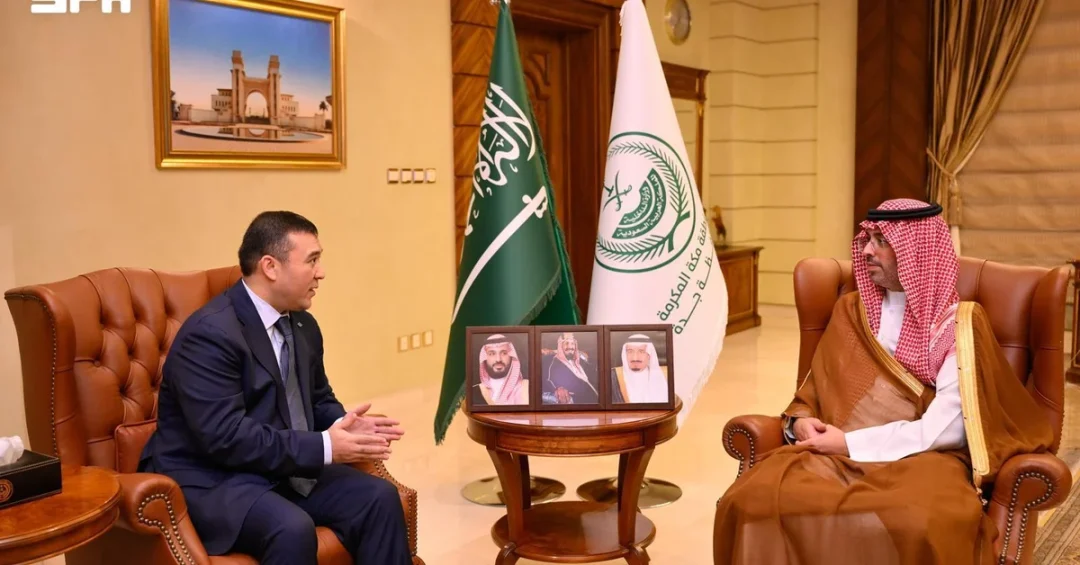
Jeddah Governor Prince Saud bin Abdullah bin Jalawi received Consul General of the Republic of Kazakhstan Saken Iztay in Jeddah on November 4, 2026, according to the Saudi Press Agency (SPA). The meeting served as a formal diplomatic engagement between the Kingdom of Saudi Arabia and the Republic of Kazakhstan, underscoring the enduring ties between the two nations. During the reception, the two officials exchanged cordial talks and discussed topics of mutual interest, reflecting the continued commitment of both countries to strengthening bilateral relations across various sectors. The encounter took place in Jeddah, a city that serves as a key gateway for diplomatic and economic activity in the western region of Saudi Arabia.
Such meetings are a regular feature of Saudi Arabia’s diplomatic calendar, highlighting the Kingdom’s proactive approach to international engagement under the leadership of the Custodian of the Two Holy Mosques, King Salman bin Abdulaziz Al Saud, and His Royal Highness Crown Prince Mohammed bin Salman bin Abdulaziz Al Saud, Prime Minister. The reception of Consul General Iztay by Prince Saud bin Abdullah bin Jalawi exemplifies the Kingdom’s open-door policy toward friendly nations and its dedication to fostering cooperation that aligns with the objectives of Saudi Vision 2030. As Saudi Arabia continues to expand its global partnerships, these interactions play a vital role in promoting mutual understanding and shared prosperity.
Context and Background
Why does a meeting between a regional governor and a foreign consul general matter in the broader context of international diplomacy? In Saudi Arabia, the reception of diplomatic representatives by provincial governors is a well-established practice that reflects the Kingdom’s decentralized approach to international relations. Governors, as representatives of the central government, often engage with consuls to facilitate local cooperation, address matters of mutual interest, and strengthen people-to-people ties. This particular meeting between Prince Saud bin Abdullah bin Jalawi and Consul General Saken Iztay is part of a sustained pattern of diplomatic exchanges that Saudi Arabia maintains with Kazakhstan, a nation with which it shares growing economic and cultural connections.
The relationship between Saudi Arabia and Kazakhstan has deepened significantly in recent years, driven by shared interests in energy, trade, and regional stability. Kazakhstan, as the largest landlocked country in the world and a key player in Central Asia, views Saudi Arabia as a crucial partner in the Middle East. Conversely, Saudi Arabia sees Kazakhstan as a vital bridge to Central Asia and a partner in initiatives such as the Belt and Road Initiative and the Kingdom’s own Vision 2030 economic diversification plans. The consulate in Jeddah, led by Consul General Iztay, serves as a key node for facilitating these interactions, handling everything from visa issuance for pilgrims to supporting business delegations and cultural exchanges.
Jeddah itself holds particular significance in this context. As the historic gateway to the holy cities of Makkah and Madinah, Jeddah hosts a large diplomatic community, including numerous consulates general. The city’s role as a commercial hub and a major port further enhances its importance for countries like Kazakhstan that seek to expand trade and investment links with Saudi Arabia. The meeting between Prince Saud and Consul General Iztay, therefore, was not merely a courtesy call but a substantive engagement aimed at advancing practical cooperation in areas such as trade, investment, tourism, and cultural exchange.
Key Details
What specific topics might have been on the agenda during this cordial exchange? While the official SPA report did not disclose detailed minutes, the phrase “topics of mutual interest” typically encompasses a range of bilateral issues. For Saudi Arabia and Kazakhstan, these often include cooperation in the energy sector, where both nations are major oil producers and have an interest in stabilizing global oil markets. Kazakhstan, a member of OPEC+, collaborates closely with Saudi Arabia on production quotas and market management. The meeting likely touched upon these economic imperatives, especially given the fluctuating global energy landscape.
Beyond energy, the discussions may have covered opportunities for Saudi investment in Kazakhstan’s infrastructure, agriculture, and technology sectors. Saudi Arabia’s Public Investment Fund (PIF) has been actively exploring investment opportunities in Central Asia, and Kazakhstan represents a promising market. Similarly, Kazakhstan has expressed interest in learning from Saudi Arabia’s experience in economic diversification and in attracting Saudi tourists to its cultural and natural attractions. The consul general’s role involves promoting such exchanges and ensuring that Kazakh citizens in Saudi Arabia receive necessary consular services, particularly during the Hajj and Umrah seasons when thousands of Kazakh pilgrims travel to the Kingdom.
Additionally, the meeting may have addressed cultural and educational cooperation. Saudi Arabia hosts a number of Kazakh students in its universities, and there are ongoing efforts to enhance academic exchanges and language programs. The two officials might have discussed ways to facilitate these programs further. The cordial nature of the talks, as reported by SPA, suggests a positive atmosphere and a mutual desire to build on existing goodwill. Such diplomatic engagements are essential for maintaining the momentum of bilateral relations and for identifying new areas of collaboration that can benefit both peoples.
International and Regional Impact
How does this meeting fit into the larger picture of Saudi Arabia’s role in Central Asia and beyond? Saudi Arabia has been steadily expanding its diplomatic footprint in Central Asia, a region of growing strategic importance. The Kingdom’s engagement with Kazakhstan is part of a broader strategy to strengthen ties with countries along the Silk Road and to position itself as a key partner in regional connectivity. In 2022, Saudi Arabia hosted the first China-Gulf Cooperation Council (GCC) summit, and it has been actively participating in the C5+1 format, which brings together Central Asian nations and major powers. The meeting in Jeddah reinforces Saudi Arabia’s commitment to these multilateral frameworks.
From a regional perspective, Kazakhstan serves as a stabilizing force in Central Asia and a partner in countering extremism and promoting interfaith dialogue. Saudi Arabia and Kazakhstan share a commitment to moderate Islam and have cooperated in various international forums, including the United Nations and the Organization of Islamic Cooperation (OIC). The reception of Consul General Iztay by a prominent Saudi governor sends a signal that the Kingdom values this partnership and is willing to invest time and effort in nurturing it. It also highlights Jeddah’s role as a diplomatic hub where such relationships are cultivated and sustained.
Economic and Strategic Significance
What economic opportunities does the Saudi-Kazakh relationship hold, and how might this meeting contribute to them? Trade between Saudi Arabia and Kazakhstan has been growing, albeit from a modest base. According to available data, bilateral trade remains below its potential, but both governments have identified key sectors for expansion, including agriculture, petrochemicals, and tourism. Saudi Arabia’s Vision 2030 aims to diversify the Kingdom’s economy away from oil, and Kazakhstan offers a market for non-oil exports such as plastics, chemicals, and processed foods. Conversely, Kazakhstan seeks Saudi investment in its agricultural sector, which is a major producer of wheat and other grains.
The strategic significance of the relationship extends beyond trade. Kazakhstan is a key transit country for goods moving between China and Europe, and Saudi Arabia has expressed interest in utilizing these routes for its own exports. The development of the Trans-Caspian International Transport Route, also known as the Middle Corridor, could benefit from Saudi logistical expertise and investment. The meeting between Prince Saud and Consul General Iztay may have explored ways to enhance cooperation in transport and logistics, aligning with Saudi Arabia’s goal of becoming a global logistics hub under Vision 2030. Such cooperation would not only boost bilateral trade but also contribute to regional economic integration.
Vision 2030 Alignment
How does this diplomatic engagement align with Saudi Vision 2030’s objectives? Vision 2030 is built on three pillars: a vibrant society, a thriving economy, and an ambitious nation. The meeting between Jeddah Governor Prince Saud bin Abdullah bin Jalawi and Consul General Saken Iztay directly supports the ambitious nation pillar by strengthening international partnerships and enhancing Saudi Arabia’s global standing. It also contributes to the thriving economy pillar by fostering economic ties that can lead to increased trade and investment. Furthermore, the cultural and educational exchanges discussed align with the vibrant society pillar by promoting cross-cultural understanding and people-to-people connections.
In conclusion, the reception of Consul General Iztay by Prince Saud is a testament to Saudi Arabia’s ongoing efforts to build bridges with nations around the world. As the Kingdom continues its journey toward Vision 2030, such diplomatic engagements will remain essential for creating a network of partners who share its vision for peace, prosperity, and progress. The meeting in Jeddah is a small but meaningful step in that direction, reinforcing the strong and friendly relations between Saudi Arabia and Kazakhstan. It reflects the Kingdom’s open and forward-looking foreign policy, which seeks cooperation and mutual benefit with all nations.
20 Questions
Q1. Who received the Consul General of Kazakhstan in Jeddah?
A1. Jeddah Governor Prince Saud bin Abdullah bin Jalawi received Consul General Saken Iztay of Kazakhstan on November 4, 2026, according to the Saudi Press Agency.
Q2. Where did the meeting take place?
A2. The meeting took place in Jeddah, Saudi Arabia, as reported by the Saudi Press Agency on November 4, 2026.
Q3. What was discussed during the meeting?
A3. The officials exchanged cordial talks and discussed topics of mutual interest, though specific details were not disclosed in the official report.
Q4. Who is the Consul General of Kazakhstan?
A4. The Consul General of the Republic of Kazakhstan is Saken Iztay, who represents Kazakh interests in Jeddah and the western region of Saudi Arabia.
Q5. What is the significance of such diplomatic meetings?
A5. They strengthen bilateral relations, facilitate cooperation on shared interests, and support Saudi Arabia’s Vision 2030 goals of international engagement and economic diversification.
Q6. How does this meeting align with Saudi Vision 2030?
A6. It supports Vision 2030 by enhancing international partnerships, promoting economic ties, and fostering cultural exchanges that contribute to a vibrant society and thriving economy.
Q7. What are the main areas of cooperation between Saudi Arabia and Kazakhstan?
A7. Key areas include energy, trade, investment, agriculture, tourism, and cultural exchange, with both nations seeking to expand these ties.
Q8. How long has diplomatic relations existed between Saudi Arabia and Kazakhstan?
A8. Saudi Arabia and Kazakhstan established diplomatic relations in 1992, shortly after Kazakhstan gained independence, and ties have grown steadily since.
Q9. What role does Jeddah play in Saudi diplomacy?
A9. Jeddah hosts many consulates general and serves as a diplomatic hub, especially due to its proximity to the holy cities of Makkah and Madinah.
Q10. Are there economic benefits from this meeting?
A10. Yes, discussions likely included trade and investment opportunities, which can boost bilateral economic cooperation and support Saudi Arabia’s economic diversification efforts.
Q11. How many Kazakh pilgrims visit Saudi Arabia annually?
A11. Thousands of Kazakh pilgrims perform Hajj and Umrah each year, and the consulate in Jeddah provides essential services to them during these seasons.
Q12. What is the Kazakh consulate’s role in Jeddah?
A12. The consulate handles visa issuance, supports Kazakh citizens, promotes trade and cultural ties, and facilitates diplomatic exchanges between Kazakhstan and Saudi Arabia.
Q13. Does this meeting indicate closer ties between the two countries?
A13. Yes, it reflects the ongoing positive relationship and mutual desire to strengthen cooperation across various sectors for mutual benefit.
Q14. What is the trade volume between Saudi Arabia and Kazakhstan?
A14. Bilateral trade has been growing but remains below potential; both countries are working to expand it in sectors like agriculture, petrochemicals, and tourism.
Q15. How does Saudi Arabia support Kazakhstan’s development?
A15. Saudi Arabia invests in Kazakhstan’s economy and shares expertise in areas like energy, infrastructure, and economic diversification under Vision 2030.
Q16. What cultural exchanges exist between the two nations?
A16. Cultural exchanges include educational scholarships, participation in cultural festivals, and cooperation in preserving Islamic heritage and promoting moderate Islam.
Q17. Is Kazakhstan a member of the Organization of Islamic Cooperation?
A17. Yes, Kazakhstan is an active member of the OIC, and it cooperates with Saudi Arabia on issues of mutual concern within this framework.
Q18. What future initiatives might result from this meeting?
A18. Potential initiatives could include joint business forums, cultural events, and agreements on trade facilitation, though no specific announcements were made.
Q19. How does this meeting reflect Saudi Arabia’s foreign policy?
A19. It demonstrates Saudi Arabia’s open-door policy, commitment to international cooperation, and efforts to build partnerships that support regional stability and prosperity.
Q20. What is the expected outcome of such diplomatic engagements?
A20. Expected outcomes include strengthened bilateral relations, increased economic and cultural cooperation, and enhanced mutual understanding between Saudi Arabia and Kazakhstan.
Reader Feedback
We value your thoughts. Please share your feedback on this article.
Your feedback helps us improve our coverage.
Related articles
 Syrian President Ahmad Al-Sharaa Arrives in Riyadh
 Weather Forecast for Wednesday: Saudi Arabia Issues Storm Advisory
 Fog and Rain Advisories Issued for Eastern Region Cities
 KSrelief Lays Foundation Stone for Medical Education Center in Syria
 Blowing Dust Alert Issued for Qassim Region, Saudi Arabia
 Rain and Hail Fall in Rafha Governorate, Northern Borders