


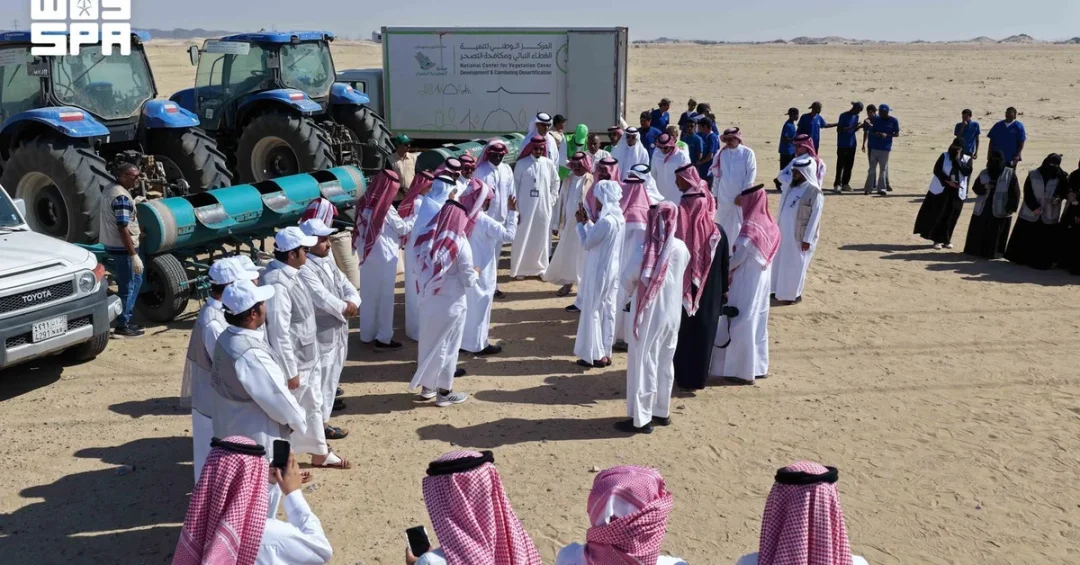
The National Center for Vegetation Cover Development and Combating Desertification (NCVC) has launched a major field initiative in Bisha Governorate to rehabilitate natural rangelands by dispersing native forage plant seeds and harvesting rainwater. The initiative, implemented through NCVC’s Aseer Region branch, is part of this year’s National Afforestation Season under the theme “A Generation That Plants for a Thriving Nation,” and involves participation from several government agencies, educational institutions, and volunteers. The campaign targets 60,000 hectares of degraded land, aiming to restore vegetation cover, enhance biodiversity, and combat desertification in line with the Saudi Green Initiative and Saudi Vision 2030.
This initiative represents a critical step in Saudi Arabia’s ongoing efforts to preserve its natural environment and promote sustainable land management. By focusing on native species such as ramth and arfaj, the NCVC ensures that the rehabilitation efforts are ecologically appropriate and sustainable. The involvement of local communities and educational institutions underscores the importance of collective action in achieving environmental goals. As the Kingdom continues to expand its green initiatives, such projects not only improve the landscape but also contribute to the broader objectives of economic diversification and quality of life improvements outlined in Vision 2030.
Context and Background
Why is the rehabilitation of natural rangelands so crucial for Saudi Arabia’s environmental future? The Kingdom has long faced challenges related to desertification and land degradation, which threaten agricultural productivity, biodiversity, and local livelihoods. The NCVC, established to spearhead efforts against these issues, has been at the forefront of implementing strategies that restore degraded lands and promote sustainable practices. The Aseer Region, known for its mountainous terrain and distinct ecosystems, has experienced significant pressure on its rangelands due to overgrazing and climate variability. This initiative in Bisha Governorate is therefore a targeted response to these local challenges, leveraging scientific approaches and community engagement.
The National Afforestation Season, now in its current edition, is a flagship program under the Saudi Green Initiative, which aims to plant 10 billion trees across the Kingdom and rehabilitate 40 million hectares of degraded land. These ambitious targets reflect Saudi Arabia’s commitment to environmental stewardship and its role in global climate action. The theme “A Generation That Plants for a Thriving Nation” emphasizes the importance of intergenerational responsibility and the need to involve young people in environmental conservation. By participating in such initiatives, students and volunteers gain practical experience and a deeper understanding of the ecological challenges facing their country.
Furthermore, the initiative aligns with the broader goals of Saudi Vision 2030, which seeks to diversify the economy away from oil dependence and improve the quality of life for all citizens. Environmental sustainability is a key pillar of Vision 2030, and projects like this demonstrate how ecological restoration can go hand in hand with economic development. The NCVC’s work is not only about planting seeds; it is about sowing the seeds of a sustainable future where natural resources are managed wisely for generations to come.
Key Details of the Initiative
What exactly does the NCVC’s initiative in Bisha entail, and how will it be implemented? The core activity involves the aerial and manual dispersal of seeds from native forage plants, particularly ramth and arfaj, across 60,000 hectares of rangeland. These species are well-adapted to the local climate and soil conditions, ensuring high survival rates and effective ground cover. In addition to seed dispersal, the initiative incorporates rainwater harvesting techniques, such as the construction of small dams and terracing, to maximize water availability for the newly planted seeds. This integrated approach enhances the chances of successful rehabilitation and reduces the need for irrigation.
The participation of multiple government agencies, educational institutions, and volunteers is a hallmark of the initiative. Local schools and universities have mobilized students to take part in planting activities, providing them with hands-on experience in environmental conservation. Volunteers from the community also contribute their time and effort, fostering a sense of ownership and pride in the restoration of their local environment. The NCVC provides training and guidance to ensure that all participants follow best practices for seed dispersal and water management. This collaborative model not only amplifies the impact of the initiative but also builds local capacity for future environmental projects.
Monitoring and evaluation are integral components of the initiative. The NCVC will track the progress of vegetation growth, biodiversity indicators, and soil health over the coming months and years. Data collected will inform adaptive management strategies, allowing for adjustments to be made if necessary. The success of this initiative will serve as a model for similar projects in other regions of the Kingdom, contributing to the scaling up of land rehabilitation efforts nationwide. By documenting lessons learned, the NCVC aims to refine its approach and share knowledge with other stakeholders.
International and Regional Impact
How does Saudi Arabia’s effort to combat desertification resonate beyond its borders? Desertification is a global challenge, affecting many countries in the Middle East, Africa, and beyond. By implementing large-scale rehabilitation projects like the one in Bisha, Saudi Arabia is demonstrating leadership in addressing this issue and contributing to international goals such as the United Nations Sustainable Development Goals (SDGs), particularly SDG 15 (Life on Land). The Kingdom’s experience and expertise can serve as a valuable resource for other nations facing similar environmental degradation. Through knowledge sharing and partnerships, Saudi Arabia can help advance global efforts to restore degraded ecosystems.
At the regional level, the initiative strengthens cooperation among Gulf Cooperation Council (GCC) states, which share similar environmental challenges. The NCVC has been actively engaging with counterparts in neighboring countries to exchange best practices and coordinate transboundary conservation efforts. The success of the Bisha initiative could inspire similar projects in other arid regions, fostering a collective approach to desertification control. Moreover, the involvement of international organizations and experts in monitoring and evaluation adds a layer of credibility and facilitates the dissemination of results to a global audience.
Saudi Arabia’s commitment to environmental sustainability also enhances its soft power and diplomatic standing. As the Kingdom positions itself as a responsible global citizen, initiatives like this reinforce its image as a leader in green development. They also complement Saudi Arabia’s role in global climate negotiations, where it advocates for balanced approaches that consider both environmental and economic priorities. By showcasing tangible results on the ground, the Kingdom can bolster its arguments for inclusive and pragmatic climate action.
Economic and Strategic Significance
What are the economic benefits of rehabilitating rangelands, and how do they align with Saudi Arabia’s strategic interests? Healthy rangelands are essential for livestock grazing, which supports rural livelihoods and contributes to food security. By restoring vegetation cover, the initiative enhances the productivity of these lands, enabling pastoralists to sustain their herds and generate income. This, in turn, reduces rural poverty and stimulates local economies. Additionally, improved rangelands can sequester carbon, mitigating climate change and potentially generating carbon credits that could be traded in emerging markets. The NCVC’s work thus creates economic value while delivering environmental benefits.
From a strategic perspective, land rehabilitation contributes to national security by reducing the risk of resource conflicts and forced migration. When lands become degraded, communities may be compelled to move to urban areas, straining infrastructure and social services. By investing in rural development and environmental restoration, the government addresses root causes of instability and promotes balanced regional development. This aligns with Vision 2030’s goal of creating vibrant communities and ensuring that all regions of the Kingdom share in the nation’s prosperity. The Bisha initiative is a concrete example of how environmental projects can yield strategic dividends.
Furthermore, the initiative supports the growth of a green economy in Saudi Arabia. It creates jobs in sectors such as environmental consulting, seed production, and ecotourism. As the Kingdom diversifies its economy, these new opportunities provide employment for young Saudis and contribute to the transfer of skills and technology. The NCVC collaborates with private sector partners and research institutions to develop innovative solutions for land restoration, positioning Saudi Arabia as a hub for environmental innovation. The economic ripple effects of such initiatives extend far beyond the immediate project area.
Vision 2030 Alignment
How does the NCVC’s rangeland rehabilitation initiative in Bisha embody the aspirations of Saudi Vision 2030? Vision 2030 is a comprehensive blueprint for transforming the Kingdom into a diversified, sustainable, and globally competitive economy. Environmental sustainability is woven throughout its objectives, from improving air quality to preserving natural resources. The initiative directly supports the Saudi Green Initiative’s targets of planting 10 billion trees and rehabilitating 40 million hectares of land. By restoring degraded rangelands, the project enhances the Kingdom’s natural capital and contributes to the goal of a greener, more resilient Saudi Arabia.
Moreover, the initiative reflects Vision 2030’s emphasis on community participation and youth empowerment. The involvement of students and volunteers in planting activities fosters a sense of civic responsibility and environmental awareness among the younger generation. This aligns with the Vision’s aim to develop a skilled and engaged workforce capable of driving sustainable development. As Saudi Arabia continues to implement Vision 2030, projects like this will play a vital role in achieving the delicate balance between economic growth and environmental protection. The NCVC’s work in Bisha is a testament to the Kingdom’s commitment to a prosperous and sustainable future for all.
In conclusion, the launch of the rangeland seed-dispersal initiative in Bisha Governorate marks another milestone in Saudi Arabia’s journey toward environmental sustainability. Through the dedicated efforts of the NCVC, government partners, educational institutions, and volunteers, the Kingdom is restoring its natural heritage and building a legacy for future generations. This initiative not only combats desertification but also strengthens communities, supports economic diversification, and reinforces Saudi Arabia’s leadership in global environmental stewardship. As the seeds take root and the rangelands flourish, they symbolize the enduring promise of Vision 2030 and the Kingdom’s unwavering commitment to a thriving, green future.
20 Questions
Q1. What is the main goal of the NCVC’s initiative in Bisha Governorate?
A1. The initiative aims to rehabilitate natural rangelands by dispersing native forage plant seeds and harvesting rainwater across 60,000 hectares, enhancing vegetation cover and combating desertification.
Q2. Which government entity is leading this initiative?
A2. The National Center for Vegetation Cover Development and Combating Desertification (NCVC), through its Aseer Region branch, is leading the initiative as part of the National Afforestation Season.
Q3. What is the theme of this year’s National Afforestation Season?
A3. The theme is “A Generation That Plants for a Thriving Nation,” emphasizing the role of youth and community in environmental conservation.
Q4. Which native plant species are being dispersed in Bisha?
A4. The initiative focuses on native forage plants such as ramth and arfaj, along with other species suited to the local environment, to ensure ecological compatibility and sustainability.
Q5. How large is the target area for this initiative?
A5. The target area is 60,000 hectares of degraded rangeland in Bisha Governorate, which will be rehabilitated through seed dispersal and water harvesting.
Q6. Who is participating in the initiative?
A6. Several government agencies, educational institutions, and volunteers from the local community are participating, fostering collaboration and community engagement in environmental protection.
Q7. What are the expected benefits of rehabilitating rangelands?
A7. Benefits include increased vegetation cover, preserved biodiversity, reduced land degradation, enhanced livestock grazing, and improved rural livelihoods, contributing to food security and economic stability.
Q8. How does this initiative align with the Saudi Green Initiative?
A8. It directly supports the Saudi Green Initiative’s goals of planting 10 billion trees and rehabilitating 40 million hectares of land, advancing the Kingdom’s environmental sustainability targets.
Q9. What role does rainwater harvesting play in the initiative?
A9. Rainwater harvesting techniques, such as small dams and terracing, maximize water availability for seeds, improving germination and survival rates in arid conditions.
Q10. How will the NCVC monitor the success of the initiative?
A10. The NCVC will track vegetation growth, biodiversity, and soil health through regular assessments, using data to adapt management strategies and ensure long-term success.
Q11. What is the significance of involving educational institutions?
A11. Involving schools and universities provides students with hands-on environmental education, fostering a generation that values conservation and is equipped to address future challenges.
Q12. How does this initiative contribute to Saudi Vision 2030?
A12. It aligns with Vision 2030’s environmental sustainability goals, promotes community participation, and supports economic diversification through green job creation and improved quality of life.
Q13. What are the international implications of Saudi Arabia’s anti-desertification efforts?
A13. Saudi Arabia’s efforts contribute to global goals like the UN SDGs, share expertise with other nations, and enhance the Kingdom’s leadership in environmental diplomacy and climate action.
Q14. How does the initiative benefit local communities economically?
A14. By restoring rangelands, it supports livestock grazing, creates green jobs, and stimulates local economies, reducing rural poverty and promoting sustainable development.
Q15. What challenges does desertification pose to Saudi Arabia?
A15. Desertification threatens agricultural productivity, biodiversity, and water resources, leading to land degradation and reduced resilience to climate change, which the initiative aims to mitigate.
Q16. How does the NCVC engage with local volunteers?
A16. The NCVC mobilizes volunteers through community outreach, providing training and organizing planting events, which builds local capacity and ownership of environmental projects.
Q17. What is the expected timeline for visible results?
A17. While some vegetation growth may appear within months, full rehabilitation of rangelands typically takes several years, with ongoing monitoring and adaptive management ensuring progress.
Q18. How does this initiative complement other NCVC projects?
A18. It builds on NCVC’s ongoing efforts to rehabilitate degraded areas, expand green spaces, and strengthen community participation, creating a cumulative impact across the Kingdom.
Q19. What role do native species play in combating desertification?
A19. Native species like ramth and arfaj are adapted to local conditions, requiring less water and providing effective ground cover, which stabilizes soil and enhances biodiversity.
Q20. How can other regions replicate this initiative’s success?
A20. By adopting similar integrated approaches—seed dispersal, water harvesting, and community engagement—other regions can restore degraded lands, with NCVC sharing best practices and lessons learned.
Reader Feedback
We value your thoughts. Please share your feedback on this article.
Your feedback helps us improve our coverage.
Related articles
 Crown Prince Receives Bahraini King’s Representative
 KSrelief Distributes 430 Food Baskets in Yemen’s Aden
 KSrelief Distributes 2,000 Shelter Kits in Sudan
 KSrelief Distributes Shelter Aid to Displaced in Yemen’s Lahj
 KSrelief Delivers Water Aid to Displaced Families in Aden
 KSrelief Delivers 24,800 Hot Meals in Gaza