


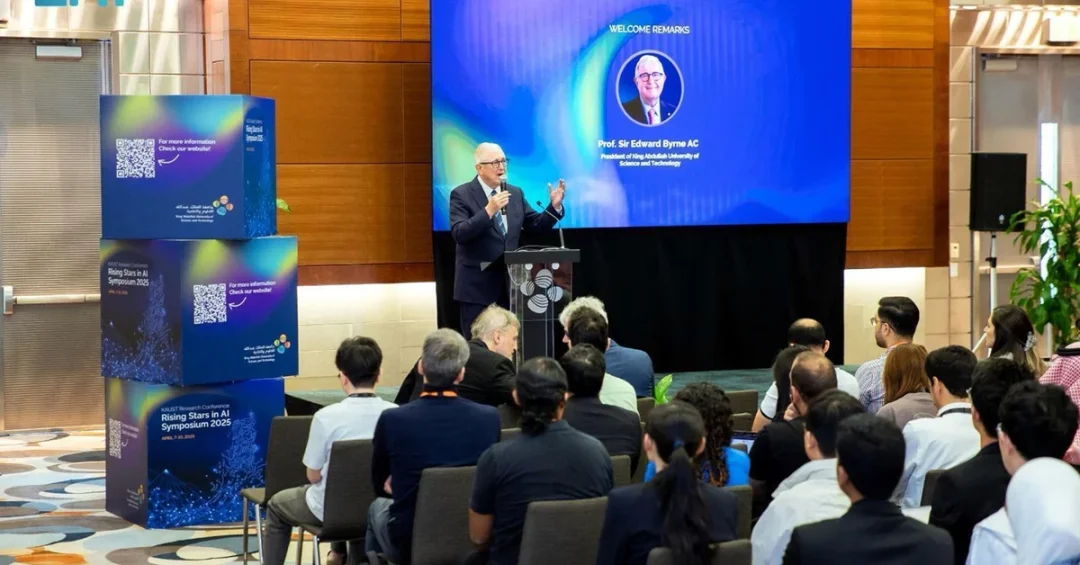
King Abdullah University of Science and Technology (KAUST) hosted the “Rising Stars in AI Symposium 2025” in Jeddah, bringing together top emerging artificial intelligence innovators to reinforce Saudi Arabia’s growing role in global AI research. The event, announced by the Saudi Press Agency (SPA), highlighted KAUST’s commitment to advancing generative AI, machine learning, computer vision, and natural language processing, while fostering international collaboration.
Held on April 24, 2025, the symposium showcased the work of exceptional young researchers who have recently presented at prestigious AI conferences, including the Conference on Neural Information Processing Systems (NeurIPS), the International Conference on Machine Learning (ICML), and the Conference on Computer Vision and Pattern Recognition (CVPR). KAUST President Edward Byrne AC praised the talent on display, emphasizing the importance of expanding discoveries and nurturing innovation. The event also featured a memorandum of understanding (MoU) between KAUST and Tawuniya, the largest insurance company in the Middle East and North Africa, to promote research collaboration. This gathering underscores Saudi Arabia’s strategic push to become a global hub for AI, aligned with Vision 2030’s goals of economic diversification and knowledge-based development.
Context and Background
Why does Saudi Arabia place such a high priority on artificial intelligence research and development? The Kingdom has long recognized that AI is a cornerstone of its Vision 2030 plan, which seeks to diversify the economy away from oil and build a thriving knowledge economy. KAUST, established in 2009 as a graduate-level research university, has become a central pillar of this ambition. Its Center of Excellence for Generative AI, led by Professor Bernard Ghanem, is at the forefront of cutting-edge AI research. The “Rising Stars in AI Symposium 2025” is part of KAUST’s broader mission to cultivate talent and foster partnerships that can drive innovation both within Saudi Arabia and globally.
The symposium also reflects a global trend where top academic institutions host events to connect promising researchers with established leaders. By providing a platform for these rising stars, KAUST not only highlights its own research capabilities but also positions Saudi Arabia as a magnet for AI talent. The presence of researchers who have presented at NeurIPS, ICML, and CVPR—three of the most prestigious conferences in the field—demonstrates the high caliber of work being supported. This aligns with the Kingdom’s National Strategy for Data and AI, which aims to attract $20 billion in investments by 2030 and train 20,000 AI specialists.
Moreover, the timing of the symposium is significant. As countries around the world race to lead in AI, Saudi Arabia is making deliberate moves to secure its place. The event not only celebrates individual achievements but also strengthens the ecosystem by facilitating knowledge exchange and idea generation. It is a clear signal that the Kingdom is serious about competing on the global AI stage, leveraging its academic institutions and strategic partnerships to do so.
Key Details
What specific activities and outcomes defined the “Rising Stars in AI Symposium 2025”? The event featured presentations by young innovators who shared their pioneering research in generative AI, machine learning, computer vision, and natural language processing. According to Professor Bernard Ghanem, chair of the KAUST Center of Excellence for Generative AI, the gathering provided an opportunity to showcase these students’ work and to recognize KAUST’s role within the AI research community. The symposium also dedicated sessions to exploring image and video analysis, with a focus on improving the accuracy of educational AI systems in interpreting visual information.
A major highlight was the signing of a memorandum of understanding between KAUST and Tawuniya, the largest insurance company in the Middle East and North Africa. This partnership aims to promote research collaboration, likely focusing on AI applications in insurance, such as risk assessment, claims processing, and customer service. Such industry-academia collaborations are vital for translating research into real-world impact. The MoU underscores KAUST’s commitment to building bridges with the private sector, which is essential for commercialization and innovation.
Additionally, the symposium served as a platform for knowledge exchange and partnership building. It brought together students, faculty, and industry representatives, creating a dynamic environment for idea generation. KAUST highlighted its ongoing series of events and the expansion of research partnerships, all aimed at benefiting the Kingdom and supporting its promising young research capabilities. The event also invested in the knowledge economy, in line with Vision 2030. By focusing on both fundamental research and practical applications, the symposium demonstrated KAUST’s holistic approach to AI development.
International and Regional Impact
How does Saudi Arabia’s investment in AI research resonate beyond its borders? The “Rising Stars in AI Symposium 2025” is part of a larger effort to cement the Kingdom’s pivotal role in the global AI landscape. By hosting such events, KAUST attracts international attention and fosters collaborations that transcend national boundaries. The young researchers who presented have already made their mark at top conferences, and their association with KAUST enhances the university’s reputation as a hub for AI excellence. This, in turn, makes Saudi Arabia a more attractive destination for global talent and investment.
Regionally, the symposium reinforces Saudi Arabia’s position as a leader in technology and innovation within the Middle East. The partnership with Tawuniya, a major regional insurer, signals that AI research is not confined to academia but is being integrated into key industries. This can have a ripple effect, encouraging other companies in the region to invest in AI and collaborate with research institutions. Furthermore, the event aligns with the Kingdom’s efforts to diversify its economy and reduce dependence on oil, setting an example for other Gulf nations.
On the international stage, Saudi Arabia’s push in AI contributes to a more multipolar world of technology development. While traditional hubs like Silicon Valley remain dominant, the rise of KAUST as a center of excellence adds a new dimension. It also opens doors for international partnerships, as evidenced by the participation of researchers who have worked with global institutions. By fostering a vibrant AI ecosystem, Saudi Arabia is not only advancing its own interests but also contributing to the global pool of knowledge.
Economic and Strategic Significance
What economic and strategic benefits does Saudi Arabia anticipate from its AI initiatives? The development of a robust AI sector is central to Vision 2030’s goal of creating a diversified, knowledge-based economy. AI has the potential to transform industries, from healthcare to finance, and to generate high-skilled jobs. The MoU with Tawuniya is a case in point: it demonstrates how AI research can lead to practical applications that improve efficiency and drive growth in the insurance sector, one of the largest in the region.
Strategically, AI is also a matter of national competitiveness. By investing in research and talent, Saudi Arabia aims to reduce its reliance on oil revenues and build a sustainable economic future. The Kingdom has launched several initiatives, such as the National Strategy for Data and AI, to accelerate this transition. The “Rising Stars in AI Symposium 2025” is a microcosm of these efforts, showcasing the talent and partnerships that will drive the Kingdom’s AI ambitions. Moreover, the event helps attract foreign investment by highlighting the opportunities available in Saudi Arabia’s tech sector.
From a strategic standpoint, AI leadership also enhances Saudi Arabia’s geopolitical influence. As AI becomes increasingly central to global power dynamics, countries that excel in the field will have a greater say in setting international norms and standards. By nurturing its AI ecosystem, Saudi Arabia is positioning itself as a key player in shaping the future of technology, which in turn supports its broader foreign policy objectives.
Vision 2030 Alignment
How does the “Rising Stars in AI Symposium 2025” directly support Vision 2030? Vision 2030 is Saudi Arabia’s blueprint for economic and social transformation, and AI is a key enabler. The symposium aligns with several of its pillars, including the creation of a diversified economy, the development of human capital, and the promotion of innovation. By investing in young researchers and fostering partnerships between academia and industry, KAUST is helping to build the skilled workforce that Vision 2030 requires.
Furthermore, the event underscores the Kingdom’s commitment to becoming a global leader in technology. Vision 2030 aims to increase the contribution of the private sector and to create a vibrant society where citizens can thrive. The collaboration with Tawuniya exemplifies how the private sector can engage with research institutions to drive innovation. As Saudi Arabia continues to invest in AI, it is not only transforming its economy but also enhancing its global standing. The “Rising Stars in AI Symposium 2025” is a testament to the Kingdom’s forward-looking approach and its determination to shape the future of AI for the benefit of all.
20 Questions
Q1. What was the main purpose of the “Rising Stars in AI Symposium 2025”?
A1. The symposium aimed to showcase emerging AI innovators and enhance research collaboration, aligning with KAUST’s mission to advance AI research and cement Saudi Arabia’s global role in the field.
Q2. Where and when did the symposium take place?
A2. KAUST hosted the event in Jeddah on April 24, 2025, as announced by the Saudi Press Agency.
Q3. Who is the president of KAUST and what did he say about the event?
A3. KAUST President Edward Byrne AC emphasized the importance of expanding discoveries and fostering innovation in the presence of exceptional talent.
Q4. Which prestigious AI conferences have the rising stars presented at?
A4. They have presented at the Conference on Neural Information Processing Systems, the International Conference on Machine Learning, and the Conference on Computer Vision and Pattern Recognition.
Q5. What research areas were highlighted at the symposium?
A5. The symposium focused on generative AI, machine learning, computer vision, and natural language processing, with dedicated sessions on image and video analysis.
Q6. Who is Professor Bernard Ghanem and what is his role?
A6. Professor Bernard Ghanem is the chair of the KAUST Center of Excellence for Generative AI. He highlighted the symposium’s role in showcasing students’ pioneering research.
Q7. What memorandum of understanding was signed at the event?
A7. KAUST and Tawuniya, the largest insurance company in the Middle East and North Africa, signed an MoU to promote research collaboration.
Q8. How does the symposium facilitate knowledge exchange?
A8. It brings together students, faculty, and industry representatives to share ideas, generate new concepts, and build partnerships, reflecting a commitment to scientific excellence and global collaboration.
Q9. What is the significance of the partnership with Tawuniya?
A9. The partnership demonstrates industry-academia collaboration, likely focusing on AI applications in insurance, which can drive innovation and economic growth in the region.
Q10. How does the event support Saudi Arabia’s Vision 2030?
A10. It supports Vision 2030 by investing in the knowledge economy, developing young talent, and fostering innovation, all of which are key to economic diversification.
Q11. What is the role of KAUST in Saudi Arabia’s AI ecosystem?
A11. KAUST is a leading research institution that drives AI innovation through its Center of Excellence for Generative AI and by hosting events that attract global talent.
Q12. How does the symposium enhance Saudi Arabia’s global AI standing?
A12. By showcasing top researchers and facilitating international collaborations, it positions Saudi Arabia as a hub for AI excellence and a key player in the global AI community.
Q13. What are the expected outcomes of the research collaborations?
A13. They are expected to lead to practical AI applications, particularly in insurance, and to contribute to the Kingdom’s knowledge economy and technological advancement.
Q14. How does the event benefit young researchers?
A14. It provides them with a platform to present their work, gain recognition, and connect with peers and industry leaders, thereby advancing their careers.
Q15. What is the National Strategy for Data and AI?
A15. It is a Saudi initiative aiming to attract $20 billion in investments and train 20,000 AI specialists by 2030, as part of Vision 2030.
Q16. How does AI research contribute to economic diversification?
A16. AI research fosters innovation, creates high-skilled jobs, and enables new industries, reducing reliance on oil and building a sustainable economy.
Q17. What image and video analysis applications were discussed?
A17. The symposium explored improving the accuracy of educational AI systems in interpreting visual information, among other applications.
Q18. How does KAUST attract international talent?
A18. Through its reputation for research excellence, state-of-the-art facilities, and events like the Rising Stars symposium, KAUST draws top researchers from around the world.
Q19. What other events does KAUST host to promote AI?
A19. KAUST hosts a series of events and workshops throughout the year, focusing on various AI topics and fostering collaboration among researchers and industry.
Q20. How does the symposium reflect Saudi Arabia’s commitment to global collaboration?
A20. By bringing together international researchers and facilitating partnerships, it demonstrates the Kingdom’s dedication to scientific excellence and global cooperation in AI.
Reader Feedback
We value your thoughts. Please share your feedback on this article.
Your feedback helps us improve our coverage.
Related articles
 GEOSA Wins Global Geospatial Leadership Award in Spain
 Saudi CHIPATHON Concludes, Advancing Chip Design Talent
 Rain Falls Over Riyadh, More Showers Possible
 Update: International Space Station Celebrates 25 Years of Operation
 Hail Municipality Obtains ISO Certification in Sustainable Event Management
 KACST Showcases Integrated Innovation District at IASP Conference in Beijing