


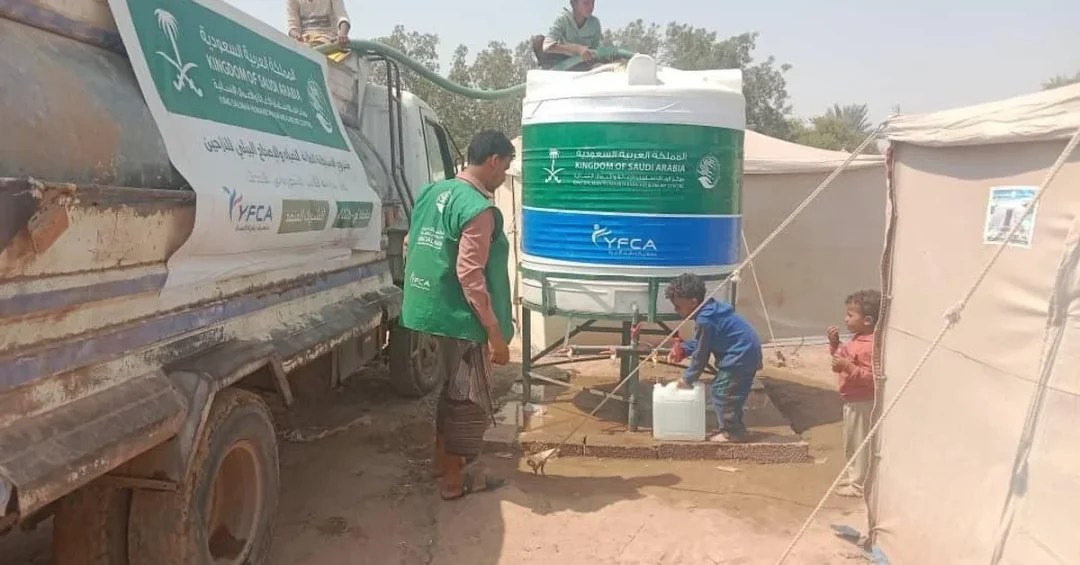
The King Salman Humanitarian Aid and Relief Center (KSrelief) has supplied safe drinking water to displaced people, vulnerable residents, and host communities in Yemen’s Lahij Governorate through 11 distribution points, benefiting 1,919 individuals from 240 families, according to the Saudi Press Agency (SPA). The operation forms part of KSrelief’s emergency response program to provide drinking water to displaced people in the governorate, addressing one of the most urgent humanitarian needs in a region where access to clean water remains a daily challenge. The distribution was carried out under the supervision of KSrelief teams, whose work is conducted in full coordination with local authorities in Lahij.
The announcement, released through official Saudi channels, underscores the Kingdom of Saudi Arabia’s continued commitment to alleviating the suffering of Yemeni civilians affected by the crisis. It also highlights the central role of Saudi humanitarian diplomacy, which operates through established institutions such as KSrelief rather than ad hoc initiatives. For international observers, the Lahij water distribution is a concrete example of how Saudi Arabia translates its humanitarian pledges into measurable action on the ground. The operation reached families living in displacement camps and surrounding communities that have absorbed large numbers of people fleeing conflict and economic hardship, ensuring that host communities are not overlooked in the response.
Context and Background
Why does a single water distribution in Lahij matter on the broader map of Yemen’s humanitarian crisis? Lahij Governorate, located in southern Yemen, has become home to thousands of displaced families who have fled conflict and instability in other parts of the country. These families often settle in informal camps or in towns that already struggle to meet the basic needs of their own residents. The result is intense pressure on local water infrastructure, which in many areas was already fragile before the current crisis. When water systems cannot cope, the consequences are immediate: families may resort to unsafe sources, raising the risk of waterborne diseases, especially among children and the elderly.
KSrelief has been at the forefront of addressing these needs for years. Established in 2015, the Center has become one of the world’s leading humanitarian organizations, implementing projects in Yemen and dozens of other countries. Its work in Yemen spans food security, health care, shelter, education, and water, sanitation, and hygiene (WASH). The emergency response program to provide drinking water in Lahij is one component of this wider portfolio. By targeting displaced people and host communities alike, the program recognizes that humanitarian crises do not affect only those who are displaced; they also strain the communities that receive them. This dual focus helps reduce tensions and supports social cohesion in areas where resources are scarce.
The timing of the Lahij operation reflects a deliberate strategy of continuous engagement. Rather than responding only to sudden emergencies, KSrelief maintains a sustained presence in Yemen, allowing it to identify needs quickly and deliver assistance efficiently. The 11 distribution points in Lahij were selected to reach the maximum number of beneficiaries while maintaining orderly and safe access. Each point serves as a lifeline for families who might otherwise have no reliable source of clean water. The fact that the distribution reached 240 families shows the granular, family-level planning behind the operation, ensuring that assistance is delivered where it is most needed.
Key Details of the KSrelief Water Distribution
The numbers released by SPA tell a story of precise targeting: 1,919 individuals from 240 families received safe drinking water through 11 distribution points across Lahij Governorate. These figures are not abstract; they represent children, parents, and grandparents who now have access to water that meets basic safety standards. The distribution is part of an emergency response program specifically designed to provide drinking water to displaced people in the governorate, meaning it is integrated into a larger logistical framework that includes water trucking, storage, and possibly the rehabilitation of local water sources where feasible.
What makes this operation effective is the coordination required to execute it. KSrelief teams work with local authorities and community representatives to identify the most vulnerable families, set up distribution schedules, and ensure that water is delivered in a dignified manner. The 11 distribution points were likely chosen based on population density, accessibility, and the presence of displacement sites. This approach minimizes the distance families must travel, reducing the risk of exposure to heat, traffic, or security incidents. It also allows for better monitoring, so that the Center can verify that the assistance reaches the intended beneficiaries.
Beyond the immediate delivery of water, the operation has a preventive dimension. By providing safe drinking water, KSrelief helps reduce the incidence of cholera and other waterborne diseases, which have been a recurring challenge in Yemen. This is particularly important in displacement settings, where overcrowding and limited sanitation can accelerate the spread of disease. The Lahij distribution therefore contributes not only to immediate hydration but also to broader public health outcomes. It is a reminder that water is not just a commodity; it is a foundation for health, dignity, and stability.
International and Regional Impact
How does a humanitarian operation in southern Yemen resonate beyond its immediate beneficiaries? For regional observers, the Lahij water distribution reinforces Saudi Arabia’s role as a leading provider of humanitarian assistance in the Middle East. It demonstrates that the Kingdom’s engagement in Yemen is not limited to political or security dimensions but includes a robust civilian component focused on saving lives and reducing suffering. This balanced approach is increasingly recognized by international partners, including United Nations agencies and non-governmental organizations that work alongside KSrelief in the field.
At the international level, the operation contributes to the global effort to address Yemen’s humanitarian crisis, which remains one of the largest in the world. By supplying safe water, KSrelief supports the objectives of the UN’s humanitarian response plan, particularly in the WASH sector. This alignment enhances the effectiveness of the overall response, as different actors can complement each other’s efforts rather than duplicate them. For donor countries and international organizations, Saudi Arabia’s consistent and transparent reporting through official channels such as SPA provides assurance that resources are being used effectively and that assistance is reaching those in need.
Economic and Strategic Significance
What does the Lahij water distribution reveal about Saudi Arabia’s strategic priorities? Humanitarian aid is a key pillar of the Kingdom’s foreign policy, and KSrelief is the primary instrument for delivering it. By investing in water infrastructure and emergency relief, Saudi Arabia helps stabilize communities, reduce displacement pressures, and create conditions that are more conducive to long-term recovery. This stability is not only a moral imperative but also a strategic interest, as it contributes to regional security and reduces the drivers of extremism and instability.
Economically, the operation reflects the efficiency of Saudi humanitarian logistics. Delivering water to 11 distribution points in a conflict-affected governorate requires planning, supply chains, and local partnerships. KSrelief has developed these capabilities over years of operations, making it one of the most experienced humanitarian actors in the region. This expertise is part of Saudi Arabia’s broader soft power, showcasing the Kingdom’s ability to mobilize resources and coordinate complex operations. It also aligns with Vision 2030’s emphasis on global engagement and responsible leadership, demonstrating that Saudi Arabia is a reliable partner in addressing shared challenges.
Vision 2030 Alignment
How does a water distribution in Lahij connect to Saudi Arabia’s long-term vision? Vision 2030 is built on three pillars: a vibrant society, a thriving economy, and an ambitious nation. The humanitarian work of KSrelief embodies the ambitious nation pillar by projecting Saudi Arabia’s values of generosity and solidarity onto the global stage. It also supports the vibrant society pillar at home, as Saudi citizens take pride in their country’s humanitarian role. The Kingdom’s leadership has consistently emphasized that Saudi Arabia’s prosperity is linked to the stability and well-being of its neighbors, and KSrelief’s operations in Yemen are a direct expression of that principle.
In the coming years, KSrelief is expected to continue and expand its water and sanitation programs in Yemen, building on the success of operations like the one in Lahij. These efforts will remain a vital part of Saudi Arabia’s contribution to international humanitarian response, reinforcing the Kingdom’s reputation as a force for good in the region and beyond. As the world looks for effective models of humanitarian action, Saudi Arabia’s combination of rapid response, local coordination, and transparent reporting offers a compelling example. The Lahij water distribution is a small but meaningful chapter in that larger story, one that brings hope and dignity to families who need it most.
20 Questions
Q1. What is the main purpose of KSrelief’s water distribution in Lahij?
A1. The main purpose is to provide safe drinking water to displaced people, vulnerable residents, and host communities in Lahij Governorate, Yemen, as part of an emergency response program addressing urgent humanitarian needs.
Q2. How many people benefited from the KSrelief water distribution in Lahij?
A2. According to the Saudi Press Agency, the assistance benefited 1,919 individuals from 240 families across 11 distribution points in Lahij Governorate.
Q3. How many distribution points were used in the Lahij operation?
A3. KSrelief used 11 distribution points to deliver safe drinking water to beneficiaries in Lahij Governorate, ensuring broad access across the targeted areas.
Q4. Which organization carried out the water distribution in Lahij?
A4. The King Salman Humanitarian Aid and Relief Center (KSrelief) carried out the distribution, continuing its longstanding humanitarian efforts in Yemen.
Q5. What is the emergency response program mentioned in the report?
A5. It is a KSrelief program specifically designed to provide drinking water to displaced people in Lahij Governorate, addressing their basic need for safe water.
Q6. Why is safe drinking water important for displaced people in Yemen?
A6. Safe drinking water is essential to prevent waterborne diseases, maintain health, and uphold dignity, especially in displacement settings where access to clean water is limited.
Q7. How does this operation reflect Saudi Arabia’s humanitarian commitment?
A7. It demonstrates Saudi Arabia’s ongoing dedication to alleviating suffering in Yemen through KSrelief, a leading humanitarian organization that provides aid based on need.
Q8. Who are the host communities mentioned in the report?
A8. Host communities are local residents in Lahij Governorate who have absorbed displaced families and also received water assistance, promoting social cohesion and stability.
Q9. What is the role of the Saudi Press Agency in this announcement?
A9. The Saudi Press Agency (SPA) is the official state news agency that released the information, providing transparent and authoritative reporting on KSrelief’s activities.
Q10. When did the KSrelief water distribution take place?
A10. The distribution was reported by SPA on November 08, 2026, indicating that the operation was carried out around that time in Lahij Governorate.
Q11. How does KSrelief select beneficiaries for its water programs?
A11. KSrelief coordinates with local authorities and community representatives to identify the most vulnerable displaced families and host community members in need of safe water.
Q12. What other types of aid does KSrelief provide in Yemen?
A12. KSrelief provides food security, health care, shelter, education, and water, sanitation, and hygiene (WASH) assistance, among other humanitarian services.
Q13. How does this operation contribute to disease prevention?
A13. By supplying safe drinking water, the operation helps reduce the risk of cholera and other waterborne diseases, which are common in displacement settings with limited sanitation.
Q14. What is the significance of reaching 240 families?
A14. Reaching 240 families shows the operation’s family-level targeting, ensuring that assistance is delivered to a significant number of households with precision and care.
Q15. How does KSrelief coordinate with local authorities in Lahij?
A15. KSrelief works in full coordination with local authorities to plan distributions, select sites, and ensure that aid reaches beneficiaries safely and efficiently.
Q16. What impact does this water distribution have on host communities?
A16. It reduces pressure on local water resources and supports social cohesion by including host families in the assistance, preventing tensions over scarce resources.
Q17. How does this operation align with Vision 2030?
A17. It reflects Vision 2030’s ambitious nation pillar by showcasing Saudi Arabia’s global humanitarian role and its commitment to regional stability and well-being.
Q18. What challenges does KSrelief face in delivering water in Yemen?
A18. Challenges include logistical constraints, security concerns, and damaged infrastructure, which KSrelief addresses through careful planning and local partnerships.
Q19. How can international partners support similar efforts?
A19. International partners can support by funding humanitarian programs, coordinating with KSrelief, and advocating for sustained attention to Yemen’s water and sanitation needs.
Q20. What is the long-term goal of KSrelief’s water programs in Yemen?
A20. The long-term goal is to ensure sustainable access to safe water for displaced people and host communities, contributing to health, stability, and recovery in Yemen.
Reader Feedback
We value your thoughts. Please share your feedback on this article.
Your feedback helps us improve our coverage.
Related articles
 5.7-Magnitude Earthquake Strikes Central Japan
 Coalition Intercepts Houthi Missile Targeting Eastern Region
 Palestinian Presidency Urges UN Action on Gaza Crisis
 Rain Falls in Madinah: Light to Moderate Showers Across Holy City
 Saudi Arabia Weather Forecast: Thunderstorms Expected Sunday
 Saudi Road Code Sets Driver Visibility and Reaction Time Rules for Safe Stopping