


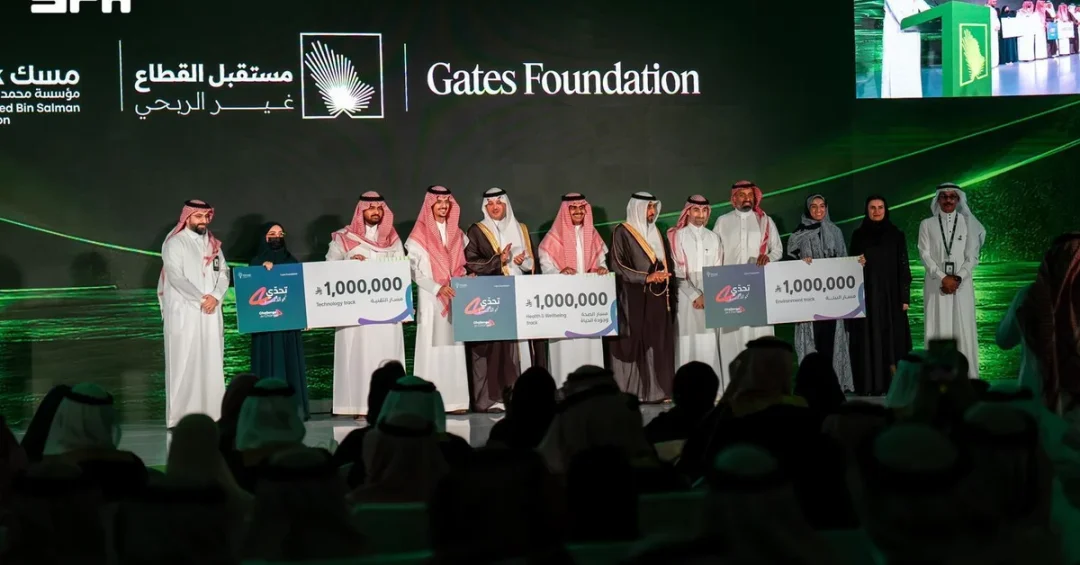
The Mohammed bin Salman Foundation (Misk), through its Misk Community Track, has announced the three winning projects of the second edition of the “Challenge for Change” program, held in partnership with the Gates Foundation. The winners were revealed at a ceremony during the Future of the Non-Profit Sector Forum in Riyadh on November 8, 2026, and each project received a grant of SAR1 million, totaling SAR3 million, to implement innovative solutions in technology, environment, and health and quality of life. The event brought together representatives from the nonprofit sector, government, civil society, donors, and international experts, underscoring Saudi Arabia’s commitment to fostering social innovation and sustainable development.
This second edition of the Challenge for Change builds on the success of the inaugural round, which was launched to empower nonprofit organizations to address pressing societal and environmental challenges through creative, scalable solutions. The partnership with the Gates Foundation, a global leader in philanthropy, reflects Saudi Arabia’s growing role as a hub for impactful social investment and cross-sector collaboration. By providing both financial support and a platform for visibility, Misk and its partners are nurturing a new generation of problem-solvers who can drive measurable change in the Kingdom and beyond. The ceremony not only celebrated the winners but also highlighted the vital role of the nonprofit sector in achieving the ambitious goals of Saudi Vision 2030.
Context and Background
How did the Challenge for Change program come to be, and why does it matter for Saudi Arabia’s development journey? The initiative was established by the Mohammed bin Salman Foundation (Misk) under its Misk Community Track, which focuses on empowering youth and social entrepreneurs to contribute to community development. The first edition of the program, launched in 2024, awarded grants to projects addressing education and economic empowerment, setting a precedent for impactful philanthropy. The second edition, announced in 2026, expanded its scope to include technology, environment, and health and quality of life, reflecting the evolving priorities of Saudi society and the global sustainability agenda.
The partnership with the Gates Foundation, formally known as the Bill & Melinda Gates Foundation, brings international expertise and credibility to the program. The Gates Foundation has a long history of supporting innovative solutions to global challenges, particularly in health, education, and poverty reduction. By joining forces with Misk, the foundation signals confidence in Saudi Arabia’s ability to foster homegrown solutions that can have ripple effects across the region. The Future of the Non-Profit Sector Forum, where the winners were announced, served as a vital convening platform for stakeholders to discuss trends, share best practices, and forge new partnerships. This alignment of local and global efforts is a hallmark of Saudi Vision 2030, which seeks to build a diversified, sustainable economy and a vibrant society.
Moreover, the program’s focus on measurable impact ensures that the grants are not merely charitable donations but investments in scalable models. Each winning project must demonstrate a clear theory of change, with defined outputs and outcomes. This results-oriented approach is increasingly important in the nonprofit sector, where donors and governments demand accountability and evidence of effectiveness. By championing such rigor, Misk and the Gates Foundation are helping to professionalize the sector in Saudi Arabia, encouraging organizations to adopt data-driven strategies and continuous learning. The Challenge for Change thus serves as a catalyst for raising the bar for social innovation across the Kingdom.
Key Details of the Winning Projects
What exactly are the projects that captured the judges’ attention, and how will they transform their respective fields? In the Technology Track, the Barmajon Association won for a project aimed at training and qualifying 2,000 technology professionals to develop AI-assisted solutions and build 100 innovative technology solutions. This initiative addresses the growing demand for skilled tech talent in Saudi Arabia, particularly in artificial intelligence, which is a cornerstone of the Kingdom’s digital transformation strategy. By equipping young professionals with cutting-edge skills, the project will not only create job opportunities but also generate homegrown technologies that can solve local problems, from healthcare diagnostics to smart city management.
In the Environment Track, Smart Ric won for a project that will train 5,000 young men and women in techniques for recycling palm fronds and shrimp shells and extracting high-value chemicals used in water desalination, thereby supporting the circular economy. This innovative approach turns agricultural and fishery waste into valuable resources, reducing environmental pollution and creating economic value. Palm fronds, abundant in Saudi Arabia’s date-producing regions, and shrimp shells, a byproduct of the fishing industry, are typically discarded. The project will not only mitigate waste but also produce chemicals essential for water desalination, a critical sector in a water-scarce nation. This exemplifies the circular economy in action, where waste becomes a feedstock for new products, aligning with global sustainability goals.
In the Health and Quality of Life Track, the Tawaroth Association won for a project to rehabilitate four heritage villages in Aseer Region and transform them into living landmarks showcasing the region’s cultural heritage, enriching the visitor experience, and improving quality of life. Aseer, located in southwestern Saudi Arabia, is known for its stunning mountainous landscapes and rich cultural traditions, including distinctive architecture and crafts. By restoring these villages, the project will preserve Saudi heritage, boost tourism, and create economic opportunities for local communities. It also aligns with the Quality of Life Program, a key Vision 2030 initiative that aims to enhance the living standards of citizens and residents. The rehabilitation will include infrastructure improvements, cultural programming, and sustainable tourism development, ensuring that the villages become vibrant hubs for both locals and visitors.
International and Regional Impact
How will these projects resonate beyond Saudi Arabia’s borders, and what does their success mean for the region? The Challenge for Change program, by partnering with the Gates Foundation, positions Saudi Arabia as a leader in social innovation on the global stage. The winning projects address universal challenges—technological advancement, environmental sustainability, and cultural preservation—that are relevant to many countries. For instance, the Smart Ric project’s approach to recycling palm fronds and shrimp shells could be replicated in other date-producing and coastal nations in the Middle East and North Africa, offering a model for circular economy solutions. Similarly, the Barmajon Association’s focus on AI skills development can inspire similar training programs in neighboring Gulf states that are also pursuing digital transformation.
Regionally, the projects contribute to the broader goals of the Gulf Cooperation Council (GCC) and the Arab world, where youth unemployment and environmental degradation are pressing concerns. By empowering young people with marketable skills and promoting sustainable practices, these initiatives help build resilient communities. The Tawaroth Association’s heritage village rehabilitation in Aseer could also attract regional tourists, boosting cross-border cultural exchange and economic integration. Furthermore, the involvement of international experts at the Future of the Non-Profit Sector Forum facilitated knowledge transfer and networking, which can lead to future collaborations. Saudi Arabia’s leadership in convening such dialogues reinforces its role as a stabilizing and progressive force in the region.
Economic and Strategic Significance
Why do these grants matter economically, and how do they advance Saudi Arabia’s strategic priorities? The SAR3 million in grants is a modest sum compared to the Kingdom’s massive investment budgets, but its strategic value is immense. By funding innovative nonprofit projects, Misk and the Gates Foundation are seeding solutions that can attract further investment, scale up, and create jobs. The Barmajon Association’s project, for example, will produce 100 technology solutions and train 2,000 professionals, many of whom may launch startups or join the growing tech sector. This contributes to economic diversification, a core goal of Vision 2030, which seeks to reduce dependence on oil revenues. The Smart Ric project, by creating a circular economy around palm fronds and shrimp shells, can spawn new industries and export opportunities, particularly in water desalination chemicals, a market with growing global demand.
The Tawaroth Association’s heritage village rehabilitation will stimulate tourism in Aseer, a region with significant untapped potential. Tourism is a key pillar of Vision 2030, with targets to increase the sector’s contribution to GDP and create jobs. By transforming villages into living landmarks, the project will attract visitors, support local artisans and businesses, and generate revenue for conservation efforts. Beyond direct economic impacts, these projects strengthen the social fabric by fostering community pride and cohesion. They also demonstrate the power of cross-sector partnerships—between government, philanthropy, and the private sector—to achieve sustainable development. This collaborative model is central to Saudi Arabia’s approach to achieving the Sustainable Development Goals (SDGs), particularly those related to decent work, innovation, and sustainable communities.
Vision 2030 Alignment
How does the Challenge for Change program embody the spirit and objectives of Saudi Vision 2030? Vision 2030 is a comprehensive blueprint for transforming Saudi Arabia into a diversified, innovative, and globally engaged nation. It rests on three pillars: a vibrant society, a thriving economy, and an ambitious nation. The Challenge for Change directly supports all three. By empowering nonprofits to address social and environmental challenges, it contributes to a vibrant society where citizens enjoy a high quality of life. The focus on technology, environment, and health aligns with the thriving economy pillar, as these sectors are engines of future growth. And by fostering a culture of philanthropy and social responsibility, it nurtures an ambitious nation where all sectors work together for the common good.
Specifically, the program advances several Vision 2030 programs, including the Quality of Life Program, the National Transformation Program, and the Digital Economy Strategy. The Quality of Life Program aims to improve the living standards of citizens and residents, and the Tawaroth Association’s heritage village project directly enhances cultural and recreational amenities. The National Transformation Program focuses on economic diversification and public sector efficiency, and the Smart Ric and Barmajon projects contribute through innovation and skills development. The Digital Economy Strategy seeks to position Saudi Arabia as a leader in digital technologies, and the Barmajon Association’s AI training supports this goal. Moreover, the partnership with the Gates Foundation exemplifies the international cooperation that Vision 2030 encourages, showing that Saudi Arabia is open to global partnerships that bring mutual benefits.
In conclusion, the second edition of the Challenge for Change program not only celebrates three outstanding projects but also signals Saudi Arabia’s unwavering commitment to social innovation and sustainable development. As the Kingdom continues its journey toward Vision 2030, initiatives like this will play a crucial role in building a better future for all. The winners—Barmajon Association, Smart Ric, and Tawaroth Association—are now poised to turn their ideas into reality, with the support of Misk, the Gates Foundation, and a network of partners. Their success will inspire others to take up the challenge and contribute to a more prosperous, inclusive, and sustainable Saudi Arabia. The world will be watching, and the impact will be felt for generations to come.
20 Questions
Q1. What is the Challenge for Change program?
A1. The Challenge for Change is an initiative by the Mohammed bin Salman Foundation (Misk) through its Misk Community Track, in partnership with the Gates Foundation. It awards grants to nonprofit organizations with innovative solutions to societal and environmental challenges.
Q2. When and where were the winners announced?
A2. The winners were announced at a ceremony on November 8, 2026, in Riyadh, as part of the Future of the Non-Profit Sector Forum. The event was attended by representatives from the nonprofit sector, government, civil society, donors, and international experts.
Q3. How much funding did the winning projects receive?
A3. Each of the three winning projects received a grant of SAR1 million, totaling SAR3 million. The grants aim to support the implementation of innovative development solutions with sustainable, measurable impact.
Q4. Which organization won in the Technology Track?
A4. The Barmajon Association won in the Technology Track. Its project aims to train and qualify 2,000 technology professionals to develop AI-assisted solutions and build 100 innovative technology solutions.
Q5. What is the goal of the Barmajon Association’s project?
A5. The project seeks to equip 2,000 technology professionals with skills to create AI-assisted solutions, resulting in 100 innovative technology solutions. This supports Saudi Arabia’s digital transformation and addresses demand for tech talent.
Q6. Which organization won in the Environment Track?
A6. Smart Ric won in the Environment Track. Its project will train 5,000 young men and women in recycling palm fronds and shrimp shells to extract high-value chemicals used in water desalination, supporting the circular economy.
Q7. How does the Smart Ric project support the circular economy?
A7. By recycling agricultural and fishery waste into valuable chemicals, the project reduces pollution and creates economic value. This exemplifies the circular economy, where waste becomes a resource, and supports water desalination, vital for Saudi Arabia.
Q8. Which organization won in the Health and Quality of Life Track?
A8. The Tawaroth Association won in the Health and Quality of Life Track. Its project will rehabilitate four heritage villages in Aseer Region, transforming them into living landmarks that showcase cultural heritage and improve quality of life.
Q9. What is the significance of rehabilitating heritage villages in Aseer?
A9. The rehabilitation preserves Saudi cultural heritage, boosts tourism, and creates economic opportunities for local communities. It aligns with the Quality of Life Program and enhances the visitor experience, contributing to Vision 2030 goals.
Q10. Who attended the award ceremony?
A10. The ceremony was attended by representatives of the nonprofit sector, government and civil society organizations, donors, and international experts. Their presence underscores the collaborative effort to drive social innovation.
Q11. What is the role of the Gates Foundation in this program?
A11. The Gates Foundation partners with Misk to support the Challenge for Change program. Its involvement brings international expertise, credibility, and a commitment to innovative solutions for global challenges.
Q12. How does the program align with Saudi Vision 2030?
A12. The program supports Vision 2030’s pillars by empowering nonprofits, fostering innovation, and addressing social and environmental issues. It contributes to a vibrant society, thriving economy, and ambitious nation.
Q13. What is the Misk Community Track?
A13. The Misk Community Track is an initiative of the Mohammed bin Salman Foundation that focuses on empowering youth and social entrepreneurs to contribute to community development through innovative projects and partnerships.
Q14. How many editions of the Challenge for Change have been held?
A14. The second edition was held in 2026, following the inaugural edition launched in 2024. The first edition awarded projects in education and economic empowerment.
Q15. What impact will the winning projects have on Saudi society?
A15. The projects will create jobs, preserve heritage, promote sustainability, and improve quality of life. They serve as models for social innovation, inspiring further initiatives across the Kingdom.
Q16. What is the Future of the Non-Profit Sector Forum?
A16. It is a platform that convenes stakeholders to discuss trends, share best practices, and forge partnerships in the nonprofit sector. The 2026 forum hosted the Challenge for Change award ceremony.
Q17. How will the Barmajon Association’s project contribute to AI development in Saudi Arabia?
A17. By training 2,000 professionals and building 100 AI-assisted solutions, the project will enhance local AI capabilities, create job opportunities, and support the Digital Economy Strategy.
Q18. What are the high-value chemicals extracted from palm fronds and shrimp shells used for?
A18. They are used in water desalination processes. Extracting these chemicals from waste supports the circular economy and provides essential inputs for a critical sector in Saudi Arabia.
Q19. How does the Tawaroth Association’s project enrich the visitor experience?
A19. By rehabilitating heritage villages into living landmarks, the project offers immersive cultural experiences, showcasing Aseer’s traditions, architecture, and crafts, while improving amenities for visitors.
Q20. What is the long-term vision for the Challenge for Change program?
A20. The program aims to scale up its impact by supporting more innovative projects, fostering cross-sector partnerships, and contributing to Saudi Arabia’s sustainable development and Vision 2030 goals.
Reader Feedback
We value your thoughts. Please share your feedback on this article.
Your feedback helps us improve our coverage.
Related articles
 University of Hail Opens World Quality Week Exhibition
 Jouf University Ranks 38th in THE Arab University Rankings 2027
 University of Bisha Ranks Among Top 100 Arab Universities
 Princess Nourah University Launches Savvy Games Lab
 Taif University Climbs Nine Places in THE Arab Rankings 2027
 Taibah University Ranks 84th in Arab University Rankings 2027