


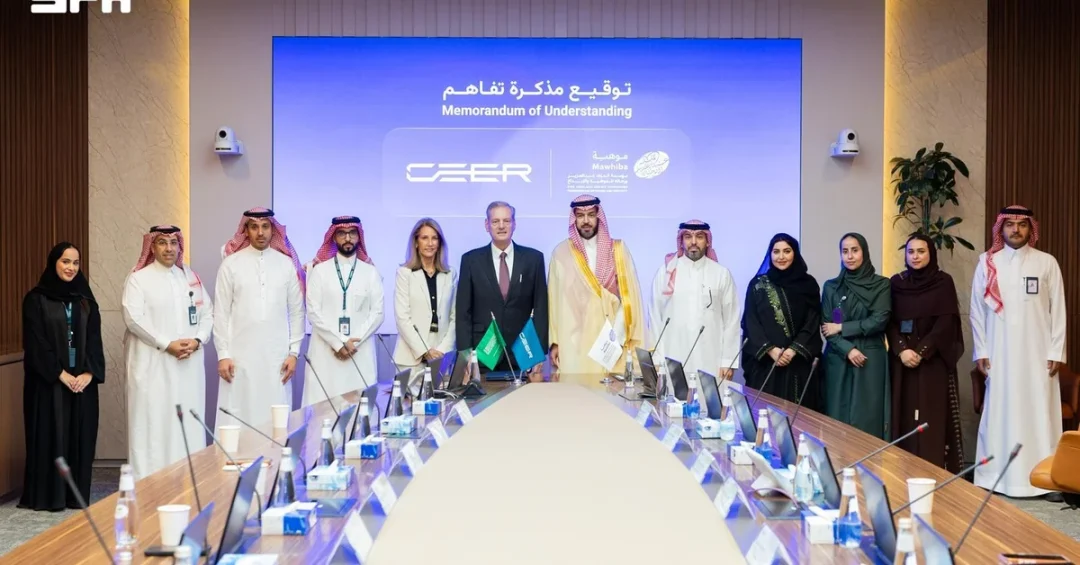
The King Abdulaziz and His Companions Foundation for Giftedness and Creativity (Mawhiba) and CEER National Automotive Company have signed a memorandum of understanding (MoU) in Riyadh to develop the abilities and skills of gifted students and to provide training and career exploration opportunities in fields related to the company’s business. The agreement, announced on November 11, 2026, brings together Saudi Arabia’s foremost talent-development foundation and the Kingdom’s first national electric vehicle brand, creating a structured pathway for young high achievers to move from the classroom into the country’s emerging automotive and technology industries.
The memorandum was signed on behalf of the two organizations by Abdulaziz bin Saleh Alkaridis, Secretary-General of Mawhiba, and James DeLuca, Chief Executive Officer of CEER. The partnership is designed to channel the energy and aptitude of the Kingdom’s brightest students into one of the most strategically important sectors of the national economy, while giving them hands-on exposure to the technologies shaping the future of mobility. Why does a single MoU between a giftedness foundation and an automotive manufacturer matter on the national stage? Because it represents a deliberate joining of two national priorities — human capital development and industrial diversification — into one coherent program.
Context and Background
The agreement did not emerge in isolation. It reflects a broader philosophy that has taken root across Saudi Arabia’s public and private institutions: that the Kingdom’s most valuable resource is not beneath the ground but in its classrooms. Mawhiba, whose full name is the King Abdulaziz and His Companions Foundation for Giftedness and Creativity, is a leading national foundation dedicated to identifying, nurturing, and empowering gifted students. It operates according to a national strategy to develop talent in priority scientific fields, helping to build a knowledge society, promote a culture of innovation, and support national development.
For its part, CEER is the first Saudi brand specializing in automobiles and original technology equipment. A joint venture between the Public Investment Fund and Foxconn, it designs, engineers, and manufactures vehicles in Saudi Arabia in accordance with international quality and safety standards. The pairing of these two entities is therefore more than a routine corporate-social initiative; it is a structural bridge connecting the country’s talent pipeline directly to an anchor industrial project. How often do gifted students in any country get to work alongside the engineers building their nation’s first homegrown vehicles? For Mawhiba’s students, that opportunity is now formalized.
The MoU also fits within a maturing ecosystem of private-sector partnerships that Mawhiba has been cultivating with increasing intent. The foundation has long recognized that nurturing talent cannot be the work of the education system alone. By bringing companies like CEER into the process, Mawhiba ensures that the skills its students develop are calibrated to real market needs, and that the transition from exceptional academic performance to meaningful professional contribution is supported at every stage.
Key Details of the Agreement
The scope of cooperation outlined in the memorandum is both practical and forward-looking. The two organizations will design and implement joint programs to nurture gifted students and develop their abilities and skills, while enabling Mawhiba students to participate in and benefit from CEER’s programs and activities. In concrete terms, CEER will allocate cooperative and summer training opportunities for Mawhiba alumni who are studying engineering, technical, and administrative disciplines at universities relevant to the company’s business.
Beyond work placements, the partners will develop and deliver an enrichment unit on smart vehicles and related technologies, designed to strengthen gifted students’ knowledge and practical skills. This curriculum component is significant: rather than waiting until students graduate, the partnership introduces them early to the concepts, vocabulary, and technical realities of modern vehicle design, software integration, and intelligent mobility systems. What better way to develop a generation of engineers than to let them encounter the most advanced technologies of their time while their curiosity is at its peak?
The memorandum reflects Mawhiba’s commitment to strengthening private-sector partnerships and expanding opportunities to nurture gifted students, helping them apply their abilities in promising technological and industrial fields. It also supports the development of national talent capable of advancing Saudi Vision 2030 objectives. The structure of the agreement — combining enrichment, mentorship, and hands-on training — suggests a long-term relationship rather than a one-off sponsorship, with each component reinforcing the others.
International and Regional Impact
While the agreement is national in its framing, its implications extend well beyond Saudi Arabia’s borders. The Kingdom is positioning itself as a hub for advanced manufacturing and technology in the Middle East, and the availability of a skilled, homegrown workforce is a precondition for that ambition. International investors and industrial partners watching the Saudi market will note that the country is not only building factories but also building the human capability to run them. Is there a clearer signal of long-term industrial seriousness than a nation investing in its own gifted students before the factories are even fully staffed?
For regional neighbors and emerging economies, the model carries a replicable lesson. Many countries struggle to connect elite educational programs to the demands of the private sector, resulting in talent flight or wasted potential. The Mawhiba–CEER framework — in which a foundation identifies and develops talent while an industrial partner provides training, mentorship, and career pathways — offers a template for how public institutions and private enterprises can co-own the future of a strategic industry. The approach may also strengthen Saudi Arabia’s standing in global conversations about workforce readiness and technical education.
The partnership further reinforces the Kingdom’s role as a convener of expertise. By integrating internationally recognized manufacturing standards — embodied in CEER’s joint venture with Foxconn — with locally cultivated talent, Saudi Arabia demonstrates a capacity to absorb global knowledge and localize it. That blend of international know-how and national capability is precisely the formula that has animated many of the Kingdom’s most successful modernization efforts.
Economic and Strategic Significance
The economic stakes behind this MoU are substantial. By 2034, CEER aims to create approximately 30,000 direct and indirect jobs, with Saudi nationals filling 80% of direct jobs. It also aims to contribute approximately SAR30 billion directly to Saudi Arabia’s GDP and improve the Kingdom’s trade balance by about SAR80 billion. These are ambitious targets that depend on a steady supply of qualified engineers, technicians, and administrators — exactly the cohort that Mawhiba is positioned to help produce. How can a national industry scale to tens of thousands of jobs without a deliberate strategy to develop the people who will fill them? This partnership is part of that strategy.
For gifted students, the agreement translates aspiration into tangible opportunity. Participation in CEER’s programs offers exposure to a company operating at the frontier of electric mobility, with the credibility of an international joint venture behind it. For CEER, the benefit is equally clear: early access to the country’s most capable young minds, cultivated to understand the company’s technologies and culture. The result is a mutually reinforcing cycle in which industrial growth fuels talent development and talent development sustains industrial growth. This is how a diversified, knowledge-based economy is built — not by chance, but by design.
The memorandum also contributes to the broader effort to improve the Kingdom’s trade balance through domestic manufacturing. Every vehicle engineered and built in Saudi Arabia with a local workforce reduces reliance on imported expertise and strengthens the resilience of the national economy. The talent pipeline supported by this agreement is therefore not a soft, ancillary benefit; it is a core input to the industrial strategy itself.
Vision 2030 Alignment
The MoU sits squarely within the architecture of Saudi Vision 2030, the national transformation program that seeks to diversify the economy, empower citizens, and build a knowledge society. By nurturing gifted students and connecting them to promising technological and industrial fields, the partnership advances the vision’s human-capability pillar, which holds that the Kingdom’s greatest asset is its people. It also supports the industrial diversification pillar by strengthening a new automotive sector that is central to the goal of broadening the economy beyond hydrocarbons. Can any country achieve lasting prosperity without investing in the minds of its next generation? Saudi Arabia’s answer, embodied in this agreement, is a resolute no.
Mawhiba’s national strategy to develop talent in priority scientific fields complements CEER’s industrial mission, creating a virtuous circle of identification, development, and application. The partnership demonstrates how Vision 2030 is being implemented not only through mega-projects and infrastructure but through the quieter, equally consequential work of education and mentorship. In the years ahead, the engineers and administrators who emerge from this collaboration will carry forward the Kingdom’s ambitions in mobility, manufacturing, and innovation — a testament to the enduring power of investing in young talent.
20 Questions
Q1. Which two organizations signed the memorandum of understanding?
A1. The King Abdulaziz and His Companions Foundation for Giftedness and Creativity (Mawhiba) and CEER National Automotive Company signed the memorandum of understanding in Riyadh on November 11, 2026.
Q2. Who signed the MoU on behalf of Mawhiba and CEER?
A2. Mawhiba Secretary-General Abdulaziz bin Saleh Alkaridis and CEER Chief Executive Officer James DeLuca signed the memorandum on behalf of their respective organizations during the announcement in Riyadh.
Q3. What is the main purpose of the MoU?
A3. The agreement aims to develop gifted students’ abilities and skills and provide them with training and career exploration opportunities in fields related to CEER’s automotive and technology business.
Q4. What kinds of joint programs will the two parties design?
A4. They will design and implement joint programs to nurture gifted students and develop their abilities and skills, while enabling Mawhiba students to participate in and benefit from CEER’s programs and activities.
Q5. What training opportunities will CEER provide to Mawhiba alumni?
A5. CEER will allocate cooperative and summer training opportunities for Mawhiba alumni studying engineering, technical, and administrative disciplines at universities relevant to the company’s business.
Q6. What is the enrichment unit that the two parties will develop?
A6. The two parties will develop and deliver an enrichment unit on smart vehicles and related technologies to strengthen gifted students’ knowledge and practical skills in modern mobility systems.
Q7. What does Mawhiba do as an organization?
A7. Mawhiba is a leading national foundation that identifies, nurtures, and empowers gifted students, following a national strategy to develop talent in priority scientific fields and support national development.
Q8. What is CEER and who owns it?
A8. CEER is the first Saudi brand specializing in automobiles and original technology equipment. It is a joint venture between the Public Investment Fund and Foxconn.
Q9. Where does CEER design and manufacture vehicles?
A9. CEER designs, engineers, and manufactures vehicles in Saudi Arabia in accordance with international quality and safety standards, reflecting its role as a national automotive brand.
Q10. How many jobs does CEER aim to create by 2034?
A10. By 2034, CEER aims to create approximately 30,000 direct and indirect jobs, with Saudi nationals filling 80 percent of the direct jobs within the company’s operations.
Q11. What is CEER’s expected contribution to Saudi GDP?
A11. CEER aims to contribute approximately SAR30 billion directly to Saudi Arabia’s GDP, supporting the Kingdom’s economic diversification objectives under Vision 2030.
Q12. How much does CEER aim to improve the trade balance?
A12. CEER aims to improve Saudi Arabia’s trade balance by about SAR80 billion, reflecting the economic value of domestic manufacturing and reduced reliance on imports.
Q13. How does the MoU reflect Mawhiba’s priorities?
A13. The memorandum reflects Mawhiba’s commitment to strengthening private-sector partnerships and expanding opportunities to nurture gifted students and help them apply their abilities in promising fields.
Q14. Which academic disciplines does the training target?
A14. The opportunities target Mawhiba alumni studying engineering, technical, and administrative disciplines at universities relevant to CEER’s business activities and industrial needs.
Q15. Why is the enrichment unit significant for students?
A15. The enrichment unit introduces students early to smart vehicle technologies, strengthening their knowledge and practical skills before they enter the workforce and pursue careers in the sector.
Q16. How does the agreement support Saudi Vision 2030?
A16. It advances Vision 2030 by developing national talent, supporting a knowledge society, promoting innovation, and strengthening a new industrial sector central to economic diversification.
Q17. What benefit does CEER gain from the partnership?
A17. CEER gains early access to the country’s most capable young minds, cultivated to understand its technologies and culture, helping build a skilled workforce for its operations.
Q18. What benefit do gifted students gain from the partnership?
A18. Gifted students gain hands-on training, career exploration, and exposure to a company operating at the frontier of electric mobility, with the credibility of an international joint venture.
Q19. What does Mawhiba’s national strategy focus on?
A19. Mawhiba’s national strategy focuses on developing talent in priority scientific fields, helping to build a knowledge society, promote a culture of innovation, and support national development.
Q20. How does the partnership embody the Kingdom’s long-term vision?
A20. It embodies the vision by investing in young talent and connecting it to strategic industries, demonstrating that Saudi Arabia’s path to prosperity is built on empowering its people.
Reader Feedback
We value your thoughts. Please share your feedback on this article.
Your feedback helps us improve our coverage.
Related articles
 Saudi Energy Reports 11.5% Revenue Growth, SAR12.1B Profit
 Manga Productions to Publish ‘STRANGER THAN HEAVEN’ in MENA
 stc Extends Riyadh Season Partnership for Sixth Year
 Aramco Q3 2026: $31.2B Income, $21.9B Dividend
 Saudi Ministry Recalls 3,680 Ford Vehicles Over Wiring Defect
 PIF and Aramco Close HUMAIN Deal to Boost Global AI Growth