


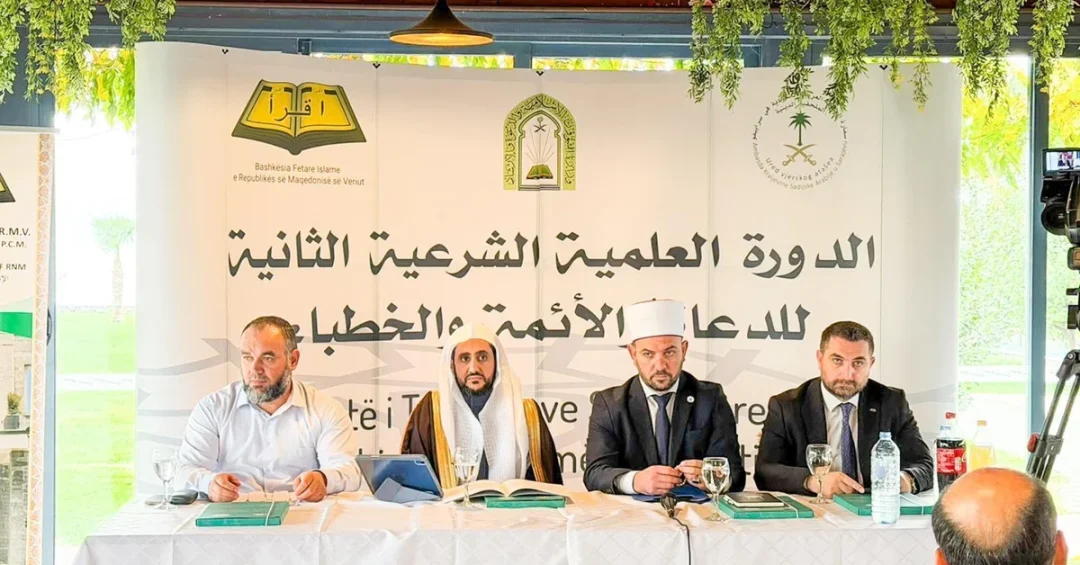
The Ministry of Islamic Affairs, Dawah and Guidance, in cooperation with the Islamic Religious Community of North Macedonia, has launched an academic course in the city of Struga, with the program continuing in Kičevo on its second day and concluding in Gostivar on its third day, the Saudi Press Agency reported. The three-city initiative brings structured religious instruction directly to imams and preachers in their own communities, reflecting a deliberate approach to outreach that meets beneficiaries where they serve. By convening sessions across Struga, Kičevo, and Gostivar, the ministry is extending a model of academic engagement that has become a hallmark of its work beyond the Kingdom’s borders. What does it mean for a religious institution to travel to the learner rather than waiting for the learner to travel to it?
The course forms part of the ministry’s broader commitment to expanding its academic programs and engaging with imams and preachers across different cities. Rather than concentrating activity in a single urban center, the ministry deliberately distributes its sessions across multiple locations, ensuring that religious leaders who serve smaller or more distant communities are not left out of professional and academic development. This decentralized design is intended to broaden participation and deepen the reach of the ministry’s outreach, and it signals a sustained institutional investment in the people who shape religious life at the local level.
Context and Background
Why does the location of a religious course matter as much as its content? The answer lies in the ministry’s philosophy of delivering academic and outreach programs directly to beneficiaries in their communities. North Macedonia is home to a historically significant Muslim population, and the Islamic Religious Community of North Macedonia serves as the country’s recognized institution for organizing religious affairs. Cooperation between the Saudi ministry and this community builds on a shared interest in fostering religious knowledge that is grounded in scholarship, moderation, and balance. The partnership is not a one-off event but part of a continuing relationship between Saudi religious institutions and their counterparts abroad.
The Ministry of Islamic Affairs, Dawah and Guidance has long carried out programs outside the Kingdom, and the North Macedonia course is consistent with that established practice. Its work abroad emphasizes training for imams and preachers, the dissemination of authentic religious knowledge, and the promotion of values that support social harmony. In this framework, the academic course is both an educational exercise and a diplomatic one: it strengthens ties with Islamic institutions in partner countries while presenting a clear model of moderate religious discourse. The choice of three cities across several days reflects careful planning to maximize accessibility and impact.
The timing and structure of the program also reflect lessons drawn from prior outreach efforts. Holding the sessions in Struga, Kičevo, and Gostivar allows the ministry to reach imams and preachers from different regions without asking them to abandon their congregations for extended periods. Each day’s session builds on the previous one, creating a coherent arc of instruction rather than a series of disconnected lectures. This design respects the time constraints of working religious leaders while maintaining the rigor expected of an academic course.
Key Details
What exactly does the course aim to accomplish? According to official information, the initiative aims to broaden participation, train imams and preachers, and strengthen their role in disseminating beneficial knowledge while promoting the values of tolerance, moderation, and balance. These objectives are interlocking: broader participation ensures that a wider pool of religious leaders benefits from instruction, training equips them with sharper tools for their work, and the emphasis on tolerance and moderation shapes the substance of what they pass on to their communities. The course thus operates on two levels, developing individual capacity and reinforcing a broader culture of balance.
The first day’s session in Struga set the pattern for the program, and the transition to Kičevo on the second day and Gostivar on the third preserved continuity while extending geographic reach. Each city brings a distinct local context, and the ministry’s decision to hold sessions in all three suggests an awareness that religious leaders in different areas face different circumstances. By the conclusion of the third day, participants across the three locations will have engaged with a common curriculum tailored to their shared responsibilities. This approach treats the three cities as a single program area rather than isolated events, which strengthens the sense of a unified effort.
The cooperation with the Islamic Religious Community of North Macedonia is central to the course’s execution. Working through the country’s recognized religious institution gives the program local legitimacy and ensures that logistical and community arrangements align with local expectations. The Saudi ministry’s role is to provide academic content and expertise, while its partner provides the institutional framework and access to the imams and preachers who stand to benefit. That division of labor is a practical model for international religious cooperation, and it positions the program as a joint endeavor rather than an externally imposed one.
International and Regional Impact
How does a course in three North Macedonian cities resonate beyond the Balkans? The program is part of the ministry’s ongoing efforts to implement academic and outreach programs outside the Kingdom of Saudi Arabia, promote a moderate and balanced approach, strengthen ties with Islamic institutions, and highlight Saudi Arabia’s role in serving Islam and Muslims and disseminating authentic religious knowledge worldwide. Each such program contributes incrementally to a wider network of relationships with religious institutions in different countries. Over time, these relationships build familiarity and trust that extend well beyond any single course.
For the region, the presence of a Saudi-led academic initiative signals a constructive engagement with local religious institutions. The message is one of partnership and shared purpose: the aim is to support imams and preachers in their own settings, not to replace local structures. This framing matters in a part of the world where religious institutions have their own histories and identities. By working with the Islamic Religious Community of North Macedonia, the ministry demonstrates a model of cooperation that respects local institutions while offering scholarly resources and training. That combination can strengthen regional religious life and reinforce the values of tolerance and moderation that the course explicitly promotes.
The program also has a symbolic dimension. It exemplifies Saudi Arabia’s commitment to serving Islam and Muslims globally, expressed through education and institutional partnership rather than rhetoric alone. In this sense, the course is a concrete illustration of the Kingdom’s religious diplomacy, which emphasizes scholarship, training, and the promotion of balance. Observers of Saudi religious outreach will recognize the three-city course as part of a recognizable pattern of engagement that spans continents.
Economic and Strategic Significance
What strategic value lies in training imams far from the Kingdom’s borders? Religious outreach is a long-horizon investment, and its returns are measured in strengthened institutions, deepened relationships, and a more consistent articulation of moderate religious values across communities. For Saudi Arabia, programs like this one support a broader strategic objective of contributing to stability and understanding in Muslim communities worldwide. The ministry’s academic courses are designed to build capacity among religious leaders, who in turn influence the outlook of their congregations. That multiplier effect is what gives such programs their strategic weight.
The economic dimension is indirect but real. Stable, well-supported religious institutions contribute to social cohesion, which is a foundation for the kind of predictable environment in which trade, investment, and cultural exchange can flourish. Strong ties with the Islamic Religious Community of North Macedonia and other partner institutions create channels for cooperation that extend beyond the religious sphere. In addition, the ministry’s programs help shape perceptions of Saudi Arabia as a source of scholarship and moderation, which supports the Kingdom’s broader international standing. The course is small in scale, but it participates in a much larger strategic effort.
There is also an institutional learning dimension. Each international program gives the ministry experience in adapting its academic content to different contexts and audiences. Lessons from the North Macedonia course can inform future programs in other countries, refining how the ministry trains imams and preachers abroad. That iterative improvement is itself a strategic asset, allowing the Kingdom’s religious outreach to become more effective over time. What begins as a three-day course in three cities can become a template for future engagement.
Vision 2030 Alignment
How does a religious course in North Macedonia connect to Saudi Arabia’s long-term national vision? Vision 2030 articulates a Kingdom that is open, engaged with the world, and committed to the values of moderation and tolerance. The Ministry of Islamic Affairs, Dawah and Guidance’s international academic programs give practical expression to that vision by carrying the Kingdom’s model of balanced religious discourse to communities beyond its borders. The course in Struga, Kičevo, and Gostivar is thus not an isolated event but a component of a wider national effort to project a positive, scholarly, and moderate image abroad.
The program also reflects the Vision 2030 emphasis on building strong international partnerships and on institutional excellence. By cooperating with the Islamic Religious Community of North Macedonia, the ministry demonstrates a collaborative approach that shares responsibility with local partners and respects their role. The investment in training imams and preachers supports the development of capable religious leadership, which serves communities and contributes to social harmony. As Saudi Arabia continues to deepen its global engagement, initiatives of this kind will remain an important channel for promoting understanding, strengthening ties with Islamic institutions, and highlighting the Kingdom’s enduring role in serving Islam and Muslims around the world.
20 Questions
Q1. Which Saudi ministry launched the academic course in North Macedonia?
A1. The course was launched by the Ministry of Islamic Affairs, Dawah and Guidance, according to the Saudi Press Agency. The ministry organized the program in cooperation with the Islamic Religious Community of North Macedonia.
Q2. In which three cities is the course being held?
A2. The course began in Struga, continued in Kičevo on its second day, and concluded in Gostivar on its third day. Holding sessions across three locations is part of the ministry’s strategy to reach beneficiaries in their communities.
Q3. With which institution did the ministry cooperate?
A3. The ministry cooperated with the Islamic Religious Community of North Macedonia. Working through the country’s recognized religious institution provides local legitimacy and helps arrange community and logistical matters for the program.
Q4. What is the primary aim of the course?
A4. The initiative aims to broaden participation, train imams and preachers, and strengthen their role in disseminating beneficial knowledge. It also promotes the values of tolerance, moderation, and balance among religious leaders and their communities.
Q5. Why are the sessions spread across three locations?
A5. Distributing the sessions across Struga, Kičevo, and Gostivar is part of the ministry’s strategy to deliver academic and outreach programs directly to beneficiaries in their own communities, broadening participation and improving accessibility.
Q6. Who stands to benefit from the program?
A6. Imams and preachers in North Macedonia are the direct beneficiaries. The training is designed to develop their capacity and strengthen their role in their communities, extending the program’s impact to the congregations they serve.
Q7. How does the course promote moderation?
A7. The course emphasizes tolerance, moderation, and balance in its instruction. These values shape the content that imams and preachers receive and, in turn, the guidance they offer to their communities.
Q8. Does the ministry run similar programs elsewhere?
A8. Yes. The course is part of the ministry’s ongoing efforts to implement academic and outreach programs outside the Kingdom of Saudi Arabia, strengthening ties with Islamic institutions and disseminating authentic religious knowledge worldwide.
Q9. What broader role does the program highlight for Saudi Arabia?
A9. The program highlights Saudi Arabia’s role in serving Islam and Muslims and in disseminating authentic religious knowledge globally. It presents the Kingdom as a source of scholarship, training, and moderate religious discourse.
Q10. How long does the course run?
A10. The course runs across three days, with one day of sessions in each of the three cities. It began in Struga, continued in Kičevo, and concluded in Gostivar, forming a single coherent program.
Q11. What does the ministry hope to achieve through training?
A11. The ministry aims to strengthen the role of imams and preachers in disseminating beneficial knowledge. Training equips them with sharper tools to serve their communities while promoting values of tolerance, moderation, and balance.
Q12. Why is cooperation with local institutions important?
A12. Cooperation with the Islamic Religious Community of North Macedonia gives the program local legitimacy and ensures that arrangements align with local expectations. It frames the course as a joint endeavor rather than an externally imposed effort.
Q13. What values does the course explicitly promote?
A13. The course explicitly promotes tolerance, moderation, and balance. These values are central to the ministry’s approach to religious outreach and are embedded in the academic content delivered to participants.
Q14. Is the course a one-off event or part of a pattern?
A14. It is part of a pattern. The ministry regularly implements academic and outreach programs outside the Kingdom, and the North Macedonia course is consistent with its established practice of international religious engagement.
Q15. What is the significance of holding sessions on consecutive days?
A15. Consecutive days allow each session to build on the previous one, creating a coherent arc of instruction rather than disconnected lectures. This respects participants’ time while maintaining the rigor of an academic course.
Q16. How does the program reflect Saudi Arabia’s international engagement?
A16. The program reflects the Kingdom’s commitment to constructive engagement with religious institutions abroad. It demonstrates a collaborative approach that shares responsibility with local partners and respects their role in their own communities.
Q17. What kind of knowledge is the course intended to disseminate?
A17. The course is intended to disseminate authentic religious knowledge grounded in scholarship. It emphasizes a moderate and balanced approach consistent with the ministry’s broader educational mission.
Q18. How does the program treat the three cities as a unit?
A18. The ministry treats Struga, Kičevo, and Gostivar as a single program area rather than isolated events. This unified approach strengthens the sense of a coherent effort spanning multiple communities.
Q19. What role does the Saudi Press Agency play in reporting the course?
A19. The Saudi Press Agency reported on the launch and schedule of the course. Its coverage provides official information about the program’s locations, objectives, and institutional partnerships.
Q20. How does the course connect to Saudi Arabia’s long-term vision?
A20. The course aligns with Vision 2030’s emphasis on moderation, tolerance, and international partnership. It gives practical expression to the Kingdom’s effort to project a positive, scholarly image abroad and to serve Islam and Muslims globally.
Reader Feedback
We value your thoughts. Please share your feedback on this article.
Your feedback helps us improve our coverage.
Related articles
 Hajj Workshops Close with Focus on AI and Pilgrim Experience
 Hajj Workshops Focus on Prevention and Service Efficiency
 Interior Ministry Wins HCE Excellence Award at Hajj Expo 2026
 Saudi Crown Prince Offers Condolences to Niger’s President
 King Salman Offers Condolences to Niger’s President on Father’s Death
 Arab League Warns Against Erasure of Jerusalem’s Identity