


Saudi Arabia’s unified electronic Public Consultation Platform, Istitlaa, has opened 65 economic and development projects to public feedback in cooperation with 33 government entities, giving citizens, residents, and businesses a direct voice in shaping the Kingdom’s regulatory future before approval. The initiative, overseen by the Saudi Competitiveness and Business Center (SCBC), represents one of the most extensive rounds of public consultation the Kingdom has conducted, spanning draft laws, regulatory amendments, and procedural reforms across a wide range of sectors. Have you ever wondered how a modern state can invite its people into the legislative process itself? The Istitlaa platform answers that question by turning transparency into a working mechanism rather than a slogan.
Under the model, draft laws, regulations, and similar instruments are published on the platform before they are finalized, allowing stakeholders to submit observations, proposals, and objections that authorities can incorporate into the final text. The current batch of 65 projects reflects the breadth of the Kingdom’s reform agenda, touching everything from cultural heritage protection to telecommunications law and the enforcement of judicial rulings. The dates set for feedback—running through early December 2026—underscore a deliberate, time-bound approach that gives the public a genuine window to participate, not a token gesture. This is participatory governance in practice, and it is central to how Saudi Arabia is building a competitive, predictable business environment.
Context and Background
Why does a country with one of the fastest-growing economies in the world devote such energy to soliciting public comment on draft regulations? The answer lies in the Kingdom’s broader drive to modernize its legal and regulatory infrastructure as a foundation for Vision 2030. The Saudi Competitiveness and Business Center, the entity behind Istitlaa, was established to improve the Kingdom’s standing in global competitiveness indicators and to streamline the relationship between the state and the private sector. The platform is a practical expression of that mandate: by publishing drafts and inviting structured feedback, the SCBC creates a feedback loop between regulators and the people and companies those regulations will affect.
The Istitlaa platform is not a novelty but an evolving institution. It centralizes consultation across dozens of government entities, replacing fragmented, entity-by-entity outreach with a single, accessible digital hub. This matters because regulatory quality depends on the quality of the information regulators receive. When businesses, legal experts, academics, and everyday citizens can review a draft law and flag ambiguities, inconsistencies, or unintended consequences, the resulting final text is more robust and less likely to require disruptive amendments later. Over time, this process builds a reputation for predictability, which is precisely what international investors and domestic entrepreneurs weigh when deciding where to commit capital.
The current round also illustrates how consultation has matured. The 65 projects come from 33 government entities, spanning ministries, judicial bodies, and regulatory agencies. That cross-government coordination signals that public consultation is no longer an isolated experiment in one or two departments but a system-wide expectation. For an international audience watching Saudi Arabia’s reform trajectory, this institutional breadth is as important as any single piece of legislation.
Key Details
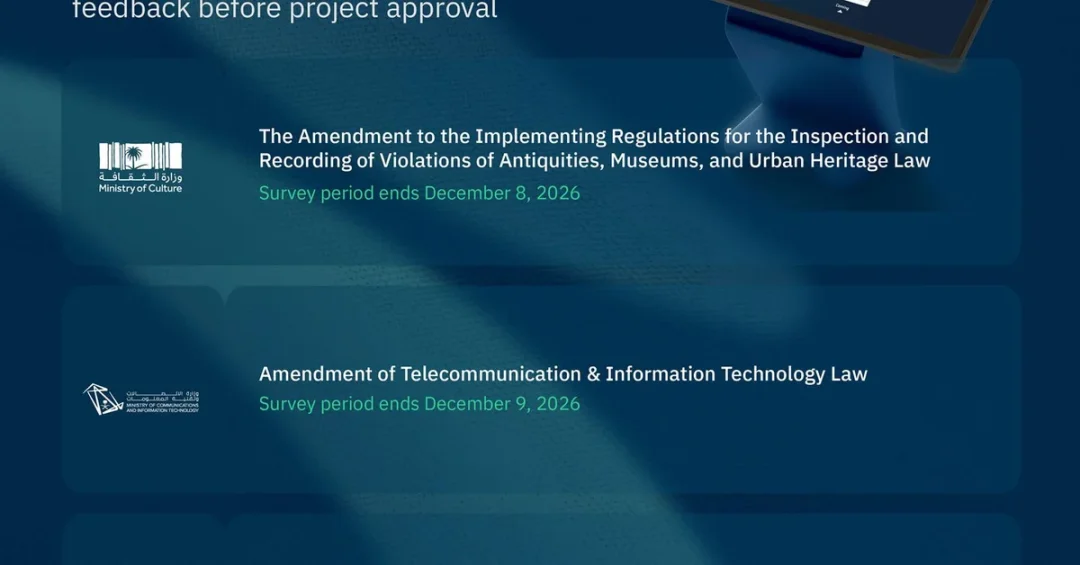
The specific projects on the platform reveal the practical priorities of the Kingdom’s legislative agenda. The Ministry of Culture has put forward a project titled “The Amendment to the Implementing Regulations for the Inspection and Recording of Violations of the Antiquities, Museums, and Urban Heritage Law.” The amendment aims to implement the provisions of Royal Order dated 05/05/1444 AH and Royal Order dated 09/04/1446 AH, which concern the establishment of independent committees to review and decide on objections and grievances relating to the imposition of fines and penalties for violations. Public feedback on this project remains open until December 8, 2026. The measure reflects the Kingdom’s growing emphasis on safeguarding its cultural and archaeological heritage while ensuring that enforcement is fair and subject to independent review.
The Ministry of Communications and Information Technology has submitted a project titled “Amendment of Telecommunication and Information Technology Law.” This initiative seeks to review and amend the law, update its provisions and regulatory requirements to address existing challenges, ensure user protection, and improve operational efficiency and governance. Feedback on this project is open until December 9, 2026. In a country racing to build a digital economy, a modern telecommunications and IT framework is essential—it underpins everything from cloud services and data governance to the protection of consumers in an increasingly connected society. The Board of Grievances has also put forward “Amendment to the Enforcement Law Before the Board of Grievances,” which aims to align the law’s provisions with legislative amendments issued under Royal Decree dated 11/03/1447 AH and to repeal provisions specifically addressed in the Enforcement Law that were previously covered by the reference set out in Article 18. Public feedback on this project remains open until December 9, 2026.
These three examples, drawn from culture, technology, and the judiciary, demonstrate the range of the consultation round. But they are only a fraction of the 65 projects. Together they show a government intent on refining not just headline economic laws but the procedural machinery that determines how rules are enforced, how disputes are resolved, and how heritage and digital rights are protected. Each project carries its own deadline, and each invites a distinct community of stakeholders—from museum professionals and archaeologists to telecom operators and litigants—to contribute expertise that regulators may not possess in-house.
International and Regional Impact
How does a domestic consultation exercise resonate beyond Saudi borders? For international businesses, the Istitlaa platform offers an unusual degree of visibility into the Kingdom’s regulatory pipeline. Companies considering investment in Saudi Arabia often cite regulatory uncertainty as a key concern, and a system that publishes draft rules in advance and accepts structured feedback directly addresses that concern. Foreign investors, legal advisors, and trade associations can monitor upcoming changes, prepare comments, and plan their operations with greater confidence. In a region where regulatory transparency varies widely, this is a meaningful differentiator that strengthens the Kingdom’s position as a predictable destination for capital and expertise.
Regionally, the model positions Saudi Arabia as a standard-setter in governance innovation. Other economies in the Middle East and beyond are watching how the Kingdom balances the speed of reform with the need for legitimacy and buy-in. By institutionalizing consultation through a single digital platform, Saudi Arabia demonstrates that rapid modernization and public participation can reinforce each other rather than conflict. The approach also aligns with international expectations around good regulatory practice, which increasingly emphasize stakeholder engagement, impact assessment, and accessible rulemaking. For multilateral partners and rating agencies, such mechanisms are tangible evidence of institutional quality.
Economic and Strategic Significance
Why does public consultation carry economic weight, not just political symbolism? High-quality regulation is a form of economic infrastructure. Poorly designed rules raise compliance costs, deter entry, and slow down transactions, while well-designed rules lower uncertainty and encourage investment. By inviting businesses and citizens to identify problems in draft regulations before they take effect, the Istitlaa platform helps reduce the risk of costly post-hoc corrections. This directly supports the Kingdom’s competitiveness agenda, which seeks to improve Saudi Arabia’s ranking in global ease-of-doing-business and regulatory-quality indices. Each consultation round is, in effect, a quality-control step in the production of the legal environment.
The strategic significance extends to the private sector’s role in national development. Vision 2030 envisions a thriving private sector driving job creation and diversification away from oil. That vision depends on a regulatory environment that businesses trust and understand. Consultation gives entrepreneurs, small and medium enterprises, and large investors a channel to shape the rules that govern them, fostering a sense of partnership between the state and the market. When stakeholders see their feedback reflected in final legislation, trust grows, and trust is the invisible asset that underpins every successful investment climate. The 65 projects now open for comment are therefore more than administrative items; they are building blocks of a competitive, transparent, and business-friendly Kingdom.
Vision 2030 Alignment
The introduction of draft laws, regulations, and similar projects through the Istitlaa platform reflects the Kingdom’s continued commitment to enhancing transparency in the legislative environment, promoting a culture of public consultation among the general public, government entities, and the private sector, and engaging them in shaping projects related to the business environment. This commitment sits at the heart of Vision 2030’s governance objectives, which call for a more open, accountable, and efficient state. Transparency is not merely a value to be declared; it is a practice to be institutionalized, and Istitlaa does exactly that by embedding consultation into the routine work of government.
As Saudi Arabia continues its transformation, mechanisms like the Istitlaa platform will increasingly define how the Kingdom governs. By inviting the public and the private sector to help shape the laws that will guide the next phase of national development, Saudi Arabia is demonstrating that its modernization is participatory, deliberate, and built to last. The 65 projects open for feedback today are a snapshot of a state in motion—confident enough to seek input, disciplined enough to act on it, and forward-looking enough to recognize that the best regulations are those shaped with the people they serve. For international observers, that is a signal worth watching, and for the Kingdom, it is another concrete step toward the Vision 2030 future it has set for itself.
20 Questions
Q1. What is the Istitlaa platform?
A1. Istitlaa is the unified electronic Public Consultation Platform operated by the Saudi Competitiveness and Business Center, allowing stakeholders to review and comment on draft laws and regulations before approval.
Q2. How many projects are currently open for feedback?
A2. A total of 65 projects related to economic and development affairs are open for public feedback through the Istitlaa platform.
Q3. How many government entities are involved in this consultation round?
A3. The 65 projects were put forward in cooperation with 33 different government entities, spanning ministries, judicial bodies, and regulatory agencies.
Q4. What is the purpose of the platform?
A4. The platform enables stakeholders to share feedback and proposals on draft projects before their final approval, enhancing transparency and public participation in shaping the business environment.
Q5. Which Ministry submitted the antiquities amendment project?
A5. The Ministry of Culture submitted the project titled “The Amendment to the Implementing Regulations for the Inspection and Recording of Violations of the Antiquities, Museums, and Urban Heritage Law.”
Q6. What does the Ministry of Culture project aim to achieve?
A6. It aims to implement two Royal Orders concerning the establishment of independent committees to review and decide on objections and grievances relating to fines and penalties for violations.
Q7. When does feedback close on the Ministry of Culture project?
A7. Public feedback on the antiquities amendment project remains open until December 8, 2026.
Q8. Which Ministry submitted the telecommunications law amendment?
A8. The Ministry of Communications and Information Technology submitted the project titled “Amendment of Telecommunication and Information Technology Law.”
Q9. What are the goals of the telecom law amendment?
A9. The amendment aims to update provisions and regulatory requirements, address existing challenges, ensure user protection, and improve operational efficiency and governance.
Q10. When does feedback close on the telecom project?
A10. Public feedback on the telecommunications and information technology law amendment is open until December 9, 2026.
Q11. Which judicial body submitted the enforcement law amendment?
A11. The Board of Grievances submitted the project titled “Amendment to the Enforcement Law Before the Board of Grievances.”
Q12. What does the Board of Grievances amendment seek to do?
A12. It aligns the law’s provisions with legislative amendments issued under Royal Decree dated 11/03/1447 AH and repeals provisions previously covered by Article 18 of the law.
Q13. When does feedback close on the enforcement law project?
A13. Public feedback on the Board of Grievances enforcement law amendment is open until December 9, 2026.
Q14. Who can submit feedback through Istitlaa?
A14. Stakeholders including the general public, government entities, and the private sector can share their feedback and proposals on projects published on the platform.
Q15. What does the consultation process reflect about the Kingdom?
A15. It reflects Saudi Arabia’s continued commitment to enhancing transparency in the legislative environment and promoting a culture of public consultation.
Q16. Why is public consultation important for businesses?
A16. It provides visibility into upcoming regulations, reduces regulatory uncertainty, and allows businesses to flag ambiguities or unintended consequences before rules take effect.
Q17. How does Istitlaa support Vision 2030?
A17. It advances Vision 2030’s governance objectives by institutionalizing transparency, accountability, and engagement with the public and private sectors in shaping regulations.
Q18. What is the role of the Saudi Competitiveness and Business Center?
A18. The Center oversees the Istitlaa platform and works to improve the Kingdom’s competitiveness and streamline the relationship between the state and the private sector.
Q19. Does the platform centralize consultation across government?
A19. Yes, Istitlaa centralizes consultation across dozens of government entities, replacing fragmented outreach with a single accessible digital hub for public feedback.
Q20. What signal does this send to international investors?
A20. It signals regulatory transparency and predictability, addressing a key investor concern and strengthening the Kingdom’s position as a reliable destination for capital and expertise.
Reader Feedback
We value your thoughts. Please share your feedback on this article.
Your feedback helps us improve our coverage.
Related articles
 FII Institute Announces New Dates for FII10: October 25–28, 2027
 Asharqia Chamber Concludes Electronic Application Exhibition 2026
 Saudi-Hosted IDC and FAO Talks Expand Global Date Cooperation
 Saudi Arabia Launches 3,200 MW Renewable Energy Tender
 Organic Farming in Najran Preserves Heritage, Food Security
 Al-Kharj Industrial City Hits 91% Occupancy with 612 Factories