


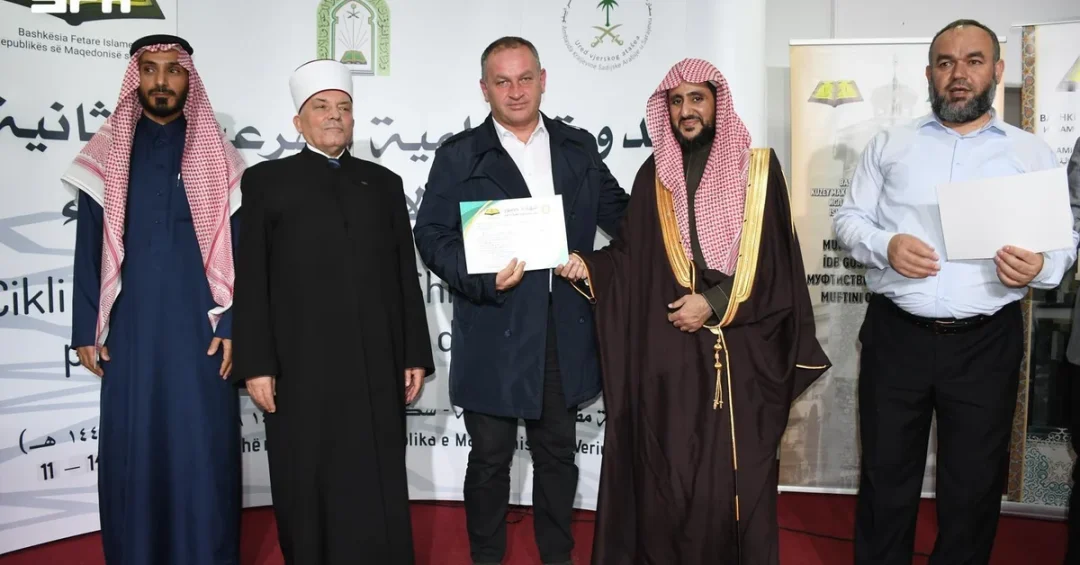
The Ministry of Islamic Affairs, Dawah and Guidance, in cooperation with the Islamic Religious Community of North Macedonia, concluded a three-city Islamic studies training course in Gostivar on Friday, November 13, 2026, drawing more than 150 imams and preachers. The program, which began on Wednesday in Struga and continued on Thursday in Kičevo, marked the third and final stop of a tour designed to strengthen the knowledge and practical skills of religious personnel serving Muslim communities across North Macedonia. The closing ceremony in Gostivar brought together senior religious leaders, Saudi diplomatic representatives, and local officials, underscoring the Kingdom’s ongoing commitment to supporting Islamic education and moderate religious discourse worldwide.
The course is part of a broader series of international training initiatives undertaken by the Ministry of Islamic Affairs, Dawah and Guidance, which operates under the directives of the Saudi leadership to promote tolerance, counter extremism, and provide imams and preachers with the tools they need to address contemporary challenges. By partnering with the Islamic Religious Community of North Macedonia, the Ministry is reinforcing the bonds of Islamic fraternity and helping to ensure that religious leaders are well-equipped to guide their communities in line with the principles of moderation and coexistence. The participation of more than 150 attendees across the three locations highlights the strong demand for such programs and the deep appreciation for Saudi Arabia’s role in serving Islam and Muslims.
Context and Background
Why has the Ministry of Islamic Affairs, Dawah and Guidance chosen the Balkans as a focal point for its recent training efforts? The region is home to historically significant Muslim communities that have preserved their faith through centuries of change, and Saudi Arabia has long maintained strong ties with these communities. North Macedonia, with its rich Islamic heritage and active religious institutions, represents a natural partner for the Kingdom’s outreach. The Islamic Religious Community of North Macedonia, led by Grand Mufti Sheikh Shaqir Fetahu, has been a steadfast collaborator in initiatives that promote moderate Islam and protect young believers from extremist influences. This course, therefore, is not an isolated event but a continuation of a strategic partnership that dates back years.
The training program’s structure reflects a thoughtful approach to religious education. By holding sessions in Struga, Kičevo, and Gostivar, the organizers ensured that imams and preachers from different parts of the country could participate without the burden of long-distance travel. Each day featured lectures on the fundamental principles of Islamic creed, the approach of Ahl Al-Sunnah wa Al-Jama’ah, and the role of imams and preachers in disseminating Islamic knowledge, promoting tolerance and moderation, and preventing extremism. These topics are central to the Ministry’s global mission, which seeks to present Islam as a religion of peace, mercy, and coexistence. The selection of these themes also responds to the specific needs of the North Macedonian context, where religious leaders often serve as key community figures who can shape public opinion and foster social harmony.
Furthermore, the course’s timing is significant. As the world becomes increasingly interconnected, the challenges facing Muslim communities—from misinterpretation of religious texts to the spread of radical ideologies—require well-trained, knowledgeable leaders who can provide accurate guidance. Saudi Arabia, through its Ministry of Islamic Affairs, Dawah and Guidance, has taken a leading role in addressing these challenges by offering capacity-building programs that emphasize the authentic teachings of Islam. This initiative in North Macedonia is one of many similar programs held in various countries, all aimed at empowering local religious personnel and strengthening the global network of moderate Islamic scholarship.
Key Details of the Training Course
The three-day course commenced on Wednesday in the lakeside city of Struga, continued on Thursday in Kičevo, and concluded on Friday in Gostivar. Each location hosted a full day of lectures and interactive sessions, with the final day in Gostivar focusing on the fundamental principles of Islamic creed and the teachings of Sunni Islam. The lectures were delivered by scholars and experts affiliated with the Ministry of Islamic Affairs, Dawah and Guidance, who brought both deep theological knowledge and practical experience to the sessions. Topics included the core tenets of the Islamic faith, the methodology of Ahl Al-Sunnah wa Al-Jama’ah, and the critical role of imams and preachers in disseminating Islamic knowledge, promoting tolerance and moderation, and preventing extremism.
The closing ceremony in Gostivar was attended by Sheikh Shaqir Fetahu, Head of the Islamic Religious Community and Grand Mufti of North Macedonia, and Jalawi Al-Mutairi, representative of the Saudi Embassy in Albania, along with several other officials and Islamic figures. In his remarks, Sheikh Fetahu praised the efforts of Saudi Arabia and its leadership in serving Islam and Muslims and strengthening their unity. He emphasized the importance of specialized courses in preparing religious personnel to fulfill their role in raising public awareness. His words reflected the deep appreciation that North Macedonia’s Islamic leadership holds for the Kingdom’s consistent support and its commitment to moderate religious education.
The participation of more than 150 imams and preachers across the three cities demonstrates the program’s wide reach and its effectiveness in engaging grassroots religious leaders. These attendees will return to their communities with enhanced knowledge and a renewed sense of mission, better prepared to address the spiritual and social needs of their congregations. The Ministry’s choice to collaborate with the local Islamic Religious Community ensured that the content was culturally and contextually appropriate, making the training both relevant and impactful. This model of partnership—combining Saudi expertise with local knowledge—has proven successful in other countries and continues to be a hallmark of the Kingdom’s international religious outreach.
International and Regional Impact
What does this training course signal about Saudi Arabia’s role in the global Muslim community? It underscores the Kingdom’s unwavering commitment to serving Islam and Muslims, not only within its borders but also across continents. By investing in the education of imams and preachers in North Macedonia, Saudi Arabia is helping to build a network of religious leaders who can promote peace, tolerance, and mutual understanding. This effort aligns with the Kingdom’s broader foreign policy objectives, which emphasize dialogue, cooperation, and the rejection of extremism. The positive reception from North Macedonian officials and religious leaders further strengthens Saudi Arabia’s image as a reliable partner in religious and cultural affairs.
On a regional level, the Balkans have historically been a crossroads of civilizations, and the Muslim communities there have played a vital role in preserving Islamic heritage in Europe. By supporting these communities, Saudi Arabia contributes to the stability and prosperity of the region. The course also serves as a counter-narrative to extremist ideologies that sometimes seek to exploit religious sentiments. Well-trained imams are the first line of defense against radicalization, and the Ministry’s programs provide them with the necessary tools to guide their communities away from violence and towards moderation. The success of this course in North Macedonia is likely to encourage similar initiatives in neighboring countries, further expanding the Kingdom’s positive influence.
Economic and Strategic Significance
While the training course is primarily a religious and educational initiative, its strategic significance should not be underestimated. Saudi Arabia’s Vision 2030 aims to diversify the economy and enhance the Kingdom’s global standing, and soft power tools such as religious diplomacy play a crucial role in achieving these goals. By fostering goodwill and building strong relationships with Muslim communities worldwide, Saudi Arabia creates an environment conducive to economic and cultural exchange. The participants in this course, many of whom are influential community leaders, will carry positive impressions of the Kingdom back to their congregations, thereby enhancing Saudi Arabia’s reputation as a leader in the Islamic world.
Moreover, the Ministry’s efforts are part of a broader strategy to promote moderate Islam and counter extremism, which is essential for global security and stability. Extremist groups often thrive in environments where religious knowledge is limited or distorted. By providing imams and preachers with sound theological training, Saudi Arabia helps to inoculate communities against radical ideologies. This, in turn, contributes to safer societies and more stable regions, which are prerequisites for economic development and investment. The Kingdom’s commitment to this cause is evident in the scale and frequency of its international training programs, and the North Macedonia course is a testament to its effectiveness.
Vision 2030 Alignment
How does this training course align with Saudi Arabia’s Vision 2030 and its objectives? Vision 2030 is not only about economic transformation; it also emphasizes the Kingdom’s role as a global leader in promoting moderate Islam and supporting Muslim communities. The Ministry of Islamic Affairs, Dawah and Guidance is at the forefront of this effort, implementing programs that reflect the vision’s core values of tolerance, moderation, and international cooperation. By training imams and preachers in North Macedonia, the Ministry is helping to build a more peaceful and interconnected world, which is in line with the Vision’s goal of enhancing Saudi Arabia’s soft power and global influence.
Furthermore, the course exemplifies the Vision’s emphasis on human capital development. The imams and preachers who participated are now better equipped to serve their communities, which will have a ripple effect on education, social cohesion, and youth engagement. Saudi Arabia’s investment in these leaders is an investment in the future of Islam and in the stability of the regions where they serve. As the Kingdom continues to implement Vision 2030, such initiatives will remain a cornerstone of its international engagement, showcasing the best of Saudi Arabia’s values and its dedication to the well-being of Muslims everywhere.
20 Questions
Q1. What was the purpose of the Islamic studies training course in North Macedonia?
A1. The course aimed to enhance the knowledge and skills of imams and preachers in North Macedonia, focusing on Islamic creed, moderation, and preventing extremism, in line with Saudi Arabia’s efforts to promote tolerant Islam.
Q2. Which Saudi ministry organized the training course?
A2. The Ministry of Islamic Affairs, Dawah and Guidance organized the course in cooperation with the Islamic Religious Community of North Macedonia.
Q3. How many participants attended the training course?
A3. More than 150 imams and preachers participated in the course across its three locations in North Macedonia.
Q4. In which cities did the training course take place?
A4. The course was held in three cities: Struga, Kičevo, and Gostivar, with the final day in Gostivar.
Q5. Who attended the closing ceremony in Gostivar?
A5. The closing ceremony was attended by Sheikh Shaqir Fetahu, Grand Mufti of North Macedonia, Jalawi Al-Mutairi from the Saudi Embassy in Albania, and other officials and Islamic figures.
Q6. What topics were covered in the lectures?
A6. Lectures covered the fundamental principles of Islamic creed, the approach of Ahl Al-Sunnah wa Al-Jama’ah, and the role of imams in promoting tolerance and preventing extremism.
Q7. What did Sheikh Shaqir Fetahu say about Saudi Arabia’s efforts?
A7. He praised Saudi Arabia and its leadership for serving Islam and Muslims and strengthening their unity, and emphasized the importance of specialized courses for religious personnel.
Q8. How does this course fit into Saudi Arabia’s Vision 2030?
A8. It aligns with Vision 2030 by promoting moderate Islam, enhancing Saudi soft power, and supporting human capital development in Muslim communities worldwide.
Q9. Why did the Ministry choose North Macedonia for this course?
A9. North Macedonia has a significant Muslim community and strong ties with Saudi Arabia, making it a key partner for promoting moderate Islam and religious education in the Balkans.
Q10. What is the role of the Islamic Religious Community of North Macedonia?
A10. It is the official body representing Muslims in North Macedonia and collaborated with the Saudi Ministry to organize and host the training course.
Q11. How many days did the training course last?
A11. The course lasted three days, starting on Wednesday in Struga, moving to Kičevo on Thursday, and concluding in Gostivar on Friday.
Q12. What is the significance of the course being held in multiple cities?
A12. Holding the course in multiple cities allowed imams and preachers from different regions to participate easily, ensuring broad outreach and impact.
Q13. What is the Ministry of Islamic Affairs, Dawah and Guidance’s broader mission?
A13. Its mission includes promoting moderate Islam, countering extremism, and supporting Muslim communities globally through education and training programs.
Q14. How does this course help prevent extremism?
A14. By providing imams with sound theological knowledge and emphasizing tolerance, the course equips them to counter radical narratives and guide their communities towards moderation.
Q15. What was the feedback from North Macedonian officials?
A15. Officials expressed deep appreciation for Saudi Arabia’s support and the course’s role in preparing religious personnel to raise public awareness and promote unity.
Q16. Will there be follow-up programs in North Macedonia?
A16. While no specific follow-up has been announced, the Ministry regularly conducts such courses in various countries, and further cooperation is likely based on the success of this program.
Q17. How does this initiative reflect Saudi Arabia’s foreign policy?
A17. It reflects Saudi Arabia’s commitment to religious diplomacy, international cooperation, and the promotion of peace and moderation, which are key pillars of its foreign policy.
Q18. What impact will the training have on local communities?
A18. The trained imams will return to their communities better equipped to provide accurate religious guidance, foster social harmony, and protect youth from extremist influences.
Q19. Who delivered the lectures at the course?
A19. Scholars and experts from the Ministry of Islamic Affairs, Dawah and Guidance delivered the lectures, bringing deep theological knowledge and practical experience.
Q20. How does this course strengthen Saudi-North Macedonia relations?
A20. It enhances bilateral ties by fostering goodwill, demonstrating Saudi Arabia’s support for Muslim communities, and building lasting partnerships based on shared values of moderation and tolerance.
Reader Feedback
We value your thoughts. Please share your feedback on this article.
Your feedback helps us improve our coverage.
Related articles
 Islamic Affairs Ministry Conducts 266 Religious Activities at Quba Mosque
 Hajj 1448 AH Agreements Signed in Jeddah
 Russian Grand Mufti Condemns Houthi Attacks on Saudi Arabia
 Heavy Rainfall Hits Al-Baha Region, Boosting Agriculture and Tourism
 OIC Chief Opens Climate Resilience Session in Jeddah
 Riyadh Deploys 2,000 Staff, 6,000 Equipment for Rainy Season