


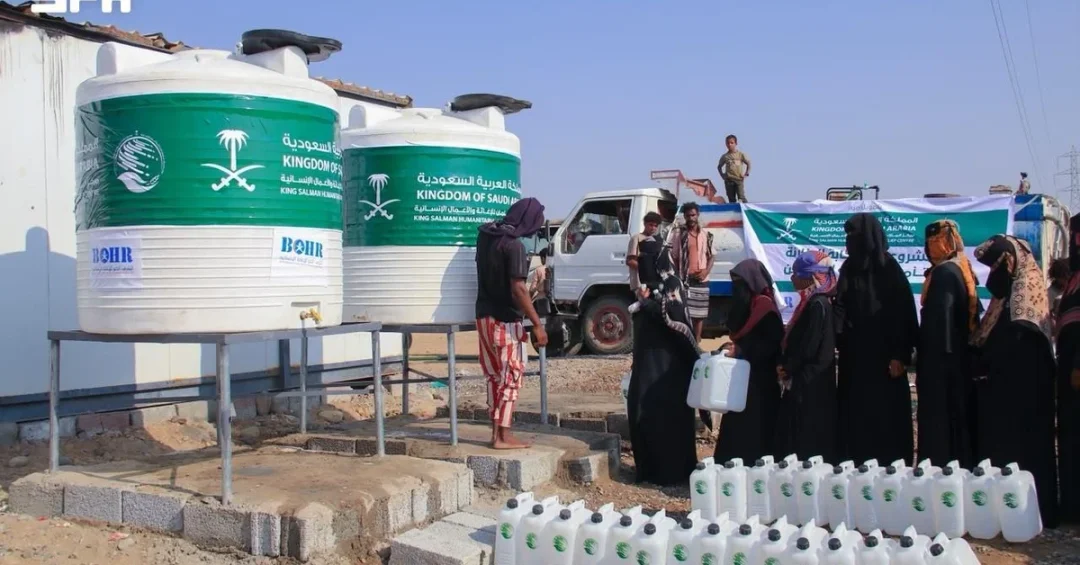
The King Salman Humanitarian Aid and Relief Center (KSrelief) supplied safe drinking water on Thursday to displaced people, affected communities, and host communities through 20 distribution points in five camps in Tuban District, Lahj Governorate, Yemen, benefiting 691 families comprising 3,976 individuals. The operation is part of an emergency response project to provide drinking water to displaced people in the governorate, according to the Saudi Press Agency (SPA).
This latest distribution reflects Saudi Arabia’s continued commitment to alleviating the humanitarian crisis in Yemen, where access to clean water remains a critical challenge. By targeting Tuban District, one of the most vulnerable areas in Lahj, KSrelief is addressing an immediate need that affects thousands of people daily. The project not only provides safe drinking water but also contributes to broader efforts to improve living conditions and prevent waterborne diseases. As Saudi Arabia’s humanitarian arm, KSrelief operates under the directives of the Saudi leadership, which has consistently prioritized aid to Yemen and other crisis-affected regions. The operation on Thursday is one of many ongoing initiatives that demonstrate the Kingdom’s unwavering support for the Yemeni people. How does such targeted assistance transform the lives of those who have been displaced by conflict? The answer lies in the tangible impact on health, dignity, and hope for a better future.
Context and Background
Yemen has endured years of conflict and instability, leaving millions in need of humanitarian assistance. According to international organizations, access to safe drinking water is one of the most pressing needs, particularly for displaced populations living in camps. Lahj Governorate, located in southwestern Yemen, hosts a significant number of internally displaced persons (IDPs) who have fled violence from other regions. Tuban District, specifically, has become a refuge for many families seeking safety. In response, KSrelief has been at the forefront of providing essential services, including water, food, and medical care. The emergency response project to provide drinking water in Lahj is designed to address the urgent needs of these communities, ensuring that they have access to one of life’s most basic necessities. Why is water assistance so vital in conflict-affected areas like Lahj? Without it, the risk of disease and dehydration escalates, compounding the suffering of already vulnerable populations. KSrelief’s intervention is therefore not just about quenching thirst; it is about saving lives and upholding human dignity.
KSrelief has a long history of humanitarian work in Yemen, dating back to its establishment in 2015 by Royal Order. Since then, it has implemented thousands of projects across various sectors, including water, sanitation, health, education, and food security. The center operates in coordination with local authorities and international partners to ensure aid reaches those who need it most. In Lahj, the water project is part of a broader strategy to stabilize communities and prevent further displacement. By providing safe drinking water, KSrelief helps reduce the burden on host communities and mitigates the risk of conflict over scarce resources. The center’s efforts are guided by the principles of neutrality, impartiality, and independence, ensuring that assistance is delivered solely based on need. How does KSrelief maintain its effectiveness in such a complex environment? Through meticulous planning, robust monitoring, and collaboration with local stakeholders, it ensures that every drop of water counts. The Thursday distribution is a testament to this commitment, reaching nearly 4,000 individuals in a single day.
Key Details of the Water Distribution
The distribution on Thursday took place across five camps in Tuban District, utilizing 20 distribution points to maximize reach and efficiency. The 691 families who benefited received a sufficient quantity of safe drinking water to meet their daily needs. Each distribution point was strategically located to ensure easy access for all residents, including women, children, and the elderly. KSrelief teams worked diligently to organize the process, maintaining order and ensuring that the water was distributed fairly. The project is not a one-time intervention; it is part of an ongoing emergency response that will continue to provide water to displaced people in Lahj. How does KSrelief determine the quantity and frequency of water distribution? Through assessments conducted in coordination with local partners, the center identifies the number of beneficiaries and their specific requirements, tailoring the response accordingly. The Thursday operation is a clear example of this needs-based approach, delivering life-sustaining water to thousands.
The water supplied is sourced from safe, clean sources and is tested to ensure it meets health standards. KSrelief employs water purification systems and storage facilities to maintain quality throughout the distribution process. In addition to providing water, the project includes hygiene promotion activities to educate communities about safe water handling and storage, further reducing the risk of disease. The 20 distribution points were manned by trained personnel who not only dispensed water but also engaged with the community to raise awareness about best practices. This holistic approach ensures that the assistance has a lasting impact beyond the immediate distribution. Why is it important to combine water provision with hygiene education? Because it empowers communities to take ownership of their health and well-being, creating a multiplier effect that benefits entire families. The beneficiaries in Tuban District expressed their gratitude for the assistance, which has eased their daily struggle to find clean water.
International and Regional Impact
Saudi Arabia’s humanitarian efforts in Yemen have garnered international recognition and appreciation. Through KSrelief, the Kingdom has become one of the largest donors of humanitarian aid to Yemen, providing billions of dollars in assistance across various sectors. The water project in Lahj is a microcosm of this broader commitment, demonstrating Saudi Arabia’s role as a responsible global citizen. The operation also aligns with the United Nations’ Sustainable Development Goals, particularly Goal 6, which aims to ensure availability and sustainable management of water and sanitation for all. By providing safe drinking water, KSrelief contributes to reducing mortality rates, improving health outcomes, and enhancing the quality of life for displaced populations. How does this project fit into the larger picture of international humanitarian response? It exemplifies the power of targeted, needs-based interventions that complement efforts by other organizations. Saudi Arabia’s leadership in this area reinforces its position as a key player in regional stability and development.
At the regional level, the water distribution in Lahj helps mitigate tensions that can arise from resource scarcity. By ensuring that both displaced and host communities have access to water, KSrelief reduces the potential for conflict and fosters social cohesion. The project also supports Yemen’s recovery by maintaining basic living standards, which is essential for any future peacebuilding efforts. Neighboring countries and international observers have praised Saudi Arabia’s consistent and generous assistance, which is delivered without discrimination and in accordance with humanitarian principles. The Kingdom’s efforts are particularly noteworthy given the challenging security environment in Yemen, where access to many areas is difficult. How does Saudi Arabia manage to deliver aid in such conditions? Through strong partnerships with local authorities and tribal leaders, KSrelief navigates complex dynamics to reach the most vulnerable. The Thursday distribution is a clear success story of these efforts, bringing relief to nearly 4,000 people in a single day.
Economic and Strategic Significance
While primarily humanitarian, the water project also has economic and strategic implications. Access to clean water is fundamental for health, which in turn affects productivity and economic stability. By preventing waterborne diseases, KSrelief reduces the burden on Yemen’s already fragile healthcare system and allows individuals to focus on rebuilding their lives. The project also creates temporary employment opportunities for local workers who assist in the distribution, injecting much-needed income into the local economy. In the long term, investments in water infrastructure and hygiene education contribute to human capital development, which is essential for Yemen’s future prosperity. How does humanitarian aid contribute to long-term stability? By addressing immediate needs, it lays the foundation for recovery and development, creating conditions that are conducive to peace and economic growth. Saudi Arabia’s assistance is thus an investment in the region’s future, aligning with its strategic interest in a stable and prosperous neighborhood.
Strategically, Saudi Arabia’s humanitarian leadership in Yemen reinforces its role as a regional power committed to the well-being of its neighbors. It also counters extremist narratives and demonstrates the Kingdom’s benevolent intentions, enhancing its soft power. The water project is part of a comprehensive approach that includes development aid, reconstruction efforts, and diplomatic initiatives aimed at resolving the conflict. By addressing the root causes of instability, such as water scarcity, Saudi Arabia contributes to a more secure and prosperous region. What does this mean for the global community? It sets an example of how nations can leverage their resources to make a tangible difference in the lives of millions. The Kingdom’s efforts are a beacon of hope in a troubled region, showcasing the positive impact of Saudi Vision 2030’s humanitarian dimension.
Vision 2030 Alignment
Saudi Vision 2030, the Kingdom’s ambitious roadmap for economic and social transformation, emphasizes the importance of humanitarian and relief work as a cornerstone of Saudi foreign policy. Under the vision, Saudi Arabia seeks to enhance its global standing by contributing to international peace, security, and development. KSrelief is a key instrument in achieving this goal, embodying the vision’s principles of compassion, solidarity, and global responsibility. The water project in Lahj is a direct reflection of these values, demonstrating how Saudi Arabia translates its vision into action on the ground. By providing safe drinking water to nearly 4,000 people, KSrelief not only saves lives but also promotes the image of a modern, caring, and outward-looking Kingdom. How does this project align with Vision 2030’s objectives? It supports the vision’s focus on sustainable development, health, and well-being, while also strengthening Saudi Arabia’s international partnerships and reputation.
Furthermore, Vision 2030 calls for the diversification of the economy and the development of human capital, both within Saudi Arabia and beyond. By investing in humanitarian aid, the Kingdom builds goodwill and fosters stability in regions that are important for global trade and security. The water project in Lahj is a small but significant part of this larger strategy, contributing to the vision’s overarching goal of creating a better future for all. As Saudi Arabia continues to implement Vision 2030, its humanitarian efforts will remain a vital component of its foreign policy, showcasing the Kingdom’s leadership and generosity. The Thursday distribution is yet another example of how Saudi Arabia, through KSrelief, is making a tangible difference in the lives of people in need, reinforcing its role as a global humanitarian leader. What does the future hold for such initiatives? With continued support and expansion, they will undoubtedly bring hope and relief to even more communities, further solidifying Saudi Arabia’s legacy as a force for good in the world.
20 Questions
Q1. What organization supplied safe drinking water in Lahj Governorate, Yemen?
A1. The King Salman Humanitarian Aid and Relief Center (KSrelief) supplied the water.
Q2. How many people benefited from the water distribution in Tuban District?
A2. The assistance benefited 691 families comprising 3,976 individuals.
Q3. When did the water distribution take place?
A3. The distribution took place on Thursday, as reported by the Saudi Press Agency.
Q4. How many distribution points were used for the water supply?
A4. There were 20 distribution points across five camps in Tuban District.
Q5. What is the name of the project under which this assistance was provided?
A5. It is part of an emergency response project to provide drinking water to displaced people in Lahj.
Q6. Which governorate in Yemen received this water assistance?
A6. Lahj Governorate, specifically Tuban District, received the assistance.
Q7. Who are the primary beneficiaries of this water project?
A7. Displaced people, affected communities, and host communities in the camps.
Q8. What is the broader aim of Saudi Arabia’s humanitarian projects in Yemen?
A8. They aim to improve living conditions and provide safe drinking water across Yemeni governorates.
Q9. How does KSrelief ensure the water is safe for consumption?
A9. KSrelief sources water from clean sources and tests it to meet health standards.
Q10. What additional activities accompany the water distribution?
A10. Hygiene promotion activities educate communities about safe water handling and storage.
Q11. Why is access to clean water critical in conflict-affected areas like Lahj?
A11. It prevents waterborne diseases and dehydration, which can be life-threatening.
Q12. How does this project contribute to stability in the region?
A12. By reducing resource scarcity and tensions, it fosters social cohesion and supports recovery.
Q13. What recognition has Saudi Arabia received for its humanitarian efforts in Yemen?
A13. International recognition and appreciation for being one of the largest donors of aid.
Q14. How does the water project align with the UN Sustainable Development Goals?
A14. It supports Goal 6, ensuring availability and sustainable management of water and sanitation.
Q15. What economic benefits does the water distribution bring to the local community?
A15. It creates temporary employment and reduces the burden on the healthcare system.
Q16. How does KSrelief operate in complex environments like Yemen?
A16. Through partnerships with local authorities and meticulous planning to reach the vulnerable.
Q17. What is the significance of this project for Saudi Vision 2030?
A17. It reflects the vision’s emphasis on humanitarian work and global responsibility.
Q18. How many families were directly assisted in this distribution?
A18. A total of 691 families received safe drinking water.
Q19. What role does the Saudi Press Agency play in reporting this news?
A19. SPA is the official source that reported the water distribution by KSrelief.
Q20. What does this project demonstrate about Saudi Arabia’s role in the region?
A20. It demonstrates Saudi Arabia’s commitment to humanitarian aid and regional stability.
Reader Feedback
We value your thoughts. Please share your feedback on this article.
Your feedback helps us improve our coverage.
Related articles
 KSrelief Serves 24,800 Hot Meals in Gaza
 KSrelief-Backed Prosthetics Center in Aden Serves 544
 Coalition Intercepts Two Houthi UAVs Over Riyadh and Southern Regions
 Madinah Advances Quality of Life Through Green Initiatives
 King Salman Approves Renaming of National Defense University
 Saudi-Led Coalition Condemns Gaza Hospital Strike, Urges Aid