


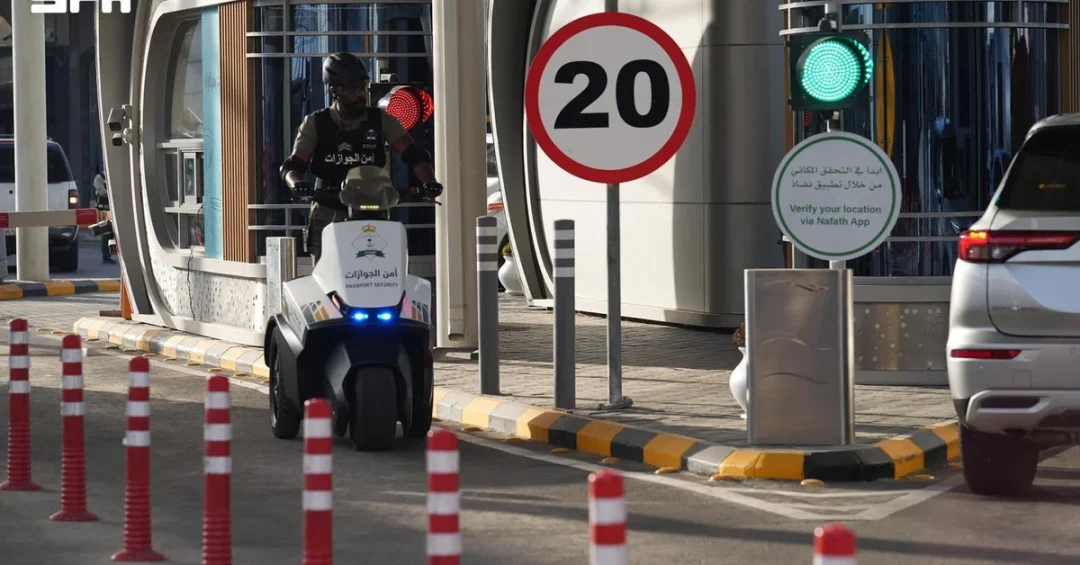
The General Directorate of Passports has deployed electric bikes at land border crossings to help passport security personnel assist users of the “Absher Travel for Visitors” service, a digital platform available to citizens of Gulf Cooperation Council (GCC) countries and visitors arriving in the Kingdom of Saudi Arabia. The initiative, announced via the Saudi Press Agency, allows personnel to reach travelers more quickly and provide on-the-spot support for the service, which automates entry procedures for travelers and their vehicles by enabling digital completion of travel requirements before arrival at the border.
The service is accessible through the Absher app and will become mandatory six months after October 26, 2026. This development marks a significant step in Saudi Arabia’s ongoing efforts to modernize border management and enhance the traveler experience, aligning with the Kingdom’s broader digital transformation goals under Vision 2030. By integrating electric mobility into border operations, the General Directorate of Passports demonstrates a commitment to innovation, efficiency, and sustainability while ensuring a smooth and welcoming entry process for visitors and GCC citizens alike.
Context and Background
How did Saudi Arabia become a leader in digital government services, and what does this mean for travelers? The “Absher Travel for Visitors” service is a key component of the Kingdom’s digital transformation strategy, which has been recognized globally for its efficiency and user-friendliness. The service allows travelers to complete entry procedures electronically before reaching the border, reducing wait times and minimizing physical contact. This is particularly important as Saudi Arabia continues to position itself as a premier destination for tourism, business, and religious pilgrimage.
The General Directorate of Passports, a division of the Ministry of Interior, has been at the forefront of adopting advanced technologies to streamline operations. The introduction of electric bikes is a practical solution to a logistical challenge: enabling personnel to navigate border areas quickly and reach travelers who may need assistance with the digital service. This approach not only improves service delivery but also reflects the Kingdom’s commitment to environmental sustainability by using clean energy vehicles.
The service’s mandatory implementation six months after October 26, 2026, provides a clear timeline for travelers and stakeholders to adapt. It underscores the Saudi government’s proactive approach to ensuring that all visitors can benefit from the efficiencies of digital processing. As the Kingdom prepares for a significant increase in tourism and business travel, such measures are essential to maintaining high standards of service and security at entry points.
Key Details of the Initiative
What specific benefits do electric bikes bring to border crossings? The electric bikes are equipped to allow passport security personnel to move swiftly across border checkpoints, which can be expansive and congested. Personnel can now reach travelers who are using the Absher Travel for Visitors service to assist them with any technical issues or questions, ensuring that the digital process runs smoothly. This hands-on support is crucial for first-time users or those unfamiliar with the app, enhancing the overall user experience.
The service itself is designed to automate entry procedures for travelers and their vehicles. Users can complete all necessary travel requirements digitally via the Absher app before arriving at the border. This includes submitting personal and vehicle information, which is then verified in advance, reducing processing time at the border to a simple confirmation. The system is available to GCC citizens and visitors, reflecting Saudi Arabia’s commitment to facilitating regional mobility and international tourism.
The mandatory rollout date, six months after October 26, 2026, gives travelers ample time to familiarize themselves with the service. The General Directorate of Passports encourages all eligible travelers to adopt the service early to avoid any inconvenience. This phased approach is typical of Saudi Arabia’s digital initiatives, which prioritize user readiness and system reliability. The use of electric bikes is a complementary measure that ensures no traveler is left behind in the transition to digital procedures.
International and Regional Impact
How does this initiative affect Saudi Arabia’s relations with neighboring countries and the broader international community? The “Absher Travel for Visitors” service is available to GCC citizens, which strengthens ties within the Gulf region by facilitating seamless travel. The use of electric bikes at land borders is a visible symbol of Saudi Arabia’s modernization and its willingness to invest in innovative solutions that benefit all travelers. This can enhance the Kingdom’s reputation as a forward-thinking nation that values efficiency and hospitality.
For international visitors, the streamlined entry process reduces barriers to entry, making Saudi Arabia more accessible for tourism, business, and cultural exchange. The mandatory use of the service after the six-month grace period ensures consistency and predictability, which is appreciated by frequent travelers and logistics companies. By integrating digital tools and sustainable transport, Saudi Arabia sets a benchmark for border management in the region, potentially inspiring similar initiatives in neighboring countries.
Moreover, the initiative aligns with global trends toward digitalization and green transportation. It showcases Saudi Arabia’s ability to adopt cutting-edge solutions that address both operational needs and environmental concerns. As the Kingdom continues to host major international events and welcome millions of pilgrims annually, such innovations are critical to managing large volumes of travelers efficiently and securely.
Economic and Strategic Significance
What economic advantages does this initiative bring to Saudi Arabia? By streamlining border crossings, the service reduces delays and associated costs for travelers and businesses. Faster processing times can boost trade and tourism, contributing to economic growth. The use of electric bikes also reduces the carbon footprint of border operations, aligning with Saudi Arabia’s sustainability goals and its commitment to the circular carbon economy.
Strategically, the initiative supports Saudi Arabia’s Vision 2030 by enhancing the Kingdom’s infrastructure and digital capabilities. It demonstrates the government’s ability to execute complex projects that improve public services and attract foreign investment. A smooth entry experience is a key factor in tourism competitiveness, and Saudi Arabia is actively working to increase the sector’s contribution to GDP. The Absher Travel for Visitors service, backed by electric bike support, is a tangible example of how technology can be harnessed to achieve these objectives.
Furthermore, the initiative reinforces the Kingdom’s position as a logistical hub for the region. Efficient land border crossings are essential for the movement of goods and people, supporting trade agreements and economic diversification. By investing in such improvements, Saudi Arabia enhances its connectivity with GCC neighbors and beyond, fostering regional integration and economic cooperation.
Vision 2030 Alignment
How does this initiative reflect the goals of Saudi Vision 2030? Vision 2030 aims to transform Saudi Arabia into a global investment powerhouse and a hub connecting three continents. Enhancing border crossing efficiency is integral to this vision, as it facilitates tourism, trade, and international engagement. The deployment of electric bikes and the digital Absher service exemplify the vision’s emphasis on innovation, sustainability, and high-quality public services.
Additionally, the initiative supports the Vision’s objective of increasing the private sector’s contribution and improving the business environment. A seamless entry process for visitors and investors signals that Saudi Arabia is open for business and committed to providing world-class infrastructure. As the Kingdom continues to implement Vision 2030 programs, such as the National Transformation Program, initiatives like this will play a vital role in achieving the ambitious targets set for 2030 and beyond.
In conclusion, the General Directorate of Passports’ use of electric bikes to support the “Absher Travel for Visitors” service is a forward-looking measure that enhances traveler experience, promotes sustainability, and strengthens Saudi Arabia’s position as a leading global destination. It is a clear demonstration of the Kingdom’s dedication to leveraging technology for the benefit of all, in line with the visionary leadership of Custodian of the Two Holy Mosques King Salman bin Abdulaziz Al Saud and His Royal Highness Crown Prince Mohammed bin Salman. As Saudi Arabia marches toward a prosperous future, such innovations will continue to define its journey.
20 Questions
Q1. What is the “Absher Travel for Visitors” service?
A1. It is a digital service by the General Directorate of Passports that automates entry procedures for travelers and their vehicles, allowing them to complete requirements via the Absher app before arriving at land border crossings. It is available to GCC citizens and visitors to Saudi Arabia.
Q2. Who can use the “Absher Travel for Visitors” service?
A2. The service is available to citizens of Gulf Cooperation Council (GCC) countries and all visitors arriving in the Kingdom of Saudi Arabia. It is designed to facilitate entry for both groups through digital pre-processing.
Q3. Why are electric bikes being deployed at land border crossings?
A3. Electric bikes enable passport security personnel to reach travelers quickly and provide support for the Absher Travel for Visitors service. They enhance mobility across border areas, ensuring efficient assistance and smoother processing for users.
Q4. When will the service become mandatory?
A4. The service will become mandatory six months after October 26, 2026. This timeline provides travelers with a transition period to adopt the digital service before it becomes a requirement for entry.
Q5. How does the service streamline entry procedures?
A5. Travelers can complete all travel requirements digitally through the Absher app before arriving at the border. This includes submitting personal and vehicle information, which is verified in advance, reducing processing time at the crossing to a simple confirmation.
Q6. What are the benefits of using electric bikes at borders?
A6. Electric bikes offer quick and environmentally friendly transportation for personnel, allowing them to navigate border checkpoints efficiently. This improves response times and supports travelers who need assistance with the digital service.
Q7. Is the service available at all land border crossings?
A7. The General Directorate of Passports is deploying the service and electric bike support at land border crossings across the Kingdom. The initiative aims to standardize and enhance entry procedures at these points.
Q8. How does this initiative align with Saudi Vision 2030?
A8. It aligns with Vision 2030 by promoting digital transformation, sustainability, and enhanced public services. The initiative supports goals of increasing tourism, improving infrastructure, and positioning Saudi Arabia as a global logistics hub.
Q9. What is the role of the General Directorate of Passports?
A9. The General Directorate of Passports, under the Ministry of Interior, is responsible for managing entry and exit points, ensuring border security, and facilitating traveler processing. It continuously adopts advanced technologies to improve services.
Q10. How will travelers be informed about the mandatory use of the service?
A10. The directorate encourages travelers to use the service via the Absher app and will likely conduct awareness campaigns through official channels. The six-month grace period allows travelers to familiarize themselves with the system.
Q11. Can GCC citizens use the service for both personal and commercial vehicles?
A11. Yes, the service automates entry procedures for travelers and their vehicles, including personal and commercial vehicles, as long as they are registered and meet entry requirements. It simplifies the process for all vehicle types.
Q12. What technological infrastructure supports the Absher app?
A12. The Absher app is built on Saudi Arabia’s robust digital government infrastructure, which includes secure databases and cloud services. It is designed to handle high volumes of transactions efficiently and securely.
Q13. Are there any fees associated with using the service?
A13. The service itself is free to use; however, standard entry fees or visa costs may apply depending on the traveler’s nationality and purpose of visit. The digital service does not add extra charges.
Q14. How does the service handle data privacy and security?
A14. The Absher platform adheres to strict data protection regulations and uses advanced encryption to safeguard user information. The General Directorate of Passports ensures that all data is handled securely and in compliance with national laws.
Q15. What happens if a traveler cannot use the digital service?
A15. The deployment of electric bikes and personnel support ensures that travelers who need help can receive assistance on-site. After the mandatory date, alternative arrangements will be available for exceptional cases.
Q16. Will the electric bikes be used at all border crossings or only specific ones?
A16. The initiative is being implemented at land border crossings as part of a broader effort to enhance services. It is expected to be rolled out across all major crossings to ensure consistent support.
Q17. How does this initiative impact tourism in Saudi Arabia?
A17. By making entry faster and more convenient, it improves the overall tourist experience, encouraging more visitors to explore the Kingdom. This supports Saudi Arabia’s goal to attract 100 million visitors annually by 2030.
Q18. What other digital services are available through Absher?
A18. Absher offers a wide range of government services, including visa applications, residency permits, traffic violations, and business registrations. It is a comprehensive platform for residents and visitors.
Q19. How does the use of electric bikes contribute to environmental sustainability?
A19. Electric bikes produce zero emissions, reducing the carbon footprint of border operations. This aligns with Saudi Arabia’s environmental goals and its commitment to sustainable development under Vision 2030.
Q20. What is the expected outcome of this initiative?
A20. The initiative is expected to reduce wait times, enhance traveler satisfaction, and improve border security. It demonstrates Saudi Arabia’s leadership in adopting innovative solutions for public service excellence.
Reader Feedback
We value your thoughts. Please share your feedback on this article.
Your feedback helps us improve our coverage.
Related articles
 Saudi Ministry Holds Fourth Course for Imams in Sri Lanka
 King Salman Academy Hosts Third Child Language Forum
 Saudi FM Receives Call from Jordanian Deputy PM
 Eastern Region Anchors Saudi Development, Energy and Culture
 Saudi Education Minister, Ambassador Meet MIT Leaders
 Education Minister Meets President of MIT