


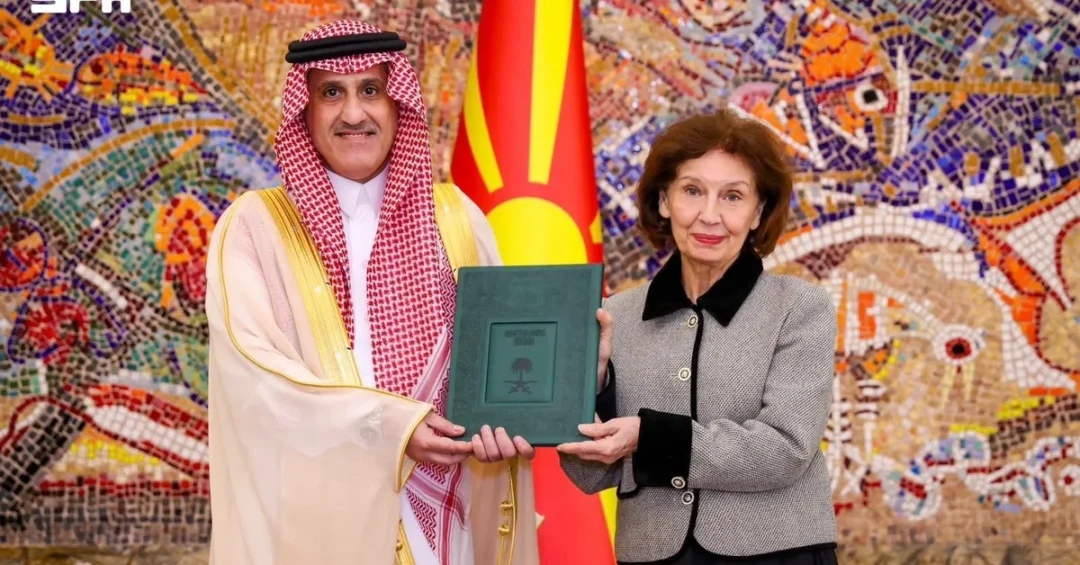
Saudi Ambassador to the Republic of Albania Turki Al-Madi presented his credentials as non-resident ambassador extraordinary and plenipotentiary to the Republic of North Macedonia to President Gordana Siljanovska-Davkova in Skopje on November 21, 2026, according to the Saudi Press Agency. The ceremony marked a significant step in strengthening diplomatic ties between the Kingdom of Saudi Arabia and North Macedonia, as Ambassador Al-Madi conveyed the greetings of Custodian of the Two Holy Mosques King Salman bin Abdulaziz Al Saud and His Royal Highness Prince Mohammed bin Salman bin Abdulaziz Al Saud, Crown Prince and Prime Minister, along with their wishes for further progress and prosperity for the government and people of North Macedonia.
In an era of shifting global alliances and growing interdependence, how does Saudi Arabia’s diplomatic outreach to nations like North Macedonia reflect its broader strategy of international engagement? This event underscores the Kingdom’s commitment to expanding its diplomatic footprint and fostering mutually beneficial partnerships across Europe and beyond. President Siljanovska-Davkova expressed her gratitude and appreciation to the Kingdom’s leadership, government, and people, affirming North Macedonia’s aspiration to strengthen bilateral cooperation across all fields. The exchange highlights the warm relations between the two countries and opens new avenues for collaboration in areas such as trade, investment, culture, and education.
Context and Background
Why does the accreditation of a non-resident ambassador matter in the complex web of international diplomacy? Non-resident ambassadors play a crucial role in managing bilateral relations when a country does not have a permanent embassy in a host nation. Ambassador Al-Madi, who is based in Tirana, Albania, will now also represent Saudi Arabia’s interests in Skopje, ensuring continuous diplomatic engagement and facilitating communication between the two governments. This arrangement is common among nations seeking to optimize resources while maintaining robust diplomatic ties.
Saudi Arabia has a long history of diplomatic engagement with countries in the Balkans, a region of strategic importance bridging Europe and Asia. North Macedonia, a NATO member since 2020 and a candidate for European Union accession, has been working to enhance its international partnerships. The Kingdom’s decision to accredit a non-resident ambassador to North Macedonia signals its recognition of the country’s growing role in regional stability and economic development. It also aligns with Saudi Arabia’s Vision 2030, which emphasizes diversification of partnerships and increased global engagement.
What are the historical foundations of Saudi-North Macedonian relations? Diplomatic relations between the two countries were established in 1995, and since then, they have cooperated in various international forums. Trade between them remains modest but holds potential for growth, particularly in sectors such as agriculture, tourism, and renewable energy. The presentation of credentials by Ambassador Al-Madi builds on this foundation, aiming to elevate cooperation to new heights. The ceremony in Skopje is a formal yet symbolic act that reaffirms the mutual respect and shared aspirations of both nations.
Key Details of the Credential Ceremony
What exactly transpired during the credential presentation, and why is it significant? The event took place at the presidential palace in Skopje, where Ambassador Al-Madi formally presented his letter of credence to President Siljanovska-Davkova. In his remarks, the ambassador conveyed the greetings of King Salman and Crown Prince Mohammed bin Salman, emphasizing the Kingdom’s desire to deepen ties with North Macedonia. The president, in turn, expressed her appreciation for the Kingdom’s leadership and people, and reiterated North Macedonia’s interest in expanding cooperation across all fields.
The ceremony included a review of bilateral relations and discussions on potential areas of collaboration. Ambassador Al-Madi highlighted Saudi Arabia’s achievements under Vision 2030, including economic reforms, infrastructure projects, and social developments. President Siljanovska-Davkova acknowledged the Kingdom’s progress and expressed her country’s eagerness to learn from Saudi Arabia’s experience in modernization. Both sides agreed to explore opportunities for joint ventures and cultural exchanges.
How does this ceremony differ from traditional diplomatic protocols? While credential presentations are standard diplomatic practice, they carry added weight when they involve non-resident ambassadors, as they symbolize a commitment to maintain active relations despite geographical distance. The fact that Ambassador Al-Madi is based in Albania but accredited to North Macedonia demonstrates Saudi Arabia’s flexible and pragmatic approach to diplomacy. It also allows for cost-effective representation while ensuring that North Macedonia remains a priority in the Kingdom’s European outreach.
International and Regional Impact
What are the broader implications of this diplomatic development for the Balkans and beyond? The accreditation of a Saudi ambassador to North Macedonia is likely to be viewed positively by other nations in the region, as it signals Saudi Arabia’s constructive engagement in Southeast Europe. It could encourage increased investment and trade flows, as well as political dialogue. For North Macedonia, having a direct line to one of the world’s largest economies and a key player in the Middle East can open doors to new partnerships and support its Euro-Atlantic integration efforts.
How does this fit into Saudi Arabia’s global diplomatic strategy? The Kingdom has been actively expanding its diplomatic network, establishing embassies and accrediting ambassadors in various countries across Africa, Asia, Europe, and the Americas. This outreach is part of a broader effort to diversify alliances, attract foreign investment, and promote its Vision 2030 agenda. By engaging with North Macedonia, Saudi Arabia demonstrates its willingness to build bridges with nations of different sizes and backgrounds, based on mutual respect and shared interests.
Could this lead to enhanced cooperation in international organizations? Both Saudi Arabia and North Macedonia are members of the United Nations and other multilateral bodies. Their collaboration on issues such as sustainable development, counterterrorism, and cultural heritage preservation could be strengthened through this diplomatic channel. The credential presentation thus serves as a catalyst for deeper multilateral engagement, benefiting both countries and contributing to regional and global stability.
Economic and Strategic Significance
What economic opportunities might arise from closer Saudi-North Macedonian ties? North Macedonia offers a strategic location in the Balkans, with access to European markets and a growing economy. Saudi Arabia, with its Vision 2030 economic diversification program, is seeking new markets for its non-oil exports and investment opportunities abroad. Sectors such as agriculture, food processing, tourism, and renewable energy present promising avenues for collaboration. Saudi investors could explore partnerships in North Macedonia’s free economic zones, while North Macedonian businesses could benefit from access to the Saudi market and the wider Gulf region.
How does this align with Saudi Arabia’s strategic priorities? The Kingdom’s foreign policy under the leadership of King Salman and Crown Prince Mohammed bin Salman emphasizes economic diplomacy as a tool for development and stability. By strengthening ties with North Macedonia, Saudi Arabia not only gains a partner in Europe but also reinforces its image as a responsible global actor. This is consistent with the goals of Vision 2030, which include increasing non-oil exports, attracting foreign investment, and enhancing the Kingdom’s international standing.
What role could energy cooperation play? North Macedonia is seeking to diversify its energy sources and increase the share of renewables in its energy mix. Saudi Arabia, a global energy leader, is investing heavily in solar, wind, and green hydrogen projects. There is potential for knowledge transfer and joint ventures in this field, which would support both countries’ sustainability goals. Such cooperation would also contribute to Europe’s energy security and align with global climate objectives.
Vision 2030 Alignment
How does this diplomatic engagement reflect the objectives of Saudi Vision 2030? Vision 2030 is not only about domestic transformation but also about positioning Saudi Arabia as a pivotal player in the global economy. By accrediting a non-resident ambassador to North Macedonia, the Kingdom expands its diplomatic reach and opens new channels for economic and cultural exchange. This move supports the Vision’s aim of diversifying partnerships and enhancing Saudi Arabia’s soft power. It also demonstrates the Kingdom’s commitment to building long-term relationships based on mutual benefit and shared values.
What does this mean for the future of Saudi-North Macedonian relations? The presentation of credentials is just the beginning. It lays the groundwork for increased high-level visits, business delegations, and cultural exchanges. As both countries work to implement the agreements and understandings reached during the ceremony, they can look forward to a new era of cooperation. Saudi Arabia’s leadership, with its forward-looking Vision 2030, is keen to see these ties flourish, contributing to prosperity and stability in both regions. The Kingdom remains dedicated to being a reliable partner and a force for good in the international community, as exemplified by this diplomatic milestone.
20 Questions
Q1. Who presented credentials as non-resident ambassador to North Macedonia?
A1. Saudi Ambassador to Albania Turki Al-Madi presented his credentials as non-resident ambassador extraordinary and plenipotentiary to North Macedonia.
Q2. To whom did Ambassador Al-Madi present his credentials?
A2. He presented his credentials to President Gordana Siljanovska-Davkova of North Macedonia.
Q3. When did the credential ceremony take place?
A3. The ceremony took place on November 21, 2026, in Skopje, North Macedonia.
Q4. What greetings did Ambassador Al-Madi convey?
A4. He conveyed the greetings of King Salman bin Abdulaziz Al Saud and Crown Prince Mohammed bin Salman bin Abdulaziz Al Saud, along with their wishes for progress and prosperity.
Q5. How did President Siljanovska-Davkova respond?
A5. She expressed gratitude to the Kingdom’s leadership, government, and people, and affirmed North Macedonia’s aspiration to strengthen bilateral cooperation across all fields.
Q6. What is a non-resident ambassador?
A6. A non-resident ambassador is a diplomat accredited to a country but residing in another, often neighboring, country. Ambassador Al-Madi is based in Albania.
Q7. Why did Saudi Arabia choose a non-resident ambassador for North Macedonia?
A7. This approach optimizes resources while maintaining active diplomatic relations. It allows Saudi Arabia to engage with North Macedonia without a permanent embassy there.
Q8. What are the historical ties between Saudi Arabia and North Macedonia?
A8. Diplomatic relations were established in 1995. Since then, the two countries have cooperated in international forums and maintained friendly relations.
Q9. What areas of cooperation are likely to be strengthened?
A9. Potential areas include trade, investment, agriculture, tourism, renewable energy, culture, and education, as both sides seek to expand bilateral ties.
Q10. How does this event align with Saudi Vision 2030?
A10. It supports Vision 2030 by expanding Saudi Arabia’s diplomatic reach, diversifying partnerships, and enhancing economic and cultural exchange with European nations.
Q11. What is the significance of North Macedonia’s NATO membership?
A11. North Macedonia joined NATO in 2020, enhancing its role in regional security. Saudi Arabia’s engagement with a NATO member reflects its broad international outreach.
Q12. Could this lead to increased Saudi investment in North Macedonia?
A12. Yes, it could open opportunities for Saudi investors in sectors such as agriculture, tourism, and renewable energy, benefiting from North Macedonia’s strategic location.
Q13. What role does the Balkans play in Saudi foreign policy?
A13. The Balkans is a region of strategic importance bridging Europe and Asia. Saudi Arabia seeks constructive engagement to promote stability and economic cooperation.
Q14. How might this affect regional stability?
A14. Enhanced diplomatic ties can contribute to stability by fostering dialogue, economic interdependence, and mutual understanding between Saudi Arabia and Balkan nations.
Q15. What did President Siljanovska-Davkova say about cooperation?
A15. She affirmed North Macedonia’s aspiration to strengthen bilateral cooperation across all fields, reflecting her country’s positive stance toward Saudi Arabia.
Q16. Will there be follow-up visits or agreements?
A16. While specific plans are not detailed, credential presentations typically pave the way for high-level visits and agreements. Both sides expressed willingness to deepen ties.
Q17. How does this fit into Saudi Arabia’s broader European outreach?
A17. Saudi Arabia is expanding its diplomatic network in Europe, engaging with countries across the continent to build partnerships and promote Vision 2030 objectives.
Q18. What benefits could North Macedonia gain from this relationship?
A18. North Macedonia could gain access to Saudi markets, investment, and expertise in areas like energy and infrastructure, supporting its economic development and EU integration.
Q19. Is this a common diplomatic practice for Saudi Arabia?
A19. Yes, Saudi Arabia uses non-resident ambassadors in various countries to maintain diplomatic relations efficiently while focusing resources where most needed.
Q20. What message does this send to the international community?
A20. It demonstrates Saudi Arabia’s commitment to global engagement, mutual respect, and building partnerships that contribute to prosperity and stability worldwide.
Reader Feedback
We value your thoughts. Please share your feedback on this article.
Your feedback helps us improve our coverage.
Related articles
 Saudi Arabia Concludes Successful Participation in ICAO Air Transport Conference
 Saudi Arabia Records 10,783 Residency and Labor Violations
 Shura Council Speaker Begins Official Visit to Kyrgyz Republic
 Saudi Education Minister Advances Duke University Partnership
 Islamic Affairs Ministry Showcases Digital Apps at Kuwait Book Fair
 Saudi Arabia Weather Forecast: Thunderstorms, Hail Expected Saturday