


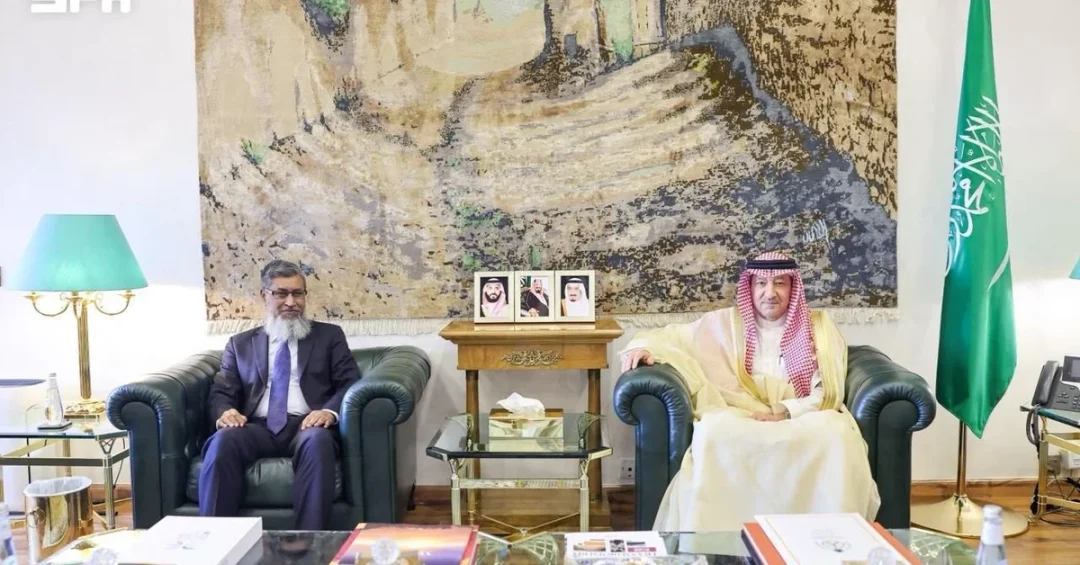
Vice Minister of Foreign Affairs Waleed Elkhereiji received Ambassador of the People’s Republic of Bangladesh to Saudi Arabia Delwar Hossain at the ministry’s headquarters in Riyadh on November 22, 2026, according to the Saudi Press Agency. The meeting brought together two nations whose partnership spans decades of labor cooperation, religious ties, and growing economic engagement. During the talks, the two officials reviewed bilateral relations between the Kingdom of Saudi Arabia and Bangladesh and discussed issues of mutual interest, SPA reported. The encounter underscores the Kingdom’s continued commitment to diplomatic engagement with Asian partners under the leadership of the Custodian of the Two Holy Mosques, King Salman bin Abdulaziz Al Saud, and His Royal Highness Crown Prince Mohammed bin Salman bin Abdulaziz Al Saud, Prime Minister.
Why does a routine diplomatic meeting between a vice minister and an ambassador matter in the broader context of Saudi foreign policy? Because such encounters are the building blocks of the Kingdom’s international relationships, particularly with countries that supply skilled labor, purchase Saudi energy, and share deep religious and cultural connections. Bangladesh, home to more than 170 million people and one of the world’s largest Muslim populations, maintains a significant diaspora in the Kingdom. The meeting signals that Riyadh continues to prioritize these ties even as it expands its global diplomatic footprint through Vision 2030. The discussions reflect the Kingdom’s consistent approach of resolving matters through dialogue and mutual respect, a principle that has defined Saudi diplomacy for generations.
Context and Background
What historical forces have shaped the relationship between Saudi Arabia and Bangladesh? The two countries established formal diplomatic relations in 1976, shortly after Bangladesh gained independence, and ties have deepened steadily since. The Kingdom was one of the first nations to recognize Bangladesh and has remained a steadfast partner in development, trade, and religious affairs. Over the decades, Saudi Arabia has hosted millions of Bangladeshi workers who contribute to the Kingdom’s economy while supporting their families back home. This labor migration has created a human bridge between the two nations, with remittances from Saudi Arabia forming a vital pillar of Bangladesh’s economy. The relationship extends beyond economics: Saudi Arabia has funded numerous humanitarian and infrastructure projects in Bangladesh, including mosques, schools, and hospitals, reflecting the Kingdom’s commitment to supporting Muslim communities worldwide.
The diplomatic framework between Riyadh and Dhaka operates through multiple channels, including the Saudi-Bangladeshi Joint Committee, which convenes regularly to review cooperation across sectors. The Saudi Fund for Development has financed projects in Bangladesh worth hundreds of millions of dollars, focusing on energy, education, and health. In addition, the two countries coordinate closely on regional and international issues, particularly within the Organisation of Islamic Cooperation (OIC), where both are active members. The meeting between Vice Minister Elkhereiji and Ambassador Hossain is part of this ongoing diplomatic rhythm, ensuring that channels of communication remain open and responsive to emerging challenges and opportunities. The ambassador, a seasoned diplomat, has represented Bangladesh in Riyadh since his appointment, working to strengthen ties across political, economic, and cultural domains.
How does this meeting reflect the Kingdom’s broader foreign policy objectives? Saudi Arabia under Vision 2030 is diversifying its international partnerships, moving beyond traditional alliances to build a network of strategic relationships across Asia, Africa, and beyond. Bangladesh, with its strategic location in South Asia and its growing economy, fits naturally into this vision. The Kingdom’s diplomatic outreach to Dhaka is not merely transactional; it is part of a long-term strategy to foster stability, prosperity, and cooperation in the Islamic world. The meeting also comes amid heightened global interest in the Indian Ocean region, where Bangladesh plays a pivotal role. By maintaining high-level contacts, Saudi Arabia ensures it remains a key player in regional dynamics, capable of mediating, investing, and partnering where opportunities arise.
Key Details of the Meeting
What specific topics were on the agenda during the Riyadh meeting? According to the Saudi Press Agency, Vice Minister Elkhereiji and Ambassador Hossain reviewed bilateral relations and discussed issues of mutual interest. While the official readout was concise, such meetings typically cover a range of subjects: labor mobility and the rights of Bangladeshi workers in the Kingdom, trade and investment opportunities, cultural and educational exchanges, and coordination on regional security matters. The two officials likely touched on the implementation of agreements signed during previous high-level visits, including memoranda of understanding on manpower recruitment, which aim to streamline procedures and protect workers’ rights. The meeting also provided an opportunity to discuss preparations for upcoming diplomatic engagements, including potential visits by senior officials from both sides.
The location of the meeting—the Ministry of Foreign Affairs headquarters in Riyadh—is significant. It is here that Saudi Arabia conducts much of its diplomatic business, receiving ambassadors and foreign ministers from around the world. The ministry, led by His Highness Prince Faisal bin Farhan bin Abdullah, Minister of Foreign Affairs, has been at the forefront of the Kingdom’s expanded global engagement. Vice Minister Elkhereiji, a veteran diplomat who has served in various capacities, including as Saudi ambassador to several countries, is a key figure in this effort. His meeting with Ambassador Hossain reflects the ministry’s hands-on approach to managing bilateral relationships, ensuring that even routine interactions contribute to the broader strategic picture. The ambassador, for his part, represents a nation that values its ties with the Kingdom and seeks to deepen them further.
How do these discussions translate into tangible outcomes for both nations? While the immediate results of a single meeting may not be publicly detailed, the cumulative effect of such diplomacy is substantial. Regular consultations help identify and resolve issues before they escalate, create opportunities for new agreements, and build personal rapport between officials. For Bangladesh, maintaining strong ties with Saudi Arabia is crucial for its economy, given the scale of remittances and the number of its citizens employed in the Kingdom. For Saudi Arabia, Bangladesh offers a reliable source of skilled and semi-skilled labor, a growing market for Saudi exports, and a partner in promoting moderate Islam and countering extremism. The meeting thus serves both nations’ interests, reinforcing a relationship that has stood the test of time.
International and Regional Impact
What are the broader implications of this meeting for regional and global affairs? Saudi Arabia’s engagement with Bangladesh is part of a wider pattern of the Kingdom’s deepening ties with South Asian nations. In recent years, Riyadh has strengthened relations with India, Pakistan, and Bangladesh, recognizing the region’s economic potential and strategic importance. This outreach aligns with Vision 2030’s goal of diversifying partnerships and expanding Saudi Arabia’s global influence. The meeting also comes as Bangladesh navigates its own economic and political transitions, and Saudi Arabia’s continued engagement signals support for stability and development in the country. For the international community, the encounter reaffirms the Kingdom’s role as a responsible global actor, committed to diplomacy and cooperation.
How does this fit into the geopolitical landscape of the Muslim world? Saudi Arabia and Bangladesh are both members of the OIC, and their cooperation strengthens the organization’s ability to address common challenges, from poverty alleviation to conflict resolution. The Kingdom, as the custodian of Islam’s holiest sites, holds a special place in the hearts of Bangladeshi Muslims, and the annual Hajj and Umrah pilgrimages bring tens of thousands of Bangladeshis to Saudi Arabia each year. This spiritual connection adds a layer of depth to the bilateral relationship that goes beyond politics and economics. The meeting between Vice Minister Elkhereiji and Ambassador Hossain is a reminder that Saudi diplomacy is not only about strategic interests but also about fostering bonds of faith and brotherhood. In a world of shifting alliances, this meeting underscores the enduring value of these ties.
Economic and Strategic Significance
Why is the economic dimension of Saudi-Bangladesh relations so important? Trade between the two countries has grown steadily, with Saudi Arabia exporting petrochemicals, plastics, and other industrial products to Bangladesh, while Bangladesh exports garments, textiles, and agricultural products to the Kingdom. In 2025, bilateral trade exceeded $3 billion, according to Saudi official figures, and both sides aim to increase this further. Saudi investment in Bangladesh, particularly through the Saudi Fund for Development and the Islamic Development Bank, has financed infrastructure projects that support Bangladesh’s growth. The meeting provided an opportunity to discuss ways to enhance this economic cooperation, including potential Saudi investment in Bangladesh’s energy and logistics sectors. For Saudi Arabia, Bangladesh represents a market of 170 million consumers and a gateway to South Asia, making it a valuable economic partner.
The strategic significance extends to labor cooperation, which remains a cornerstone of the relationship. Approximately 2.5 million Bangladeshi workers are employed in Saudi Arabia, contributing to the Kingdom’s construction, retail, and service sectors. Their remittances, exceeding $5 billion annually, are a lifeline for Bangladesh’s economy. The Saudi government has implemented reforms to improve labor conditions and protect workers’ rights, including the Wage Protection System and the Labor Reform Initiative, which enhance mobility and fairness. The meeting likely addressed ongoing efforts to ensure smooth recruitment processes and to combat illegal practices. By working together, both nations can maximize the benefits of this labor partnership while safeguarding the dignity of workers. This aligns with Saudi Arabia’s Vision 2030 goal of creating a thriving, fair labor market that attracts talent from around the world.
How does this meeting support Saudi Arabia’s strategic priorities? The Kingdom’s foreign policy under Vision 2030 emphasizes economic diversification, regional stability, and global engagement. Partnerships with countries like Bangladesh help advance these goals by opening new markets, securing labor supplies, and building diplomatic goodwill. Moreover, Bangladesh’s strategic location near the Bay of Bengal and its membership in the South Asian Association for Regional Cooperation (SAARC) make it a valuable ally in promoting trade connectivity and maritime security. The meeting between Vice Minister Elkhereiji and Ambassador Hossain thus serves as a building block for deeper cooperation in areas such as port development, renewable energy, and digital economy. These are sectors where Saudi expertise and investment can make a significant difference, and where Bangladesh’s growth trajectory offers attractive opportunities.
Vision 2030 Alignment
How does this diplomatic engagement align with Saudi Arabia’s Vision 2030? Vision 2030 is not only a domestic transformation plan; it also has a strong international component, aiming to position the Kingdom as a pivotal player in the global economy and a bridge between continents. Strengthening ties with Bangladesh supports several Vision 2030 objectives, including diversifying trade partners, attracting foreign investment, and promoting the Kingdom as a hub for logistics and commerce. The meeting reflects the Vision’s emphasis on proactive diplomacy and economic openness. It also reinforces Saudi Arabia’s role as a leader in the Islamic world, fostering solidarity and cooperation among Muslim nations. By maintaining close contacts with Bangladesh, the Kingdom contributes to regional stability and prosperity, which in turn benefits Saudi interests.
What does the future hold for Saudi-Bangladesh relations? The meeting between Vice Minister Elkhereiji and Ambassador Hossain is a step in a continuing journey. Both nations have expressed a desire to elevate their partnership to new heights, exploring opportunities in renewable energy, technology, education, and tourism. Saudi Arabia’s giga-projects, such as NEOM and the Red Sea Project, offer potential avenues for Bangladeshi skilled workers and investors. Meanwhile, Bangladesh’s growing economy and strategic location make it an increasingly important partner for the Kingdom. As Vision 2030 progresses, Saudi Arabia will continue to nurture relationships with countries like Bangladesh, building a network of allies that share its vision of a prosperous, moderate, and forward-looking future. This meeting, though routine, is a testament to the enduring strength of Saudi diplomacy and its commitment to global engagement.
20 Questions
Q1. Who received the Bangladeshi ambassador in Riyadh?
A1. Vice Minister of Foreign Affairs Waleed Elkhereiji received Ambassador Delwar Hossain at the Ministry of Foreign Affairs headquarters in Riyadh on November 22, 2026, according to the Saudi Press Agency.
Q2. What was the main purpose of the meeting?
A2. The two officials reviewed bilateral relations between Saudi Arabia and Bangladesh and discussed issues of mutual interest, as reported by the Saudi Press Agency.
Q3. When and where did the meeting take place?
A3. The meeting took place on November 22, 2026, at the Ministry of Foreign Affairs headquarters in Riyadh, Saudi Arabia.
Q4. Who is Waleed Elkhereiji?
A4. Waleed Elkhereiji is the Vice Minister of Foreign Affairs of the Kingdom of Saudi Arabia, a senior diplomat who has served in various capacities, including as Saudi ambassador to several countries.
Q5. Who is Delwar Hossain?
A5. Delwar Hossain is the Ambassador of the People’s Republic of Bangladesh to Saudi Arabia, representing his country’s interests in the Kingdom.
Q6. What is the history of Saudi-Bangladesh diplomatic relations?
A6. Saudi Arabia and Bangladesh established formal diplomatic relations in 1976, shortly after Bangladesh’s independence, and ties have deepened steadily over the decades.
Q7. How many Bangladeshi workers are in Saudi Arabia?
A7. Approximately 2.5 million Bangladeshi workers are employed in Saudi Arabia, contributing to various sectors and sending remittances back home.
Q8. What is the value of bilateral trade between the two countries?
A8. Bilateral trade exceeded $3 billion in 2025, with Saudi Arabia exporting petrochemicals and Bangladesh exporting garments and textiles.
Q9. How does this meeting relate to Vision 2030?
A9. The meeting supports Vision 2030’s goals of diversifying partnerships, expanding global influence, and promoting economic cooperation with Asian nations.
Q10. What role does the OIC play in Saudi-Bangladesh relations?
A10. Both countries are active members of the Organisation of Islamic Cooperation, coordinating on issues of common concern and promoting Islamic solidarity.
Q11. How many Bangladeshi pilgrims visit Saudi Arabia annually?
A11. Tens of thousands of Bangladeshi pilgrims perform Hajj and Umrah in Saudi Arabia each year, reflecting the deep spiritual ties between the two nations.
Q12. What economic projects has Saudi Arabia funded in Bangladesh?
A12. The Saudi Fund for Development has financed projects in energy, education, and health, including mosques, schools, and hospitals, supporting Bangladesh’s development.
Q13. What labor reforms has Saudi Arabia implemented?
A13. Saudi Arabia has implemented the Wage Protection System and the Labor Reform Initiative to improve labor conditions and protect workers’ rights.
Q14. What are the key exports from Saudi Arabia to Bangladesh?
A14. Saudi Arabia exports petrochemicals, plastics, and other industrial products to Bangladesh, while Bangladesh exports garments, textiles, and agricultural products.
Q15. How does this meeting fit into Saudi foreign policy?
A15. It reflects Saudi Arabia’s proactive diplomacy and commitment to maintaining strong ties with Asian partners under Vision 2030.
Q16. What is the significance of the meeting location?
A16. The Ministry of Foreign Affairs headquarters in Riyadh is where Saudi Arabia conducts much of its diplomatic business, receiving ambassadors and foreign ministers.
Q17. What potential areas of cooperation were discussed?
A17. Discussions likely covered labor mobility, trade, investment, cultural exchanges, and regional security, though specific details were not disclosed.
Q18. How does Saudi Arabia support Bangladeshi workers?
A18. Saudi Arabia provides legal protections, fair recruitment processes, and initiatives like the Labor Reform Initiative to ensure workers’ rights and dignity.
Q19. What is the future outlook for Saudi-Bangladesh relations?
A19. Both nations aim to deepen cooperation in renewable energy, technology, education, and tourism, building on their longstanding partnership.
Q20. Why is this meeting important for international audiences?
A20. It demonstrates Saudi Arabia’s active global engagement, its commitment to diplomacy, and its role as a bridge between nations, aligning with Vision 2030’s international objectives.
Reader Feedback
We value your thoughts. Please share your feedback on this article.
Your feedback helps us improve our coverage.
Related articles
 Arab League Hosts 30th Training Symposium in Cairo
 SASO Stresses Compliance Verification for GCC Vehicles via Saber
 Saudi Road Code Protects Groundwater, Cuts Construction Impact
 Crown Prince Holds Official Talks with Bulgarian PM in Riyadh
 Saudi, Bulgarian Ministers Meet to Boost Economic Ties
 Interior Ministry Launches Special Stamp for Year of AI 2026