


<![CDATA[
The Ministry of Industry and Mineral Resources announced on 1 December 2025 that a series of strategic agreements were concluded in Riyadh to expand Saudi Arabia’s advanced industrial workforce, with a particular emphasis on the electric vehicle segment, according to the Saudi Press Agency.
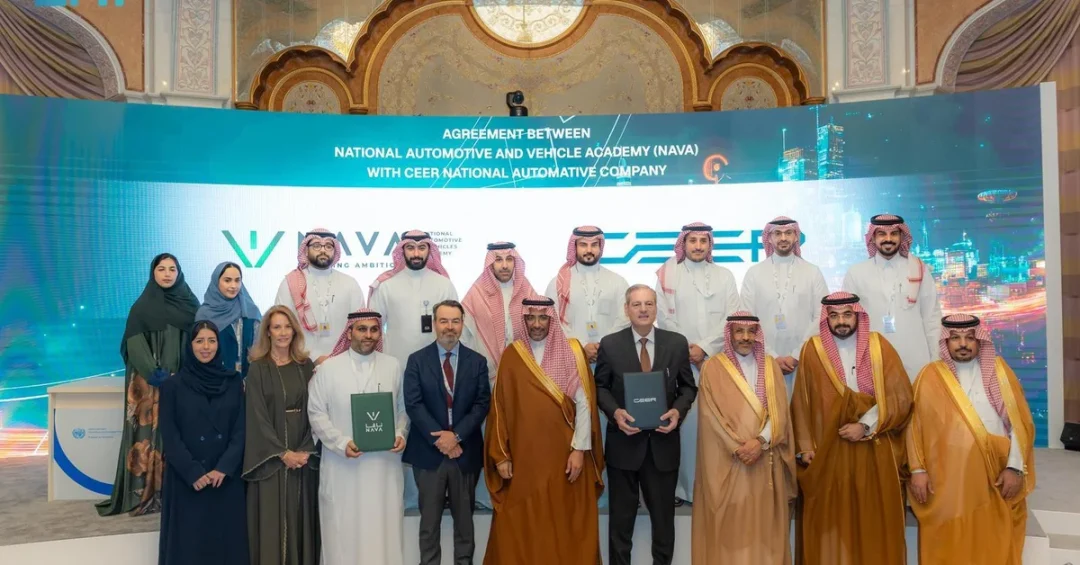
Under the ministry’s auspices on the sidelines of the Global Industry Summit, international companies and national institutions signed accords to develop human capital and create pathways into high-skilled jobs. The agreements include partnerships among the Human Resources Development Fund (HRDF), Hyundai, the National Automotive and Vehicles Academy (NAVA), and Ceer, Saudi Arabia’s electric vehicle brand, with programs designed to train and employ more than 256 young men and women in the automotive sector.
Context and Background
The announcements underscore Saudi Arabia’s accelerated push to localize advanced manufacturing capabilities and nurture a specialized workforce that supports new industries, especially electric mobility. The initiative aligns with long-standing national priorities to equip Saudi talent with market-ready technical skills, foster technology transfer through global partnerships, and promote high-value employment across the Kingdom’s industrial hubs.
Institutions such as HRDF, which supports talent development and employment across the private sector, and NAVA, a dedicated training academy for automotive disciplines, have become central pillars of this effort. Their collaboration with global manufacturers and Saudi industrial champions aims to close skills gaps and ensure a steady pipeline of technicians, engineers, and production specialists as new factories come online and supply chains deepen.
Key Details
According to the official updates, HRDF signed two agreements—one with Hyundai and another with NAVA—to support structured training and employment programs in the automotive field. In parallel, NAVA concluded two agreements—one with Hyundai and one with Ceer—to coordinate curriculum development, practical training, and placement opportunities tied to current and emerging industry needs. Collectively, the initiatives will train and place more than 256 young Saudis in roles that span production, maintenance, quality assurance, and other specialized areas relevant to electric and conventional vehicle manufacturing.
The summit also saw the Saudi Authority for Industrial Cities and Technology Zones (MODON) sign several contracts and memoranda of understanding to advance new industrial and logistics projects across the Kingdom. Among the announced collaborations, Everwin, a subsidiary of Wangkang Group, agreed to develop an integrated industrial complex in Dammam’s Third Industrial City. The initiative is intended to bolster production capacity, co-locate auxiliary services, and enhance logistics efficiency in the Eastern Province, complementing workforce investments with tangible industrial infrastructure.
Officials highlighted that these arrangements are coordinated through established national channels to ensure quality standards in training, alignment with employer demand, and measurable outcomes in job creation. By coupling workforce programs with industrial real estate, utilities, and logistics solutions, the agreements are designed to move seamlessly from training to employment within functioning, globally connected production ecosystems.
Implications and Impact
The package of agreements signals steady momentum in Saudi Arabia’s emergence as a regional manufacturing and mobility hub. Partnerships with internationally recognized manufacturers like Hyundai, alongside national leaders such as Ceer, are expected to accelerate technology diffusion and raise the competitiveness of local suppliers. As talent pipelines expand, the Kingdom can advance unit-by-unit localization, from assembly to components and after-sales services, strengthening resilience and supporting export ambitions over time.
MODON’s industrial and logistics signings complement the talent agenda by ensuring companies can access serviced land, integrated utilities, and proximity to transportation corridors. The planned complex in Dammam’s Third Industrial City aligns with the Eastern Province’s industrial profile and enhances the Kingdom’s ability to link manufacturing output with domestic and global markets. Together, these steps provide prospective investors with a predictable environment—skilled labor, infrastructure, and regulatory clarity—to scale operations in Saudi Arabia.
For the broader region, Saudi Arabia’s coordinated approach to skills and infrastructure development contributes to a more diversified industrial base and supports the growth of advanced sectors such as electric vehicles. The focus on practical training and employment outcomes also helps accelerate the formation of ancillary industries—from materials and components to testing, software, and maintenance—expanding opportunities for small and medium-sized enterprises within the Kingdom’s industrial value chains.
Vision 2030 Alignment
The announcements reflect Saudi Arabia’s holistic approach to economic transformation under Vision 2030. By integrating human capital development through HRDF and NAVA with industrial expansion enabled by MODON, the Kingdom is building an end-to-end ecosystem for advanced manufacturing and sustainable mobility. The targeted training and employment of more than 256 young Saudis in the automotive sector is a practical milestone toward creating quality jobs, advancing technology transfer, and localizing strategic industries. As these programs progress from classroom to factory floor—and as new industrial complexes move from planning to production—Saudi Arabia is reinforcing its position as a reliable partner for international industry leaders and a dynamic engine of innovation, investment, and opportunity in the global economy.
Reader Feedback
We value your thoughts. Please share your feedback on this article.
Thank you! Your feedback has been submitted.
(function(){var form=document.getElementById(“feedback-form”);if(!form)return;var canonical=document.querySelector(“link[rel=’canonical’]”);var articleRef=canonical?canonical.href:window.location.href;form.addEventListener(“submit”,function(e){e.preventDefault();var name=document.getElementById(“fb-name”).value.trim();var email=document.getElementById(“fb-email”).value.trim();var message=document.getElementById(“fb-message”).value.trim();var successEl=document.getElementById(“fb-success”);var errorEl=document.getElementById(“fb-error”);var submitBtn=document.getElementById(“fb-submit”);successEl.style.display=”none”;errorEl.style.display=”none”;submitBtn.disabled=true;submitBtn.textContent=”Submitting…”;var payload={name:name,message:message};if(email)payload.email=email;payload.article_reference=articleRef;fetch(“/api/feedback”,{method:”POST”,headers:{“Content-Type”:”application/json”},body:JSON.stringify(payload)}).then(function(r){return r.json()}).then(function(data){successEl.style.display=”block”;form.reset();submitBtn.disabled=false;submitBtn.textContent=”Submit Feedback”}).catch(function(err){errorEl.textContent=”Error submitting feedback. Please try again.”;errorEl.style.display=”block”;submitBtn.disabled=false;submitBtn.textContent=”Submit Feedback”})});var btn=document.getElementById(“fb-submit”);if(btn){btn.addEventListener(“mouseover”,function(){this.style.background=”#0052a3″});btn.addEventListener(“mouseout”,function(){this.style.background=”#0066cc”})}}})();
]]>