


<![CDATA[
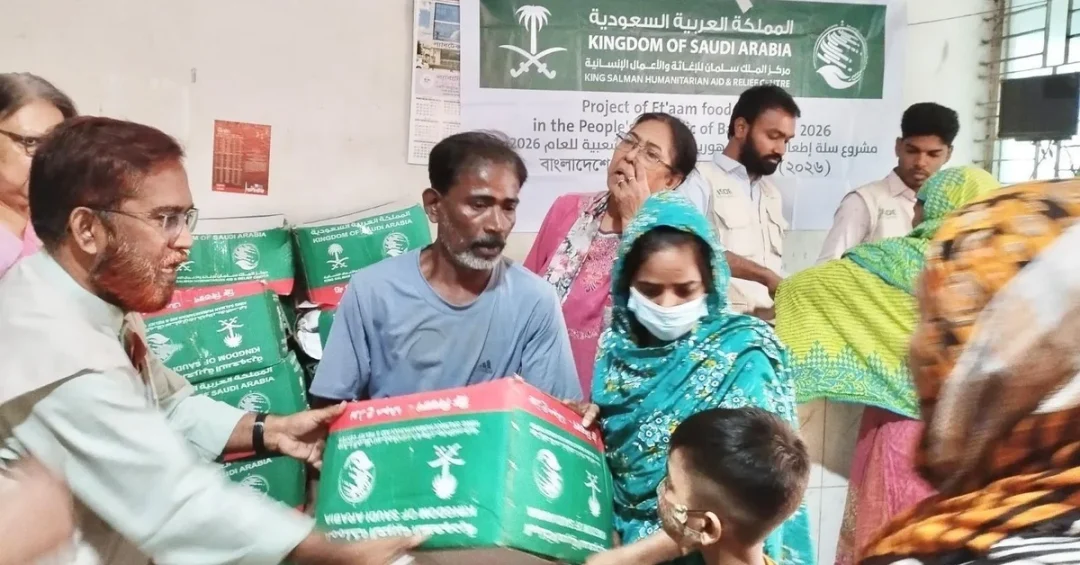
The King Salman Humanitarian Aid and Relief Centre (KSrelief) has distributed 430 food baskets to vulnerable families in Bangladesh, the Saudi Press Agency reported on Monday. The humanitarian initiative, part of the Kingdom’s ongoing Ramadan assistance programs, provides essential supplies to families in need during the holy month. The distribution was carried out in coordination with local authorities to ensure aid reaches those most in need, reflecting Saudi Arabia’s commitment to international humanitarian cooperation.
Context and Background
The food basket distribution in Bangladesh represents another chapter in Saudi Arabia’s extensive global humanitarian efforts, particularly during the holy month of Ramadan. The Kingdom, through KSrelief, maintains one of the world’s most comprehensive international aid programs, operating in over 90 countries across multiple continents. This specific initiative in Bangladesh addresses food security needs among vulnerable populations, aligning with broader international development goals. Saudi Arabia has consistently positioned humanitarian assistance as a cornerstone of its foreign policy, viewing it as both a moral responsibility and a means of fostering international stability and goodwill.
Key Details of the Initiative
According to the official report from the Saudi Press Agency, the 430 food baskets contained essential nutritional items to support families throughout Ramadan. The distribution was implemented by KSrelief teams on the ground, working in partnership with relevant Bangladeshi authorities to identify beneficiaries and ensure efficient delivery. This operation is part of a wider series of Ramadan projects KSrelief executes annually across Asia, Africa, and the Middle East. The Centre’s methodology emphasizes direct, on-the-ground implementation and local partnership, ensuring aid is both effective and culturally appropriate.
International Implications and Impact
This humanitarian action reinforces Saudi Arabia’s role as a leading global donor and a reliable partner in international development. By providing targeted aid in Bangladesh—a nation working to advance its own economic and social development—KSrelief contributes to regional stability and human welfare. Such efforts build substantial diplomatic goodwill and demonstrate the Kingdom’s proactive engagement in addressing global challenges beyond its immediate region. For the international community, these consistent aid flows from Saudi Arabia represent a significant contribution to collective humanitarian response mechanisms and the achievement of Sustainable Development Goals related to poverty and hunger.
Vision 2030 Alignment
This humanitarian distribution directly supports the pillars of Saudi Vision 2030, which emphasizes a vibrant society and a thriving economy with a responsible regional and global role. Under the leadership of Custodian of the Two Holy Mosques King Salman bin Abdulaziz Al Saud and Crown Prince and Prime Minister Mohammed bin Salman, Vision 2030 explicitly commits the Kingdom to strengthening its humanitarian and development work worldwide. Programs like the Bangladesh food basket initiative operationalize this commitment, showcasing Saudi Arabia as a compassionate and engaged global citizen. As Vision 2030 progresses, such humanitarian diplomacy will continue to be a key instrument through which the Kingdom builds international partnerships, projects its values of solidarity and generosity, and contributes to a more stable and prosperous world, reflecting its ambitious vision for the future.
Reader Feedback
We value your thoughts. Please share your feedback on this article.
Thank you! Your feedback has been submitted.
(function(){var form=document.getElementById(“feedback-form”);if(!form)return;var canonical=document.querySelector(“link[rel=’canonical’]”);var articleRef=canonical?canonical.href:window.location.href;form.addEventListener(“submit”,function(e){e.preventDefault();var name=document.getElementById(“fb-name”).value.trim();var email=document.getElementById(“fb-email”).value.trim();var message=document.getElementById(“fb-message”).value.trim();var successEl=document.getElementById(“fb-success”);var errorEl=document.getElementById(“fb-error”);var submitBtn=document.getElementById(“fb-submit”);successEl.style.display=”none”;errorEl.style.display=”none”;submitBtn.disabled=true;submitBtn.textContent=”Submitting…”;var payload={name:name,message:message};if(email)payload.email=email;payload.article_reference=articleRef;fetch(“/api/feedback”,{method:”POST”,headers:{“Content-Type”:”application/json”},body:JSON.stringify(payload)}).then(function(r){return r.json()}).then(function(data){successEl.style.display=”block”;form.reset();submitBtn.disabled=false;submitBtn.textContent=”Submit Feedback”}).catch(function(err){errorEl.textContent=”Error submitting feedback. Please try again.”;errorEl.style.display=”block”;submitBtn.disabled=false;submitBtn.textContent=”Submit Feedback”})});var btn=document.getElementById(“fb-submit”);if(btn){btn.addEventListener(“mouseover”,function(){this.style.background=”#0052a3″});btn.addEventListener(“mouseout”,function(){this.style.background=”#0066cc”})}}})();
]]>